By Maximilian Fuhrig
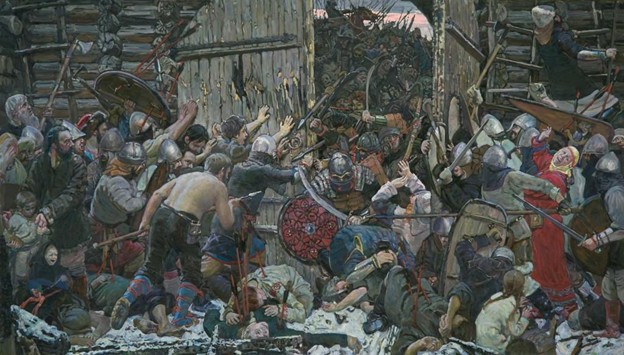
The history of Russo-Mongol relations starts in the early 13th century, when the Mongol Empire conquered Kyivan Rus’. Early Russo-Mongol contact was brief. The Mongol Empire and its successors quickly Turkicized and direct Russo-Mongol contact ceased for several centuries. As Mongol power declined, Moscow’s power rose. The Grand Duchy of Moscow expanded to fill the power vacuum created by the collapse of central authority on the steppe and transformed into the Tsardom of Russia in 1547 (Hosking, 2013, pp. 13-16). By the late 17th century, Russian rule stretched all the way to China, along the border of what is today Mongolia. Mongols north of the modern border, called Buryats, now constitute the Republic of Buryatia within Russia.
Mongolia attempted to assert its independence in 1911 at the outset of the Chinese Revolution, but lacked international support and in 1915 was forced to admit autonomy within China with the Treaty of Kyakhta (Batsaikhan, 2013, p. 75). Spillover from the Russian Civil War caused the Chinese to unilaterally revoke Mongolian autonomy in 1920. This was used as a pretext by the White general, Roman Fedorovich von Ungern-Sternberg to invade Mongolia and expel the Chinese in 1921. Later dubbed the Bloody Baron, Sternberg was perhaps one of the most eccentric and ruthless figures of the era. His dream after conquering Urga was to incoherently restore the Mongol empire and the Chinese and Russian monarchies simultaneously, a task which apparently required the wholesale slaughter of Urga’s tiny Jewish population (Jennings, 2022, pp. 33–50).
In 1920, Mongolian exiles in Russia formed the Mongolian People’s Party (MPP) with the hope of establishing an independent Mongolia and in 1921 raised the Mongolian People’s Revolutionary Army (MPRA) to fight remaining Chinese and White forces. In June 1921, Sternberg attacked the border town of Kyakhta but was repelled by the Red Army and MPRA, allowing the Red Army and MPRA to march into Urga without a fight on July 6. The MPP formed a new government five days later on the 11th. That September Sternberg was captured and executed by the Soviets. The MPRA was led by Damdin Sükhbaatar, today remembered as one of Mongolia’s greatest heroes and for whom Ulaanbaatar is named. Because of his legacy and early death, shortly before Lenin in 1923, he is popularly seen as Mongolia’s Lenin (Dillon, 2020, pp. 73–75).
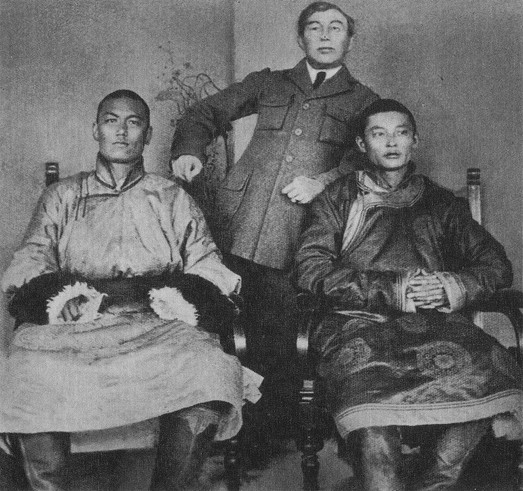
Soviet interference in communist Mongolia was substantial but not absolute from its foundation. “Advisors” provided by Moscow wielded influence but lacked total control (Dillon, 2020, pp. 75–76). The new government established in 1921 kept the old Buddhist theocratic monarch, the 8th Bogdo Jebtsundamba (or simply the Bogd Khaan), as a constitutional monarch, a significant deviation from Soviet dogma, making the Mongolian government from 1921 to 1924 a communist, theocratic monarchy, the only one in history. Although formed under the auspices of the Comintern, the early MPP was first anti-Chinese and nationalist (Dillon, 2020, pp. 63–65).Nevertheless, Soviet influence slowly grew. When the Bogd Khaan died in 1924, the monarchy was abolished and replaced with the Mongolian People’s Republic. The early MPR was rife with factionalism, and Buddhism still played a significant, albeit increasingly less tolerated, role in public life. It would not last.
Mirroring the rise of Stalin, by the mid-1930s, power had centralized behind Marshal Khorloogiin Choibalsan. He was heavily backed by the NKVD (Soviet secret police) and represented the secret police and military (Dillon, 2020, pp. 94–96). Under Choibalsan, Soviet “advisors” quickly tightened their grip. The Mongol Great Purge (1937-1939) paralleled the Soviet Great Purge and killed roughly 3-5% of the entire population. Most victims were Buddhist monks; others were targeted as “Japanese spies”. The NKVD produced lists of victims and orders to kill, that were then effected by Mongolian secret police (Dillon, 2020, pp. 96–98).
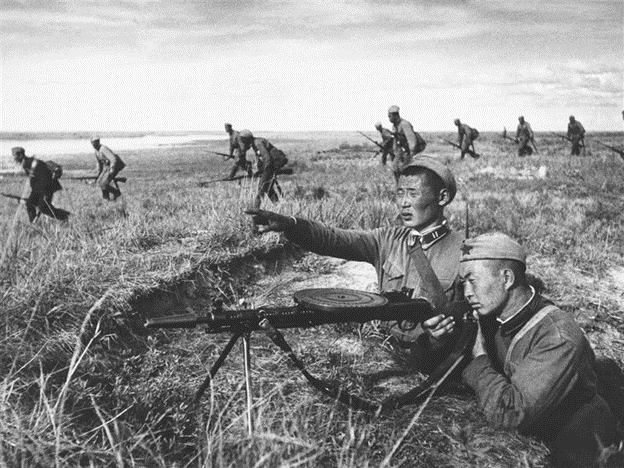
The advent of World War II brought tens of thousands of Soviet troops to Mongolia, concentrated on the border with the Japanese puppet state Manchukuo. The only major engagement in Mongolia was a series of battles in far-eastern Mongolia in 1939, called the Battles of Khalkhin Gol. Soviet forces were commanded by a green Georgy Zhukov whose victory prevented a Japanese invasion of the USSR. Instead of participating directly against Nazi Germany, Mongolia financed Soviet units and several hundred Mongols volunteered for service in the Red Army. The growth of Soviet hard and soft power in the 1930s and 1940s completely integrated Mongolia into the Soviet system. After the war, Mongolia continued to host tens of thousands of Soviet troops at any given time. During the 1969 Sino-Soviet Border Crisis, for example, Mongolia hosted up to 80,000 Soviet troops; more than 6% of Mongolia’s population at the time (Batsaikhan, 2018, p. 324).
When Choibalsan died in 1952, he was succeeded by his political disciple, Yumjaagiin Tsedenbal, again handpicked by Moscow. Under Tsedenbal, Mongolia experienced genuine but uneven economic growth as sections of countryside were developed for mining. The economy was overly reliant on resource extraction generally, and was entirely dependent on trade with the USSR. Only a minority of Mongols benefited, and most still remained part of the herding economy (Dillon, 2020, pp. 107–109). Tsedenbal survived five separate Soviet administrations, from Stalin to Chernenko, only to be exiled to Moscow in 1984 when he resisted Gorbachev’s Glasnost and Perestroika. His successor, Jambyn Batmönkh, like several Mongol leaders before him, followed Gorbachev’s plans. Batmönkh oversaw reform of the Soviet system in Mongolia until protests in 1990, which he refused to use violence against, brought down the Mongolian People’s Republic and ushered the abrupt end to seven decades of Soviet domination.
Hosking, G. (2012). Russian history: A very short introduction. Oxford University Press. https://doi.org/10.1093/actrade/9780199580989.003.0002
Batsaikhan, E. O. (2013). Mongolia: Becoming a nation-state (1911–1952) (B. Szalántai, Ed.). Self-published.
Batsaikhan, O., Lonjid, Z., Chimeddorji, E., Amarsanaa, S., & Baatar, S. (2018). The history of modern Mongolia, 1911–2017. Soëmbo Printing.
Dillon, M. (2020). Mongolia: A political history of the land and its people. I.B. Tauris.
Jennings, J. M., & Steele, C. (Eds.). (2022). The worst military leaders in history. Reaktion Books.
Polian, P. M. (2004). Against their will: The history and geography of forced migrations in the USSR (A. Yastrzhembska, Trans.). Central European University Press.