
By Eliza Sullivan
After an enlightening semester, Miami University’s Havighurst Colloquium class had its final guest speaker on Monday, November 17. The speaker, Dr. Neringa Klumbyte is a professor of anthropology and European studies at Miami University. She gave a talk in Benton Hall on Lithuanian Soviet humor, one based largely on her book Authoritarian Laughter: Political Humor and Soviet Dystopia in Lithuania, which examined the role of Soviet humor in Lithuania.
Klumbyte focused mostly on Broom, a satirical Lithuanian magazine. Broom was published by the Lithuanian Communist Party and contained the cartoons and satirical essays, called feuilletons, which the editors felt were sufficiently aligned with the Party’s ideological message.
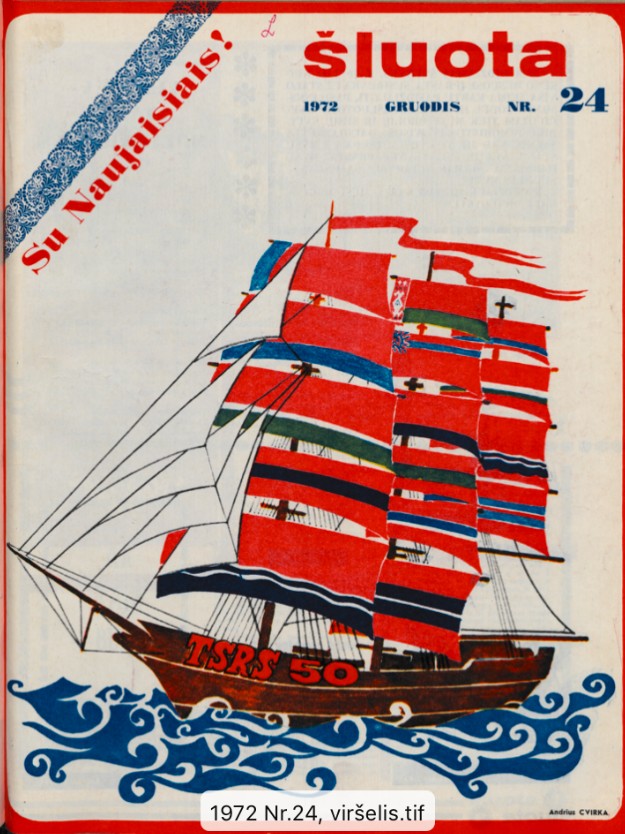
The Communist Party, as Klumbyte noted, used humor as a method of propaganda. Their hope was that by telling Broom readers what to laugh about, the Party could shape their perception of society. Klumbyte argues that this is a difficult, if not impossible task, because you can’t control the way people consume the media you create. Propaganda is not a one-way process; both the author and the audience of a piece of media are responsible for the message that is ultimately conveyed.
Broom writers and editors practiced what Klumbyte referred to in chapter 6 of her book as “banal opposition.” Unless there was an overtly problematic message conveyed in the pieces they reviewed, Broom editors would allow cartoons that could be read as critical of the Soviet state to run. Editors knew where the hard lines they could not cross were, but were always pushing the boundaries of acceptable criticism. These editors were seen as loyal by the Communist Party, so their transgressions were considered accidental and they were not harshly punished.
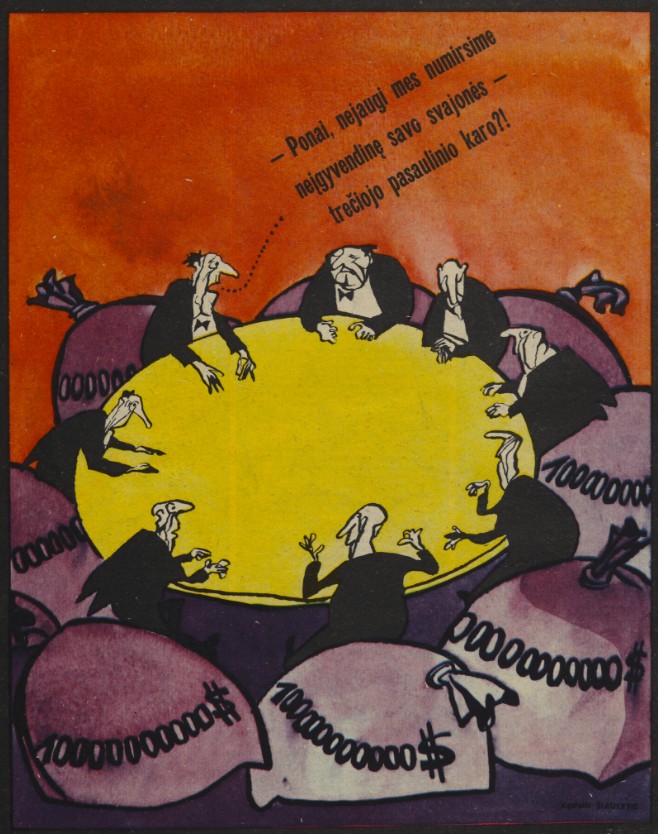
As a result of this “banal opposition,” the “official humor” sanctioned by the Communist Party and published in Broom was suspiciously similar to “unofficial humor”–jokes individuals made privately because their creators knew they could face reprimands for speaking that way about the regime.
Klumbyte argued that, because not all Lithuanians were fully committed to the Soviet cause, laughter in Lithuania was “multidirectional.” Satirical propaganda laughed at the social ills the Communist Party had prescribed as appropriate targets, but their satire could also be used as a weapon against the Soviet system.
It must be noted that Broom satire was not a revolutionary force. On the contrary, it upheld the Soviet system. As Klumbyte writes in chapter 7 of her book, people often wrote to the Broom in hopes of correcting injustices. When the Broom published its satirical material, the public shaming and mockery of wrongdoers was incredibly effective. Many people were afraid of being reported to Broom.
However, the Communist Party had a policy of only criticizing individual instances of wrongdoings and protecting high-level officials. As a result, the problems that Broom investigated were often injustices symptomatic of larger structural issues, or issues that could be attributed to high-level officials, but were instead blamed on laypeople. Broom could not affect true justice because it was working within the framework of the State. It did provide for some accountability, but that accountability was selective, inconsistent, and very rarely aimed at the true cause of the issues.
It may seem counterintuitive that a State would allow its official propaganda to poke fun at the society it created. However, from a Soviet perspective, Lithuanian propaganda in the Broom reinforced the State’s message that societal issues are the result of individual bad actors, not systemic problems. The fear people had of being reported to the Broom encouraged them to stay in line and participate in the Soviet project. Of course, there were also always pieces satirizing the ills of the West and capitalism, which further demonstrated the superior nature of the Soviet Union.
However, because many Lithuanians were not fully on board with the Soviet project, they chose to interact with propaganda differently. Broom editors printed cartoons that pushed the boundary of the party line. Readers engaged in multidirectional laughter; they were able to both enjoy a piece of satire for its intended message and also poke fun at the system using its own propaganda. As Dr. Klumbyte said, “they can kill people, but they can’t occupy your soul. They can’t make you laugh if you don’t want to laugh.”