
By Alexa Johnson
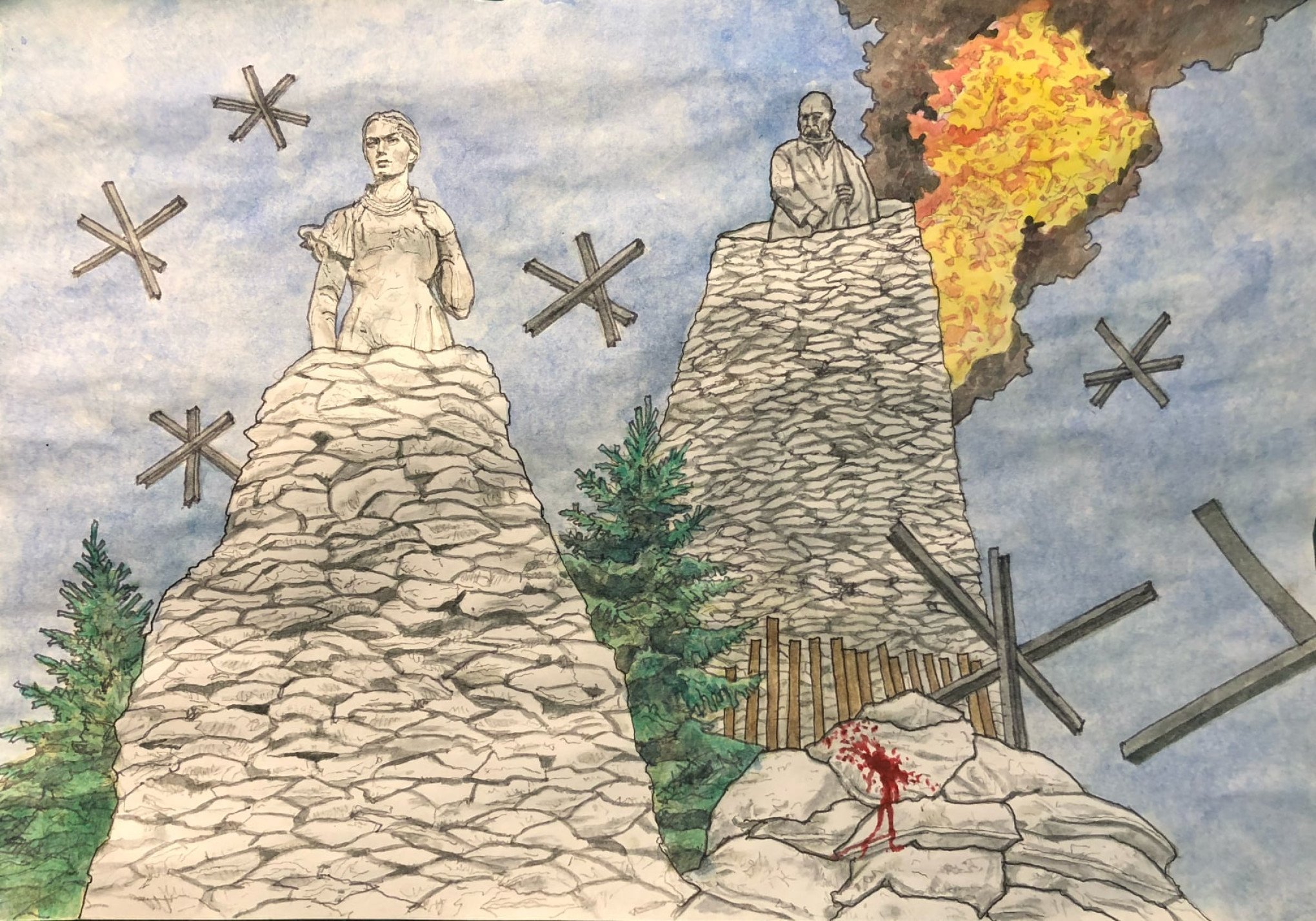
It was an uncharacteristically cold spring in Oxford, Ohio. My attendance to each of the three talks facilitated by the Havighurst Center were punctuated by my long winter coat, even in the months when one might have preferred a jacket.
Maksym Butkevych, Katerina Gordeeva, and two journalists of Meduza all visited Miami (the latter two more in spirit over Zoom) with the intent of educating about journalism in the Baltic Republics, Russia, and Ukraine. Their visits drew numbers that often exceeded the seats available in Harrison Hall, their words powerful, moving, and extremely poignant, at least to this author.
Butkevych’s talk was first, on a February afternoon that became a night as we listened. He was unassuming, with buzzed hair and a black hoodie, a soft voice that he retains from “prison habits” after having been a prisoner of war for two years, released in 2024. He expressed surprise to learn that people called him a pacifist, because it “came naturally” to join the armed forces on the very first day of Russia’s invasion of Ukraine. His narration paints pictures, and is distinctly absent of audible bitterness and hatred. From him, we learn that this is not a war of territories or even of resources, but a war of worldviews and values. As Butkevych puts it, contemporary Russian ideology is based on the state, completely inverse to the Ukrainian worldview where “people are number one” and the state is a tool through which to achieve a better life.
Before the questions, he spoke to us about The Principle of Hope– an organization that he cofounded, a charity for those who remain under Russian captivity. He urges us to help them maintain hope, calling himself fortunate that he never lost hope. “Hope”, he said, “is what keeps people going.”
At the end of the month, I am at home, early in the morning, wearing a thick orange sweater and listening to the journalists of Meduza over a Zoom call. Someone’s AI assistant speaking has forced us all to mute ourselves. But we hear from Sam and Eilish, Americans in journalism, who chart their career paths out for us, an audience of mostly wide-eyed undergrads. Meduza is the largest Russian media outlet operating entirely in exile. After being designated a “foreign agent” in April of 2021, it “strangled [their] business model”, forcing them to move to a crowdfunding model. A new “undesirable” designation in 2023 has criminalized interaction with Meduza, but the media outlet maintains its audience and sustains itself on donations.
In the same room in Harrison Hall, exactly a month after Butkevych’s visit, I sit and take my notes not in a dry, black book with a black pen, but on the thick pages of a watercolor sketchbook, with different highlighters and markers. As the talk goes on, I find the moments to sketch a portrait of Katerina Gordeeva, failing in many ways to capture her energy but succeeding in what’s necessary to remind myself of what she looked like. She had short, brown hair and wore a gray sweater, spoke with a gravitas and sensitivity that made me understand why so many people had spoken to her after the worst events of their lives.
Gordeeva is a famous war correspondent who left Russia after the annexation of Crimea and Ukraine. Her Youtube channel boasts two million subscribers who watch as she interviews Russian stars. In September of 2022, she was named a foreign agent by the Russian government. She tells us that this is her third lecture in English on what she calls “trauma journalism”. From her, we learn about a terrorist attack in Moscow on Valentine’s Day at a water park, where she gave a boy, frozen in terror, her mittens. Humanity is part of her job, and it allowed her to remain friends with the boy, to become the godmother of his children, but the story remained between them.
It is an interesting lecture on silence, and on trauma. We are the first ones to hear the story of Georgie and his red wine, the lover it was for, because publishing it may have hurt people, and would not have changed anything about the train crash she was reporting on. We listen in an utter hush as she describes how she grappled with working with refugees in camps, with learning how people protect themselves from trauma when forced to recount their harrowing stories. They edit their memories to turn a Russian missile strike into a Ukrainian one, they say different or contradictory things, support Putin with images printed on their cars– all in an effort to protect their minds with reformatted memories. In teasing out what really happened, Gordeeva’s method takes up 10-12 hours of the day, searching for an innocuous question that will open the door to the truth. I leave with a blocky page of colorful notes, and a heavy head. Maybe what Gordeeva said is true: “My head is wealthier– healthier than yours.”
Alexa Johnson graduated in 2026 with a BA and MA in History