By Becca Borton
Oxford, OH, September 22, 2025. Amidst the Purge-induced terror of the 1930s, Soviet dictator Joseph Stalin paused his quest to assassinate Leon Trotsky and assuaged the fears of his people in the best way he knew: commissioning fan fiction about Peter the Great. Stalin would have LOVED Ao3.
Dr. David Brandenberger, professor of history and global studies at the University of Richmond and the world’s leading scholar on Soviet propaganda, spoke to a group of Miami history students studying Stalin’s highly-promoted pantheon of great heroes. Stalin and his henchmen made some interesting picks when deciding who would inspire the Soviet people– Ivan the Terrible, for instance, who was famously terrible. And why would the hardy Soviet people see themselves in the frilly, aristocratic, serf-owning poet Alexander Pushkin? Were the princes, conquerors, and aristocrats of Old Russia not the very enemies of the people that the Bolsheviks had sworn to destroy?
Brandenberger argued that the decision to promote these characters marks a major shift in Soviet propaganda– one that responded to the Soviet people’s growing resentment for the Party that claimed to save them. As Brandenberger wrote in his 2012 book Propaganda State in Crisis, conflict with the British and tightening propaganda efforts in the wake of the War Scare of 1927 saw workers throughout the Soviet Union calling for the destruction of the Bolsheviks just ten years after its victory in the Civil War. In that year, a peasant in the Amur region wrote: “It would be good if the Communists gave up without a fight” so that the British could take over. Another peasant from the Moscow province concurred: “Soon war will come and they’ll give us peasants weapons and we’ll turn them against Soviet power and the communists.” Soviet officials received these reports and had to ask themselves why their propaganda state was not able to convince its people to love their new government?
Prior to 1927, Soviet revolutionary-era propaganda had often been avant-garde, ideological, and unrecognizable to the majority of people in the Soviet Union, particularly because literacy efforts had not yet made the working class into scholars as intended. Propaganda posters that depicted ideas or caricatures proved to be unpersuasive to the average Soviet citizen. That is why, once Stalin solidified his power in 1929, he implemented a dramatic policy shift. While propaganda had previously been vague, espousing the movements of collective people rather than individuals, Stalin chose to identify heroes and promote them. Brandenberger described this shift from Marxist “materialist” history – one which denies the importance of personality – to one that again focused on “the great men of history.”
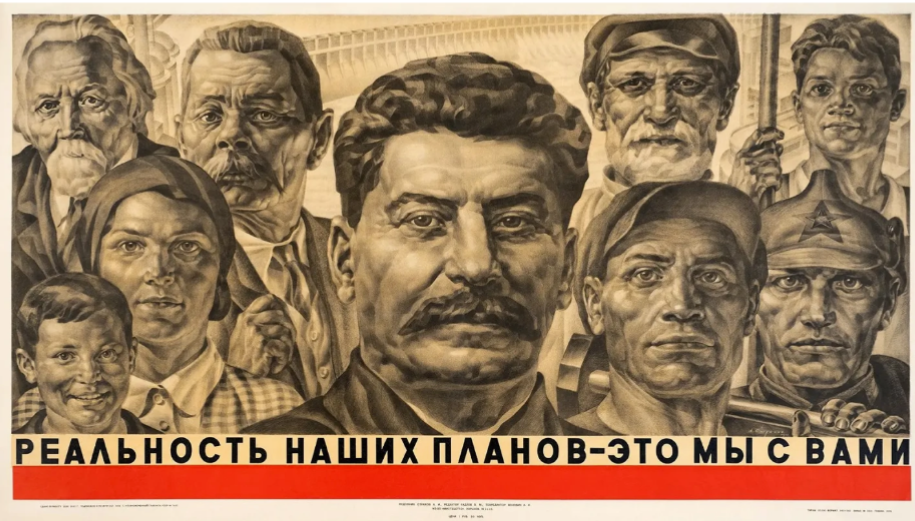
The first phase of this shift saw the uplifting of heroes from the common Soviet people. In his lecture, Brandenberger illustrated it with the Adolf Strakhov-Braslavskii propaganda poster “The Reality of Our Plan is that We Are With You.” Heroes depicted in this painting include Aleksei Stakhanov, a miner, and Dusya Vinogradova, a weaver, both elevated to celebrity status after exceeding their quotas during their factory shifts. Their legacies, along with those of political heroes of the Party, were cemented when they were included in the foundational historical textbook of the Soviet Union, Short History of the USSR (1937).
The problem with these living heroes is that they tend to screw up. The Short History of the USSR is chock-full of edits by Stalin himself, who crossed out portraits and names of heroes who had fallen out of favor and become victims of the purges: Brandenberger’s translated version of this textbook has recently appeared under the title Stalin’s Usable Past. The most famous of these fallen heroes was Leon Trotsky, originally a vital member of the Party, but villainized in the textbook due to his conflict with Stalin.
This “usable past” came to mean historical figures who could be repackaged into heroes, even some who oppressed peasants and workers. Figures such as Peter the Great, Ivan the Terrible, and Alexander Pushkin were rehabilitated in literary works and textbooks to represent patriotism, Russocentric culture, and a strong centralized government.
How could Stalin possibly justify them as heroes of the Soviet Union? According to Marxist-Leninist philosophy, history represents the inevitable progress from one epoch to the next. These “great men of history,” the tsars most clearly, may have been terrible to the ordinary people who actually lived under their reigns, but these men nonetheless made pivotal decisions that led, inevitably, to the creation of the Soviet Union as Stalin came to know it. As Stalin said himself, “Every generation is met with certain conditions that already exist in the present form as that generation comes into the world. Great people are worth something only insofar as they are able to understand correctly these conditions and what is necessary to alter them.” In other words, Ivan gets a pass for being terrible— he entered into Stalin’s history book because he expanded Russia’s territory and encouraged literacy among his people, steps that would lead hundreds of years later to the creation of the Soviet Union.
What would Ivan IV have to say about Bolshevism? The trick is that it doesn’t matter. He’s dead.
That, Brandenberger concluded, is why dead heroes are so much more valuable than living ones. While a formerly formidable Party member could later be denounced for plotting against Stalin or a Stakhanov-like worker could later fail in a future factory shift, Ivan IV will only say whatever Stalin wants him to.
It is perhaps worth considering who our own dead heroes are today and who speaks through them. Whose words do we use to justify our own actions? Whose words does the government use to make sweeping, unprecedented policy change? Who lies in death, a legacy made impeachable by martyrdom, now doomed forever to be the face of a movement? Do not be duped into believing that death makes one’s legacy impeachable– Scrutinize your heroes and how they came to be deemed so. Ivan the Terrible is not my hero.