By Grace Farrell
World War II – known as the Great Patriotic War in the Soviet Union – wreaked havoc on the nation, creating a need to unify and protect the people against the Nazi invaders. During a time of extreme desperation, propaganda emerged not only as a key way to unite the Soviet people but also to depict Soviet successes to the outside world. Propaganda geared toward an English-speaking audience, such as the daily newspaper Moscow News, brought to light the will of the people and the determination to destroy fascism no matter the cost. The English-speaking audience could read about the efforts of the Soviet troops, ostensibly united in their cause under one Soviet identity, to do whatever it took to rid the world of the Hitlerites. The nation that was once considered by the outside world to be backwards was portrayed on the page as the powerhouse of the war.
What was the Great Patriotic War like for those on the frontlines or at home? Or rather, how were the homefront and Red Army soldiers portrayed to those both inside and outside of the Soviet Union? Through stories, cartoons, and reports of battle strategies, readers were meant to gain confidence in the Red Army as well as the superiority of the Soviet socialist system.
Successes of superior military strategy and tactics were highlighted while failures were rarely mentioned. On August 29, 1943, for example, the “superior tactics” of the Soviet forces are highlighted in an article titled, “Red Army Continues to Go ahead After Kharkov’s Capture, Deepens Breach in Nazis’ Donbas Defenses. It states, “the German counter-blow failed completely. The Red Army units repulsed all the enemy’s counter-attacks.” While the column does admit that “enemy defenses…are of great depth,” it goes on to reassure readers that “Our troops, however, are…dealing the enemy heavy losses.” Detailing the actual battles themselves was crucial to ensure that those within and outside of the Soviet Union had faith in the Red Army’s military tactics, displaying the utmost superiority over the enemy.

“Red Army Continues to Go ahead After Kharkov’s Capture, Deepens Breach in Nazis’ Donbas Defenses,” showing troops in the region; Moscow News, No. 66, 1943
Battle strategy was beneficial in boosting confidence about the superior Soviet strategy, but narratives did something that strategy and statistics could not: it humanized the soldiers and Soviet people. One story in an article from March, 31 1943 titled “Civilian Survivors From Cellar Tell Ghastly Story About Three Months of Life in Thick of Battle” describes an account of a Red Army soldier during the Battle of Stalingrad liberating women and children who were starving due to the evil policies of the Nazis. The article describes how a woman, Claudia Fedchenko, saved her three children when the Germans invaded their village. Her young girl was sick and she “went to the Germans for help, but the soldiers…threatened to shoot,” if they came out of the pit that served as their hiding place. As the days continued, the woman began to help other children who had lost their families to the destruction. She describes that “before long we were all swollen with hunger.” Fedchenko decided to send her daughter to the Red Army, knowing that they would help; the children that night slept on comfortable cots around the soldiers, relieved that they were—at least temporarily—safe. The Red Army, despite experiencing its own harsh conditions, were able to provide shelter for their fellow Soviets, creating a sense of unity against a common enemy, as well as a mutual desire to protect their own way of life.
The war itself was also fought by the people away from the battlefield, by those living in villages that took part in guerrilla warfare, as well as those who fought back simply by surviving. The Moscow News portrayed the Soviet people as heroes, driven by the purpose to protect their beloved Motherland, which in turn provided plentiful and productive lives for all its citizens. On January 12, 1942, Vyacheslav Molotov, People’s Commissar of Foreign Affairs, spoke about the horrific scenes that were taking place all across the USSR. Specifically, he explained that Nazis would pour “fuel on the houses and set fire to them.” He continued, “The village of Kobneshki…was completely burned down.” Not only was this note used as a rallying call to the rest of the world to fight against Hitler, it also warned all readers about the atrocities that the Nazis were committing and the threat they posed to Soviet life. Molotov describes, “The USSR …declares…that the emancipatory struggle of the Soviet Union is a struggle for the rights and freedom…of all liberty loving peoples of the world.” By publishing Molotov’s note in Moscow News, it brought to light all horrific events that were taking place against the people of the USSR, revealing to the English-speaking audience a new appreciation for the Soviet people’s suffering, resilience, and dedication to peace and preservation of their home. It was those who encountered the Wehrmacht in their own homes that helped to fight the perilous battle for peace that allowed victory to be won.
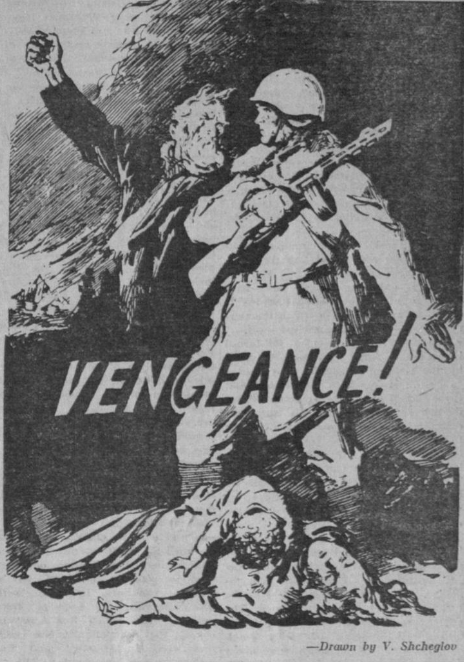
Guerrilla forces proved to be crucial to Soviet success. In Ukraine, guerrilla activity helped to defeat the Nazi forces, as explained in an article on November 27, 1943 titled, “Guerrilla Activity in Ukraine Flares to Greater Scope As Soviet Troops Advance,” describing how “Groups of guerrillas composed of local peasants established control over a large territory which included 12 inhabited places held by the Germans…the peasant units….met the SS men…and wiped them out.” The conditions at home were filled with violence and a drive to protect homes and livelihoods. Moscow News portrays ordinary Soviet citizens fighting as necessary to protect not just their own homes but the entirety of the USSR, perhaps prompting foreign readers to gain a clearer understanding of Soviet dedication to protecting their way of life.
One of the most essential tools in portraying Red Army superiority over the Nazis was to belittle Hitler and the Wehrmacht’s impact on Soviet forces, as well as to portray the quality of life under Hitler’s regime as horrific and evil. On May 5, 1942, an article titled, “War Prisoners Tell How Nazis Drain Germany to Feed Hitler’s Meatgrinder on East Front,” suggests that Germany is being drained of people “to feed Hitler’s meatgrinder.” A German prisoner describes how “the ‘Fuherer” has had to begin feeding it [the frontlines] with workers from war plants who were…exempt from service.” The prisoner, Erwin Zinn, describes how when he and some peers found out they were being forced to join the army on the Eastern front, they “all made a dive for the phone to let our wives know that we were leaving and wouldn’t even be able…to say goodbye.” Sharing the perspective of a German war prisoner emphasized how the Soviet Union was far superior to anything in Nazi Germany. The fact that a Nazi soldier was revealing weaknesses in Hitler’s plans emphasizes the lack of control he had over his own army as well as the fact that as early in the war as 1942, Nazi ambitions were dwindling.
In the same issue, a political cartoon drawn by Boris Efimov goes hand in hand with what Zinn recounted: Hitler had no real plan and destroyed his own country with the conflict he created. The image portrays Hitler as a madman, with a quote from Hitler’s speech on April 26, 1942, reading, “The destiny of nations and states cannot be entrusted to madmen!” Efimov’s cartoon turns the table on Nazi propaganda that portrayed leaders of the outside world as madmen: instead, the true madman is the one leading Germany into war with the USSR. By putting down Nazi troops, Moscow News elevated the Soviet Union as the greater power. Although at this point in the war, the Soviets were experiencing the utmost hardships brought on by the Nazis, propaganda heavily honed in on weaknesses of the Third Reich and the success, no matter how small, of the USSR.

Efimov’s political cartoon depicting Hitler as a madman; Moscow News, No. 18, 1942
Stories of Soviet heroes as well as those detailing battle strategies were necessary tactics to secure feelings of superiority over the Nazis as well as a general sentiment of hope, confidence, and security in the Red Army. The resilience displayed by the fighters exhibits enthusiasm to protect their homeland that was just a few decades ago regarded as inferior to the West. Narratives told by frontline soldiers unveil a part of the Soviet Union that some Western readers may not have been accustomed to: one of sincerity and mutual respect for one another. Soldiers began to be viewed not just as pawns to be played in a world war, but as people who valued humanity and protecting their way of life and their fellow citizens’ way of life. Perhaps this led some Western readers to question their own preconceived notions about the USSR; perhaps there was a reason the Soviets were fighting so hard to preserve their way of life.
Bibliography:
A. , K. (1943, August 29). Red Army Continues to Go ahead After Kharkov’s Capture, Deepens Breach in Nazis’ Donbas Defenses. Moscow News.
Efimov, B. (1942). You Said It! In Moscow News.
Krinitsky, B. (1943, November 27). Guerrilla Activity in Ukraine Flares to Greater Scope As Soviet Troops Advance. Moscow News.
Molotov, V. M. (1942, January 12). Note of VM.Molotov, Peoples Commissar of Foreign Affairs Regarding the Wholesale Looting, Ruination of the Population and Monstrous Atrocities Perpetrated by the German Authorities on Soviet Territories Seized by Them. Moscow News.
Muguyev, H.-M. (1943, March 31). Civilian Survivors From Cellar Tell Ghastly Story About Three Months of Life in Thick of Battle. Moscow News.
Zaitsev, I. (1942, May 5). War Prisoners Tell How Nazis Drain Germany to Feed Hitler’s Meatgrinder on East Front. Moscow News.