
By Nicole Payne
October 20, 2025
Oxford, OH – Emil Draitser, a Professor Emeritus at the Hunter College of the City University of New York and a Soviet émigré, presented on his career producing satirical pieces during the mid-1960s through the early-1970s in the Soviet Union. His lecture, “Soviet Satire, Condoned and Condemned” mirrored the writings in his 2021 memoir, In the Jaws of the Crocodile, which touched on his life story as a young Jewish boy born in the Ukrainian Soviet Socialist Republic through his time as a writer in Moscow and eventual emigration to the United States.
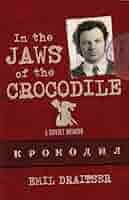
His memoir opens in Odessa in 1953, when fifteen-year-old Draitser received praise for his writings for the first time, granted by his Russian literature teacher. The memoir immediately sets itself up for his future as a satirist for Soviet journals such as Youth and Crocodile, but first it outlines a struggle between reason and passion. Draitser’s mother sent her son to study engineering after he failed to earn recommendations for prominent humanities-focused universities, which Draitser theorized was due to the rampant anti-Semitism of the late Stalinist period.
Draitser stayed committed to the path set forth by his mother and graduated from the Odessa Polytechnic Institute with a degree in electrical engineering in 1960, giving up on his passion for writing. However, after a move to Moscow he often caught himself working on diary entries, sketching, and explained that he had once again caught the “scribbler’s bug” that bit him in his teens. With the encouragement of a close friend, Draitser visited the offices of the newspaper Moscow Komsomol Member and submitted a piece for review. Almost immediately, he was accepted into the ranks as a writer, not based on his submitted work, but because he was from Odessa, a city known for its cult classic satirists such as Ilya Ilf and Yevgeny Petrov.
Soon thereafter, Draitser began contributing to Crocodile, the most prestigious satirical magazine published by the Soviet Central Executive Committee. At its peak, Crocodile was issuing three volumes a month and consistently selling 6.5 million copies per release, while major satirical magazines in the U.S. such as MAD were printing one volume a month and selling 2 million copies per release. However, this rise in popularity came with a price, as Draitser’s Jewish heritage would once again hinder his ability to advance in the literary world. He was forced to adopt a penname, that of E. Abramov, to erase his Jewish-sounding surname from publications in fear of not being seen as ethnically Russian.
Draitser explained, both in his memoir and in his lecture, that there were three main targets of state-sponsored satire in the Soviet Union: the West, rank-and-file employees, and low- to mid-level management and administration. Any criticism of the higher ranks of the Communist Party was immediately punished to protect the legitimacy of the state and suppress dissent. In his memoir, Draitser explained that the difference between a Western satirist and a Soviet satirist is that the Soviet’s job “is not to dig out some unseemly truths about, say, corruption or abuse of power. Mostly, he ridicules things the state apparatus has proved wrong and worthy of criticism.”
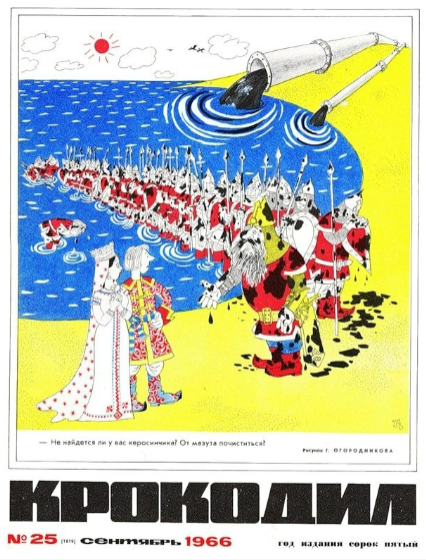
Draitser explained that satirical targets aimed at rank-and-file employees often critiqued poor work discipline such as long smoke breaks and excessive drinking, poor workmanship, theft at the workplace, and stores overpricing their items and stealing from customers. For low- and mid-level management, these satirical pieces critiqued bureaucracy, the overarching prominence of identification methods, bribery, fraud, mismanagement, abuse of administrative power, industrial pollution, among others. This type of satire also incorporated a bounty of Russian folk wisdom, often calling back to fairytales produced by the likes of Alexander Pushkin.
Draitser also mentioned that near the end of his Soviet writing career in the early 1970s, Aesopian satire began to spread rapidly in order to avoid political censorship. Many writers utilized the “children’s room” rubric, wherein satirists would create short poems or songs labeled for “children,” when in actuality they were created to mask criticism designed for the intellectual class. These encrypted meanings were meant to circumvent the harsh condemnations placed on satirical writers and their critical pieces of the period.
Outside of these allowances, Draitser clarified that banned topics of satirical writing by the Soviet state included systematic economic faults rather than sporadic local faults, reports on medical shortages, critiques on Soviet foreign policy, crossing of the Communist Party apparatus by publications outside of Pravda, and critiques on certain territories sponsored by high-ranking officials.
Punishment for criticizing a banned topic was best exemplified when Draitser was expelled from contributing to Crocodile in 1971 after writing a feuilleton titled, “Shut Up, You Scatterbrain!” Draitser’s piece poked fun at a play he attended while visiting the town of Belgorod. However, unbeknownst to Draitser, the playwright was also the editor-in-chief of Theater, a leading literary journal in the Soviet Union. This journal was produced by the Ministry of Culture, creating a direct link between the play and Yekaterina Alekseevna Furtseva, a member of the Central Committee of the Communist Party and the Minister of Culture in the USSR. Thereafter, Draitser was banned from contributing satirical pieces to Crocodile due to this singular mistake.

Faced with rising antisemitism within the Soviet Union placing hindrances on his writing career, alongside a slightly laxer emigration policy post-1968, Draitser decided to leave for the U.S. in the mid-1970s. In America, Draitser earned a Ph.D. in literature, began working at Hunter College, and has since published seventeen acclaimed books discussing the Soviet Union and Russian history. Draitser’s story highlights the dangers of living in a totalitarian state, especially allowing the audience to understand the point-of-view of a minority group in the Soviet Union. His tales warn against heavy censorship and ultimate state control and its effects on creativity, individuality, and expression. Draitser’s resilience and courage, relating to his journalism career as a Jewish man facing backlash for his ethnicity and pieces critiquing the state apparatus, alongside his journey to America, should inspire all readers to embrace their identity and sound the alarm when an abuse of power is prevalent.