
By Quinn Riley
On Monday, March 2, the Havighurst Center for Russian and Post-Soviet welcomed Dr. Timothy Model, Havighurst Teaching Fellow and Visiting Assistant Professor, to the spring colloquia series. In a lecture titled “Russia’s Weaponization of Corruption in Ukraine,” Model explored Russia’s use of corruption as a form of hybrid warfare in a post-Soviet geopolitical space.
Russia is often noted for its high-profile foreign and domestic engagements; the downing of Malaysian Airlines Flight 17 in Ukraine, the annexation of Crimea in 2014, and questionable news stories televised by state-controlled media are a few of the most memorable. These events and actions pertain, more broadly, to Russia’s weaponization of weapons, information, and oil. Against this backdrop, Model advanced an additional component in Russia’s repertoire of weaponization: corruption.
Model defined Russia’s government as a “captured autocracy,” meaning a system without free and competitive elections that has been “captured by a small group of people with a substantial control over assets in the country.” He finds that corruption in these systems is actually a tool of governance as opposed to an activity of individuals within government.
Corruption in Russia is systematic, carefully managed and deliberately designed. Exchanges between members of the Russian government and elites all over the world are conducted in a complex, international network that is, in many ways, dangerous to its own participants. Model described the methods of creating a network of corruption as different variations of recruitment, usage and maintenance.
Networks of corruption require the recruitment of individuals for whom loyalty can be negotiated, bribed or forced. These recruits are used to achieve domestic, ideological, foreign policy and economic goals; however, networks of corruption are sustained through maintenance. Maintenance of assets is critical to the survival of the network due to the information that recruits learn by virtue of their participation. Model emphasized two prominent individuals that serve the corrupt network Russia uses as a tool of governance: Dmytro Firtash and Oksana Marchenko.
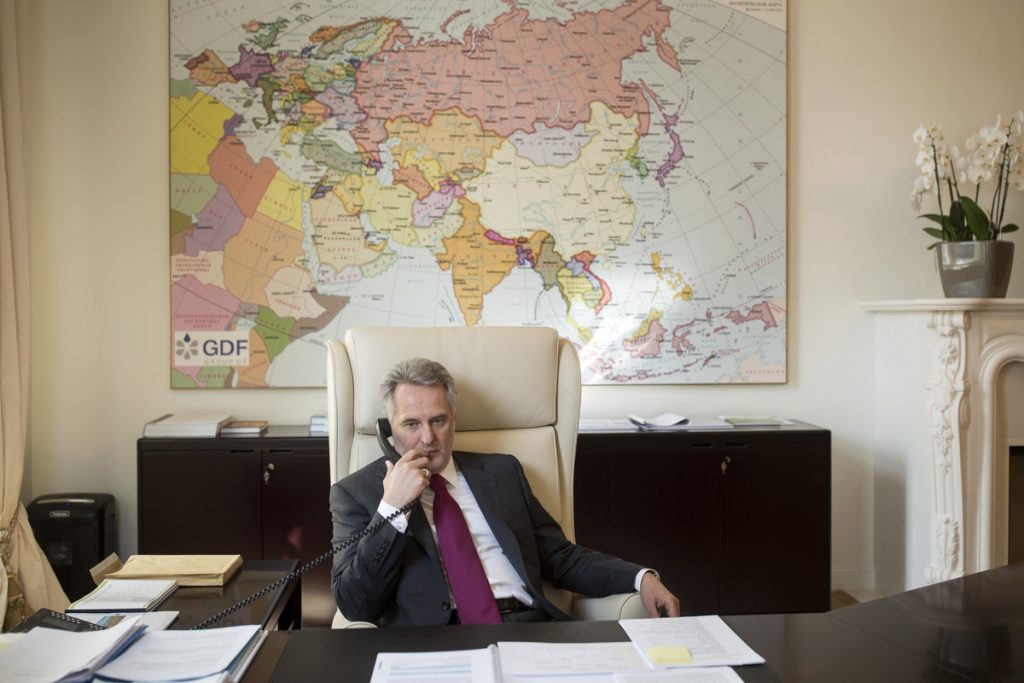
Firtash is the owner of business conglomerate Group DF, which has a major stake in banking, media, and raw material industries from Ukraine with direct connections to the Russian government. He is the former owner of RosUkrEnergo, the gas company that ultimately garnered a leading role in the Russia-Ukraine gas trade after Russia hiked Ukraine’s gas prices five times the original amount in 2006. Due to Firtash’s distinct relationship with Russia, he has frequently served as an intermediary between Russia and Ukraine, lobbying on behalf of Russia’s economic and political agendas in Ukraine.
Oksana Marchenko is a well-known television personality and social media influencer in Ukraine. Marchenko became the owner of a plethora of well-known shell companies previously owned by her husband Victor Medvedchuk before he fell victim to U.S. sanctions. Medvedchuk is a Ukrainian oligarch and Pro-Russian politician with a major stake in a Russian oil field. His ties to the Kremlin are both visible and deeply personal, as President Putin and his wife are the godparents of Medvedchuk’s daughter. Additionally, in his role as Chief of Staff to former Ukrainian President Kuchma, Medvedchuk played an integral role in rewriting the Ukrainian constitution.
These individuals don’t pose exceptions to Russia’s style of governance- they are the rule and they exist alongside hundreds if not thousands of compatriots within the Russian network of overt and covert corruption. The stakes are equally high for both Russia and its pawns; while the benefits of engaging in these channels of corruption are substantial and immediate, there are serious dangers posed by leaving the network, not excluding threats to one’s friends and family.
Russia prioritizes the maintenance of its sphere of influence by whatever means necessary. This often amounts to unimaginable violence, political instability, propagandized information and economic inequality being lived realities for Russian and Ukrainian people. Ultimately, regional and global superpower status are strategic objectives for Russia as a nation, and the weaponization of corruption is central to achieving these goals.
Quinn Riley is a first-year M.A. student in Political Science.