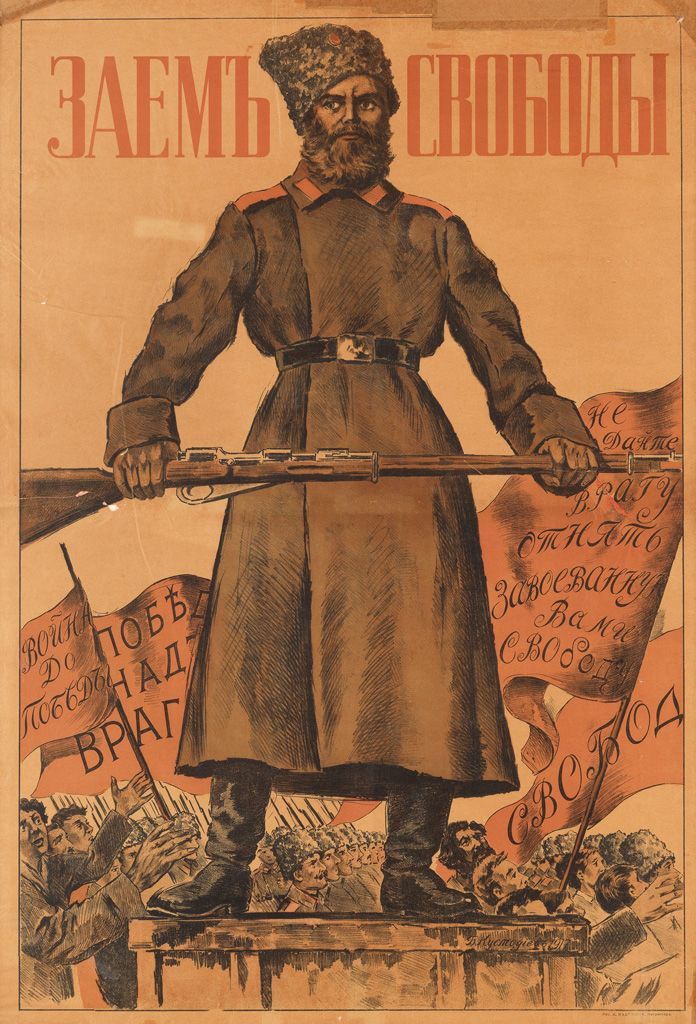
Boris Kustodiev, “Freedom Loan.” Poster, 1917
By Jennifer Fargo
When University of Oklahoma Professor of History Melissa Stockdale began her work on World War I, she certainly was not expecting to upend the traditional understanding of the Russian Empire’s place in that conflict. Nearly a century of scholarship had produced a conventional story that the Russian Empire was destroyed, because it was so far behind the curve compared to its European competitors that it could not afford to fight a modern war. Perhaps even more disheartening, Stockdale had to rely on the scattered documents that had survived two civil wars and seventy years of Soviet domination. It came as quite a surprise, therefore, when her research told a different tale of Russia’s involvement in World War I. While the Russian Empire was certainly behind the curve technologically, Stockdale’s investigations revealed a Russian people who were armed with ideas that most nations had not even begun to consider.
One key issue that historians had overlooked was the Russian Empire’s ability to inspire its subjects into a patriotic fervor during World War I. Most histories of the Russian Empire in World War I focused on the expressions of nationalist sentiments that served to accelerate the downfall of the Russian Empire. However, Stockdale’s research shows a Russian people who eagerly threw themselves into patriotic projects to protect the war effort across the Russian Empire. This patriotism, she argued in her September 26 lecture at Miami, crossed class boundaries, from the generous donations of the Moscow Merchant’s Guild to construct military hospitals to the peasants that flocked to donate what little money they earned each year to collective funds to pay for supplies to be sent to the front. It also crossed nationalist boundaries, as the national organizations that were fighting for their independence from the Russian Empire took time to help aid the soldiers fighting to defend that empire halfway across the world.
Stockdale pushed her point further with her argument that the Russian Empire, even as it was falling apart, had a military culture that the wider world would begin to embrace during the interwar period. Primary among her evidence for this point is her commentary on the surprisingly modern practice of recognizing soldiers that fell in combat. During World War I, the belligerent powers all recognized their soldiers, but the Russian Empire alone, as she wrote in a 2006 article, fought to “properly bury and commemorate fallen soldiers, to recognize and reward heroes, and to create a national holiday celebrating soldiers who shed their blood for their country.” Although the Russian Empire was one of the first imperial powers to collapse under the strain of World War I, its military would hold together for years while trapped between an unprecedented enemy assault and a crumbling home front. One of the greatest contributors to this unusual military vigor was the Russian Empire’s dedication to assuring its soldiers that their lives and their efforts mattered, even if, in the end, many soldiers would not live to reap the fruits of their labor.
One of the strange twists of the Russian Empire’s involvement in World War I, often overlooked by scholars before Stockdale’s research as nothing more than an unusual novelty inspired by desperation, is the sudden outbreak of feminist sentiment in the military of the Russian Empire. In most of the world, women were still relegated to their sphere of household care and familial duty; their presence in the military was relegated to the nurse corps and the sisters of mercy. However, as the Russian Empire committed to its military effort, an unprecedented number of women were given special exemption to join the Russian military. Eventually, this led to the development of entire battalions of women volunteers. The Russian Empire pushed for this truly modern development, Stockdale argues in another recent article, with the “public celebration of a female combat unit formally sanctioned by the authorities – not only civil authorities but … military and religious as well.”
Stockdale presented her findings to a crowded room of eager students at Miami University on September 27th, 2016. Her presentation was met with excited questions and vigorous discussion among the students present, who generally agreed that her work was revolutionary. This presentation is part of a series of lectures on the Russian Revolution this fall, sponsored by the Havighurst Center for Russian and Post-Soviet Studies.
Jennifer Fargo is a senior at Miami majoring in History.
One Response to Melissa Stockdale Shakes Up Traditional World War I Narrative at Miami University