By Emily Erdmann
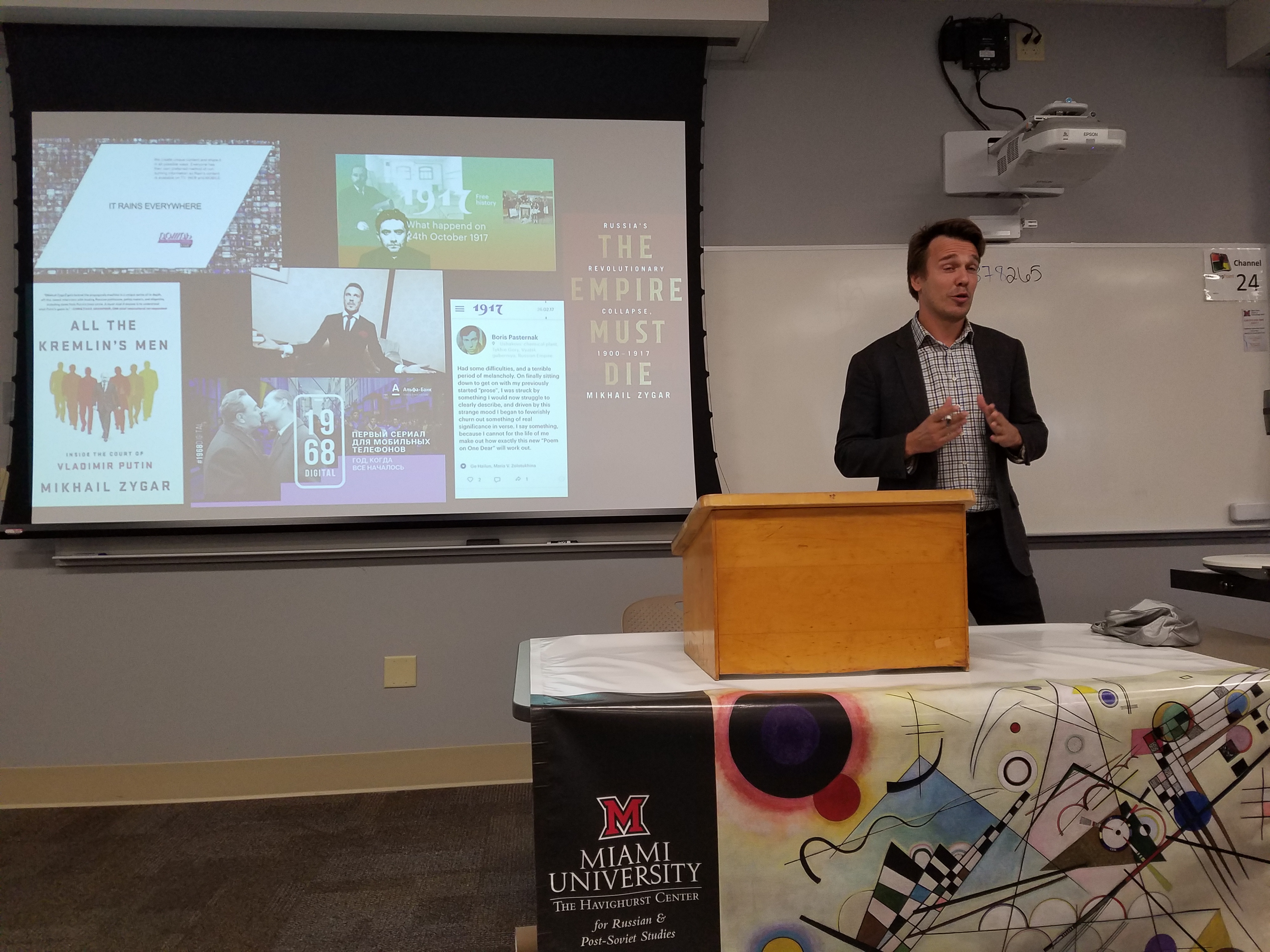
On Friday October 26th, Miami students and faculty welcomed Mikhail Zygar, a best-selling author and former journalist for TV Dozhd’, as part of the Havighurst lecture series on “Truth and Power.” His visit was particularly poignant as it illustrated the legacy of the late and beloved Karen Dawisha, the Havighurst Center’s former director. Dawisha dedicated her influential work, Putin’s Kleptocracy: Who Owns Russia?, to independent journalists like Zygar and his colleagues with the words “to free Russian journalism.” Although he sought to distinguish himself from the label of “opposition,” Zygar’s work both past and present nonetheless reflect an unbiased approach to relaying information, however it may affect the appearance of Russian authority. His lecture walked the audience through his career path and projects to showcase his investment in raw, independent media portrayal and its impact on the upcoming generation.
Zygar spent the earlier days of his career in a rather unorthodox way, hopping from warzone to warzone as a war correspondent for Kommersant. He admitted that, after a while, for the sake of his mental health, a change of subject matter was greatly needed. Constantly surrounded by war, he accrued an outlook defined by a certain degree of pessimism and hatred for those who were not going to wars, he joked. Although he swiftly transitioned out of such correspondence, he had already expertly managed to cover numerous events in Syria, Iraq, Uzbekistan, Kyrgyzstan, and more.
During the next phase of his life, Zygar joined forces with a small team that began building a new independent Russian news outlet: TV Dozhd’ (otherwise known as TV Rain). He noted that this new programming was popular among younger audiences for its reputation as a more “optimistic” channel, in contrast with the bitterness and pessimism emblematic of other independent, liberal media sources. This initial success with Russian young people was just the beginning of Zygar’s efforts to invent new formats that aim step-by-step to change the psychology of Russian youth.
Like Alexei Navalny and other opposition leaders, Zygar believes in the potential of the upcoming generation to ignite change for the better. He fervently conceded that he absolutely does not view himself as the sole savior of the Russian youth—but he is determined to be a part of the bigger movement. From Project 1917 to Project 1968 Digital, Zygar’s contributions to this drive for openness and greater freedoms lay in lessons from the past. His projects hinge on a belief that “history is the rehearsal of the future,” where learning from the past may enlighten future footfalls. By understanding the grass-roots personalities and dynamics that fed into the 1917 Revolution, a society can preemptively look to avoid any recreation thereof. And by understanding the birth of the dissident movement and the ideological collapse of the Soviet Union in 1968, a society can find precedent models to follow in the pursuit of freedoms. There is a great deal that stands to be gained from looking back.
However, for a generation more and more disinterested by traditional forms of literature, Zygar and his team direct a substantial portion of their efforts towards channeling historical information into online platforms that are more aesthetically attractive and readily available for quick consumption. Both projects are thus offered as apps whose formats are akin to those of familiar social networking sites. Project 1917 resembles Facebook or Vkontakte while 1968 Digital episodes unfold like podcasts applied to Instagram stories. Zygar noted that he is content with the growing popularity of the two—with approximately 8 million people, predominately between the ages of fifteen and twenty-five, scrolling through the former and a growing viewer population for the latter. But the experimentation continues, Zygar added, to design an effective means of reaching, educating, and shaping Russian millennials in the hope of a freer tomorrow.
For more information on Project 1917 and 1968 Digital, you can read synopses by August Hagemann and Helen McHenry, respectively. In addition, feel free to join the Center’s next guest lecturer, prominent journalist Masha Gessen, on November 6th at 5 PM in Shideler 152.
Emily Erdmann is a senior majoring in REEES and French.