
By Maddie Cramer
In a Russian prison cell, one thing helps keep prisoners of war alive: hope. Maksym Butkevych, a journalist, human rights advocate, and former POW, attributes his survival to hope after enduring over two years of harsh imprisonment by Russian forces.
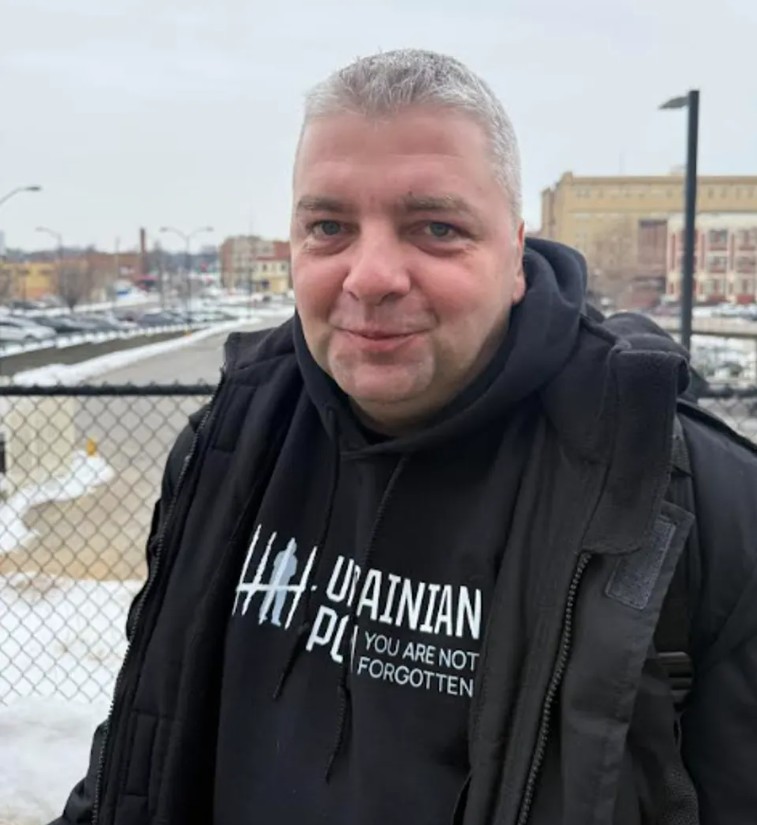
Butkevych, a man considered a “fascist” and “radical propagandist” by pro-Kremlin media outlets,[1] spoke to Miami University students on February 2, 2026 during a Havighurst Center for East European, Russian, and Eurasian Studies-sponsored event in Harrison Hall. The lecture, titled “The Principle of Hope”, centered around Butkevych’s experiences in captivity from June 2022 until he was released during a prisoner exchange in October 2024.
I had the opportunity to hear him speak that day in a room so crowded that people were sitting on the floor and standing in the doorway. He started by discussing his past, including his participation in the 1990 Ukrainian student-led Revolution on Granite when he was only 13, his career as a BBC journalist, and his work as a human rights advocate across Eastern Europe.
Despite being a lifelong anti-militarist, Butkevych joined the Armed Forces of Ukraine in February 2022. He was captured in June of that year during a battle in the occupied Luhansk region. He was falsely tried for war crimes and subsequently sentenced to 13 years in prison on “trumped-up” charges.
He spoke about his time in captivity, discussing the differences between Russian ideology and his own. As a POW, Butkevych was forced to do things on command: push-ups, squats, even singing the Russian anthem. He was also interrogated by the Russians many times, but his captors did not try to extract military information from him. Instead, they wanted to extract his values. They could not understand his participation in the Maidan Revolution of 2013-14. The interrogators believed that people cannot change anything, that the authorities will always have their way. They did not refer to the war as a “war against Ukraine,” but as “special military operations against the liberal West.” Butkevych described this viewpoint not as a war of territory or resources, but as a “war of worldviews and values.”
As Butkevych endured beatings, torture, and forced re-education, he always held one thing close to him: hope. He talked about how prison guards would constantly reinforce that nobody remembers you, and how easy it is to fall into these thoughts of hopelessness. Butkevych never allowed himself to believe these thoughts. He knew that his friends and family remembered him and that he would be liberated. Butkevych added that the most important thing to remember was “to know that you are not alone, that there are people out there who fight for you.” This idea is also what has helped Ukraine fight back, since he believes that without hope they wouldn’t be able to repel Russian aggression: “We put our hope in our values and ability to resist.”
Another concept Butkevych spoke about at length was the concept of freedom. Freedom, or “volia”, is a primary theme in the Ukrainian national anthem, which itself centers on the idea that
Ukraine’s freedom and glory have not yet perished.[2] He noted that this is very different from the Russian national anthem, as “it is all about the state”, and people are mentioned only twice.[3] Butkevych defines freedom as the ability to make choices. He stated that violence is a misunderstood concept, and it is not always simply inflicting physical harm on someone. Rather, violence is about turning someone into an object and taking away their ability to choose. This is essentially what was done to him while he was in prison. If the guards told prisoners to do a push-up, they did it. If the guards told them to sing the Russian national anthem, they did it. Freedom, then, becomes real when one can make choices.
These ideas culminated in the “Principle of Hope” foundation, co-founded by Butkevych. The organization helps those released from Russian captivity and facilitates their reintegration into society. It also aims to keep the international community cognizant of Ukrainian POWs and active in efforts for their release.[4]
As I listened to him speak, I realized that Butkevych’s experiences ultimately are not something that many of my peers or I can relate to. We know about the Russo-Ukrainian war and many other current events through news outlets or social media. When we are constantly bombarded by global issues, it can feel overwhelming or hopeless. However, Butkevych demonstrates that how we react to our circumstances is a form of agency. We are free in the sense that we have the ability to make choices. Whether the choice is something small, like what to do with our friends this weekend, or something bigger, like what we want to do with our lives, we are the authors of our own responses. In that overflowing room, Maksym Butkevych showed all who were listening that there is always hope, and there is always a choice.
Maddie Cramer is a senior graduating with a degree in Integrated Social Studies Education with a minor in History.
[1] Fears rise for a rights activist captured while fighting for Ukraine. – The New York Times
[2] Ukraine – nationalanthems.info
[3] What are the lyrics to Russia’s national anthem, and what do they mean? – Classic FM