Olivia Patel
As media coverage of the Russia-Ukraine war fades into the background, it’s hard to keep such a catastrophic conflict in front of mind. The American media cycle turns hundreds of stories a week — with so much to cover, both here and internationally, the suffering of millions can get lost or buried.
Housed in the Media, Journalism and Film Department, “War Stories” (JRN 310), taught by Dr. Rosemary Pennington, analyzes this phenomenon perfectly. To put it simply: if the war is not in your backyard, people have a hard time bringing themselves to care. Even more so, as perfectly depicted by artist Martha Rosler, even if the war is in your own backyard, people will likely opt to turn a blind eye unless they are directly affected by its wake.
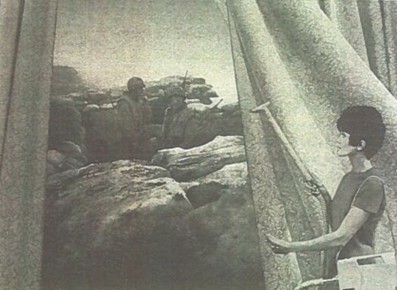
Cleaning the Drapes from the series House Beautiful: Bringing the War Home
c. 1967-72
The Havighurst Center for East European, Russian, and Eurasian Studies, through its guest speaker series, invited a collection of Russian and Ukrainian journalists, artists and activists to bring a new light to the conflict overseas. Their physical presence and shocking first-hand testaments to the war brought the stories they told to life, and they acted as a physical testament to the horrors of the Russia-Ukraine war that still very much rages on.
The lecture series featured a number of prominent speakers, from both sides of the conflict. Maksym Butkevych, a Ukrainian journalist and human rights advocate, visited Miami University’s campus on February 2, 2026. He opened his lecture by discussing how he got to the place he is now — a journalist who helps people being persecuted.
He originally joined the fight against Russia by enlisting with no prior military experience. He had very little military training, and in 2022, he went straight into battle.
“I never wanted to be in the military, but I came to be in the military especially because I am a human rights advocate,” Butkevych said.
Butkevych and eight others were captured by Russians, and they spent three years and four months in Russian captivity, where the army officers fabricated a criminal case against him (i.e. war crimes). Through this experience, aside from the torture and dehumanizing conditions he experienced, he also had the chance to learn the Russian perspective on not only the war, but the world around him.
“This is not a war for territories; it was never a war for territories … it’s not even a war for resources … This is a war of worldviews and values,” Butkevych said. “Russia wants to be an empire.”
Russian journalist Katerina Gordeeva, who began her career as a journalist in Russia before leaving the country in 2014, visited Miami’s campus on March 2. In her lecture, she discussed her experience covering the Russia-Ukrainian war, hearing the stories of both Russian and Ukrainian citizens and refugees. She began her lecture with stories and gut-wrenching photos from the water park terror attack in Moscow in 2004. From this, she took listeners through her journey to covering the Russia-Ukraine war, mostly highlighting her experience in human interest stories during conflict.
When the war broke out in 2022, Gordeeva said she was “reporting inside of the inferno;” in other words, she was gaining first-hand perspectives from being inside Russia that others could not access. She also went to a Russian refugee camp in Germany in 2022.
Her powerful stories and perspectives were a result of the personal connections she was forming with these refugees, whom she needed to get to trust her in order to share their experiences and trauma.
“I will not change your words – they are the most important testimony to the war,” Gordeeva said to the Russian refugees.
She circled her lecture around the central theme of how a journalist deals with trauma — most notably, trauma that has since been buried deep.
To close out the lecture series, Vika Lomasko, an artist/muralist and graphic Russian journalist now living in exile, gave a lecture in close proximity to her mural in King Library on April 16. Her visual presentation was unlike the other two lectures, in that she took viewers through an immersive experience of how she saw the Russia-Ukraine war. Lomasko’s artwork offered both an accurate and interpretive perspective on the war, and she used her illustrations to tell often overlooked stories of people who suffered from communism. She also used her art to express her own political views.
As the daughter of a propaganda artist, she grew up with a small spark of rebellion inside of her. She grew up despising the government, and she saw the West as a dream that had to be reached, which she later portrayed in her artwork through a metaphor of being underwater.
“The biggest failure for an artist is to depict the enemy’s ideology,” Lomasko said.
Like the images of being underwater, Lomasko also used things like snow and forests as a way of conveying emotion and passion in her artwork. Her use of color was also very intentional, including her choice to use no color at all.
All three of the Russian and Ukrainian activists who attended the lecture series presented their own individual ways of protesting against the war. While Butkevych and Gordeeva used their journalistic abilities, Lomasko took on the same mission, but instead through art. Their stories brought the horrors of the war alive, and they made it very hard for students and faculty attending to continue to look the other way.
Olivia Patel is a senior graduating with degrees in journalism and political science with a minor in classical studies. She was the editor of The Miami Student during its 200th year.