Booth- PBL: What Makes a Hero?

What Makes a Hero?

Key Knowledge, Understanding and Success Skills

  • RL.4.1 Refer to details and examples in a text when explaining what the text says explicitly and when drawing inferences from the text.
  • RL.4.3 Describe in depth a character, setting, or event in a story or drama, drawing on specific details in the text (e.g., a character’s thoughts, words, or actions).
  • RI.4.1 Refer to details and examples in a text when explaining what the text says explicitly and when drawing inferences from the text
  • RI.4.2 Analyze informational text development. a. Determine the main idea of a text and explain how it is supported by key details. b. Provide a summary of the text that includes the main idea and key details, as well as other important information.
  • RI.4.6 Compare and contrast a firsthand and secondhand account of the same event or topic; describe the differences in perspective and the information provided.
  • RI.4.8 Explain how an author uses evidence to support particular points in a text.
  • RI.4.9 Integrate information from two texts on the same topic in order to write or speak about the subject knowledgeably.
  • W.4.1 Write opinion pieces on topics or texts, supporting a point of view with reasons and information.
  • W.4.4 Produce clear and coherent writing in which the development and organization are appropriate to task, purpose, and audience.
  • W.4.5 With guidance and support from peers and adults, develop and strengthen writing as needed by planning, revising, and editing.
  • SL.4.3 Identify the reasons and evidence a speaker provides to support particular points.
  • SL.4.4 Report on a topic or text, tell a story, or recount an experience in an organized manner, using appropriate facts and relevant, descriptive details to support main ideas or themes; speak clearly at an understandable pace.
  • 21st Century Skills: critical thinking, collaboration, self-management

Challenging Problem or Question?

  • What makes a hero?

Sustained Inquiry

  • Students will analyze multiple informational resources about different types of heroes such as:
  • Students will also analyze fictional resources about heroes including superheroes and fictional stories that include characters who can be seen as heroes such as:
    • Wonder by R.J. Palacio
    • Comic Books
    • Matilda by Roald Dahl
  • Students will examine firsthand and secondhand accounts about heroes to examine different perspectives of the same event.
  • Students will reflect on videos such as the following:

    https://www.youtube.com/watch?v=x0mfJ4pQGcw

  • I will have local heroes/first responders come speak to the students about their experiences. The students will have to have questions ready to ask their guest speakers.
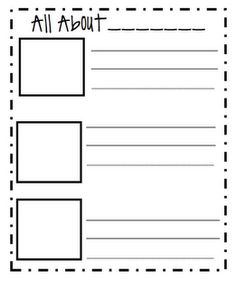
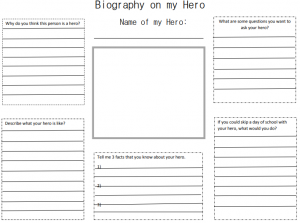
  • Students will have to choose one person who they see as a hero. They will have to interview that person and interview others about their chosen hero to investigate why others may see them as a hero as well. Students may select their parent, sibling, grandparent, coach, mentor, teacher, friend, etc. Students will then create a report and poster about their hero. Students will have to present these to the class and a panel made up of other teachers, administrators, and the guest speakers who previously came to the class. (The planning page for the students to start brainstorming this process would look similar to the document below. The full document can be found on the Teachers Pay Teachers website, however I would modify this document to encompass the material I would like the students to cover in their project.)

Authenticity

  • This project is authentic because this project relates to their own lives. The students are able to choose someone who has had an impact on their own life. This project has the students analyzing articles about real life heroes and kids just like them. The students are also able to work on their interviewing skills, collaborating with their peers, and how to present their information to others.

Student Voice & Choice

  • Students will be able to decide what questions they would like to ask the guest speakers in class.
  • The students will be allowed to choose anyone for their final project as long as they see that person as a hero and can provide evidence to support why that person is a hero. Students will have a list of questions they must ask the hero they are interviewing for their final project and the students will have to create their own questions as well.

Reflection

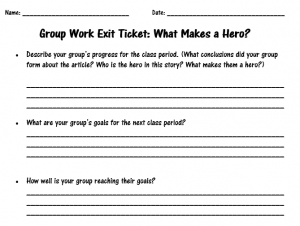
  • When the students analyze the informational/fictional texts, they will be working independently and then as a group. The students will have to complete an exit slip after every class answering the following questions:
    1. Describe your group’s progress for the class period. (What conclusions did your group form about the article? Who is the hero in this story? What makes them a hero?)
    2. What are your group’s goals for the next class period?
    3. How well is your group reaching their goals?

Critique & Revision

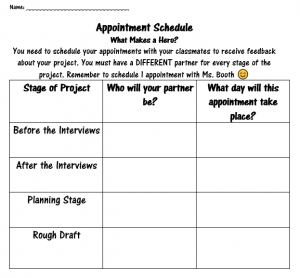
  • The students will be able to set appointments with other students in the class for feedback from their peers about their final heroes project. Students will meet during different stages of this project: before the initial interviews, after the interviews are conducted, planning stages of their report/poster, and when they have completed a rough draft of their report/poster. This will allow the students to receive constructive feedback from their peers. The students will also have to set an appointment with myself at some point during this process.

Public Product

  • Students will create a report and poster about the hero of their choosing. I will compile the reports into a book of heroes to display in our classroom. The posters will be displayed throughout our school for other students to see. The students will also have to present their reports/posters to the class and a panel made up of other teachers, administrators, and the guest speakers who previously came to the class.


Posted in Project-Based Learning | Leave a comment

Cooperative Learning Exercise 1 – Hello Governor!

Super Tuesday in Ohio

Cooperative Learning Lesson #1 :   

Hello Governor! 

The first activity I would implement for the cooperative learning lesson would utilize the Coop Coop format. Students would research the candidates seeking running for Governor of Ohio, students would ultimately present their findings and as a group endorse candidate position on the platform.


Team selection: Co-op Co-op is designed  to be a student centered learning experience. Therefore students would self select according the issue area of interest, with a maximum of 4 students per team. For example, candidates have platforms on healthcare, education, employment, etc. which will be dispersed throughout the room. Once teams are selected, students will begin their process with an interview exercise. Peers will interview each other on their passions and based on their answers they will develop a slogan for a peer, that will have a corresponding group poster that will  be posted throughout the duration of the assignment. Students would also be encouraged to choose “controversial topics” like reproductive rights, marijuana legalization etc.

Teambuilding & Interdependence Each team member will be given the outline a template with different team roles, similar to Collaborative justice. Example roles: informal spokesperson, catalyst, optimist, caretaker etc.  Once team members receive this sheet they will read and identify the role they are accustomed to playing on a team. Once everyone has identified how they usually operate on a team, they will turn in their sheet and receive the another blank version of the same document. The team will decide what different role they will play for this particular project, and identify an accountability buddy to help them shift to their new role. This promotes leadership development, and interdependence as students are embracing opportunities less familiar to them, that may be uncomfortable or and challenging.


Separation and delegation of work: Each student will be responsible for gathering information pertaining to the particular candidate they choose. For example, if the general topic is criminal justice, a student can decide they will capture the platform for the Green party candidate. Each student will have a deadline with check in points where they can capture their progress and snags.


Team presentations:

Student presentations would be treated like a conference. Each team would present research based on specific parameters pertaining to the policies of the candidates. Once all of the facts have been presented on a policy, the group will announce what candidate’s platform they selected and their rationale. Student audience members would use their devices to select candidates based on policy before the team reveals their selection.


Evaluation Student evaluation would be based on peer evaluation, as well as project rubric.

Exercise #2 Banned Book Report?

Against Banned Books (Please Spread This Pic & The Text)

Guided Reciprocal Peer Questioning

Room Set-up: Students will begin in a large circle, and count of to 3. Once the counting off is complete, students will find their fellow numbered partners, and prepare for the lecture. Each student will have blank sheets of paper, markers, and examples of big questions that are on the floor in the middle of the room.


Teambuilding & Interdependence: Once students are broken off into 3 they will introduce themselves and answer an icebreaker question. After they introduce themselves they will be responsible for creating a book judging group name. During this period everyone will be responsible for identifying 1 guideline they propose upholding during their time together as a team (example: Give positive feedback, one micprophone etc.). Once all ideas have been presented, each team member will agree or disagree to these guidelines by using “fist of five” as a hand signal to confirm the guidelines. Fist of five is a consensus building process where a five signals full agreement, and three signals indifference, and less than three requires additional team conversation. Once this has been established, each team member will be responsible for identifying when guidelines are not being upheld. Thus requiring mutual leadership and accountability within the group.

Opening:  The instructor will give an overview of the history of banned books. The general context of banned book will lead into specific mention of which particular texts are banned, and for what stated reasons.

Stem Questions:

Following this brief presentation will reflect on the following stem questions: How does the process of banning books affect education?

What are the strengths and weakness of banning literature? Once the group has processed these questions they will begin posing their own.


Learning teams:  Once each separate group has identified their group questions, they will regroup themselves with 1,2 &3s and share one question from their previous groups. All questions will be recorded and displayed for future critical thinking exercises.


Evaluation: There will be no formal assessment for this exercise, just observation. Students will be encouraged to use democratic speaking processes, to ensure all learners are engaged.


Posted in Misc | Leave a comment

Cooperative Learning

Cooperative Learning Lessons

Kristina Hamester

Idea #1: Cooperative Learning “Signs All Around Us”      
Based on Co-op Co-op, by Spencer Kagan

A class of Second Grade ESL students learn about safety signs in a community and work together to form an imaginative community.

Materials:

Lesson Delivery

  1. Ask Students, “What is a community?” A community is a group of people living in the same place or having a particular characteristic in common. We are learning in a school community.
  2. A community can be bigger than a school and include a neighborhood and the shops around it too. Show students a picture of a community map like the one shown here from National Geographic: https://www.nationalgeographic.org/maps/community-map/

Ask students to tell elements of this community and their symbols. These include houses, roads, a school, businesses, restaurants, a park, a farm and a bank.

2.) Show students 3 community signs (including road signs, school related signs, and signs for places of business) and ask how incorporating signs can help people get to places they need and keep the community safe. Here is a link to printable community signs: https://www.teacherspayteachers.com/Product/Community-Signs-Flashcards-with-Words-1141412

3.) As a whole group, the teacher asks students what are other kinds of signs you have seen? Each student writes ideas on the the board as a chalk talk activity called, “Types of Signs”. Students each have their own colored marker that distinguishes their contributions so the teacher is able to see who is engaged in the activity and who may be struggling. The teacher challenges students to think about whether these signs are road signs, school related signs, business related signs or other.

4.) Students form teams of 3 on their own with each student being responsible for a type of community sign (road, school, or business related.) If teachers need to rearrange groups, they can do so.

4.) Individually, students will learn about the kind of sign they represent. This can be done with printable articles or notes about different signs, books about signs or students may be allowed to research their kinds of signs on the internet. Students need to find three signs that fit in their category, they need to know what the sign is called and why this sign is useful to people. The teacher may give students a graphic organizers like this one to help them sort their ideas (through drawing and writing) out on paper.

5.) Once their research is complete, students rejoin their teams to combine all 9 signs in a  made up community which they will draw on butcher paper. Each student will use a separate color to draw their part of the map and their signs. Each will be responsible in explaining how their signs contribute to a safe community.

6.) Students will evaluate their own presentations through a few questions such as, “Which parts of your presentation were strongest? Which parts of the presentation could use more detail?” The teacher can give feedback to each team based on these questions as well and recommendations for future presentations. Beyond this, no formal evaluation is needed as learning can be the reward.  

7.) For extra fun as whole group if time allows, play Bingo – with Signs  https://www.teacherspayteachers.com/Product/Community-Signs-BINGO-1235576


Idea #2: Team Building “Let’s Bake a Cake!” 
Based on Team Investigation, by Shlomo Sharan

A class of First Grade ESL students will explain how to make a dessert of their choice.   

Materials

  1. The teacher says that today we will be baking! Students will place themselves in teams of 3. Each team should choose a colored chef hat to represent them (Team Red, Blue, Yellow, Green, Purple). Teams will be asked to decide an item they want to “bake”. These could include a cake, brownies, cookies, a pie, a cobbler, or cupcakes.

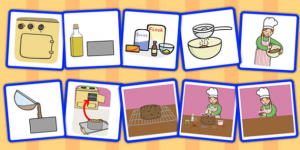
2. Given a set of 12 cards– including various baking utensil picture cards and some word cards, such as “mix the batter”. Students must work together to match the word cards with the picture cards first.

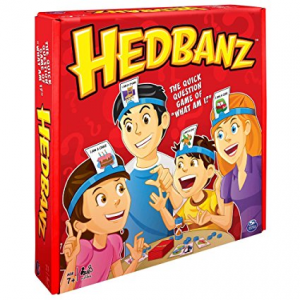
The trick is each student can only pick up one picture card at a time but can not look at the card until their teammates have described it to first to them and they have guessed what it is. In a sort of “Hedbanz” party game fashion, students hold a picture card on their forehead and while other students on their team describe what they see. The student guessing reads the 6 word cards to figure out what it is they have on their heads. Once all students have had 2 turns to guess the cards, the cards will all be matched. This game ensures that students are all participating in the game, and rely on each other to help their team move forward.

For reference of Headbands Party Game see: http://howdoyouplayit.com/headbanz-rules/  

3. After word and picture cards are matched, students must work together put the cards in sequence order of first to last step in how to bake an item. Example: Match the “mix the batter” card to a picture of a bowl of batter and a spoon.

4. Students will arrange their steps on a felt chart and practice presenting 2 of the 6 steps for a whole class presentation. Hearing for each student about only 2 of the steps in “baking their dessert” will stress interdependence within the group.

5. As a team, students will present their cards by each explaining two of the steps, with a total of 6 steps. Here, teachers will check student participation through watching the team present equal parts of the process. 

6. Teams that successfully “bake their cakes” within the suggested amount of time win a special sweet treat. 

Posted in Misc | Tagged , , | Leave a comment

Cooperative Learning – Whalen

Idea 1- Team Building Activity for The House on Mango Street

This unit will be the first unit of the school year.  The novel revolves around a coming of age story, with the female protagonist facing many challenges and decisions my students (all female) will be able to relate to. We will start by getting to know the author and her work, aided by this author Facebook Page:

https://www.facebook.com/sandracisnerosauthor/ 

I will use this unit to team build along the way and set the scene for future units that will focus on collaborative learning.  Here’s how:

In intervals of the book I have students reflect on the reading.  I can have them reflect together so they can team build and get to know each other.  For example, in the book is a vignette about the protagonist’s name – its origins, its connotations in her life, how she feels about it, etc.  This lesson as cooperative learning would look like this:

Lesson Day 1:

  1. Read vignette in class, focusing on elements of a vignette and writing style
  2. Give students 4 minutes to reflect on their own name, jot notes down
  3. Get into pre-assigned teams of 4
  4. Give 5 minutes to discuss their name reflections and give each other feedback/impressions based on brainstorming
  5. Assign “My Name” vignette.  Each student completes this independently (complete for hw).

Lesson Day 2:

  1. Present vignette to the team (informal, read aloud in small groups)
  2. Peer edit vignettes in teams
  3. Make any adjustments/corrections       

This type of activity allows students to reflect on the reading AND get to know each other better.  Even if students are already friends, this will likely teach them something about their classmate they didn’t already know, even if it’s as simple as them being named after a relative.  Plus, sharing this reflective information with each other will bring the students closer together.

I will repeat this activity, but with different reflective prompts, for the duration of the 3 week unit.  The “easy” nature of the responses, all being opinion based, will give each student an opportunity to speak, share, and become part of the team.  This will prepare them for the rest of the collaboration for the semester by letting them get comfortable with each other.  For each reflective activity the groups will shift somewhat, so the whole class gradually gets to know each other and becomes comfortable together.

Idea 2 – Julius Caesar Co-op Co-op

For this lesson I will use the Co-op Co-op method.  To do so, students will have the opportunity day 1 of the unit to brainstorm things they would like to learn in addition to reading the play, then they can gather that information and present it as we go along.

A team of 4 will be pre-assigned by me at the beginning of this unit.

As a team, students will decide on a sub-topic of the unit they want to explore.  Examples include:

  • Shakespeare’s life and background
  • Roman arts and culture during the time of JC
  • Focused historical study on one person – Antony, Caesar, etc.
  • The globe theater and how the play would have been performed

Then, students will have time over the course of 2 weeks to gather information and make an informative presentation.  This could be via Powerpoint, a poster, Prezi, or another presentation tool.

Students might be interested in this Crash Course Youtube video about the Roman Empire:


I will ensure success by having work days in class where I can monitor progress and participation.  I will also have students begin by assigning responsibilities, so each student is collaborating equally.  Each student will have to be an active participant in the presentation of the information, and peer/self evaluations will be completed at the end of the unit.

As students work I will walk around and monitor the class, keeping notes on how the students are working, and nudging students in the right direction if they get stuck or off track.  This will also help ensure that one student doesn’t dominate the discussion and leave out quieter kids – I can model inclusion by asking opinions from those students to bring them back into the team.


Posted in Cooperative Learning | Tagged , , , , , | Leave a comment

Cooperative Learning

Cooperative Learning Lesson Ideas

Unit #1 : Red Carpet Preview Day   

Red Carpet Preview Day is an event designed to recruit high ability students. High ability students are invited to campus to learn more about Miami and the programs we offer. High ability students are those who have excelled in high school by achieving a high ACT/SAT score or high GPA. The event accommodates approximately 300 people total. The event offers a jam-packed day full of Miami experiences – anything from classes to sit in on to eating a Tuffy’s Roll at Pulley Dinner! It takes a team to successfully facilitate this event. Implementing some of the cooperative learning techniques would only be beneficial in preparing for Red Carpet Day.

  • Techniques to be used
    • Group Investigation: groups decide how to proceed based on information and facts
    • Coop Coop: teams created based on commonalities
    • Teams are created based on common goals/experience but full team will function as a group investigation (especially given each group with be going off of different data/facts)
  • Each team member will be assigned a specific task to complete: Caterer, Tour Guide Manager, Venue Securer and Director
    • All positions have their own responsibilities and they rotate each event so everyone understands/learns how to do every job
    • It’s also important for everyone to understand how to manage/do every job in case they need to step in at any point (You never know what can happen!)
  • Share this video about positive and negative team work: https://www.youtube.com/watch?v=fUXdrl9ch_Q
  • Harkness style discussions to take place with our secretary monitoring input from the whole office

  • Daily meetings occur to address concerns and questions
  • Day of Event each member assumes assigned role and team facilities event smoothly and successfully as one unit
  • Teaches team work, importance of communication, and how important versatility is

Unit #2 : Tour Guides

The student tour guides at Miami are responsible for giving official campus tours daily. In order to be selected as a tour guide, students must go through the 3-round-interview process. Because of the job’s communicative nature, we like to make sure candidates are comfortable speaking in all settings. Student do, however, need to stay up to date on all information. A great way to introduce new information/facts is by using the Jigsaw Method:

  • Jigsaw Method
    • Students will be broken up into groups of 4
    • Each group will have a title – examples include “Managers, Tour Guide Leads, Veterans and Historians
    • These groups will stay the same for the whole semester with “information/fact refresher meetings” happening 3x/semester
    • Each group will be responsible for researching information (one fact per group member) about Miami and then presenting it to the rest of the tour guides
      • Topics will be assigned prior to each meeting to each group: anything from Freedom Summer, Cradle of Coaches and professional experience opportunities
      • The presentation MUST feature each team member and one fact that THEY, the individual, found
        • This is to ensure that there is equal effort among the group
    • From all groups presenting, the guides will receive a broad understanding of the university
    • Additionally to ensure this method is successful, we will ask each guide to share their thoughts anonymously about the information refresher through a short writing reflection

Here’s a small diagram I made to show how each group would be contributing 4 informational facts.

Once the tour guides have received all the information they can prepare a tour that has one fact from the Veterans, one fact from the Tour Guide Leads, one from the Managers, etc. The tours, after this information refresher, will contain information from everyone. It’s a great way for everyone to collaborate!


Posted in Misc | Leave a comment

Cooperative Learning Strategies

Cooperative Learning Method 1: Circle of Viewpoints

For this idea, students are able to gain different viewpoints and perspectives from other classmates about a certain event, topic, or issue.This allows for a thorough and more complete understanding about what is being learned, as different students may offer information or think about the topic in different lights than others.

For example, a classroom might be asked what their first thoughts are when they see or hear the topic ‘Africa’. Each student would have the opportunity to think of what they think this topic is most associated with to them from what they have seen, heard, or read, including where Africa stands today on multiple bases, major figures that represent Africa as a nation, different cultures and languages commonly recognized, problems faced by the people who live there, and more.

During the activity, the compiled viewpoints can then be further explored. When having students explain their views before taking on another viewpoint to observe, the following prompts can be used to generate classroom/student discussion:

  1. I am thinking of ‘Africa’ from the point of view of…
  2. I think…because…
  3. A question/concern I have from this viewpoint is… (171).

Going along with the topic of Africa, one student might introduce the idea that Africa is culturally diverse. To approach this viewpoint, one might say that they are thinking about Africa from the point of view of it’s population/people. To explain their reasoning, one might say they think Africa is very culturally diverse given that they have seen statistics on the number of different cultures available within the continent. In response to that student, another student may respond to that idea with a concern or question about how that might affect neighboring groups of people who don’t share the same beliefs.

Cooperative learning structures would play out here as students would be able to build off of one another when coming together to share their different perspectives to create a more ‘whole’ way to view a topic, issue, or event and the ideas that are connected to it.

This type of learning method uses a ‘CO-OP CO-OP’ approach, where discussion is centered around students and are able to learn more about a unit/topic by expressing their ideas after brainstorming. This method also calls for record-keeping of student ideas before allowing them to share their thoughts, as stated in the lesson plan below:

Lesson Plan (Written Approach):

1. Approach the learning material to students by showing a story, explaining an issue or event, or simply introducing a topic and allow them to examine and consider where they stand and what other ideas it makes them think about. Writing the name of the topic also helps students to stay within that particular subject path.
Encourage students to ask questions, make observations, and really consider what they think and why. (As this is a written classroom activity, also make note to allow students to write their initial and concluding viewpoints for later discussion)

2. Compile and generate a large list of varying student viewpoints and ideas or even other related concepts or objects similar to the introduced topic. The list should be put together in a large circle to make things easier to see and bring all the topics together.

3. Ask the class which viewpoint they would like to explore the most and allow students to explain their thoughts on the topic.

4. Have students respond to the selected topic by letting them take on that particular viewpoint using the ‘I think…’ prompt based on what they have heard, seen, read, or interpreted. Have each student record their ideas down.

5. Have students respond to the ‘A question I have from this viewpoint…’ prompt and allow them to document their ideas.

6. Allow students to come together as a class to share their findings and different reasoning. Highlighting main and broad topic ideas for class discussion that has to do with difference in viewpoints between class members may be critical to dive into together for further contemplation and student thinking.

Practicing activities like such in the classroom encourages students to be more well-rounded and take on challenges individually while using multiple ways of thinking into how they work.

What I really like about this strategy is how students are brought together to discuss their divergent viewpoints where everyone will typically have a different perspective on the topic due to difference in culture or past experiences.  This is very admirable in the way that learners can gather knowledge from other students based off of different cultural values that individuals possess as well as how all students think differently.

To understand that students think and feel differently is essential to understand due to how it is a crucial aspect of the fairness ideal.  From doing this activity, students are able to think of new ideas towards a subject from different perspectives as well as pose new questions that come to mind.  For more information on this learning method and student examples of how this ‘circle’ could be filled out, this website dives into more detail. Other examples can also be found here under this pinterest link.

Cooperative Learning Method 2: Sentence-Phrase-Word (207)

Using this method, students are engaged in rich discussions with another from reviewing a specific text.  Students then choose a sentence that incited an emotion or an overall theme of the text, a phrase that provides engagement, and finally a word that is powerful to the individual. This idea allows individuals to create discussions with one another “while drawing attention to the power of language”(207).

For example, one book for students to look at could be Fahrenheit 451 by Ray Bradbury. In this text, students can focus on a variety of different themes such as:

  • Foreshadowing
  • Censorship
  • The Power of Knowledge

Students can look for different quotes or areas in the text where the respected theme is being expressed in the book along with their explanation of why it fits the theme. This type of learning method uses a group investigation approach, where students begin in small groups and each focus on a portion of the text individually before sharing what they chose and why. Afterwards, students can come together to discuss their thoughts as a class and analyze how the topics they came up with allows them to understand the text better.

Lesson Plan: 

1. Provide students the selected text and give them some time to annotate the given piece to get a better understanding.

2. Once students are finished reading the piece, make sure that each person chooses a sentence that is most meaningful or powerful to them.

3. Gather students in groups from four to up to six people(varies on classroom size) and ask them to share and jot down their findings, and explain why they selected them.  The first participant should share the sentence they chose, provide why he/she chose it, and allow others to comment and create discussions.  Once the first student is done, the sentence they chose is recorded, and then the following student starts to share, record, and starts speaking until everyone in the group shares his or her own sentence.  By doing this, the group discussion flows smoothly. Students should each share their thoughts in order to prevent any one student from becoming the ‘dominant’ spokesperson in any group and to let everyone have a fair and equal opportunity to share. To ensure this, it is best that the teacher go around and listen to student’s ideas and monitor how groups perform with each other.

4. After students share, each group analyzes all of the responses.  Student should identify the common themes derived from responses as well as the predictions they suggested.  Finally, the group should identify any areas of the piece that were not provided in their own choice of sentence, phrases, and words.

5. Lastly, posting all groups documents up.  It is essential to provide time for students to look at the sentences, phrases, and words that they chose and all of the implications that were drawn from them. Then, each group member should be able to briefly reflect on their understanding of the specific text and how this routine helped contribute with their understanding before coming together as a class to share their thoughts as a whole.

Using strategies like the Sentence-Phrase-Word encourages students to engage with one another when going over a specific text.  This routine enables students to “capture the essence of the text”(207).  What I love about this strategy is that it allows students to be able to discuss with one another while slowly realizing how powerful language is when breaking down pieces of text to one word.

For more information on this method, please refer to this pdf file where this classroom activity is further discussed, or this video where this method is being performed!

 

Posted in Cooperative Learning | Tagged | Leave a comment

Cooperative Learning: Booth

Lesson Idea #1: Team Building- It’s a Mystery

  • Lesson Goal: The goal of this lesson is for students to work as a team to complete activities. This lesson will require students to find a way to work together and will have them learn about one another along the way. I will be doing this activity at the beginning of the school year to start to create a positive learning environment.
  • Lesson Plan:
    • As a class, we would create a list of expectations for the activity such as: being respectful, listening to each other’s ideas, working together as a team, etc. I would record their responses on the board so that they would be present during the activity. (I would then copy them onto a poster board and have them displayed throughout the school year.)
    • Students would be divided into groups of 4 and I would then tell the students the directions for the activity. I will also tell them that the only way they will reach the end is if they work together as a TEAM.
    • I would start the timer and students would be off to start their challenge. Students will have to solve riddles, solve puzzles, and mini team building activities during their experience. I would use the activities that can be found on Pinterest but would also include getting to know you activities such as the groups finding one thing they have in common between all of them.
    • They would not get the next clue until they have successfully completed each challenge. The reward for the groups would be CHAMP dollars that they have to divide among their groups. (These are fake dollars that the students can use to purchase items at the CHAMP store at our school.)
      • 1st place= 20 CHAMP dollars
      • 2nd place= 16 CHAMP dollars
      • 3rd place= 12 CHAMP dollars
      • 4th place= 8 CHAMP dollars
      • 5th place= 4 CHAMP dollars


Lesson Idea #2: Zoom/Book Box- Holes by Louis Sachar

  • Lesson Goal: For students to work together as a team to brainstorm what our upcoming novel will be about. Another goal is for students to examine the different perspectives of their classmates.
  • Lesson Plan:
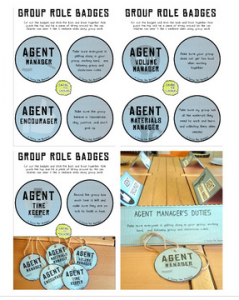
    • I would divide the students into groups of four. We would go over the expectations for groups that the students had previously created. Each student would be given a role in their group. I would provide the students with a card with the description of their job. I would use cards such as the ones that can be found below. The only job I would not assign would be the recorder/scribe.
    • Students would then break off into their groups. Each group would be given an envelope of the same pictures: a lizard, a shovel, a pig, an onion, and a pair of shoes. Each group would have to write a story using all of the items.
    • Each student would be given a colored pencil/marker of a different color. The students will have to pass around the paper writing a line of the story.
    • The groups will then present their stories to class and they will have to read the lines they wrote. We will then watch a trailer for the book and have a classroom discussion about their stories and decide which story they think will be the closest to the novel we are about to read.
    • As we read the book, I would use the Guided Reciprocal Peer Questioning activity that can be found on the Cooperative Learning Models document in the module. I think that this activity would be very beneficial during classroom/group discussions for the students to guide the conversation. After each chapter, the students will write down a question to ask their group and the students can then have a meaningful conversation around that question. Students will be assigned roles, just like as before, and a recorder(s) will write down what their group discusses. We will then come together as a class for the groups to present what they discussed.
Posted in Cooperative Learning | Leave a comment

Branches of Government and Candy!

Candy Icebreaker:

  1. Prepare a Dixie cup with skittles including colors red, orange, yellow, green, and purple for each student.
  2. Tell students in advance not eat their candy until after they answer their question.
  3. Provide chart indicating colors with corresponding questions. Tell students that we will go around the room so each student can share the answer that corresponds to question and the color of candy. Students will answer one question at a time until each student has had the opportunity to answer each question.
  4. Ex: tell the students that they are going to share the red candy question and then have everyone eat the red candy at the same time. This will continue until everyone has answered that color question.
  5. This will continue until all colors of candy are eaten and each student has answered all questions.
  6. Use a chart similar to this one found on Pinterest, or create your own.

Branches of Government: 

Topic: The Branches of the U.S. Federal Government/understanding separation of power-using Jigsaw

Introduction: The teacher asks the students, “How would you like to be the teacher for this lesson? The teacher explains that the class will be studying the branches of government and they will take on the role of teacher for their classmates. We will also be working together as a group to discuss checks and balances of power.

Objectives: Students will be able to identify the three branches of U.S. government, as well as their individual functions. As a class, the teams will work together, to see how checks and balances of power work within the branches.

Academic Standard(s): Social Studies: Civics and Government; describe the three branches of the United States government, including their functions and relationships.

Ask motivating questions: Why is it important for us to understand the role and functions of the three branches of government in the United States? Why is it important to have checks and balances of power?

Lesson Steps:

  1. Explain to students: For this activity, students will be divided into three teams. Students will then pick from a hat, one of three branches of government (Executive, Legislative and Judicial)
  2. Each team should create a sign displaying their branch name, so that the class can clearly identify their team branch.
  3. Once each team has been assigned a branch they will then discuss and research as a team, the role/function of that particular branch. Provide team with tech necessary to complete the task.
  4. Each team member will be responsible for a role or function of each branch. For example, if a team has the legislative branch, one group member will describe a function, such as, makes laws. Another team member may describe that a function is to approve presidential appointments etc…
  5. Each group member will have a different color marker when describing and writing these functions.
  6. After each student describes a function of each branch, the team presents its research to the class. Each student is responsible for describing their individual function that they have defined.
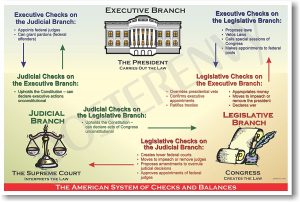
  7. After all teams have presented their branch and its role. Student will then work as a team to discuss how checks and balances work.
  8. Use a current event to discuss checks and balances. For example, discuss the recent retirement announcement for Justice Anthony Kennedy, what does that mean for the government? Who nominates judges? Who must confirm the president’s nomination? Can any branch impeach a judge? Who can veto congressional legislation? How might the process look when a new judge is appointed? Why are these checks and balances important?
  9. Show YouTube video to explain the branches of government:

10. Display charts found on Pinterest to help with describing the branches and the checks and balances to add a visual aid to the lesson.


Assessment: The teacher will assess the students on the performance objectives based on their individual presentations and overall understanding of the topic.


Posted in Misc | Leave a comment

Ideas for Cooperative Learning in 5th Grade ELA

IDEA #1: Text Structure “Magazine” Jigsaw

As a review of text structures, groups will create a “class magazine” in one class period! Of course, this magazine would not be something publishable or “final” in any way, shape or form. Instead, the “magazine” activity is just a vehicle for cooperative group work and content practice. This activity might come at the beginning of a non-fiction unit, because typically students know the text structures well from fourth grade and just need a refresher before they write using text structures. This uses the “jigsaw” cooperative learning model.

GOAL: Students will work cooperatively to write in various text structures.

PROCESS:

1) Students will be grouped by ability (mixed abilities) in groups of four.

2) Students will determine roles: (1) “designer” (headlines, layout, font, etc.); (2) “writers” (will write the text for the articles); (1) “editor” (proofreading).

3) The group will determine the topic of the “magazine” and then what two text structures the writers will use. Then, the writers think of subtopics that fit those text structures and write a quick first draft. Meanwhile, the designer begins sketching the layout. Editor proofreads as necessary, and helps other areas as necessary.

4) When finished, the group will reflect on how well they worked together, what they learned about working with others.

5) The next day, groups will read each other’s “magazines” and identify the text structures used.

**Click the image below for a helpful text structure reference page from The Teacher Next Door! **


IDEA #2: ZOOM Teambuilding activity

In this learning experience, students will reassemble a cut-up version of the book Zoom by Istvan Banyai (1998). The book itself is really great for conversations about part-whole relationships (it gradually zooms out through a series of scenes). Click here to view a YouTube version of the book. I bought a used version a few years ago, tore out the pages, and had them laminated. This lesson is meant to teach about cooperation and communication and would be used when groups are formed initially. Because it is not intended to be an enduring activity that lasts multiple class periods, specific roles and jobs will not be assigned.

GOAL: Students will work cooperatively and communicate effectively to order the images in the book Zoom.

PROCESS:

1) Students will be grouped randomly.

2) Students will be given their section of the book (4 pages). They CANNOT SHOW EACH OTHER the pages. They must only verbally describe what is going on in the pages.

3) They order themselves based on what they think is the right order from their oral descriptions. What I love about this activity is that it is easy to “self-check” — it is obvious when they’re in order.

4) After the small group has ordered their pages, they will write a brief reflection on communication.

5) Once all groups have accomplished the task, the groups will elect two representatives to participate in the ordering of ALL of the group’s pages. The other two students will take notes on how the other students communicate.

6) Finally, we’ll reveal the whole book and check the order followed by a class discussion about communication using these as guiding questions:

* What made this hard? What made this easy?

*What skills and strategies did you or members of your group use to communicate effectively?

*How did you help each other?

*How did you know you were on the right track?

*What kinds of things did your group do or say that were helpful? Not helpful?

Posted in Cooperative Learning | Leave a comment

The Lorax and Wilt Chamberlin:

Lesson #1-The Lorax: Whose resources?   

[Show movie: Dr. Seuss’s The Lorax

Generalization: Human impact on the environment

Concept: Natural Resources

Concept: Capitalism

Concept: Interdependence


Facts:

Facts: Air/Water Pollution

Facts: All living things are interdependent

Facts: Interdependence within and between biological environments is vital

Facts: Greed


Guiding Questions:

-Who owns natural resources?

– Do we have ethical obligations to the environment?

– Why is sustainability important? How does it impact human living?

– Who makes the laws regarding the environment?

– What can we do to make a difference?

– Do we really need the items that we have? Or do we really just have a lot of Thneeds?

Critical Content:

Teaching interdependence between humans and the environment, and ultimately our  impact on the environment.

Getting students involved:

Exercise:

-Think of a way in which all living things are interdependent and show the relationship (or Cycle) in a model of your choice: It could be a diorama or a picture board, whatever you choose.

Pinterest: Use Pinterest to find interesting environmental facts:

Lesson #2-Change: Why do we have a such a problem with it?

[Listen: to Podcast Revisionist History: The Big Man Can’t Shoot

Generalization: Why are we hesitant to change: Social Systems

Concept: Change is necessary for growth

Concept: Change may be positive or negative

Concept: Change requires adaptation


Guiding Questions:

-What are some characteristics of Change?

– In the example, why was Wilt resistant to change? What would you do differently?

-How does change affect our lives?

-Why are we hesitant to change?

Critical Content:

Discuss the reason Wilt didn’t change his free throw shot? Was it because he was embarrassed? Or because it wasn’t what the majority agreed was the best practice? What social ideas have similar structure? Civil Rights, Women’s Rights, LGBTQ movement. In what ways are these similar? Why did it take so long for these societal structures to change? How did we change perceptions?

Exercise:

-Provide an example of something that you would like to change? Do you see something that needs improving? In what ways do you think you could change it for the better? Do you think that people would be open to your change idea?

Posted in Concept-Based, Making Thinking Visible, Social Justice | Tagged , , | Leave a comment