

%20Anne%20Davis-1.jpg)
On Monday, February 23, the Humanities Center and the Creative Writing Program hosted celebrated author Kathryn Davis along with Miami faculty members Dr. Cathy Wagner and Professor Margaret Luongo for a panel entitled “How to Make a World: Writers on Creativity.” Dr. Timothy Melley, director of the Miami University Humanities Center, introduced the panel, which is the second installment in this year’s Humanities series. In honor of Miami University President David Hodge’s declaration of the 2015-2016 academic year as The Year of Creativity and Innovation, each event will focus on creativity.
Davis is the author of seven novels, and has won the Kafka Prize, the Morton Dauwen Zabel Award, the 2006 Lannan Award for Fiction, and has been awarded a Guggenheim Fellowship. She currently teaches in the MFA program at Washington University in St. Louis.
Luongo launched the panel by stating that often, writers and artists think in terms of having the freedom to create, and strive to have no restraints. But, she asked, are there times in which restraint can work for creativity?

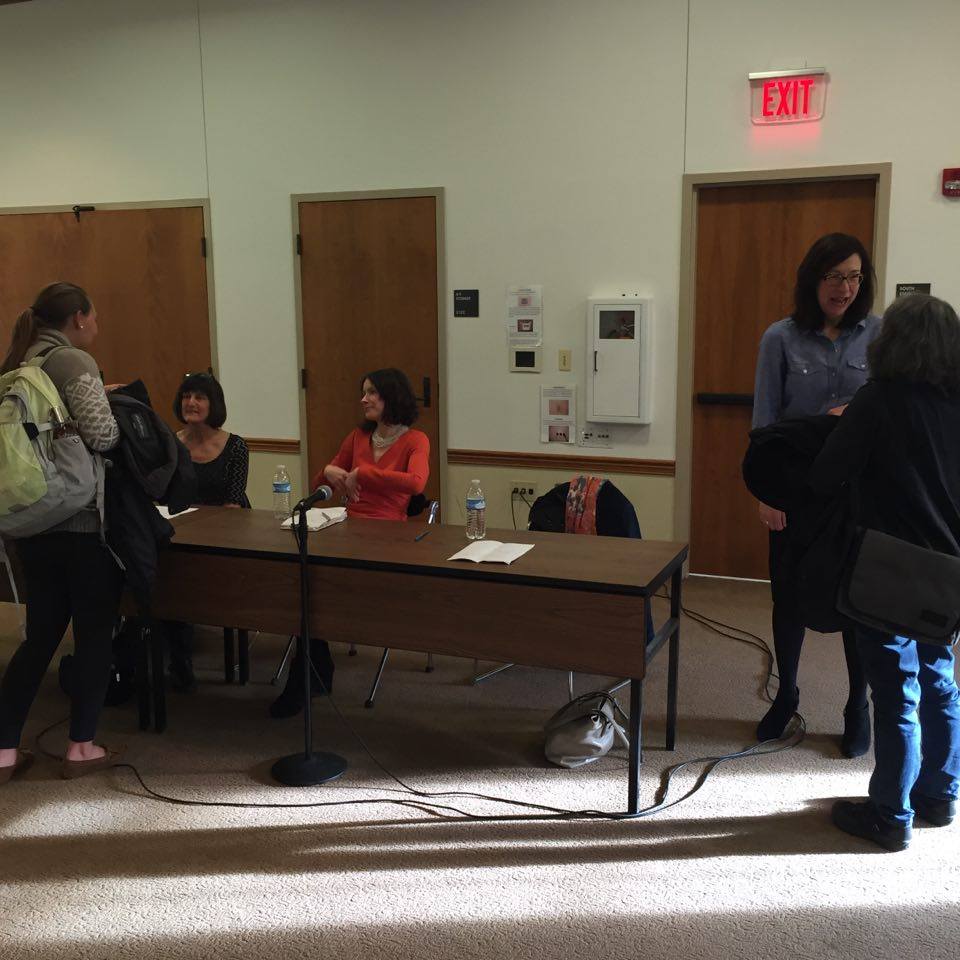
The Creativity panel, from left: Kathryn Davis, Dr. Cathy Wagner, Professor Margaret Luongo
“I believe there is no creativity without constraint,” answered Davis. “If you have too much freedom, it’s like trying to pour something into nothing—it will just go everywhere! You need the form… to feel like you’re free enough.” That, she continued, is why many writers have rigid work habits.
The panel also acknowledged the pros and cons of time constraints, coming to the conclusion that having too much free time can add a debilitating amount of pressure, and that working around life’s busy schedule allows a creative response to life in a way that would not materialize with too much free time.
They also discussed how creativity functions in relation to consciousness. A common notion many readers entertain is that authors generally know exactly what they are going to write when they begin creating a story. Luongo refuted this idea, saying, “I don’t seem to know what’s on my mind until I’ve written at least a hundred pages or so!”
Davis also addressed this, stating that preconceived notions do not translate into creativity, and that she finds the utmost importance in not knowing where the story is headed when beginning to write, because the story and its characters will not fascinate or surprise the readers if the author is not also fascinated or surprised while writing.
All three panelists stressed the importance of writing, even when it might seem useless.
“There’s something about the physical act of writing,” said Luongo, implying that even in the least creative of times, taking the time to physically write can produce something wonderful.
“You have to push past the ‘Ugh, this is going to suck,’” said Wagner, while Davis stressed that as much as a story might be mentally planned out, “You can’t write in your head,” and therefore, nothing one imagines in his or her mind will necessarily work in the story, so everything must be written down before it can be considered part of the story.
And while planning is nevertheless important, the key is to simply begin to write, and ignore any impulses that might suggest what is being written is not quality work. All panelists stressed the importance and transformative powers of revision, and Davis explained revision to be a tool to incorporated even more meaning and clarity into the work:
“I would never say that something will emerge as a symbol, or that something will foreshadow [future events]. You’re writing to figure out what ‘it’ is, and once you’ve written [the work] you can look at it and see what needs to be brought to the surface, or why it would be good for the reader to know [a certain piece of information].”
When asked simply, “Why do you write?” each panelist had a quick answer.
“What else?” Davis responded. “What makes me be alive is writing.”
“It’s a way of engaging, of encountering reality and experience, but there must be the other stuff,” said Wagner. “It [feels] good and like a way of communication.”
“It’s the only way I can think,” said Luongo.
As for how to stay creative, the panelists all stressed the importance of sleep and cited regular exercise, even light work like taking walks outside.
In final words of wisdom, Davis said, “Just to continue to show up at your desk and just do what you have to do… you have to demonstrate by your own behavior that you have faith in yourself. Act, at least, as if you are a writer.”
Alison Block
English Department Ambassador