Three States, Three Stories: Farm Loss and the Stigma of Personal Failure

by Laurel Myers
Junior History Major

Until recently, my knowledge of small-town America was slim. Born and raised in suburban Ohio, I graduated high school with 800 of my closest peers. As a result, I understandably felt out of my element when we first began learning about Storm Lake this January. I had difficulty relating to the town, and as a creature of suburban America, I didn’t want to pretend to understand the struggles of a place unfamiliar to me.

However, as we continued to dig deeper into conversations about the economic strain and uncertainty facing family farms in America’s heartland, I began to sense recurring themes between our assigned readings—specifically Debt and Dispossession by Kathryn Marie Dudley, a collection of interviews and individual narratives reflecting the lasting impact of farm loss in western Minnesota during the 1980s farm crisis—and the experiences of my extended family in rural Kentucky.

Many summers of my childhood were spent visiting my mother’s side of the family in their central Kentucky hometown of just over 2,000 residents; nearly all of these relatives operate small-scale farms on which they raise cattle and tobacco. Though Kentucky is no Iowa or Minnesota, many of the issues facing Midwestern farmers in Debt and Dispossession still mirrored the economic hardships endured by family farms in the Bluegrass State.
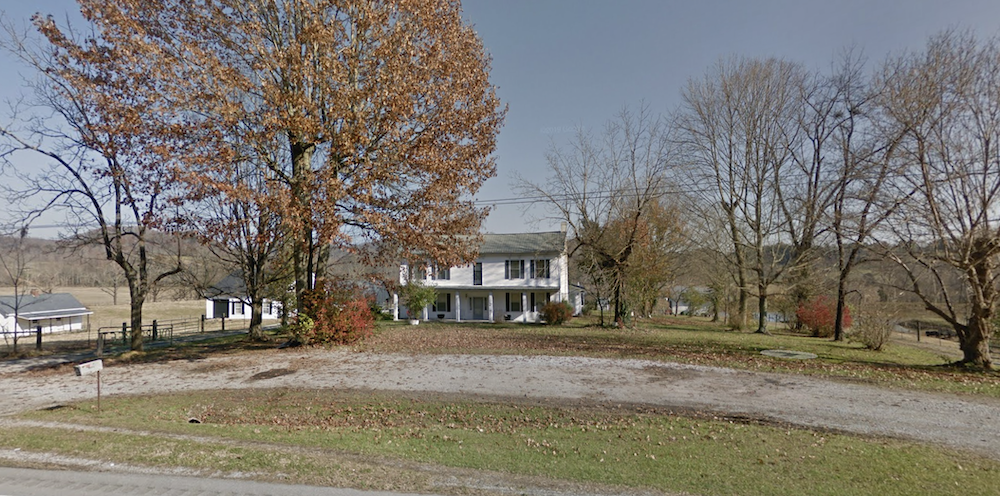
The author’s great uncle’s farm in central Kentucky

Farm loss, as I would soon realize, was a shared trauma in every region of the country.

Most of the farmers in my family were fortunate enough to make it out of the crisis of the 1980s largely unscathed. Those who managed to stay afloat made changes to the way their farms operated during these years to secure their income in any way they could. This included selling off portions of land, and adding cattle for tax deductions.

A few, however, were not so lucky. They joined the 200,000 to 300,000 commercial farmers who defaulted on their loans in the 1980s alone.

Even those relatives who avoided farm loss were still forced to work outside jobs to support their families and keep their land. I can think of one relative in particular who worked a myriad of jobs at different times in his life; on top of running his cattle and tobacco farm, he also operated a farm gate business, a service station, and served in various public office positions for the county, among other things. His life experience is consistent with Dudley’s observations in Debt and Dispossession, where she notes that “over half (60 percent) of all farm families require the wages of off-farm jobs to make ends meet, or that this employment accounts for a significant portion (40 percent) of their income.”
Even besides the parallels I uncovered between Debt and Dispossession and my family’s personal experience with farm loss, perhaps the detail of Dudley’s interviews that stood out to me the most was the negative attitudes surrounding property loss and economic insecurity within the agricultural community. The interviews revealed the commonly held belief among its participants that “distressed farmers were, on the whole, bad managers who deserved to lose their farm.” Many were quick to blame struggling farmers for poor business practices while ignoring the systemic economic issues and predatory lending practices that were conducive to an impending farming crisis, attaching a stigma of personal failure to an already painful situation.

This was not the first instance of farm-shaming I had come across in my research for this class.

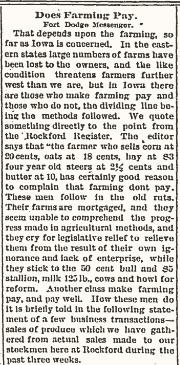
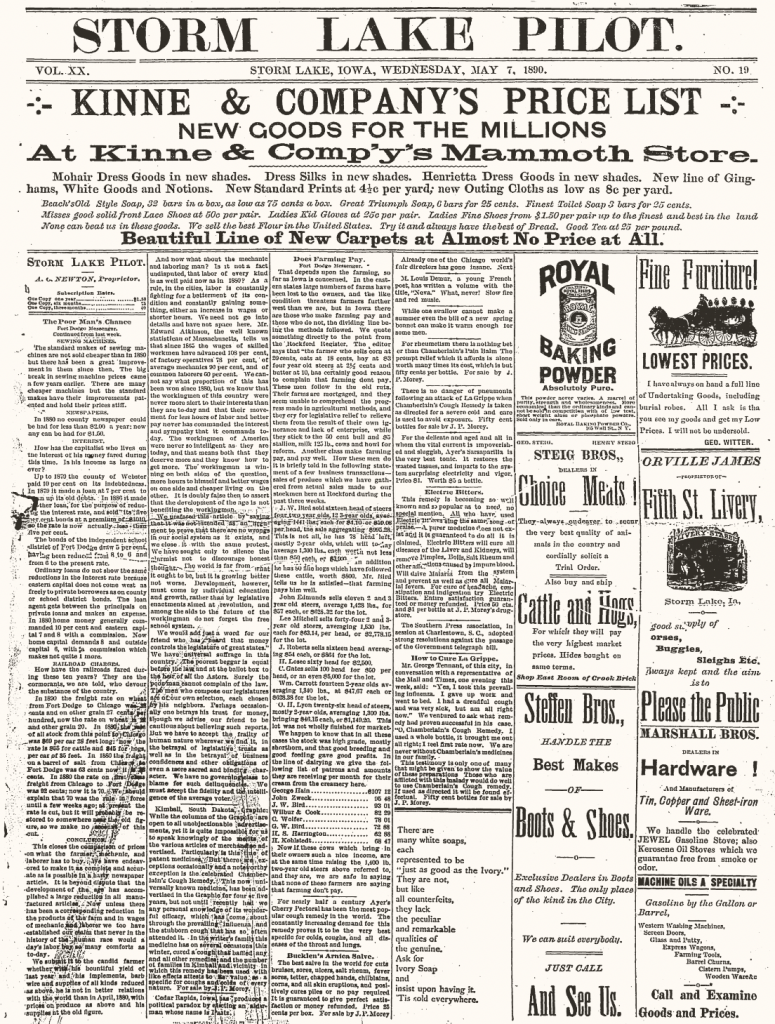
A few days before our discussion of Dudley’s book, I had found an article in the Storm Lake Pilot professing the exact same argument…only it was dated May 7th, 1890. The article (“Does Farming Pay”) makes the following claim about struggling farmers:

“These men follow in the old ruts. Their farms are mortgaged, and they seem unable to comprehend the progress made in agricultural methods, and they cry for legislative relief to relieve them from the result of their own ignorance and lack of enterprise…”

Nearly a hundred years prior to the 1980s farming crisis, it seems the stigma of individual fault was already well established within agricultural circles. These attitudes viewing economic insecurity as a personal failure—deeply rooted in the American Dream and its promise that anyone can achieve anything if they simply work hard enough—combined with the public nature of foreclosures and public auctions, were part of what made the farming crisis evolve into what Dudley labels as a “social trauma.” And this trauma isn’t unique to Iowa or Minnesota, or even the Midwest. It’s the same stigma that makes it difficult for the farmers in my own life to open up about their experiences with loss.
This stigma, I’ve found, is still alive and well, and helps us better understand the devastation of farm loss and the lingering wounds it has left on America’s heartland.

These three separate stories of farming insecurity—Dudley’s Debt and Dispossession, the Storm Lake Pilot’s “Does Farming Pay,” and my own family’s experience with the financial hardships of farming—set across three states and the span of a century, may seem only vaguely related upon first glance. When viewed together, though, these examples add depth to the history of how farm loss, and the social stigmas it bred, contributed to a recurring national trauma.

Laurel Myers is a junior History major with a minor in Museums and Society. She is currently a member of the History Honors Program on campus and is interested in researching World War I and the interwar period. Outside of class, she is active in her music fraternity and enjoys watching documentaries, playing board games with friends, and finding new hiking trails. After graduating from Miami, Laurel plans to attend graduate school to continue studying history.
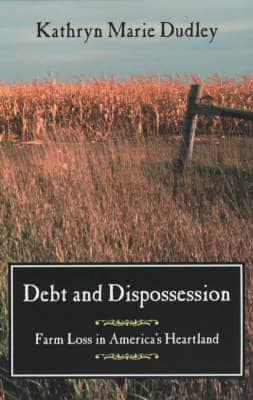
Debt and Dispossession

by Garrett Moyer
Junior History and Political Science Major

One of the most interesting courses I have taken at Miami addressed Native American history. As a future teacher, I felt it was necessary to be familiar with a subject that most of our schooling ignores. Why? Are we not capable of coming to terms with our own history?

Relationships between Native Americans and our ancestors affected how settlement patterns shaped the countryside, especially in places like Ohio and Iowa. Tactics—such as creating a cycle of dispossession, debt, and ethnic stereotyping—unfortunately echo throughout the lands in which we currently live.

Debt forced many Native American tribes to cede their lands to the federal government. In some cases, tribes would enter into a contract with government agents or trading officials, and would be unable to pay off debts in subsequent years. This would create a worsening cycle of debt. If a year was bad for farming or hunting, tribes would be forced into default, often using their land claims as collateral. Tribes therefore were forced westward, losing ancestral homes and lands of personal and spiritual significance.

The relationship between debt and dispossession was not unique to Native Americans, of course. (Some readers who lived through the 1980s should be nodding at this point.) In class, we have been reading a related book, Kathryn Dudley’s Debt and Dispossession, which analyzes the complex state of farming in southern Minnesota during the late 20th century. At this point in time, mostly white farmers who created too much debt within their farm were rapidly losing their lands to home and farm foreclosure. Predatory loan tactics of the banks, constant spending on new and better equipment, and insufficient farming policies forced many people from their homes and farms, once held in the family for generations.

This definitely sounds familiar.

Interestingly, in my research I uncovered a 1910 Iowa commission surrounding the early settlement of the state. One of the most insightful discoveries was that of a journal detailing Black Hawk’s War in the early 1830s. As a member of the Sauk and Fox Tribe, Black Hawk saw his tribe’s lands shrink, ultimately forcing them across the Mississippi into Iowa. Black Hawk then led a “rebellion” for several months, forcing the military to quash this uprising. What might be the similarities between this and the actions of farmers just a few decades ago? Debt and Dispossession discusses the impacts of interest groups, penny auctions, and other tactics of disrupting debt collection.

It’s an intriguing question: what constitutes rebellion?

There is a disconnect between our views on Native America and a countryside commonly seen as white. This is an intrinsic cultural error, I think. In a separate book I have read, Winning the West with Words by James Buss, the author helps to understand the differing perspectives on what, in reality, are very similar issues.

Last week, one of my fellow students wrote a post about how we have been deconstructing the mythological notion of rural America. But why is this myth so prevalent? Winning the West With Words discusses in detail the retrospective reframing of land acquisition: away from clearing Native Americans from the land and towards a view of lands as intrinsic to an “American culture.” Through the media, notions of squatting and breaking treaties gave way to brave pioneers, men and women who sacrificed the cruel realities of the frontier to establish what we hold dear today. Portrayal of these events are crucial to the perpetuation of these types of stereotypes.

“The ‘warriors’ consisted of local white community leaders ‘playing Indian.’ Volunteers ‘stripped to the waist,’ ‘wore long hair,’ and splashed themselves with bright hues of face and body paint.”

James Buss, Winning the West with Words

Buss’ text begins with a detailed description of “Pioneer Days,” events in Indiana around 1911. By this time most Native Americans had been dispossessed, removed to Oklahoma or reservations in other states. These events were often accompanied by reenactments of struggles with Native Americans, as a way to mythologize and normalize the recent past.

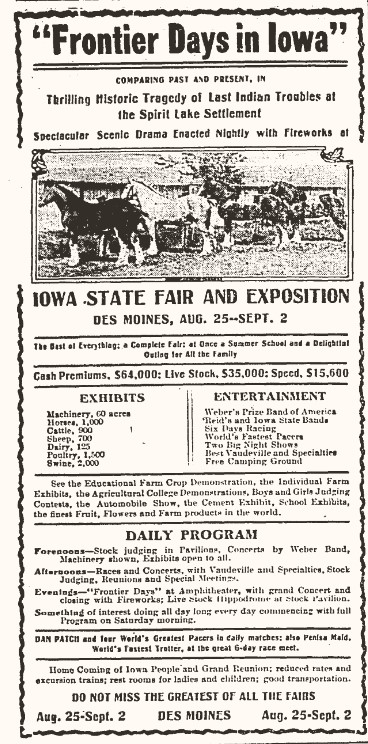
While this was Indiana in 1911, the same was true for Iowa in 1910. Consider an advertisement for the Iowa State Fair that ran in the pages of the Storm Lake Pilot-Tribune. The general purpose of the Fair was to celebrate the state’s agricultural prowess and history, but at the same time it functioned to disseminate ethnic stereotypes.

Storm Lake is a shining example of how rural Americans can integrate many others simply would not. However, it is also important to realize the significance Northwest Iowa has in the removal of tribes from their ancestral land. In 1889, Sioux land was already being settled after payments to the tribe began in 1863. Many flocked to the region for the rich farmland and abundant resources that it offered. As we continue to foster communities of inclusivity and equity, it is important to realize our collective history. Native America was by no means empty, transforming almost overnight to a colony, and again to a foreign country. Movement disrupted lives, forcing the creation of new lives in an unknown land.

There are many similarities that we can glean from our research on Storm Lake and its intersections with Native American history. As a community, Storm Lake has an inclination towards acceptance of new members of society, but also as one that learns from past mistakes. We all share a part in redefining past mistakes. If anybody can do it, Storm Lake can.


Garrett Moyer is a junior from Dayton, Ohio, studying History and Political Science. In his free time he enjoys sports, especially his hometown Cincinnati Bengals. He is pursuing education and wishes to teach here in southwest Ohio. 

A Missed Opportunity

by Joey Belmonte
Junior Political Science Major

Soon, our class will be conducting individual interviews with Storm Lake residents once again. The benefit of taking this class now, the second time it has been offered, is that we can build upon the work done by those before us.

For example: Mark Prosser. Recently, Dr. Offenburger called our attention to a terrific editorial that Prosser wrote in the Des Moines Register, exploring the problems and possible solutions for America’s broken immigration system. Thanks to previous students’ work, we had access to an interview with the former chief of police last year.

He is no stranger to Storm Lake, of course. The 30-year decorated veteran of the SLPD now works as a Catholic deacon. He first arrived in Storm Lake in 1989, becoming a firsthand witness to the extreme changes the town would undergo over the next several decades. Later in his career, Prosser served as an important advocate for newcomers, gaining understanding through his experiences.

In his interview with this class, Prosser identified some challenges facing the department when he first took the job:

We already had a sizable Southeast Asian community with Vietnamese folks from Laos, Laotians and some Cambodians. So we had that population already starting to change the community, but we really started to interact with and have contact with a lot of Spanish speaking individuals, and so I can vividly remember a police officer coming into my office. He says we have a Hispanic gentleman in custody and he’s not documented. He’s illegal. What the hell do we do? It was out of sight, out of mind, for Northwest Iowa and it was like, oh my God, the shock. At the same time, we started to really experience language barriers and what do we do? How do we get resources?

Former Chief of Police Mark Prosser speaks via Zoom with previous students in “Researching Midwestern History” (2021).

Much of policing in smaller communities such as Storm Lake relies on personal relationships and trust, and with the unique makeup of the town, Prosser immediately identified communication as being a big potential roadblock. Without the ability to properly interact with residents and mediate issues effectively, trust could never be built. To respond to this issue, then, in 1991, the City Council and the County Board of Supervisors in Buena Vista formed the Task Force on Unmet Needs. Mr. Prosser says the key issue was communication, and bridging the reality of the language gaps in town would prove crucial to policing.

In the nineties, the diversity in Storm Lake proliferated with the influx of immigrants, but this caught the attention of Uncle Sam. Prosser would be coerced by INS (now ICE) into cooperating with a raid on the IBP plant to round up undocumented workers. He hadn’t been much of an advocate just yet, but when he saw media crews filming supposedly undercover agents walking out handcuffed workers, it became clear, to him, that this was a publicity stunt for public relations rather than honorable law enforcement. Though most who were arrested were released due to having expired visas or falsified documents, it still meant these residents could face deportation. Prosser, on the aftermath:

We scared the hell out of the people and we put a lot of families in fear. That particular operation caused rumors to run through the community that we were raiding homes, kicking in doors, and we weren’t. It was specific to the employer, but it was a reality for the people. And it, it really negatively…it damaged relations. And you have to understand, back then, there were people standing on the streets cheering when they saw the INS busses come through, and [there were] people standing on the streets crying. And as I stood back…and I knew it that day and just watched and listened and saw the dynamics…I knew that day that it was a mistake on my part. And I was pretty public from there on out saying that our organization would never be part of that again.

Prosser would then meet with advocates of the community to qualm their fears over rapidly spreading rumors. Many were naturally skeptical about his word, though, so he continually assured through those he knew in the community, too, that this would never happen again. As Storm Lake continued to grow, those who likely cheered for the busses became more vocalized. People would stop Prosser on the street, telling him it was his job to “round up the Hispanics” and that they wished it’d go back to being how it was twenty years ago. But this only inspired him to continue with his advocacy, telling them to get comfortable, because these people were here to stay in Storm Lake. “And so I was very open with our elders,” he said, “with our civic groups to say, you know, ‘Get over it,’ because this is the direction of our country and this is the direction of Storm Lake in northwest Iowa.”

The department would grow alongside its residents, too. Through diversity and cultural sensitivity training, and bringing in experts from different ethnic groups, the SLPD began to train its officers on the backgrounds of those in their community. Understanding their relationships with law enforcement, where they came from, the history of their countries, and what they have experienced would all aid in the department repairing its connection. The SLPD built outreach programs to facilitate discussion between community groups, and would go to different areas in town just to get to know folks, not for an emergency or crisis. With Prosser at the helm, tremendous progress was made in the relations of Storm Lake residents and the police department.

In recalling the final days of his career, Prosser said, “Fast forward to the final days, months and years of my career. Somebody I was at a meeting with said, ‘Well, we have a new Micronesian population rolling into town and a new Hmong population, with new dialects and things like that.’ And it was like, ‘OK, been there, done that. Business as usual.’”

Considering these experiences, I read Prosser’s recent editorial with great interest.

He was addressing the opportunity that Republicans had to speak on immigration reform, in response to President Biden’s State of the Union address. In his editorial, he touched upon the fact that there must be a bipartisan bill passed to protect foreign-born workers. Many farms across the country have relied upon these workers in a time of worker shortages, making them integral to hundreds of farms. Without protections and the ability to come here to work legally, well, industries in the Midwest would suffer.

More resources are certainly needed for border patrol agents to adequately perform their duties, and for administrative services within our immigration offices. Prosser mentions that there’s already legislation for this in the docket; through advocacy it could be passed.

Next, Congress needs to pass a permanent legal solution for DACA recipients, which could be ended, and for Dreamers, whose legal immigration status has now been threatened. Prosser puts forth that this will not only lead to safer and more stable communities, but that in the condition of Iowa and the nation’s current labor shortage, the last thing needed is a large pool of legal employees disappearing.

Lastly, Governor Reynolds had the opportunity to encourage a consensus to be met on legislation created to help tens of thousands of Afghan refugees integrate into new communities, a thousand of which are actually in Iowa. This legislation would then solidify their legal status in the U.S. so they could have the stability of a future in our country.

In many ways, Prosser himself and his editorial are inspirational, especially in these times. Law enforcement and many communities, not just immigrants, are embroiled in politicized issues across the U.S. in addition to immigration-related enforcement.

People like Prosser seek to mediate these through communication and education, and by learning more about one another rather than accepting biases and preconceived notions. He has seen and experienced so much in so many different ways. He has been in direct contact with all of these people, garnered an understanding of their backgrounds and ways of life, and built relationships.

Considering this, I had hoped that Governor Reynolds might share some of the same awareness, and reflect it in her response. Though Iowa may be relatively small, the impact from these goals would be felt nationwide, much like the comparatively small group of immigrants who support many of these industries across our country.

Instead, the topic of immigration reform never came up. The closest Governor Reynolds came was to say that the Biden Administration “has refused to secure our border.” I only wish she had given Prosser’s editorial more thought.

Joey Belmonte is a junior Political Science major with hopes of going to law school after Miami. Alongside his interest in First Amendment law, he hopes to do litigation for the federal government. Besides school, he likes to spend time with his fraternity brothers, play hockey, or read. 

Launch: “Small Town, Big World”

It’s a big day!

Today we are launching the website “Small Town, Big World” (www.smalltownbigworld.org), which will contain the profile pieces written by students of this class, complete with audio profiles and photos from BVU students.

Sponsored in part by the Storm Lake Community School District, “Small Town, Big World” has the goal of letting regional (and global) audiences into the lives and experiences of the people, from all backgrounds, who call the town “home.”

The first profile is on the Storm Lake Police Department’s Pom Kavan, who has faithfully served as the Community Service Officer to the Laotian community and beyond for the past twenty-seven years. Her work for the SLPD and the community has been essential to building trust between authorities and newcomers, especially. As a celebration of her retirement, and a well-wishing for her future endeavors, we are pleased to kick off the profile series with her story.

We’d like to add that the working relationship between Storm Lakers and Miami students has been mutually beneficial. Just this morning we received an email from Olivia LeRoux, a former student from last year’s class on Storm Lake, who has gone on to attend law school at Ohio State. LeRoux provided an update on her career: that she has accepted a summer internship at the USDA’s Office of the General Counsel, in their Marketing Regulatory and Food Safety Programs division.

LeRoux writes, “I will be working with the office to research and help construct regulations for the Food Safety and Inspections Services as well as the Grain Inspection Packers and Stockyards Administration. … Being able to talk about our Storm Lake research and how invested I had become in agricultural communities through that experience gave me an incredible advantage in my job search. I really look forward to being able to apply what we researched and hopefully be able to bring that knowledge to my internship and maybe even make a small difference in communities like Storm Lake.”

LeRoux’s update is especially notable and timely because she is the very author of the profile on Pom Kavan! It’s fitting, then, that we begin this series with Kavan’s story, as told by LeRoux.

We welcome your comments and criticisms. Please be in touch!

Haley Knuth, Co-Editor, [email protected]
Dr. Andrew Offenburger, [email protected]

Game Over: Demythologizing Rural Iowa

by Joe Yeager
Senior History Major

Many of us students in the class only know rural life through its more romanticized portrayals. Of course there are books and films based on Little House on the Prairie, or, in the more recent past, popular video games like Stardew Valley. Recently, our class has read two books that examine rural Iowa more candidly.

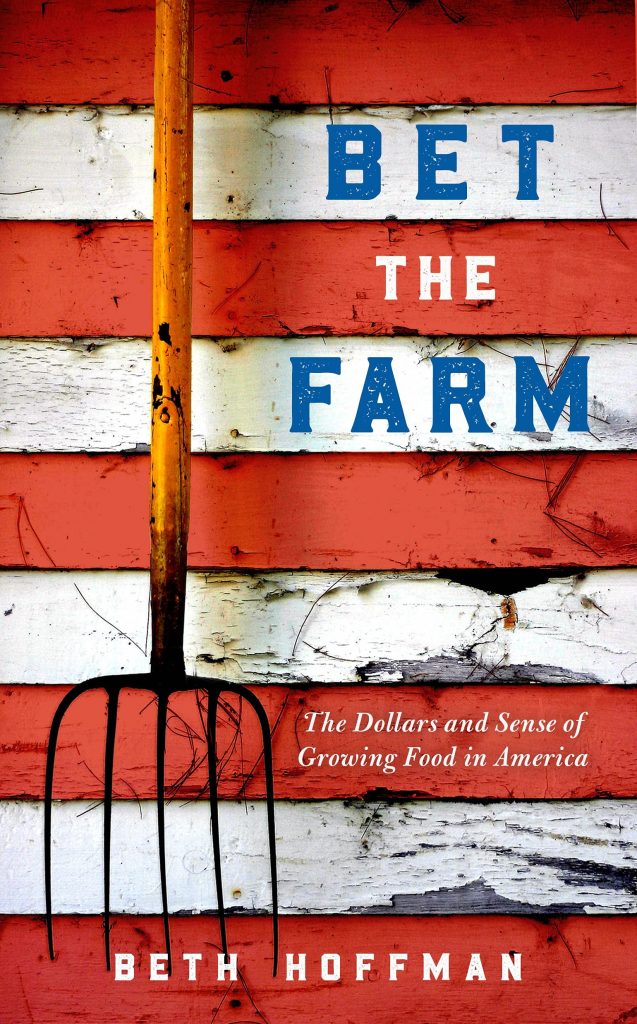
Beth Hoffman’s Bet the Farm details the author’s journey of moving from San Francisco to take over her husband’s family farm, along with the many, many obstacles they faced in doing so. The couple had to take control of the farm from her father-in-law, a much older farmer reluctant to give up the land and see it change. They struggled to make a profit. Indeed, one of the biggest points Hoffman conveyed is how expensive farming really is, between the land, equipment, seeds, animals, and potential losses. Adding to these expenses was her desire to keep the farm sustainable and grow cover crops. Not only did this strategy prove less profitable, at least at first; it seemed as though no one in the area knew how to grow them. She recounted her experience trying to bring oats to a grain elevator, and asking the owner about other potential crops to grow: “I asked whether he had heard of Kernza, a perennial getting a lot of attention in places such as San Francisco because it produces a seed good for bread or cereal but doesn’t need to be planted and harvested every year like corn. He looked at me as if I were speaking a foreign language. ‘No,’ was all he said.” In Hoffman’s experience, running the farm was challenging, but separating the farm from convention seemed almost impossible.

Bet the Farm gave the class an honest, unromanticized look at farming. I won’t speak for my classmates, but I certainly don’t have firsthand experience farming. The romanticized, Jeffersonian view of it—of total independence, where your only limit is your own hard work—is all I’ve ever been shown. Bet the Farm offered a firsthand account, backed by research, of how this is often not the case: “Unless you are raising food solely for your family, farming is a business. It is not a hobby, even if you don’t make much money at it; it’s hard work, often both enjoyable and very stressful. And every farm is embedded within an industry full of extremely complex problems—problems that can begin to be untangled only if we understand the history of how we got here.” Hoffman had great things to say about working outdoors and putting in hard work, but she demonstrated that it requires an enormous amount of capital, government support, and help to run even a small farm. When you’re studying history, it’s important to know how things really are, as opposed to how they’re portrayed, and Bet the Farm has helped our class in this regard.

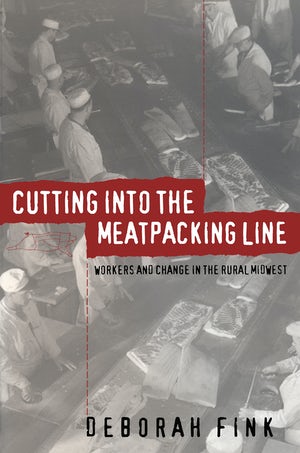
We then read Deborah Fink’s Cutting Into the Meatpacking Line: Workers and Change in the Rural Midwest, first published in 1998. It examines the rise of meatpacking in the rural Midwest, and what it’s like to actually work in the industry. It’s a book with two faces: one of history, and one of anthropology.

Fink’s historical work does a great job of tracing the developments of rural Midwestern history that led to the domination of meatpacking. She spends a great deal of time examining the historical relationship between rural farm life and wage labor. As she notes in her introduction, “Wage labor was a central, if frequently overlooked, constituent of rural midwestern economic growth.” Yet Fink’s research also reveals tension between these two types of work. Small town, rural communities typically resisted wage laborers’ attempts to unionize, leading to the lack of control, resources, and agency that most meatpacking workers face today. While there are unions, the help they offer is limited, if it’s there at all. As Fink explains, “Much of the existing union structure reinforces rather than challenges the isolation and weakness that workers experience.” Fink also examines how gender and race, and societal perceptions of them, shaped rural history in the Midwest, e.g., how it was considered “indecent” for women to work in plant and factory jobs.

The pathos of Fink’s book, however, is found in her participant observation. She took a job at the IBP meatpacking plant in Perry to get a firsthand perspective of life as a worker there, and her reports were touching, poignant, and at times frightening. Workers were frequently injured, either in accidents or as a natural consequence of the plant’s demanding, dangerous work, and the union’s ways to help them were limited. Fink recalled her own battles with fatigue:

“With commuting, the job consumed nearly twelve hours of my day—sometimes more—and I would reach home stiff with cold and totally exhausted every evening. Large purple, yellow, and green bruises covered the front of my thighs as long as I was at IBP, although I never figured out what I did to cause this injury. I was lucky if I could enter notes in my computer at the end of the day, and I dozed whenever I tried to read or watch television.”

Workers at the plant worked sixty hours a week, and it seemed to consume their lives completely. In Fink’s experience, “Details like getting my hair cut or going to the post office were hard to negotiate, and I shuddered when I imagined trying to do the job and cope with children at home.” Things were even harder for women and non-white people, who faced workplace discrimination on top of all the other hazards (Fink notes that while the plant employed many women and non-white workers, nearly every position of authority was held by a white man).

Throughout all of Fink’s findings, there seems to be one consistency: contradiction. As Fink herself puts it, “No one can dispute the significance of the 1980s as a decade of change, but Cutting Into the Meatpacking Line emphasizes the continuity with which these changes grew out of contradictions endemic to rural life and culture.” Fink’s research reveals a variety of contradictions that have been present throughout small-town, rural Midwestern history. Wage labor was crucial to the economy, yet it was disliked and unions were resisted. Workers were needed, yet there was pushback against letting women work. Fink argues that the hard times that hit the Midwest in the 1980s stemmed, in part, from these contradictions, and as a student of history and a Midwesterner, I hope that these experiences can be learned from.

Taken together, Bet the Farm and Cutting Into the Meatpacking Line gave our class some valuable context regarding the Midwest. Both books offer firsthand experiences of sides of rural life that are completely unfamiliar to those who are not directly involved in them. Bet the Farm demonstrates that farming is first and foremost a business, and needs to be understood that way. Cutting Into the Meatpacking Line shows what life in rural America can be like for the working class, who are often not considered in depictions of rural life. Both books move away from the typical understanding of rural America and try to detach it from its popular portrayal. They offer a frank, sometimes brutally honest, look at the often romanticized world of small-town, rural America, working against the misconceptions and stereotypes to examine what that world is really like and how it got that way.

The game Stardew Valley serves as a perfect example of the persistence of a romanticized version of rural life.

If you need an example of how persistent this rosy view of rural life is, look no further than Stardew Valley, a popular video game and app released in 2016. Truth be told, it’s a fantastic game, but it is also an equally impressive example of rural romanticization. The game begins with you (your character) leaving an oppressive office job in the city to inherit your grandfather’s farm in the tiny, isolated town of Stardew Valley. The farm is completely run-down, and you have no idea what you’re doing. But the game emphasizes that with some honest hard work, you can fix the farm up and learn to live on it. The game even has a bar that tracks your energy. As you use energy, you slowly build up more material success. Hard work pays off. There is never a need for wage workers on your farm; you can get by on your own just fine. When you want to sell your products, you just drop them in the bin at the edge of your farm, no need to drive anything to a weigh station. Your player character faces no gender- or ethnicity-based discrimination. In Stardew Valley, the only thing in the way of your success is you. It presents the romanticized, self-centered portrayal of small-town rural life that Hoffman and Fink learned was rarely, if ever, the case.

Joe Yeager is a senior History major and Anthropology minor from Cincinnati, Ohio. He enjoys punk rock and heavy metal music, Godzilla movies, Dungeons and Dragons, and learning new things about history. He is currently writing his honors thesis about Godzilla and its reception as a Japanese piece of media in post-WWII America. After graduation, his current plan is to work in the Cincinnati libraries.

“Print the Truth and Raise Hell”: Tom Cullen and the Importance of Local Journalism

by Madeline Phaby
@madphabes
Senior History & Sociology Major

Storm Lake is an anomaly in more ways than one. Pick a rural Iowa town of about 14,000 people at random, and the odds of it having a foreign-born population of more than 30 percent are, I think it’s safe to say, quite low. The odds of it having not one, but two local newspapers? Even lower.

Indeed, Storm Lake boasts two separate newspapers in an era when few small towns can claim to have just one. The Pilot-Tribune is the older of the two by nearly 100 years, as it has existed in some form since the 1890s. (We’re looking forward to involving its editor, Dana Larsen, in our class this semester.) But it’s the Times, founded in 1990, that lays claim to a Pulitzer Prize and a documentary.

Brothers Art and John Cullen serve as the editor and publisher of The Times, respectively, and they keep the paper afloat with the help of a small-but-mighty staff made up of mostly family members. Art is the boss—and the author of the editorials that earned The Times a Pulitzer—but the most common byline on the paper’s stories belongs to his son, Tom.

Tom Cullen joined our class for a discussion of local journalism, Storm Lake, and its changes since The Times first began publishing.


We asked Tom many questions about local journalism, growing up in Storm Lake, and the town’s unique culture. His answers were insightful, but, as a journalist myself, his views on the importance of local journalism were of particular interest to me.

I work as an editor for The Miami Student, our newspaper here at Miami University. We’re completely student-run, but because the surrounding city of Oxford has no professional newspaper, we’re the city’s primary source of local news. That’s a lot of pressure for a team of 18-22 year olds whose editorial board changes every single year, but as far as newspapers go, we’re privileged. We put our souls into our paper only to get accused of publishing fake news by people twice our age, but we receive funding from the university – we don’t experience the anxiety of needing to sell subscriptions to keep our newsroom’s lights on.

I was eager to ask Cullen a question about how The Times has maintained a high-quality print paper while also shifting some of its focus onto its website, as journalism is trending increasingly toward a digital-first approach. We at The Student have spent countless hours pondering that very question, and I’m sure the staff of The Times has too, but Cullen’s answer was simple.

Senior Madeline Phaby checking the finished product.

“Whether it’s print or digital or video, you have to write stories that people will read above all else,” Cullen said. “If you don’t have that, you’ve got nothing.”

The need to write stories people will read, Cullen said, caused him to occasionally test the boundaries of what was “acceptable” to write about. Specifically, he mentioned writing exposés on large agricultural suppliers, many of which also advertised in The Times. Journalism is so competitive, Cullen said, that a publication that wishes to stand out needs to cross into spaces “where other newspapers just wouldn’t go.”

Like many other small, local newspapers, The Times hardly makes any profit. As hard as that is, Cullen said it removes some of the pressure to please the masses that exists in larger newspapers with significant streams of revenue. As Cullen puts it, “you do not write stories for sources; you write stories for readers.”

Even more bluntly, a brief guide Cullen wrote for interns at The Times states that the newspaper’s guiding philosophy is to “print the truth and raise Hell.”

Whether it’s print or digital or video, you have to write stories that people will read above all else. If you don’t have that, you’ve got nothing.

— Tom Cullen

Armed with that clear mission, The Times does its best to cover Storm Lake’s most pertinent issues, though Cullen admits the publication isn’t perfect. Despite the town’s noted diversity, the paper’s subscriber base is overwhelmingly white and college-educated. Expanding its readership to include other demographic groups—especially those with a first language other than English—has proven very difficult for the paper. Cullen said the best remedy for this issue is to continue publishing stories about aspects of Storm Lake life that people of all backgrounds care about—the schools, the churches, the Tyson plant—in hopes of “getting to the issues that matter.”

The questions of who the paper is meant to serve, and which issues ultimately “matter,” are ones that every newspaper with limited resources, including my own, have to confront. Above all else, though, small towns that have local newspapers have a noted advantage over those that don’t: whenever something important happens in town, be it big or small, someone will be there to cover it.

“We’re the backstop, at the end of the day,” Cullen said. “And if we’re not there, then no one else is.”


Madeline Phaby is a senior majoring in history and sociology with a minor in political science. Her research interests include the American West, Indigenous history, and Latin American history. She currently serves as an editor at The Miami Student, Miami University’s student-run newspaper, and she loves that the Storm Lake class combines her interests in history and journalism. In her spare time, Madeline enjoys watching baseball, doing crossword puzzles, and reading. She hopes to eventually go to law school and become an immigration lawyer.

Back in the (712)

It’s great to be back in Storm Lake.

At least, that’s what it feels like. Over the last few weeks, “Researching Midwestern History” has been convening for the second time. With a new roster of students—19 undergraduates, and 3 Master’s candidates—we have begun to investigate Storm Lake’s past and present once again.

This year, introducing students to the town has been a whole lot easier. The documentary, Storm Lake, offers a view into the local setting better than any lecture I could pull together, though its emphasis on the important issue of local journalism sidelines to a degree other aspects of town that make it so fascinating. To these ends we hope that our work can contribute in a significant way to Anchor Pictures’ The Americans.

The research completed by students in 2021 also offers a tremendous boost to this year’s group. It has been wonderful to review completed notes and interview transcripts as a way to jumpstart our investigations. Students now are copyediting transcripts from past interviews, and preparing them for publication or donation to the BV County Historical Society. Before long, we will begin publishing online the profile pieces written from these interviews in a series, “Small Town, Big World.” Central to this was our previous collaboration with Dr. Andrea Frantz’s class at BVU, and the assistance of Superintendent Stacey Cole.

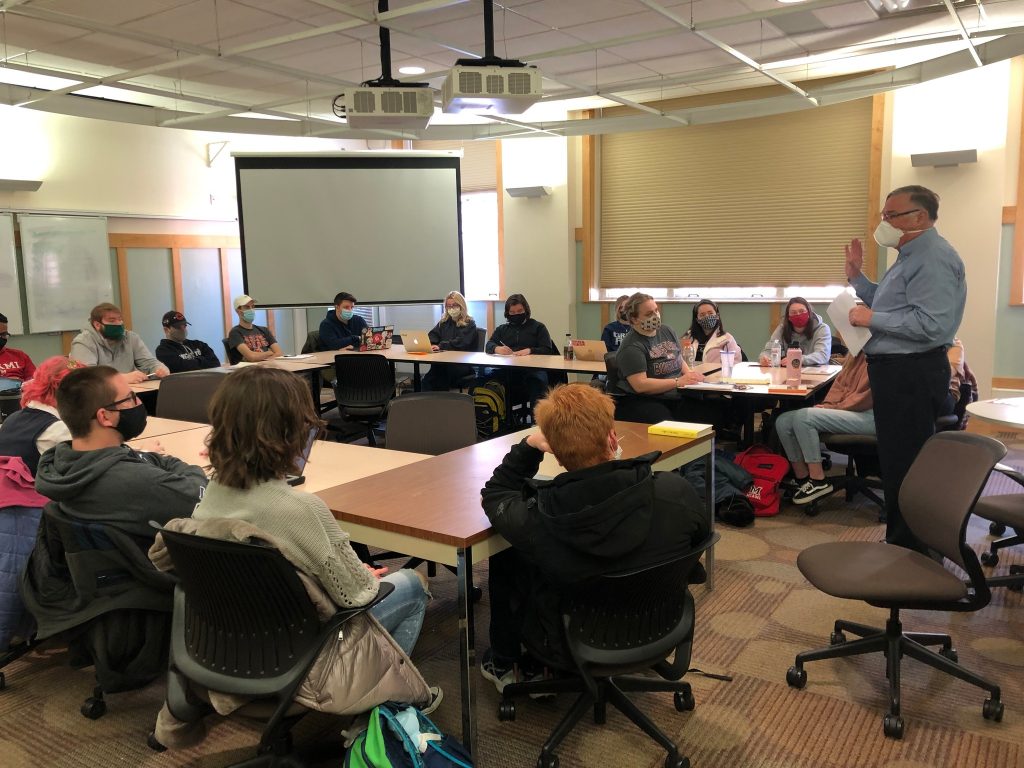
Michael “Doc” Whitlatch visited our class on January 31.

So things are more developed, the second time around, as we expand upon the work of those before us. Importantly, we have kept one “tradition” to class. Doc Whitlatch visited us two weeks ago, to speak on his own experiences in town. We couldn’t ask for a better visitor. Doc, as most of you know, was once a long-time resident of Storm Lake and professor at Buena Vista, who now lives near Dayton, and (believe it or not) is an alumnus of Miami University! As a professor of theater, he knows a few things about oration and holding an audience’s attention. When I think back on the creation of this class, I had no idea Doc lived near us. Now it’s hard to think of teaching it without his visit to kick off the semester.

Starting next week, student blogs will resume. The first couple of posts will bring you all up to date on our early conversations. We have spoken with two guests and read two books already. But get ready for some older news stories to frequent the posts. Students will be researching the period of 1880-1940, so that we can have a stronger comparison point to contemporary Storm Lake.

And I’ll add this: we will continue our interviews with local residents. If you would be open to participating in this project, please reach out to us at any time.

We look forward to working with you all in the coming weeks!

Dr. Andrew Offenburger is associate professor of history at Miami University and can be reached at [email protected] or at https://offenburger.miamioh.edu.

Hearing from the Other Side: Reflections and Ideas from Two Tyson Representatives


by Nathaniel Hieber


Given how much our class has focused on Tyson Foods and the impact it has on Storm Lake, it seems fitting to have the last interview of the semester involve not one, but two current representatives from the company. Two weeks ago, we interviewed Gary Mickelson and Jeaneth Ibarra, both of whom have high positions working for Tyson. We all had many questions to ask them. Our interactions with these two not only helped to illuminate how Tyson approaches its environmental and social impacts, but also how much its views contrasted with the perspectives of other informants of ours this semester.

Both interviewees gave summaries of who they were and what they did. Ibarra originally hails from Honduras, but came to the United States in 1997. She moved to Iowa to work for IBP in 2000, and then held several positions working for Tyson once the company took over in 2001. While at Tyson, she learned to speak English and began working as an interpreter, then as a benefits counselor. After leaving the community for a few years, Ibarra returned to Storm Lake in 2012 as a community liaison and recently rose to be manager of human resources at Tyson’s turkey plant.

Mickelson also went into detail on his roots. He grew up in nearby Rembrandt, Iowa. His family used to raise hogs and sell them to the old Hygrade meatpacking plant. During the 1980s, Mickelson worked as a reporter for the Pilot Tribune, and later covered news for a television station in Sioux City. Not long after this, he took the opportunity to work as a communications director for IBP and eventually for Tyson Foods. He has remained in the meatpacking business for the last 35 years, with his current position as a PR specialist at Tyson’s corporate headquarters in Arkansas.

Gary Mickelson

Even though he’s spent the last 17 years away from Buena Vista County, Mickelson took great lengths to show how deep his roots were in Northwest Iowa. He explained to us that his ancestors came to the United States as immigrants from Germany, Ireland, and Norway. On his Norwegian roots, Mickelson said, “One kind of fascinating story to me is one of my great grandparents . . . one of their children wrote down their experience leaving Norway and coming to the United States, and how challenging that was. They felt like they were almost slaves or serfs in Norway.” Implicitly, this could have been meant to draw comparisons between the harsh conditions of Mickelson’s ancestors, and the current rough situations faced by many immigrants working for Tyson today.

Mickelson’s grandparents did encounter hardships once they came to the United States. They had fifty dollars each to make their new lives in this country. By the time they got to Storm Lake, they only had one cent to their names, no English skills, and no connections to the town. After spending the night at the train depot, Mickelson’s grandparents eventually made connections in town, working as farm hands until they could own a farm themselves. It is a good story of a poor immigrant family working hard and eventually making something for themselves and their children, similar to the current stories of immigrants coming to Storm Lake in the present, looking for a better life. Perhaps that is why Mickelson told it. It’s a multigenerational success story. His current position, as a public relations representative for Tyson, is far removed from his grandparents’ lives and from those of contemporary immigrants.

Our interview focused on two broad topics. The first was Tyson’s environmental impact, while supplying both the United States and foreign markets with protein. From the start, Mickelson characterized Tyson as part of a supply chain, which includes everything from the farmers growing feed for the pork producers, to the people at the meatpacking plants, to those who transport the meat around the globe, to the companies and grocery store chains that purchase Tyson’s protein. Mickelson made it clear that since most of the pork producers for Tyson work independently from the company, there is not much that it can do to ensure that they are being as environmentally friendly as possible. Despite this, he impressed upon the class how much Tyson is doing to assist in reducing its ecological footprint, including implementing methods to reduce and recycle wastewater and pledging to reduce the company’s greenhouse gas emissions by 30% by 2030.

Not only that, but Tyson has in recent years been diversifying its products to include plant-based protein. According to Mickelson, “We view ourselves as a protein company and our desire is to be a protein authority. Not just in the United States, but globally.” To that end, Tyson has recently announced that it will begin to add meatless sausages and hamburgers to its product line. This is a continuation and expansion from when Tyson first began to offer plant-based protein products in 2019. While the meatless division of the company only accounts for a small fraction of its business, this move shows that Tyson is diversifying its products in response to current trends among its consumers. Many customers are being more conscientious of what they eat, and are trying to have a more positive impact on the environment through their consumption of plant-based protein.

While this is all great news to hear, is it too little too late, given Tyson’s history with the environment? According to the Institute for Agriculture and Trade Policy, Tyson Foods is the world’s second largest meat producer and, when taking into account all the energy and chemicals used to grow the livestock it relies on (the supply chain Mickelson discussed), the company is one of the largest producers of greenhouse gases on the planet. When Mickelson encourages us to read Tyson’s sustainability report or says things like, “You need to engage all parts of the supply chain to make progress,” it can feel like a deflection of responsibility of Tyson’s impact on the environment, implicating numerous actors that, as he admits, Tyson has little control over. Even if one were to grant Mickelson that you need to consider the entire supply chain when assessing the company’s impact, such a force remains incredibly destructive. Mickelson did not go into detail on how Tyson was getting independent actors to be more environmentally friendly, merely saying that it needed to happen for true change to occur.

The other major topic was worker safety, a recurring theme in many of our other interviews and in our research material. Both Mickelson and Ibarra made it clear that worker safety was the number one priority for Tyson. According to them, the company always looks for new ways to reduce worker injury and stress. This includes increasing automation to reduce the injuries and fill positions, rotating workers to reduce stress, and in some plants hiring ergonomic supervisors to ensure the safety of employees. Given the situation with Covid-19, Tyson has also apparently worked with several local organizations in Storm Lake to keeps many people as safe as possible, including having on-site Covid testing and vaccinations, offering up to four hours of pay for workers to travel and get vaccinated, allowing family and household members to get vaccinated, and (soon) establishing a health clinic, by late May or early June. From their descriptions, it would seem that Tyson is doing its best to ensure that workers are safe and healthy at its plants.

Jeaneth Ibarra

Based on much of the available evidence and interviews we have compiled, according to others, Tyson’s best has not been good enough. Whether it comes from Matthew Marroquín or Art Cullen or Steve and Willis Hamilton, the consensus is clear that working at Tyson involves long hours with dangerous, grueling, and monotonous work with a high rate of injury. How many cases of carpel tunnel, broken bones, or other such injuries can occur and still be acceptable to the company, and to the town? Tyson hires over 3,000 people in the Storm Lake area according to Mickelson. It would be interesting to know many of those people have been injured or made sick thanks to the close working conditions and hard work required.

Not only that, but recent events relating to Covid-19 have shown how little some in the larger company value the safety of their workers. A wrongful death lawsuit begun last year against Tyson’s Waterloo pork plant has a heap of allegations against the managers and supervisors there. As of November 2020, the allegations included, but are not limited to:

  • inexperienced low-level supervisors being given managerial tasks they were not prepared for because the plant managers began avoiding the plant floor for fear of infections;
  • plant managers denying in March and April of last year the existence of any Covid-19 infections or confirmed cases within the plant;
  • one upper-level manger explicitly telling supervisors to ignore symptoms of Covid-19 and to continue showing up to work even if they had symptoms; and
  • one plant manager organizing a winner-take-all betting pool in mid-April of last year for supervisors and managers to wager how many people would test positive for Covid-19.

None of these incidents happened in Storm Lake. However, they are a sign of what some Tyson managers and supervisors thought was acceptable in order to keep their plants running. If this was the work culture for what was considered acceptable, then Tyson’s stance on worker safety was sorely misguided in Waterloo. To Tyson’s credit, seven of that plant’s top managers were fired shortly after an independent investigation confirmed allegations that they bet on how many workers would test positive for Covid-19. However, that is like crediting a doctor for stopping an infection that s/he allowed to fester and spread.

To be clear, no one in the class faults Mickelson or Ibarra for giving as bright a picture as possible of how Tyson operates. That’s their job. And we appreciate them taking the time to answer our questions as fully as possible. Their statements help to provide a new perspective on how Tyson operates.

Furthermore, their conversation with us reinforced how important it is, whenever conducting research, to have as complete a picture as possible, with many different voices contributing to the conversation.

Nathaniel Hieber received his M.A. in history from Miami University this month. He specializes in American history between 1850 and 1950. He also has a minor in art history. This summer, Nathaniel will work as a research assistant for Dr. Andrew Offenburger, continuing to analyze the history of Storm Lake, while he pursues employment opportunities in the field.

Labor and the Law


by Michel Reising


Is the meatpacking industry a positive or negative force in the town of Storm Lake? This was a recurring question this week, emerging in collaborative revisions of our profile pieces and in an interview with Steve and Willis Hamilton, lawyers with roots in Storm Lake deeper than 150 years.

Throughout the duration of this research project, meatpacking has made its way into every aspect of our research, whether in interviews or the archives. In our SourceNotes database, out of 682 current entries, 262 have been tagged with keywords relating to the subject of meatpacking. For a town that appears to be ever-changing, the one constant in its story is the main source of employment at its meatpacking plants. Names may change every couple of decades–Hygrade, IBP, Tyson–but the work remains constant. 

Within the research I have conducted, and the interviews I have witnessed, the meatpacking industry is always championed as what caused Storm Lake to evolve into what it is today. Almost every interviewee from Storm Lake will have worked at the plants, known someone who has worked at the plants, and will most likely have an opinion on the plants. Within my inquiry into Storm Lake newspapers from the years 1986, 2000, and 2014, IBP and later Tyson Foods are praised for their trustworthiness and the commerce that their respective plants attracted to the town. To really drive a point home, according to an article I read from the Storm Lake Times from 2014, Tyson Foods was praised by Forbes as the “sixth most trustworthy company” out of the 8000 companies the magazine reviewed. On the surface, the meatpacking industry seems like the savior of Storm Lake, and a pillar of the community.

However, within the various interviews we have conducted, most interviewees from town associate a negative connotation to the local plants. There have been negative remarks regarding employee wages, working conditions, high turnover rates, and scandals related to IBP and later Tyson. All of these anecdotal stories and complaints against the plants were supplemented by our interview with the Hamiltons this week, legal experts engaged for decades with and against the meatpacking industry.

The Hamilton brothers, Steve and Willis, together with Mary and Molly now, have been practicing attorneys for around 40 years. Their family has been practicing law since shortly after the American Civil War. They certainly have strong ties to the community. One example: when Buena Vista faced a major financial crisis years ago, the Hamiltons’ grandfather, Willis Edson, mortgaged the family farm and donated the funds to the college. Edson Hall stands in his honor.

Both brothers spent a few summers working at Hygrade. Its operation as a union shop secured them higher wages than most other blue-collar jobs in the area. Willis stated that he stopped working at Hygrade after a few summers because he moved onto law school, and Steve jokingly added that he would have done so himself had Hygrade not fired him. The Hamilton brothers praised Hygrade, noting that they did not hear of injuries as often as they do now, that the workers were paid and treated well, and that the workforce was generally retained.

…When IBP took over the plant from Hygrade, IBP ensured that the workers were not able to unionize. Steve added that IBP’s doubling the speed of the production line, and decreasing safety features, sparked a flurry of new injuries. This resulted in an extremely high turnover rate. Steve said that a former client, previously a production line manager, spoke under deposition that during one year in the 1990s, IBP’s turnover was 7,500 workers, and this for a workforce (then) around 2,000!

By the time that IBP took over, the brothers were practicing law, and they have represented hundreds, if not thousands, of plant workers who have sued for damages, whether that be categorized as workers compensation or worse. The Hamilton brothers listed case after case in which IBP was brought to court over injuries. They stated that when IBP took over the plant from Hygrade, IBP ensured that the workers were not able to unionize. Steve added that IBP’s doubling the speed of the production line, and decreasing safety features, sparked a flurry of new injuries. This resulted in an extremely high turnover rate. Steve said that a former client, previously a production line manager, spoke under deposition that during one year in the 1990s, IBP’s turnover was 7,500 workers, and this for a workforce (then) around 2,000! Due to this high turnover rate, training was not as well emphasized, which Steve stated resulted in “a lot of injuries, a lot of minor, a lot of major injuries.” Steve further emphasized that IBP “would just fire the worker and make them fight for the money.” The Hamiltons noted that, especially under Tyson, the corporation would be willing to settle on minor injuries, but they generally would resist major claims.

Steve Hamilton

Willis and Steve were especially critical of IBP. At one point in the 1980s, they said, the company was called to testify to Congress regarding major OSHA violations. During these hearings, the Hamilton brothers stated that the IBP representative basically lied to Congress about the working conditions of their plants and were forced to pay major fines. The brothers consistently represent workers from the plant (now a Tyson property) in which they still see the same major and minor work-related injuries that they witnessed under IBP’s ownership.

Currently, the Hamilton brothers are in a legal battle with Tyson over the alleged wrongful death of their client, Michael Everhard, by COVID-19, which they attribute to Tyson’s failure to adhere to safety protocols. The lawsuit is pending due to an appeal by Tyson to Iowa’s Eighth Circuit Court of Appeals, in which Tyson claims the trial should be held in Federal District Court on the grounds that the plant was operating under Executive Order. The Hamilton brothers argued, with us, that Tyson is entirely responsible for their client’s death because of their blatant disregard for employee safety. Willis claimed that instead of slowing down production to allow for proper social distancing, “…they just did the opposite, they sped it up, so you couldn’t spread them out, in fact, they probably jammed them a little closer together.” The Hamiltons also stated that Tyson employees were not provided proper personal protective equipment. In the end, the brothers do not expect the lawsuit to be resolved any time soon. 

Willis Hamilton

The interview with the Hamiltons this week really displayed why so many of our interviewees have had negative experiences or opinions related to the meatpacking plants in Storm Lake. With past interviews, one could say that the experiences presented were anecdotal at best, but the Hamilton brothers have represented hundreds if not thousands of clients who have had legal battles with the meatpacking plant under multiple companies. The experiences shared with us by the Hamiltons furthered our understanding of the darker side of the industry.

That said, there are always two sides to every story. As historians, we strive to provide objectivity within every study, and hopefully our scheduled interview with Tyson representatives next week will provide the perspective that our project is missing.

Michel Reising is majoring in business at the Farmer School of Business. He is also majoring in history, with a specific interest in American history and the World Wars. After graduation, Michel plans to attend law school with interest in constitutional law.