
by Garrett Moyer
Junior History and Political Science Major
One of the most interesting courses I have taken at Miami addressed Native American history. As a future teacher, I felt it was necessary to be familiar with a subject that most of our schooling ignores. Why? Are we not capable of coming to terms with our own history?
Relationships between Native Americans and our ancestors affected how settlement patterns shaped the countryside, especially in places like Ohio and Iowa. Tactics—such as creating a cycle of dispossession, debt, and ethnic stereotyping—unfortunately echo throughout the lands in which we currently live.
Debt forced many Native American tribes to cede their lands to the federal government. In some cases, tribes would enter into a contract with government agents or trading officials, and would be unable to pay off debts in subsequent years. This would create a worsening cycle of debt. If a year was bad for farming or hunting, tribes would be forced into default, often using their land claims as collateral. Tribes therefore were forced westward, losing ancestral homes and lands of personal and spiritual significance.

The relationship between debt and dispossession was not unique to Native Americans, of course. (Some readers who lived through the 1980s should be nodding at this point.) In class, we have been reading a related book, Kathryn Dudley’s Debt and Dispossession, which analyzes the complex state of farming in southern Minnesota during the late 20th century. At this point in time, mostly white farmers who created too much debt within their farm were rapidly losing their lands to home and farm foreclosure. Predatory loan tactics of the banks, constant spending on new and better equipment, and insufficient farming policies forced many people from their homes and farms, once held in the family for generations.
This definitely sounds familiar.
Interestingly, in my research I uncovered a 1910 Iowa commission surrounding the early settlement of the state. One of the most insightful discoveries was that of a journal detailing Black Hawk’s War in the early 1830s. As a member of the Sauk and Fox Tribe, Black Hawk saw his tribe’s lands shrink, ultimately forcing them across the Mississippi into Iowa. Black Hawk then led a “rebellion” for several months, forcing the military to quash this uprising. What might be the similarities between this and the actions of farmers just a few decades ago? Debt and Dispossession discusses the impacts of interest groups, penny auctions, and other tactics of disrupting debt collection.
It’s an intriguing question: what constitutes rebellion?
There is a disconnect between our views on Native America and a countryside commonly seen as white. This is an intrinsic cultural error, I think. In a separate book I have read, Winning the West with Words by James Buss, the author helps to understand the differing perspectives on what, in reality, are very similar issues.
Last week, one of my fellow students wrote a post about how we have been deconstructing the mythological notion of rural America. But why is this myth so prevalent? Winning the West With Words discusses in detail the retrospective reframing of land acquisition: away from clearing Native Americans from the land and towards a view of lands as intrinsic to an “American culture.” Through the media, notions of squatting and breaking treaties gave way to brave pioneers, men and women who sacrificed the cruel realities of the frontier to establish what we hold dear today. Portrayal of these events are crucial to the perpetuation of these types of stereotypes.
“The ‘warriors’ consisted of local white community leaders ‘playing Indian.’ Volunteers ‘stripped to the waist,’ ‘wore long hair,’ and splashed themselves with bright hues of face and body paint.”
James Buss, Winning the West with Words
Buss’ text begins with a detailed description of “Pioneer Days,” events in Indiana around 1911. By this time most Native Americans had been dispossessed, removed to Oklahoma or reservations in other states. These events were often accompanied by reenactments of struggles with Native Americans, as a way to mythologize and normalize the recent past.
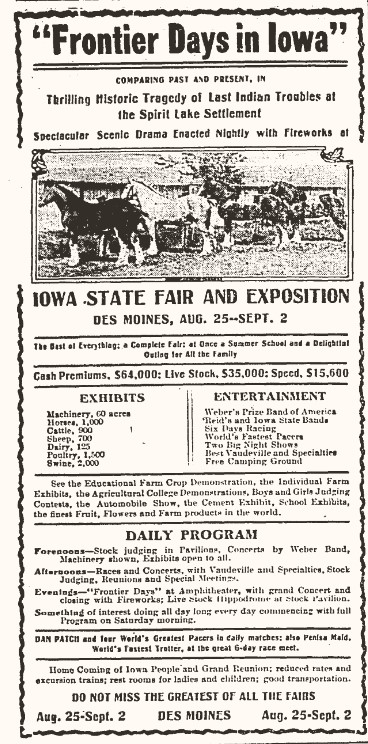
While this was Indiana in 1911, the same was true for Iowa in 1910. Consider an advertisement for the Iowa State Fair that ran in the pages of the Storm Lake Pilot-Tribune. The general purpose of the Fair was to celebrate the state’s agricultural prowess and history, but at the same time it functioned to disseminate ethnic stereotypes.
Storm Lake is a shining example of how rural Americans can integrate many others simply would not. However, it is also important to realize the significance Northwest Iowa has in the removal of tribes from their ancestral land. In 1889, Sioux land was already being settled after payments to the tribe began in 1863. Many flocked to the region for the rich farmland and abundant resources that it offered. As we continue to foster communities of inclusivity and equity, it is important to realize our collective history. Native America was by no means empty, transforming almost overnight to a colony, and again to a foreign country. Movement disrupted lives, forcing the creation of new lives in an unknown land.
There are many similarities that we can glean from our research on Storm Lake and its intersections with Native American history. As a community, Storm Lake has an inclination towards acceptance of new members of society, but also as one that learns from past mistakes. We all share a part in redefining past mistakes. If anybody can do it, Storm Lake can.
Garrett Moyer is a junior from Dayton, Ohio, studying History and Political Science. In his free time he enjoys sports, especially his hometown Cincinnati Bengals. He is pursuing education and wishes to teach here in southwest Ohio.
