
by Joe Yeager
Senior History Major

Many of us students in the class only know rural life through its more romanticized portrayals. Of course there are books and films based on Little House on the Prairie, or, in the more recent past, popular video games like Stardew Valley. Recently, our class has read two books that examine rural Iowa more candidly.
Beth Hoffman’s Bet the Farm details the author’s journey of moving from San Francisco to take over her husband’s family farm, along with the many, many obstacles they faced in doing so. The couple had to take control of the farm from her father-in-law, a much older farmer reluctant to give up the land and see it change. They struggled to make a profit. Indeed, one of the biggest points Hoffman conveyed is how expensive farming really is, between the land, equipment, seeds, animals, and potential losses. Adding to these expenses was her desire to keep the farm sustainable and grow cover crops. Not only did this strategy prove less profitable, at least at first; it seemed as though no one in the area knew how to grow them. She recounted her experience trying to bring oats to a grain elevator, and asking the owner about other potential crops to grow: “I asked whether he had heard of Kernza, a perennial getting a lot of attention in places such as San Francisco because it produces a seed good for bread or cereal but doesn’t need to be planted and harvested every year like corn. He looked at me as if I were speaking a foreign language. ‘No,’ was all he said.” In Hoffman’s experience, running the farm was challenging, but separating the farm from convention seemed almost impossible.
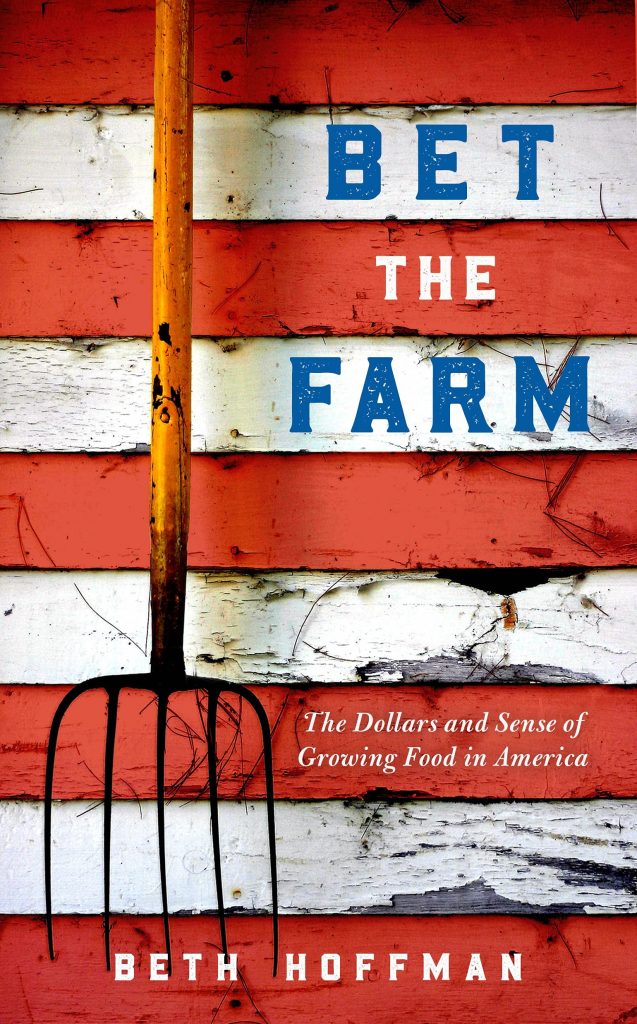
Bet the Farm gave the class an honest, unromanticized look at farming. I won’t speak for my classmates, but I certainly don’t have firsthand experience farming. The romanticized, Jeffersonian view of it—of total independence, where your only limit is your own hard work—is all I’ve ever been shown. Bet the Farm offered a firsthand account, backed by research, of how this is often not the case: “Unless you are raising food solely for your family, farming is a business. It is not a hobby, even if you don’t make much money at it; it’s hard work, often both enjoyable and very stressful. And every farm is embedded within an industry full of extremely complex problems—problems that can begin to be untangled only if we understand the history of how we got here.” Hoffman had great things to say about working outdoors and putting in hard work, but she demonstrated that it requires an enormous amount of capital, government support, and help to run even a small farm. When you’re studying history, it’s important to know how things really are, as opposed to how they’re portrayed, and Bet the Farm has helped our class in this regard.
We then read Deborah Fink’s Cutting Into the Meatpacking Line: Workers and Change in the Rural Midwest, first published in 1998. It examines the rise of meatpacking in the rural Midwest, and what it’s like to actually work in the industry. It’s a book with two faces: one of history, and one of anthropology.
Fink’s historical work does a great job of tracing the developments of rural Midwestern history that led to the domination of meatpacking. She spends a great deal of time examining the historical relationship between rural farm life and wage labor. As she notes in her introduction, “Wage labor was a central, if frequently overlooked, constituent of rural midwestern economic growth.” Yet Fink’s research also reveals tension between these two types of work. Small town, rural communities typically resisted wage laborers’ attempts to unionize, leading to the lack of control, resources, and agency that most meatpacking workers face today. While there are unions, the help they offer is limited, if it’s there at all. As Fink explains, “Much of the existing union structure reinforces rather than challenges the isolation and weakness that workers experience.” Fink also examines how gender and race, and societal perceptions of them, shaped rural history in the Midwest, e.g., how it was considered “indecent” for women to work in plant and factory jobs.
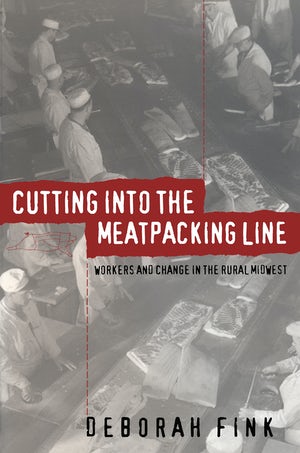
The pathos of Fink’s book, however, is found in her participant observation. She took a job at the IBP meatpacking plant in Perry to get a firsthand perspective of life as a worker there, and her reports were touching, poignant, and at times frightening. Workers were frequently injured, either in accidents or as a natural consequence of the plant’s demanding, dangerous work, and the union’s ways to help them were limited. Fink recalled her own battles with fatigue:
“With commuting, the job consumed nearly twelve hours of my day—sometimes more—and I would reach home stiff with cold and totally exhausted every evening. Large purple, yellow, and green bruises covered the front of my thighs as long as I was at IBP, although I never figured out what I did to cause this injury. I was lucky if I could enter notes in my computer at the end of the day, and I dozed whenever I tried to read or watch television.”
Workers at the plant worked sixty hours a week, and it seemed to consume their lives completely. In Fink’s experience, “Details like getting my hair cut or going to the post office were hard to negotiate, and I shuddered when I imagined trying to do the job and cope with children at home.” Things were even harder for women and non-white people, who faced workplace discrimination on top of all the other hazards (Fink notes that while the plant employed many women and non-white workers, nearly every position of authority was held by a white man).
Throughout all of Fink’s findings, there seems to be one consistency: contradiction. As Fink herself puts it, “No one can dispute the significance of the 1980s as a decade of change, but Cutting Into the Meatpacking Line emphasizes the continuity with which these changes grew out of contradictions endemic to rural life and culture.” Fink’s research reveals a variety of contradictions that have been present throughout small-town, rural Midwestern history. Wage labor was crucial to the economy, yet it was disliked and unions were resisted. Workers were needed, yet there was pushback against letting women work. Fink argues that the hard times that hit the Midwest in the 1980s stemmed, in part, from these contradictions, and as a student of history and a Midwesterner, I hope that these experiences can be learned from.
Taken together, Bet the Farm and Cutting Into the Meatpacking Line gave our class some valuable context regarding the Midwest. Both books offer firsthand experiences of sides of rural life that are completely unfamiliar to those who are not directly involved in them. Bet the Farm demonstrates that farming is first and foremost a business, and needs to be understood that way. Cutting Into the Meatpacking Line shows what life in rural America can be like for the working class, who are often not considered in depictions of rural life. Both books move away from the typical understanding of rural America and try to detach it from its popular portrayal. They offer a frank, sometimes brutally honest, look at the often romanticized world of small-town, rural America, working against the misconceptions and stereotypes to examine what that world is really like and how it got that way.
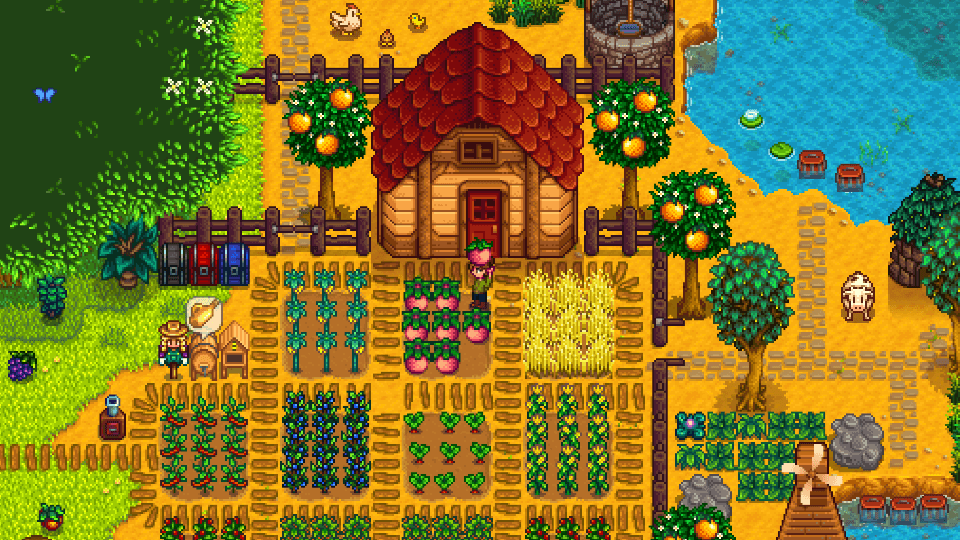
If you need an example of how persistent this rosy view of rural life is, look no further than Stardew Valley, a popular video game and app released in 2016. Truth be told, it’s a fantastic game, but it is also an equally impressive example of rural romanticization. The game begins with you (your character) leaving an oppressive office job in the city to inherit your grandfather’s farm in the tiny, isolated town of Stardew Valley. The farm is completely run-down, and you have no idea what you’re doing. But the game emphasizes that with some honest hard work, you can fix the farm up and learn to live on it. The game even has a bar that tracks your energy. As you use energy, you slowly build up more material success. Hard work pays off. There is never a need for wage workers on your farm; you can get by on your own just fine. When you want to sell your products, you just drop them in the bin at the edge of your farm, no need to drive anything to a weigh station. Your player character faces no gender- or ethnicity-based discrimination. In Stardew Valley, the only thing in the way of your success is you. It presents the romanticized, self-centered portrayal of small-town rural life that Hoffman and Fink learned was rarely, if ever, the case.
Joe Yeager is a senior History major and Anthropology minor from Cincinnati, Ohio. He enjoys punk rock and heavy metal music, Godzilla movies, Dungeons and Dragons, and learning new things about history. He is currently writing his honors thesis about Godzilla and its reception as a Japanese piece of media in post-WWII America. After graduation, his current plan is to work in the Cincinnati libraries.
