
by Joey Belmonte
Junior Political Science Major
Soon, our class will be conducting individual interviews with Storm Lake residents once again. The benefit of taking this class now, the second time it has been offered, is that we can build upon the work done by those before us.
For example: Mark Prosser. Recently, Dr. Offenburger called our attention to a terrific editorial that Prosser wrote in the Des Moines Register, exploring the problems and possible solutions for America’s broken immigration system. Thanks to previous students’ work, we had access to an interview with the former chief of police last year.
He is no stranger to Storm Lake, of course. The 30-year decorated veteran of the SLPD now works as a Catholic deacon. He first arrived in Storm Lake in 1989, becoming a firsthand witness to the extreme changes the town would undergo over the next several decades. Later in his career, Prosser served as an important advocate for newcomers, gaining understanding through his experiences.
In his interview with this class, Prosser identified some challenges facing the department when he first took the job:
We already had a sizable Southeast Asian community with Vietnamese folks from Laos, Laotians and some Cambodians. So we had that population already starting to change the community, but we really started to interact with and have contact with a lot of Spanish speaking individuals, and so I can vividly remember a police officer coming into my office. He says we have a Hispanic gentleman in custody and he’s not documented. He’s illegal. What the hell do we do? It was out of sight, out of mind, for Northwest Iowa and it was like, oh my God, the shock. At the same time, we started to really experience language barriers and what do we do? How do we get resources?

Much of policing in smaller communities such as Storm Lake relies on personal relationships and trust, and with the unique makeup of the town, Prosser immediately identified communication as being a big potential roadblock. Without the ability to properly interact with residents and mediate issues effectively, trust could never be built. To respond to this issue, then, in 1991, the City Council and the County Board of Supervisors in Buena Vista formed the Task Force on Unmet Needs. Mr. Prosser says the key issue was communication, and bridging the reality of the language gaps in town would prove crucial to policing.
In the nineties, the diversity in Storm Lake proliferated with the influx of immigrants, but this caught the attention of Uncle Sam. Prosser would be coerced by INS (now ICE) into cooperating with a raid on the IBP plant to round up undocumented workers. He hadn’t been much of an advocate just yet, but when he saw media crews filming supposedly undercover agents walking out handcuffed workers, it became clear, to him, that this was a publicity stunt for public relations rather than honorable law enforcement. Though most who were arrested were released due to having expired visas or falsified documents, it still meant these residents could face deportation. Prosser, on the aftermath:
We scared the hell out of the people and we put a lot of families in fear. That particular operation caused rumors to run through the community that we were raiding homes, kicking in doors, and we weren’t. It was specific to the employer, but it was a reality for the people. And it, it really negatively…it damaged relations. And you have to understand, back then, there were people standing on the streets cheering when they saw the INS busses come through, and [there were] people standing on the streets crying. And as I stood back…and I knew it that day and just watched and listened and saw the dynamics…I knew that day that it was a mistake on my part. And I was pretty public from there on out saying that our organization would never be part of that again.
Prosser would then meet with advocates of the community to qualm their fears over rapidly spreading rumors. Many were naturally skeptical about his word, though, so he continually assured through those he knew in the community, too, that this would never happen again. As Storm Lake continued to grow, those who likely cheered for the busses became more vocalized. People would stop Prosser on the street, telling him it was his job to “round up the Hispanics” and that they wished it’d go back to being how it was twenty years ago. But this only inspired him to continue with his advocacy, telling them to get comfortable, because these people were here to stay in Storm Lake. “And so I was very open with our elders,” he said, “with our civic groups to say, you know, ‘Get over it,’ because this is the direction of our country and this is the direction of Storm Lake in northwest Iowa.”
The department would grow alongside its residents, too. Through diversity and cultural sensitivity training, and bringing in experts from different ethnic groups, the SLPD began to train its officers on the backgrounds of those in their community. Understanding their relationships with law enforcement, where they came from, the history of their countries, and what they have experienced would all aid in the department repairing its connection. The SLPD built outreach programs to facilitate discussion between community groups, and would go to different areas in town just to get to know folks, not for an emergency or crisis. With Prosser at the helm, tremendous progress was made in the relations of Storm Lake residents and the police department.
In recalling the final days of his career, Prosser said, “Fast forward to the final days, months and years of my career. Somebody I was at a meeting with said, ‘Well, we have a new Micronesian population rolling into town and a new Hmong population, with new dialects and things like that.’ And it was like, ‘OK, been there, done that. Business as usual.’”
Considering these experiences, I read Prosser’s recent editorial with great interest.
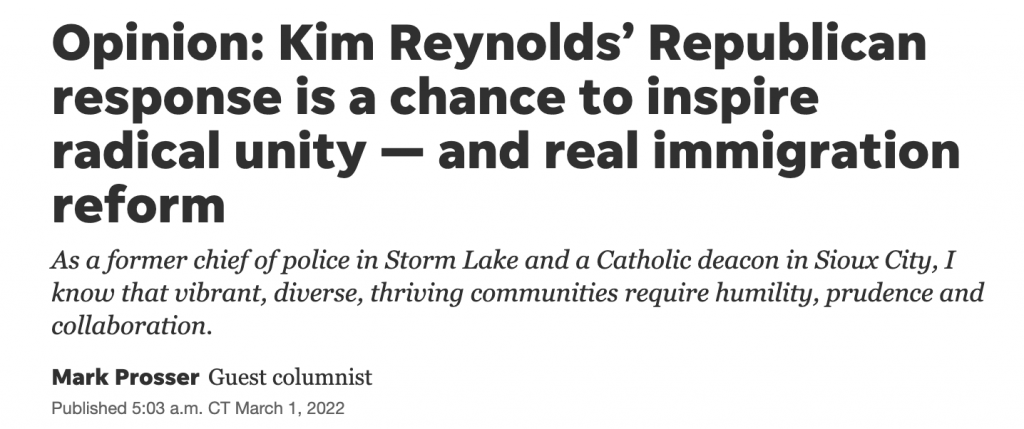
He was addressing the opportunity that Republicans had to speak on immigration reform, in response to President Biden’s State of the Union address. In his editorial, he touched upon the fact that there must be a bipartisan bill passed to protect foreign-born workers. Many farms across the country have relied upon these workers in a time of worker shortages, making them integral to hundreds of farms. Without protections and the ability to come here to work legally, well, industries in the Midwest would suffer.
More resources are certainly needed for border patrol agents to adequately perform their duties, and for administrative services within our immigration offices. Prosser mentions that there’s already legislation for this in the docket; through advocacy it could be passed.
Next, Congress needs to pass a permanent legal solution for DACA recipients, which could be ended, and for Dreamers, whose legal immigration status has now been threatened. Prosser puts forth that this will not only lead to safer and more stable communities, but that in the condition of Iowa and the nation’s current labor shortage, the last thing needed is a large pool of legal employees disappearing.
Lastly, Governor Reynolds had the opportunity to encourage a consensus to be met on legislation created to help tens of thousands of Afghan refugees integrate into new communities, a thousand of which are actually in Iowa. This legislation would then solidify their legal status in the U.S. so they could have the stability of a future in our country.
In many ways, Prosser himself and his editorial are inspirational, especially in these times. Law enforcement and many communities, not just immigrants, are embroiled in politicized issues across the U.S. in addition to immigration-related enforcement.
People like Prosser seek to mediate these through communication and education, and by learning more about one another rather than accepting biases and preconceived notions. He has seen and experienced so much in so many different ways. He has been in direct contact with all of these people, garnered an understanding of their backgrounds and ways of life, and built relationships.
Considering this, I had hoped that Governor Reynolds might share some of the same awareness, and reflect it in her response. Though Iowa may be relatively small, the impact from these goals would be felt nationwide, much like the comparatively small group of immigrants who support many of these industries across our country.
Instead, the topic of immigration reform never came up. The closest Governor Reynolds came was to say that the Biden Administration “has refused to secure our border.” I only wish she had given Prosser’s editorial more thought.
Joey Belmonte is a junior Political Science major with hopes of going to law school after Miami. Alongside his interest in First Amendment law, he hopes to do litigation for the federal government. Besides school, he likes to spend time with his fraternity brothers, play hockey, or read.
