
by Laurel Myers
Junior History Major
Until recently, my knowledge of small-town America was slim. Born and raised in suburban Ohio, I graduated high school with 800 of my closest peers. As a result, I understandably felt out of my element when we first began learning about Storm Lake this January. I had difficulty relating to the town, and as a creature of suburban America, I didn’t want to pretend to understand the struggles of a place unfamiliar to me.
However, as we continued to dig deeper into conversations about the economic strain and uncertainty facing family farms in America’s heartland, I began to sense recurring themes between our assigned readings—specifically Debt and Dispossession by Kathryn Marie Dudley, a collection of interviews and individual narratives reflecting the lasting impact of farm loss in western Minnesota during the 1980s farm crisis—and the experiences of my extended family in rural Kentucky.
Many summers of my childhood were spent visiting my mother’s side of the family in their central Kentucky hometown of just over 2,000 residents; nearly all of these relatives operate small-scale farms on which they raise cattle and tobacco. Though Kentucky is no Iowa or Minnesota, many of the issues facing Midwestern farmers in Debt and Dispossession still mirrored the economic hardships endured by family farms in the Bluegrass State.
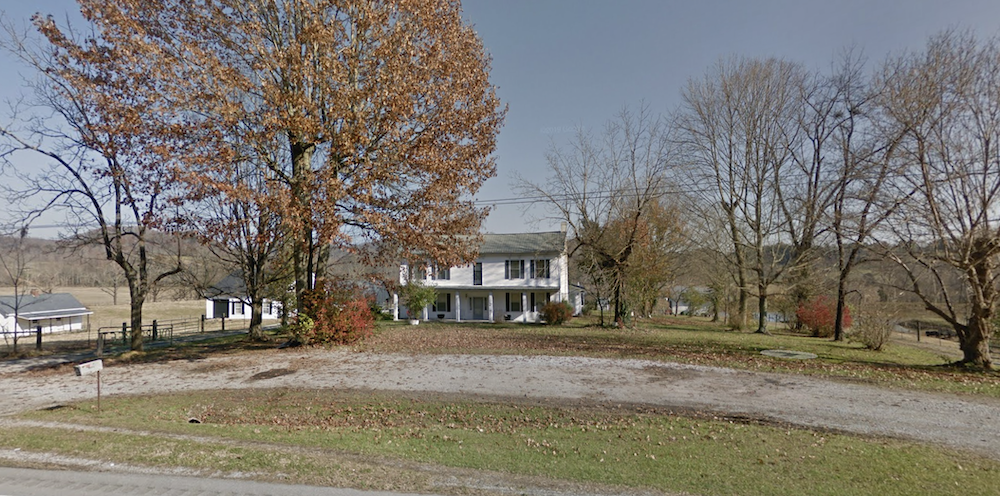
Farm loss, as I would soon realize, was a shared trauma in every region of the country.
Most of the farmers in my family were fortunate enough to make it out of the crisis of the 1980s largely unscathed. Those who managed to stay afloat made changes to the way their farms operated during these years to secure their income in any way they could. This included selling off portions of land, and adding cattle for tax deductions.
A few, however, were not so lucky. They joined the 200,000 to 300,000 commercial farmers who defaulted on their loans in the 1980s alone.
Even those relatives who avoided farm loss were still forced to work outside jobs to support their families and keep their land. I can think of one relative in particular who worked a myriad of jobs at different times in his life; on top of running his cattle and tobacco farm, he also operated a farm gate business, a service station, and served in various public office positions for the county, among other things. His life experience is consistent with Dudley’s observations in Debt and Dispossession, where she notes that “over half (60 percent) of all farm families require the wages of off-farm jobs to make ends meet, or that this employment accounts for a significant portion (40 percent) of their income.”
Even besides the parallels I uncovered between Debt and Dispossession and my family’s personal experience with farm loss, perhaps the detail of Dudley’s interviews that stood out to me the most was the negative attitudes surrounding property loss and economic insecurity within the agricultural community. The interviews revealed the commonly held belief among its participants that “distressed farmers were, on the whole, bad managers who deserved to lose their farm.” Many were quick to blame struggling farmers for poor business practices while ignoring the systemic economic issues and predatory lending practices that were conducive to an impending farming crisis, attaching a stigma of personal failure to an already painful situation.
This was not the first instance of farm-shaming I had come across in my research for this class.
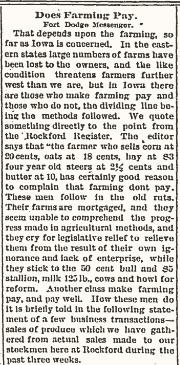
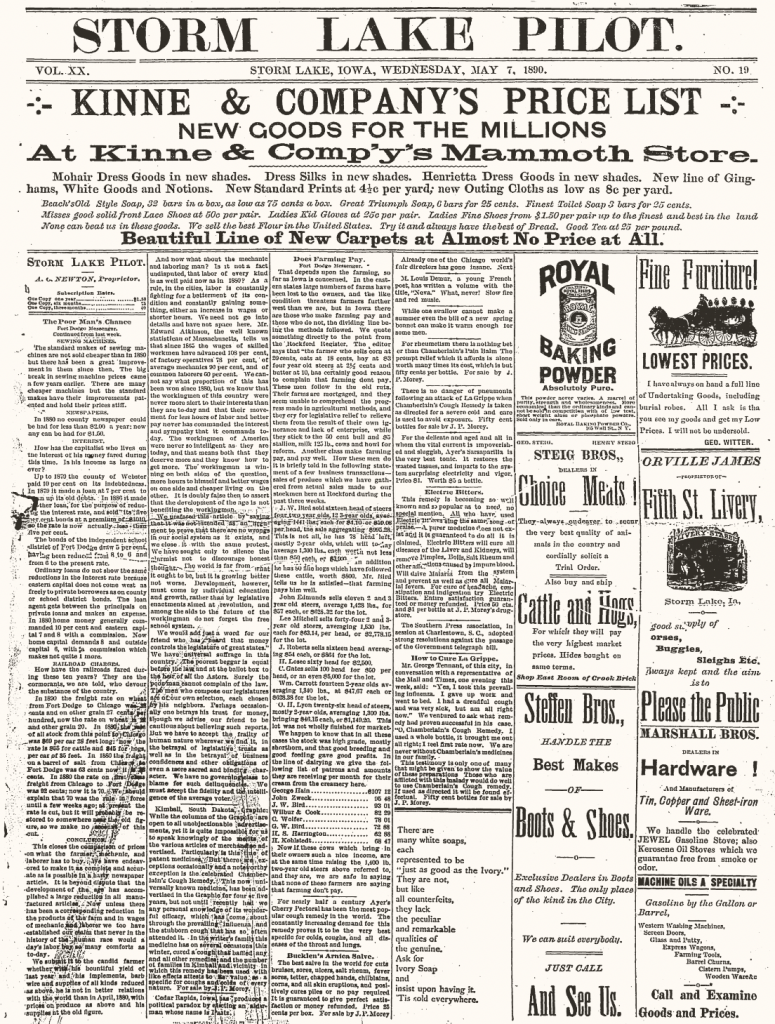
A few days before our discussion of Dudley’s book, I had found an article in the Storm Lake Pilot professing the exact same argument…only it was dated May 7th, 1890. The article (“Does Farming Pay”) makes the following claim about struggling farmers:
“These men follow in the old ruts. Their farms are mortgaged, and they seem unable to comprehend the progress made in agricultural methods, and they cry for legislative relief to relieve them from the result of their own ignorance and lack of enterprise…”
Nearly a hundred years prior to the 1980s farming crisis, it seems the stigma of individual fault was already well established within agricultural circles. These attitudes viewing economic insecurity as a personal failure—deeply rooted in the American Dream and its promise that anyone can achieve anything if they simply work hard enough—combined with the public nature of foreclosures and public auctions, were part of what made the farming crisis evolve into what Dudley labels as a “social trauma.” And this trauma isn’t unique to Iowa or Minnesota, or even the Midwest. It’s the same stigma that makes it difficult for the farmers in my own life to open up about their experiences with loss.
This stigma, I’ve found, is still alive and well, and helps us better understand the devastation of farm loss and the lingering wounds it has left on America’s heartland.
These three separate stories of farming insecurity—Dudley’s Debt and Dispossession, the Storm Lake Pilot’s “Does Farming Pay,” and my own family’s experience with the financial hardships of farming—set across three states and the span of a century, may seem only vaguely related upon first glance. When viewed together, though, these examples add depth to the history of how farm loss, and the social stigmas it bred, contributed to a recurring national trauma.
Laurel Myers is a junior History major with a minor in Museums and Society. She is currently a member of the History Honors Program on campus and is interested in researching World War I and the interwar period. Outside of class, she is active in her music fraternity and enjoys watching documentaries, playing board games with friends, and finding new hiking trails. After graduating from Miami, Laurel plans to attend graduate school to continue studying history.
