
Category: Project Update
Face-to-Face Encounters: How Personal Experience Can Change One’s Perception of Others
by Talon Wolter
Can intimacy and face-to-face encounters change individuals’ perspectives of others, specifically of Latinx immigrants in the United States? This week, our class delved into three chapters of Dr. Jane Juffer’s book, Intimacy Across Borders, and we held a conversation with Dr. Juffer herself. As her work makes clear, Dr. Juffer’s scholarship has been shaped by her personal experiences, bridging private and public life. This methodology nicely echoes an assertion in her work, building on work by the theorist Emmanuel Levinas, that deeply held views are most powerfully shaped (and challenged) by face-to-face encounters.

Dr. Juffer studied journalism as an undergraduate at Drake University. After graduation, she worked for a time with the Wall Street Journal, and then as an activist for Latinx migration issues along the U.S.-Mexico border. While many scholars focus on Latinx communities in urban areas, Dr. Juffer’s Intimacy Across Borders does so in rural communities in Iowa and Pennsylvania. Additionally, her work takes Latinx studies a step further by drawing out thematic similarities between social policies and community formation in the United States with those in South Africa. The strongest connections in this work focus on the shared ties to the Dutch Reformed Church and how that institution adapted to Latinx migration in the case of the United States, and to the anti-apartheid movement in the case of South Africa.
On a personal note, Dr. Juffer grew up in Orange City, Iowa, and her husband, the South African academic Dr. Grant Farred, grew up in Cape Town, under apartheid; each was heavily influenced by the Dutch Reformed Church. She begins her preface analyzing a picture of her at age five and him at age four, implicitly wondering how historical currents would bring them together. (They first met at an academic conference.) In the 1980s, Dr. Juffer participated in the anti-apartheid movement and was critical of how the Reformed Church had used scripture to assert racial superiority and validate segregation in South Africa. All of these personal aspects of her life inform her work. As she notes in her preface, when her husband’s mother in Cape Town learned that they were to be married, she remarked, “Dutch Reformed girls all over the streets of Cape Town, and you had to find one from Iowa?”
In chapter 3, Dr. Juffer examines in great detail the history of the Reformed Church denominations and her personal connection to Reformed Christianity. She describes how it shaped her childhood in northwestern Iowa, and she then investigates the origins and recent history of Amistad Cristiana, a largely Latinx congregation in Sioux Center. Its roots extend to 1995, when the local Covenant Christian Reformed Church offered services in Spanish, had a Latino pastor, and was theologically based in Anglo Reformed teachings. The church soon constructed another building, for Amistad Christiana, which developed into a hybrid blend of Anglo and Latinx Christian culture, a mix of the Christian Reformed Church and the Reformed Church of America.
[This book] is a narrative, at times an argument, about the possibilities generated by movement and desire. … How do the encounters produced by these migrations lead to intimacies and vulnerabilities and desires that draw on the past yet also present new possibilities? … Compassion and rage. Belonging and racial profiling. People, legal and undocumented, interact intimately, face to face, creating the possibility of friendship, community, desire, animosity–all generated by the vulnerability of face-to-face contact.
Jane Juffer, Preface, Intimacy Across Borders
Dr. Juffer sets this in context of the Reformed Church itself, going all the way back to the Protestant Reformation. In the 1500s, the Reformation changed Europe. Protestants fled persecution and immigrated to Holland. In 1550, a group of exiled Dutchmen decided to form the Dutch Reformed Church. This held ties to the Dutch West India Company when it formed in 1629, and eventually many Dutch Reformists immigrated to North America and, later, southern Africa. In 1857, the Dutch Reformists in the United States changed their name to the Reformed Church of America. Between 1857 and 1882, 47 congregations left the RCA and formed the Chirstian Reformed Church, with minor differences in ideology.
By 1995, and the Covenant Christian Reformed Church began a project to hold Bible study classes for Latinx members of the community. Amistad was born. By 2004, it had gained large enough of a presence that it left CCRC and became its own church. By 2011, it became so big that it overtook the whole building. Amistad’s popularity for both Anglo and Latinx members of Sioux Center, as well as members of both reformed faiths, continues to grow to this day. Its popularity flourished such that the church started a Sunday radio program with more than 5,000 followers. While Dr. Juffer thought that, in the 1980s, the Reformed Church had yet to grapple with the moral failings of its teachings and leadership in apartheid South Africa, she felt as though the example of Amistad Cristiana is addressing these issues by supporting Latinx members, helping and educating them, rather than dismissing them as “Others.”
Dr. Juffer uses anecdotes from her personal life and those of others to help illustrate her argument, based on the theories of Emmanuel Levinas about the power of face-to-face encounters. Briefly, Levinas theorizes that meaningful encounters with another person in an intimate setting can allow for a greater understanding of one another and change how the other is perceived. The vulnerability in these encounters–especially through eye-to-eye contact–can serve as the source of an ethics of love and empathy, while it can also lead to feelings of rejection and hate.
Dr. Juffer applies this theory to the example of Maria G., an undocumented immigrant with false papers whose abusive husband caused a domestic dispute. As a result of this, Maria was detained for forgery and risked losing her 10 month old son to the system, along with the likelihood of deportation back to Guatemala. In her trial, she received three years in prison for the forgery charge, yet she needed to be out in less than a year to avoid problems with her “U” visa, which would allow her to stay in the United States with her son. Through grassroots activism and face-to-face encounters with a social worker and the sheriff , the judge agreed to reduce her sentence to 364 days, thereby averting visa problems and personal calamity.
In another personal anecdote, Dr. Juffer describes the experiences of her mother, who got to know Latinx immigrants in her town. She offered to tutor a few folks, and in the course of tutoring them in English, she began to pick up Spanish. It was through her personal experiences, face-to-face with immigrants, that her perception of them as a whole began to change, and real intimate connections were made. Dr. Juffer and her mother also took a trip to Mexico together, to visit a mother and daughter they had met previously in Iowa. During this visit, they lived and experienced Mexican culture, and Dr. Juffer witnessed her own mother’s growth through these personal connections and “well-worn path between Orange City and Aguascalientes.” When they reunited with treasured friends there, now south of the border, she writes, “This was not simply a case of reversing the position of the ‘Other,’ though I suppose there was an element of that–although if anyone was the Other, it was me, as Peggy’s friends didn’t know me. Rather, there was little sense of anyone being an Other–simply a sense of community reconstituted in the plaza of Jesus María, transported thousands of miles from the windmills of Orange City’s town square.”

In our conversation with the author, we discussed Storm Lake, racism, and the acceptance of Latinx immigrants. We came to the conclusion that Storm Lake and Sioux County have some similarities when it comes to the rise of immigrants since the 1990s, to an overall general acceptance of newcomers, and to the underlying racism that can still exist. Gillain Davis, a student in our class, told Dr. Juffer that she had learned in her interviews with Storm Lake residents that racism still exists in the schools through unevenly promoting trade school to students of color, and college for white students. Dr. Juffer told a similar story about another teacher, saying, “She said that one of my Hispanic students just got a job at the Pizza Ranch and she just thought that was some, like, huge indicator of success, and she was going to claim part of the credit for that success.” Both Gillian and Dr. Juffer touched on how subtle racism still exists in these communities and can be seen through occupational segregation.
Dr. Offenburger asked Dr. Juffer if she felt that meatpacking plants still somehow provide the old idea of the “American Dream.” Her response took me slightly by surprise. She said, “There never was a real American Dream.” At first I disagreed, but then, as I thought about it from the perspective of an immigrant worker, I came to realize she is likely right. The American Dream exists for those with the agency and opportunity to get there, but those who have obtained that dream have made it inaccessible, or at least more difficult, for others to attain. There will always be racism, immigration, and inequality. And yet we can point to real success stories in Storm Lake, of immigrants coming and making a better life for themselves despite all these challenges.
In a concluding thought, Dr. Juffer shared her optimism for the future with us. She said, “At Cornell, we have this activist group that is working to abolish immigration detention and we’ve been visiting people, immigrants who are being held at the Batavia Buffalo Federal Detention Facility, and I became particularly close” to several people and their stories. She and others assisted one person to be released while her immigration case is pending. “There are those little victories, I think, that keep me optimistic,” she said, “difficult as it was during the Trump years, because I am feeling a little better now with Biden.” Her optimism is refreshing to hear.
Talon Wolter is a junior history major with a minor in German. He enjoys early American, colonial, and Native American history.
Same City, Different Ideas: Storm Lake and the Presence of Politics
by Travis Shane
Politics have fascinated me for as long as I can remember. The research in the books we have read, as well as in the newspaper archives, tells us much about the different political issues over time and their ongoing relevance. This interest leads me to examine the politics of Storm Lake. While I will be heavily focused on my own personal research for this blog post, I will pull up relevant materials from others that have been tagged “politics” in our notation system.
The newspaper archives, discussed by Anna last week, go back as far as 1865. However, our focus has remained on people and events from 1979 to the present. Like everyone else, I was assigned three years to research in the archives in order to collaboratively study Storm Lake’s past and present. I am personally responsible for the years 1987, 2001, and 2015, all of which were crucial to local and national politics. At the time of writing this blogpost, we have taken 656 SourceNotes, with 54 of them related to politics, and more than a quarter of those posts originating from my research.
The politics of the era were interesting, since 1979 marked the tail end of the Carter era and the ascension of Ronald Reagan to national office. In Storm Lake, though, the late seventies and early eighties marked a key change with the closure of the Hygrade meatpacking plant and its reopening in 1982 under IBP. Throughout this time, there were arguments with political undertones familiar to us today: the efficacy of pooling labor from immigrants while laying off local workers, unionization efforts, and other topics.

I began my archive research by focusing on 1987. That year, a number of articles appeared about Democrats making stops in Storm Lake to campaign for the presidential nomination. This included a ‘darkhorse’ candidate, Bruce Babbitt, then Governor of Arizona. With his appearances at the Gingerbread Day Care Center, he fingerpainted with children and outlined the key pillars of his campaign, which most importantly addressed childcare and education. He was also very critical of Reagan’s Star Wars defense system and desired more negotiations for ceilings to the nuclear stockpiles of the U.S. and USSR. Another visitor to Storm Lake in 1987 was Richard Gephardt, then a congressman from Missouri. He stopped at the Country Kitchen to outline himself as an antidote to President Reagan. He espoused similar points on education and trade like Babbitt, while also lambasting the administration’s corruption with the ‘Contra Aid’ scandal perpetrated by Oliver North. Iowa for the past few decades has been a bellwether state and, despite its importance, it was interesting to see more direct stories in how Storm Lake played a key role in the campaign stops of multiple nominees, some of whom actually visited town more than once during this election season.

Shortly after this, in 1990, there was a hearing in Des Moines about the hiring practices of IBP. (Thanks to Anna Rottenborn for her note on this.) The bill proposed fines up to $1000 for the first infraction of knowingly hiring illegal immigrants and then a $2000 fine for every time after that. The bill also outlined that if more than 5% of a workforce in a given company can’t speak English, then an interpreter needs to be provided. The bill also prevented companies from deducting the costs of company housing and safety equipment from their paychecks. A short story like this really exposes the tensions of the time that continue to have relevance in town today.
In 2001, we saw politics come up in other areas that haven’t been discussed much. Early that year, the changes from the Federal Balanced Budget Relief Act were set to help the hospital save roughly $254,000 over the course of five years. The bill was designed to help hospitals across the nation keep costs down, saving them 11.5 billion total dollars. Seeing the impact on the Buena Vista County Hospital itself was interesting because, when looking through the lens of politics, one can draw connections with Storm Lake’s political influence on the outside world, and vice versa.
Other political intrigues from 2001 included the ever-controversial politician, then-State Senator Steve King, declining to run for governor in 2002 against Governor Tom Vilsack. The article went into detail as to why he dropped out. His platform criticized Vilsack for taxing the poor people of Iowa to provide more accommodations for the rich and well-off residents of the state. In 2001, there was also a rollout of a new program that allowed for sponsorships of illegal immigrants to become citizens if they had at least a bachelor’s degree and four employment sponsors. This was notable. Many applauded the program, since leaders disliked seeing families split up, yet others said that the program did not go far enough to help illegal immigrants who could not meet some of the requirements like formal education. There was even a national story on how the government had Microsoft on the ropes with an antitrust case that had been waged since the Clinton presidency, demonstrating an earlier example of the careful relationship between the federal government and big tech companies. Politics have reached into a new stratosphere with the arrival of a candidate who would somehow beat the odds and secure a term as President: Donald Trump. However, my research year of 2015 preceded his victory over Hillary Clinton, and most of the articles covering Trump and Iowa came later in the year. They especially detailed the battle between Trump and Ben Carson, who had surged in the polls. Another article covered Congressman Steve King’s comments about Donald Trump’s campaign platform–specifically immigration. Representative King, in an interview with CNN, said that Trump’s stances on immigration were promising and that Trump owes his success to his ability to tap into the political discontent of middle America.

But 2015 provides other focuses that are more liberal in their point of view. Continuing with the article about Steve King and Donald Trump, another point of view was provided by LULAC, which planned to protest Donald Trump whenever he held a rally in the state. Other articles address the platform of Storm Lake resident David Walker, who was running to keep his seat on the city council, praising the direction of the town.
From 2017 to the present, there are a number of SourceNotes that cover the policies of the Trump administration, but there are plenty of SourceNotes connected to politics that came from our class “news responses.” To learn more about the town and to practice how to properly craft our SourceNotes, we created weekly news responses based on articles in the Storm Lake Times in 2021. As a result, we learned a great deal about the community today and how it is grappling with the political realm. This included community support for a bill that would provide protection for mobile home dwellers, to coverage of the Myanmar-related protests back in February. We are also up to date on the saga revolving around the marina. SourceNotes and our research have allowed us not only to better understand the past, but they give us a sense of what issues are facing Storm Lake at the moment.
While politics may be a source of division between people today, as they always have been, they provide a helpful perspective to understand life in Storm Lake. Here I am reminded of Police Chief Chris Cole, who spoke on truth, trust, diversity, and community building. I am paraphrasing his thoughts here, but I think it is an important point that has stayed with me: in life and politics, only with truth and trust can there be a path to peace.
Travis Shane is a senior history major with interests in American and military histories. Beyond class, Travis also draws, reads, and likes to hang out with friends.
Video Update Three: Time to Collaborate
Disappearing Domesticity: It’s No Longer Nine-to-Five
by Anna Rottenborn
In an industry dominated by the stories of men, what roles do women play? This week, our class took a break from interviews, books, and scholarly articles, instead using our time together to dive into the Storm Lake Public Library’s newspaper archives. In order to give ourselves a fuller picture of the town’s history, we set a timeframe (1979-2020) of newspaper articles to consult. Then, we assigned each student three years from that timeframe, spaced out so that we would all get a sense from our individual research how Storm Lake changed over time. For example, I am responsible for covering the years 1990, 2004, and 2018, for finding around 20 important articles from each year to summarize in SourceNotes.
SourceNotes is the website we use to catalogue our findings, tagging keywords and people from each article to help us see broader trends across time. So far, we’ve accumulated 558 notes. We have dozens of keywords, the most popular of which include “IBP,” “Immigration,” “Tyson,” and “Politics.” My personal favorites are “Waste Sludge” and “Storm Lake (Lake).”
Through various newspaper articles dating back to 1979, we gain a clearer understanding of how women’s lives in Storm Lake changed with the shuttering of the Hygrade plant, and then the takeover of IBP by Tyson.
One topic that particularly interested me was that of women in Storm Lake. Thus far, all of the books we’ve read have been written by men, and a majority of the people we’ve interviewed in class have been men. It’s a problem common to this field, in which labor-oriented meatpacking histories rely on men’s experiences. While this has given us countless insights into meatpacking, rural politics, and immigration trends, it has failed to paint a picture of what life is like for women in Storm Lake. Through various newspaper articles dating back to 1979, we gain a clearer understanding of how women’s lives in Storm Lake changed with the shuttering of the Hygrade plant, and then the takeover of IBP by Tyson.

Prior to 1981, a job at the plant meant that you could comfortably support an entire family. In our first interview of the semester, Dr. Michael Whitlatch told us about the dynamic of Storm Lake when Hygrade was the primary employer: “The average worker out there could make between 35 and $40,000 a year. In 1981, that’s a lot of money,” he said. Thus, if the husband was employed at Hygrade, the wife would be able to stay home and take care of the kids. This relegated the role of most women in town to keeping their households and their community in order. They didn’t have to work outside the home, and so they were free to engage with their community primarily through volunteering and through social organizations. One important thing to note about these women: they were primarily white, as was most of the population prior to the Hygrade’s closure.
A SourceNote logged by Nathaniel Hieber demonstrates this dynamic. It summarizes the article “UPW Hears of World Hunger,” which appeared in a 1979 issue of the Storm Lake Pilot Tribune. The article covers a meeting of the United Presbyterian Women, who met at Lakeside Presbyterian Church to watch a presentation on world hunger. The presentation, led by Mary Autenrieth of the American Friends Service, broke down food scarcity in Southeast Asia, culminating in a call for action urging the women to support politicians’ efforts to fight world hunger. The UPW served as a place where women could gather under a common religious context and discuss social issues, allowing them to strengthen both their church and their community. In this way, it exemplified the role of women in Storm Lake prior to 1981.

IBP opened its Storm Lake plant in 1982. Offering low wages and poor benefits and displaying open hostility to union activity, IBP was immediately forced to look outside of Storm Lake for workers. This prompted a surge of immigration to town, as we well know; people from all over the world were brought in to work for IBP. This surge in immigration was the subject of a SourceNote entered by Gillian Davis, pulled from the opinion pages of the Storm Lake Pilot Tribune in 1982. The unnamed author argues that it is necessary to get tough on illegal immigrants, insisting that “the US [must] stem the unlawful massive influx of aliens into the country and at last gain control of its borders.” This article suggests that tensions already existed regarding increased immigration. With the influx of immigrants, the town underwent countless paradigm shifts, especially concerning women’s issues.

The immigrant women who arrived to work at IBP faced different realities than the women native to the surrounding areas. One person’s income at IBP was not enough to support an entire family, and so women were no longer able to stay home if their husbands were employed at the plant. Many went to work at IBP themselves, though they faced somewhat different working conditions than male employees. Timothy Pachirat’s Every Twelve Seconds reveals the rampant sexual harassment suffered by female employees of packing plants. Pachirat recalls that, of the few female workers employed at the Omaha packing plant where he worked, many of them were tasked with auxiliary jobs that placed them in a highly visible part of the plant, allowing male workers to “openly exchange comments about the relative degree of attractiveness of the [women’s] bodies, jeering, laughing, and leering when the women have to bend over to pick up feet out of a metal tub to pack them into the boxes.” The troubling phenomenon of sexual exploitation of immigrant women by their employers is bolstered by a 1991 article in the Pilot Tribune, “Illegal, but human,” cataloged by Logan Kelleher. This editorial outlines all of the injustices suffered by undocumented immigrants, including that “many young girls are being threatened by employers to have them reported to INS if they do not cooperate sexually.” This dynamic of power and abuse is one that was likely present at IBP for many of the women who worked there. At the very least, they would have been vulnerable to such power relations.

The low wages at IBP (and eventually Tyson) necessitated multiple sources of income to support a family, and while some women helped by joining their husbands at IBP, others worked at family businesses or started their own. In his interview, Dr. Whitlatch recalled the gradual growth of immigrant-owned businesses throughout the 1980s and 1990s. One such business was highlighted in a 2004 issue of the Storm Lake Times. The article, “Lidia dreams of fashion franchise,” profiles Lidia Montiel, who was born in El Salvador and moved to California before eventually settling in Storm Lake. Montiel, who worked the morning shift at Tyson, also opened her own clothing store, where she filled custom orders for formal gowns and, in a pinch, poodle skirts. Montiel’s work demonstrates the new dynamic that women in Storm Lake embraced. No longer able to stay at home while their husbands worked at the packing plant, women started engaging with the community primarily through their work and their small businesses rather than by volunteering or focusing solely on community organizations. As more and more women joined the workforce, they became vital players in Storm Lake’s economic success, which empowered them to demand change and advocate for progress in the community. This is something that we see of women in Storm Lake today.

One of the biggest problems that emerged for Storm Lake’s rapidly shifting population was lack of support for mothers and young children. Any Way You Cut It notes that in meatpacking towns, women and children are most likely to suffer without adequate medical attention. This concern was reflected in a 1997 edition of the Pilot Tribune, in which the article “Infant mortality rate spikes upward” reported that, over the previous 2 decades, teen pregnancy rates and infant mortality rates in Iowa spiked. The increase can be attributed to the lack of specialized prenatal and maternal care available to women in smaller, rural towns, particularly women without adequate healthcare, as is often the case for employees of IBP.
In 2001, Tyson acquired IBP, and by 2002, it began processing. Despite attempting to revamp its public image with the addition of positions such as chaplains and community liaisons, Tyson continued paying its workers low wages and maintained poor benefits, leading to a similar strategy as one used by IBP. Tyson recruited new workers aggressively, and was accused of going to Mexico on multiple occasions to court potential employees. This led to regular surges of immigrants arriving in Storm Lake, and maintained similar circumstances for the women arriving as those who came earlier to work at IBP.
One issue that surfaced in the wake of the Tyson takeover was the lack of affordable and accessible childcare for Tyson’s employees. Emilia Marroquín highlighted this issue in my recent interview with her, going as far as to say that childcare is one of Storm Lake’s biggest problems. Marroquín explained, “Not everybody qualifies for childcare assistance, especially if you work at Tyson, so that’s something that I’ve been going through myself. At least $350 a week because you need to pay for child care services and not everybody cannot afford that. See, that’s something that makes people make that decision. Okay, I prefer to leave my one-year-old with my twelve-year-old because I’m going to save $150 a week.”
Childcare is expensive and, for some workers at Tyson, completely inaccessible. If parents work the night or morning shifts, they may not be able to find childcare that works with their unusual hours. A SourceNote that I logged covering a 2004 article from the Pilot Tribune, “Children found locked up, SL mother arrested,” described a 24-year-old mother arrested on three charges of child endangerment. The mother, who was working the night shift at Tyson, had locked her three children (ages 1, 3, and 5) in a bedroom alone for her eight-hour shift. Clearly, this mother had to make the devastating decision to leave her young children home alone because she couldn’t afford childcare. Many Tyson employees surely face this difficult decision, prompting community members like Marroquín to call for Tyson to invest in quality daycare for their employees’ families. According to Marroquín, “The employees are the main source for [Tyson] to succeed, so they should get together and make something. They can write a grant, they can do, they have money. I mean, they have come up with so many great things, but they can help better there. If they make [their employees] lives easier, most likely, they will stay with them.”
In Storm Lake today, women are actively engaged in improving their community, particularly through checking Tyson’s power and ensuring that there are plenty of resources for the new families still coming to town. SALUD!, an organization run entirely by women, is a forceful example. Its members have organized events like free blood-pressure and BMI screenings for Tyson employees, and they aren’t afraid to criticize Tyson’s treatment of its employees and call for them to do better. As Storm Lake continues to evolve, so will the role of women in building and maintaining a thriving community.
Anna Rottenborn is a freshman at Miami, double-majoring in math and secondary math education. She enjoys calculus, politics, and knitting. Anna plans to become a math teacher after her time in Oxford.
Out of Sight, Out of Mind
by Rachel Rinehart
There’s no doubt that Tyson has enabled Storm Lake to become the diverse community it is today, but the town’s thriving has not come without problems. Like most meatpacking towns, the brutality of the industry remains understandably hidden from everyday sight. Workers are either exploited or given precious opportunities, depending on your perspective. Their jobs require them, in one form or another, to watch the life go out of a cow’s eyes, thousands of times over. These dynamics are beyond the sight of consumers, of course. But who bears the responsibility of this normalized violence? Does it end with the employees, the meatpacking plants, or the meat-eater?
This week, we finished Timothy Pachirat’s Every Twelve Seconds, a study on normalized violence in slaughterhouses and society. In the book, Pachirat examines the responsibility of killing in slaughterhouses, and how this contributes to the “politics of sight.” Pachirat, an Associate Professor of Political Science at the University of Massachusetts Amherst, joined us via Zoom.
In addition to our engagement with Every Twelve Seconds, some students (with their BVU partners) had interviews for our “Small Town, Big World” project. My partner, Max Oslan, joined me to interview Lori Porsch, a long time educator and leader in Storm Lake. Oslan is a sophomore digital media and sports business double major at Buena Vista University, and he’s on the basketball team. In addition to this, for our Miami class requirements, I also interviewed Dolores Cullen, a photojournalist and writer for The Storm Lake Times.
The second half of Pachirat’s Every Twelve Seconds details his time in a packing plant in Omaha. Pachirat worked in various positions, starting as a liver-hanger and working his way up to quality control (after only two months because of his English fluency). The author notes that, for his promotion, he had to prove to management he was “one of them,” that he should be on the “clean” (non-killing) side of the plant. Before his promotion, however, he witnessed and participated in animal slaughter first-hand, experiencing violence while working in the chutes.
“In any given situation, who functions as the knocker? Who functions as the individual on which we locate and bound our notions of guilt, blame, and responsibility?”
— Timothy Pachirat
Pachirat worked the chutes out of necessity. He had started as a liver line worker, hanging the internal organ thousands of times a day. But when no livers were being processed for a week at the plant, he was moved to the chutes. There, Pachirat prodded cattle with electric rods to keep them moving in a line for slaughter. The cattle are tightly packed, covered with feces, and moved along to the man holding a “knocker.” A knocker is a cylindrical gun that “is suspended in the air over the knocking box’s conveyor, balanced with a counterweight and powered by compressed air supplied via a yellow tube.”
Pachirat felt the rawness and violence of the confrontation between living animals and the men leading them to their death. However, only the knockers are provided psychological care by the company. Psychological care to other employees is on their own dime, because, to the company and other workers, the knocker stands alone as the real killer. This role is something that we discussed with the author during our interview. Pachirat extended his thinking from the book to society in general, asking, “In any given situation, who functions as the knocker? Who functions as the individual on which we locate and bound our notions of guilt, blame, and responsibility?”
Later in the book, Pachirat is promoted to a quality control position. As a QC, Pachirat worked with USDA inspectors, but there was a division of loyalty between the two groups. The QCs look for anything to avoid noncompliance reports, which can lead to fines or even a shutdown of the plant; the inspectors look for anything that would qualify for noncompliance reports. Loyalty is very important, and showing it means helping the plant move the line as quickly as possible. As a result, some things were overlooked, such as the deliberate practice of not reporting contamination of the meat found at two checkpoints. If contamination is found, the employees are just told to “do better,” because if the meat is thrown out, that is a waste product and the halting of the line slows down production.
The equipment itself is cleaned before inspection, and QCs examine it with flashlights alongside the USDA. At one point, the flashlight of the USDA leader, Donald, wasn’t working, and Pachirat offered him his own. Pachirat’s trainer, Jill, lashed out, “It’s not [their] job to help him.” The meatpacking plant believed that the USDA was not on its side, and workers attempted to take every advantage possible.
Pachirat reflected on his time as a green-hat, and felt that what was remarkable was not the massive food-safety procedure violations nor the deception and falsification by the managers, but how the focus on food safety deflects the attention away from the work of killing onto the technical realm of hygiene. The responsibility every worker has to the deceptions of food safety neutralizes the horror of the violent work being performed. Normalized violence in fact motivated Pachirat to go undercover. He wanted to study how it became acceptable in society to “raise and kill billions of sentient beings for the sole purpose of food consumption.” Slaughterhouses are sites of normalized violence, which Pachirat connected to executions of prisoners and wars fought by mercenary contracted armies, all of which are dangerous and violent works done on our behalf by others. “This was a kind of violence that I thought was so implicated into the fabric of normalcy that it would be really interesting to examine it,” he said.
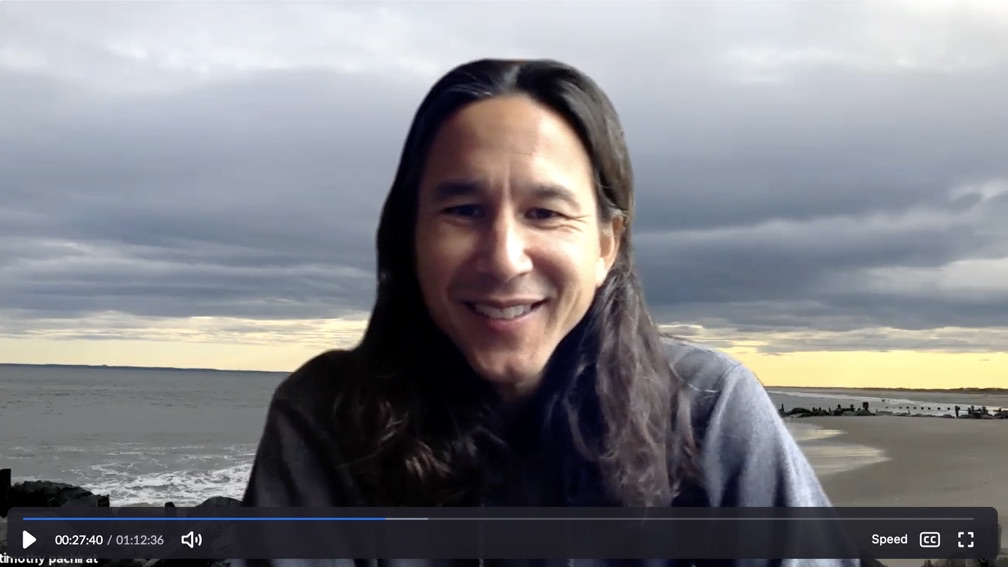
Pachirat’s scholarship leads us to ask where the responsibility of the killing lies: with those who eat meat or with the 121 workers who do the killing. He holds the position that those who benefit at a distance have a moral responsibility. “Human beings are capable of contributing to massive forms of violence without having a clear understanding of the overall process of what they are contributing to,” he said. In eating the meat that is abused while alive and sped through inspection after slaughter, meat eaters are bearing responsibility for the dirty work. This position prompted Pachirat to ask, “In what ways is the entire world constructed like a kill floor?”
The moral responsibility for the killing is an argument about the politics of sight. Pachirat calls it the “120 + 1” argument, where the work is being done by a select few and is out of sight of those who implicitly or explicitly authorize the work. The people who are able to evade responsibility are able to do so because “of their citizenship, the taxes they pay, their race, their sex, or the actions of their ancestors.” The slaughterhouses prey upon citizenship, he said, and “rely on a powerless labor force that is not going to raise political problems and look the other way as these corporations mass produce food as ‘cheaply as possible.”
Pachirat noticed that slaughterhouses code different jobs by race and gender. The actual killing is done only by men, and only a certain type of man. At his particular slaughterhouse, the men “manly enough” for the killing were refugees from East Africa. (They came from Sudan because there was a relocation center in Omaha.) These were men who had no other option due to no citizenship. They took whatever pay and working conditions they could. Pachirat did not want to ask about how the slaughterhouses prey upon gender because he said he “didn’t want to enter whatever safe space [the women] were able to form away from the male gaze and sexual harassment.” He acknowledged this bias in his ethnographic research.
Though Tyson drives Storm Lake’s population figures today, there are many frustrations about the working conditions and low pay. By the “120 + 1” logic, the people that eat the meat are not only taking moral responsibility for killing the animals, but also taking moral responsibility for the poor working conditions.
The poor working conditions caught the attention of Pachirat, and they are well known to the people of Storm Lake. One member of the community who knows this well, Dolores Cullen, is a photojournalist for The Times, and I had the pleasure of speaking with her last week. She has been looking into the inner workings of Tyson for years despite pushback from the company, and she says The Times “will not be frightened into submission.”
The paper has been in production for over 30 years, and Cullen has witnessed many changes during her career. She spoke of how corporations have tightened control on the free flow of information. Previously, Cullen had been able to go into sections of the Tyson plant and take pictures of employees for a story, but now she is not allowed entrance. The hospitals also stopped allowing the journalists in, even before COVID-19 struck, because everything was classified through HIPAA. Reporting general information to the public therefore has become a difficult task.

Cullen offered a more humanistic look at Storm Lake and the changes that Tyson has brought. She showed me a story for which she took a picture of a man who used to work at the Hygrade plant. She noted a key difference between then and now. When Cullen took the man’s photo, he had fond memories of his time at Hygrade, recalling the nicknames for his friends at work. He enjoyed his time there. Now, Cullen maintains, the working conditions at Tyson have snuffed out most comradery.
“If these were white people, these would be great tales of their survival. Instead, they’re just people on the lowest rung here.”
— Dolores Cullen
She said her goal in the paper is to “treat the Tyson workers as respected, valuable members of the community.” Part of this goal has been finding out who has died from COVID-19, especially those who had been working in the plants while they remained open. The hospitals were not releasing that information, so she scavenged Facebook and made her own records. She scrolled through the pages of family members, friends, and coworkers. “I realized that some of these Tyson workers, three of them worked on the same shift. They had to go to the same job and people were getting sick,” she said. The deaths of these three men were not previously reported. Cullen published the stories from the perspectives of those that knew them, to show that these were real people with personalities.
Though she has witnessed some racism, the community, like Cullen, values Storm Lake’s immigrant members. When the Trump administration was talking about rejecting and displacing the DREAMers, Cullen said, “It was unimaginable that the Republicans and Trump were talking about that,” because newcomers’ stories are so incredible. She said that she can still hear some of their voices from past interviews. “If these were white people, these would be great tales of their survival,” she said. “Instead, they’re just people on the lowest rung here.” Like Pachirat, Cullen also realized that the packing plants are taking advantage of refugees. “They have this low expectation of what life should offer, or like what a job should offer. [The plants] make you work in a dangerous environment, and [workers] won’t complain.”
These refugees are the powerless workforce that meatpacking plants rely on because of their race and lack of citizenship. The community is rallying around them, though, trying to make them feel important when work and politics don’t. Nevertheless, Storm Lakers like Cullen keep these injustices in view. For some, though, it’s far too easily out of sight, out of mind.
Rachel Rinehart is a freshman majoring in Journalism and Sociology. Her interests include running, doing yoga, cooking, and true crime. She aims to work for a newspaper as an investigative journalist in the future.
Video Update 2: Community Trust, the INS, SALUD!, and BVU
Tyson and Storm Lake: Can You Have One Without the Other?
by Gillian Davis
“You can’t divorce yourself from the fact that Tyson is integrated deeply into the community.”
– Art Cullen
There is the perception that Tyson and the community of Storm Lake rely on one another to keep a stable and profitable business and town thriving. Without town residents, specifically immigrant workers, Tyson could not sustain itself in Iowa. Storm Lake, on the other hand, needs the company, too. It provides incentives for immigrants to arrive and maintain (or increase) the population, providing a boost to the local economy. However, might the relationship be co-dependent and toxic? Are community members exploited regularly, fitting a pattern of other meatpacking towns? We focused on these questions this week, reading the first five chapters of Dr. Timothy Pachirat’s Every Twelve Seconds, and speaking with Art Cullen, editor of The Storm Lake Times.

Pachirat’s book provided fascinating insights into meatpacking plants and the towns that host them. Pachirat is a political scientist who decided to go undercover as a worker in an Omaha slaughterhouse for five months, working on the kill floor. The author went undercover to understand the realities of routinized animal killing, hidden from view, while also analyzing the impact it has on the workers and how consumers are able to remain ignorant to this violent production process. His book also seeks to understand how society and even the workers can maintain a distance—spatially and psychologically—from the realities of routinized slaughter. The author highlights this distance by beginning his book with an anecdote of police shooting a cow that had escaped in Omaha, Nebraska, and the revulsion that slaughterhouse workers felt for the act; yet these same people were forgetting their daily involvement in a job that has an animal killed “every twelve seconds.”
Pachirat wrote the book narratively and from the perspective of a slaughterhouse worker. His conversations with fellow employees, witnessing the day-to-day life in the slaughterhouse, “challenges the reader to use these narratives as a way to think through what it means, from the perspective of a lived experience, to perform the daily work of industrialized killing.” He also does not sanitize any of his experiences or conversations, instead including all the gory and graphic details. In doing so, he ensures that readers cannot maintain a distance from the truth of his experiences, and those of all other workers. This decision was his tool to force society to remove the veil from meatpacking plants and slaughterhouses, and to think about the truth behind each piece of meat purchased. Low-priced protein, in fact, comes with very high costs. The author writes, “The detailed accounts that follow are not merely incidental to or illustrative of a more important theoretical argument about how distance and concealment operate as mechanisms of power in contemporary society. They are the argument.”
The author highlights how, even though towns and plants need one another, consumers really perpetuate the troubled relationship. Americans want to ignore the truths of the meatpacking industry, which is bolstered by the government and powerful lobbies. Pachirat describes how most Americans’ “demand for a cheap, steady supply of physically and morally sterile meat” is “fabricated under socially invisible conditions.” This willful ignorance allows the meatpacking plants, for example, to impede union formation, necessary to ensure worker rights and the ability to make a livable wage. As we have recognized before, if unions could reestablish themselves, the price of meat would rise to an “unacceptable” price for everyday Americans, who typically have the privilege of demanding cheap meats. This privilege allows most of us to ignore the need of the workers to survive on a living wage, unmet by companies working to meet consumer demand.
Our thoughts this week formed around a concept presented in Every Twelve Seconds: the “politics of sight.” Pachirat defines the term as “organized, concerted attempts to make visible what is hidden and to breach, literally or figuratively, zones of confinement in order to bring about social and political transformation.” In other words, this concept brings the public’s attention to hidden aspects of society, like meatpacking plants in nondescript places, hiding routinized killing from society. Doing so can push for change, socially and politically.
The class used this analysis to examine meatpacking plants in rural areas. Even though Tyson’s turnover rate is around 100%, it continues to manufacture meat cheaply and efficiently in conditions that, to many, are troubling. On this topic, we also watched a couple of YouTube videos this week. One, “An Inside Look at U.S. Poultry Processing,” left much of the class troubled and led to a conversation on the ethics of meat consumption. In this video and another, we were confronted with the practice of production. Indeed, Pachirat’s “politics of sight” forced us to reconcile a habit of meat consumption with the truth hidden behind factory walls. Our class has not abruptly converted to vegetarianism, of course; but making the hidden visible will, at the very least, lead us to better informed decisions as consumers.
Art Cullen, as a proponent of open discussion and access to information, certainly knows the importance of this issue. He spoke freely with our class on the potential for Storm Lake and the challenges it faces with the meatpacking industry. “It’s really the responsibility of Tyson to pay their workers twenty-five bucks an hour,” he said, “so they can pay somebody a decent amount of money to care for their family or, perish the thought, one parent might be able to actually afford to stay at home and raise the kids themselves, like I was.”
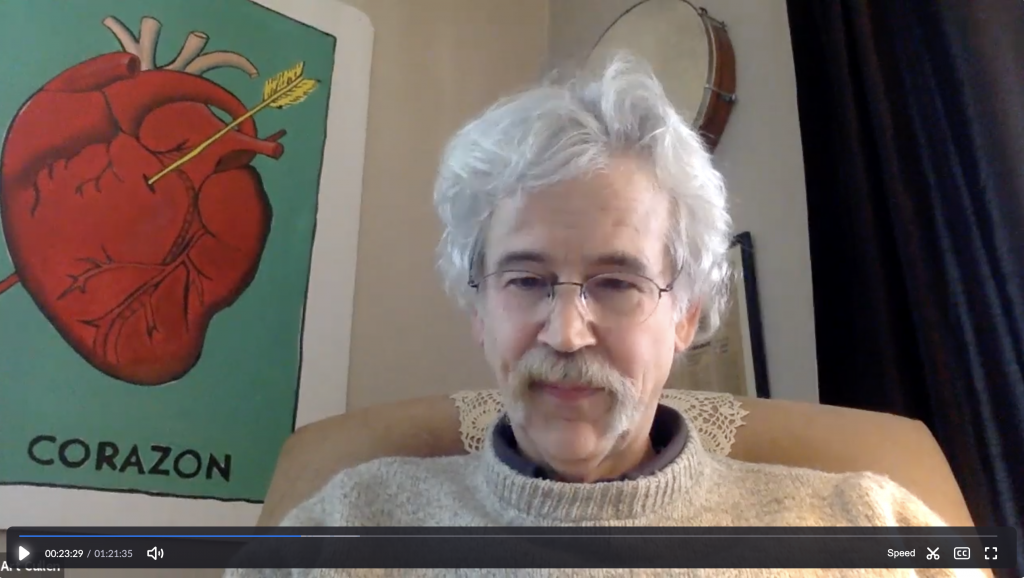
Cullen was noticeably frustrated by a recent phone call with a Tyson media relations representative. We asked him bluntly if Storm Lakers should ever be nervous that Tyson would relocate and threaten residents’ livelihoods. That view “really goes back to busting the Union in 1980,” he said. “The bullshit was instilled in our heads that they’ll leave Storm Lake, [that] ‘we’ve got to give away the farm to IBP to come in here to bust the union and pay half the wages. Otherwise, we wouldn’t have any jobs at all.’ Well, hello, wake up! We are growing two hundred bushels [per acre] of corn here. Nobody is more efficient at feeding hogs. There’re going to be hogs here as long as there’s corn. What were we thinking?”
At the heart of this issue, in Cullen’s view, is workers’ lost trust in the good-faith direction of their employers. “Trust with Tyson (or JBS of Brazil or Smithfield of China) is something that needs work,” he wrote in his recent editorial, “Trust is the Issue.”
“It’s really the responsibility of Tyson to pay their workers twenty-five bucks an hour, so they can pay somebody a decent amount of money to care for their family or, perish the thought, one parent might be able to actually afford to stay at home and raise the kids themselves, like I was.”
– Art Cullen
At the same time, Cullen recognizes the importance of diversity to Storm Lake, how it has revitalized the town to create a thriving place for many to live. At what cost, though?
In the past, Tyson “did offer solid guaranteed employment to a paranoid community that never wanted to see another layoff again,” he said. “That was a horrible experience for Storm Lake, for that meatpacking plant to shut down for a year. And so nobody ever wanted to see that thing shut down again, and Tyson came in, and they cleaned up the plant, and they made it look better. Planted some flowers and raised wages. But it’s still, you know, an average of 18 bucks an hour, and that’s just not enough, and I’ve just had to wake up to the fact that, when are we going to pay the real patriots in this country a living wage?”
It’s hard to ignore, to put out of sight: the town has been revitalized in part by the exploitation of the many people who have come for work opportunities and to have a place to settle and raise their children. Yet they are compelled to do so on a wage that cannot even let them afford child care, or for one parent to stay home for a few years, as Cullen was able to do.
Cullen recognizes that, for years, he (like others) had lived under the fear of layoffs, as in 1981, or a fear that the town would die without continual plant operations. However, is the threat of closure necessary, or would consumer pressure and unionization be able to fix the issue? How can the town trust the company to do the right thing? “Who’re you going to believe,” Cullen asked rhetorically, a company “that just paid a $221 million fine for price fixing and which fights their employees’ wages for putting on and taking off their equipment at the beginning and end of the shift? A company that uses Donald Trump to order its employees back into work without personal protective equipment? You know, is this the kind of people you want to do business with?”
The discussion we have had all week as a class, and the insights gleaned during the interview with Art Cullen and the book Every Twelve Seconds, lead to a very important question: is Tyson truly integral to Storm Lake, now in 2021? The immigrant workers have now formed a tight-knit community and have built successful small-town businesses, and many of their children are going to college and returning to begin addressing key issues in the community, like Joanne Álvorez, a leader of SALUD!
Or is there, perhaps, a more symbiotic relationship between Storm Lake and Tyson, where one relies equally on the other for prosperity? The town is now thriving and has established that Tyson needs its workers, and the company needs the town. Why hasn’t there been significant change to wages and protections for employees?
This year, the pandemic has revealed much of the vulnerabilities of the industry. The “politics of sight” have shown the American public, even if briefly, that the industry’s business policies can be highly questionable, if not morally compromising. Perhaps Tyson needs Storm Lake more than the town needs the company.
Gillian Davis is a history and American studies double-major who plans to enter law school in the fall of 2021. She anticipates specializing in international law. Gillian is currently involved in the History Department’s Honors Program and is researching hair shearing in post-Occupied France from 1944-1945. She enjoys women’s and European history, as well as American history (any era).
The Stories that Change Our World
by Hunter Kolbus
Storm Lake, as we have come to know, is a town filled with hope, change, diversity, and tragedy. Our goal this week: to take a deeper look into the stories that make Storm Lake what it was, and what it is. To do so, we have begun collaborating with students at BVU.
Readers of this blog might wonder how we have been conducting collaborative research to date. We (students at Miami) are organizing and sharing historical research with each other via SourceNotes, an online program. It helps us summarize and organize our notes on old newspaper articles, accessed through the Storm Lake Public Library’s website. We tag keywords and people on each entry. Bit by bit, we are building a large database of entries for our final research papers and other projects. So far, we have more than 300 entries from newspaper archives dating back to 1979, from our previous academic readings, and from current Storm Lake Times issues.
So far, we have more than 300 entries from newspaper archives dating back to 1979, from our previous academic readings, and from current Storm Lake Times issues.
I recently found, for example, a couple of interesting articles from 1984 about a vote to re-unionize at IBP, and how some workers claimed that managers at the plant vandalized their cars because they were in support of the union. One portion of the article stated that “employees favoring unionization would have their cars damaged and were threatened with violence.” Fellow students Travis Shane and Adam Kimble both mentioned how they, too, had found more articles about failed unionizing efforts at IBP. Nathaniel Hieber also found something noteworthy: a story from 1979 about how the community of Lakeside took Storm Lake to court because the price of its water had been increased; Lakeside claimed that Storm Lake was giving a discount to Hygrade, while over-charging them to make up the difference. These stories helped to bring more to our discussions in class and lit the fire under a lot of students to dig out the hidden gems from these archives.
This week also marked the start of a large project called “Small Town, Big World.” This is a joint effort between our class and Dr. Andrea Frantz’s Digital Journalism class to create profile pieces on residents connected to Storm Lake High School. Each of us at Miami is paired with one or two BV students to produce a written and multimedia profile. Soon, we will schedule Zoom meetings to hear our interviewees’ stories. We want to understand how newcomers to Storm Lake are much more than immigrants; they all have their own personal stories of sacrifice and struggle.
Dr. Frantz, Professor of Digital Media at BVU (and also, apparently, a big-time Wonder Woman fan!), shared how excited she was to have historians and journalists working together for this project. This raised a potential challenge and opportunity for us: our disciplinary differences. We history students at Miami need to rely on BV students for their digital media and storytelling skills, and they must lean on us for our historical knowledge and training. To address this, in our first online meeting, Dr. Frantz spoke with us for a half hour on digital journalism and interviewing tactics. A group gathering of all students followed, where we introduced each other. Then, Dr. Offenburger spoke to BV students on the difference between journalism and oral history.

“Journalism is the first draft of history,” the cliché states, but Dr. Frantz spoke of how journalism’s purpose is to empower the informed, foster civic discussion, and be a watch dog of the government. (One interesting claim to fame for journalists: their profession is the only one named in the Constitution.) If we don’t have a free press, we can’t have a democracy. While, in history, we tend to interpret stories, in journalism, they tend to focus on getting information out quickly. This conversation seems very fitting for some of the world events this past year.
When the students were together, we learned some fascinating things about each other. Katie Johnston (Miami) speaks a little bit of Scottish Gaelic. Clayton Van Horn (BV) hosts his own radio show, “The Untitled Radio Show.” Talon Wolter (Miami) is a third-degree black belt in taekwondo. Colin Imhoff (BV) also brought up how he is a second-degree black belt with a national medal in taekwondo. (Looks like there will have to be a match in the octagon to settle this.) Michel Reising (Miami) always wears rock-band tee-shirts. (Apparently, if he is not, it is a cry for help.) When Max Olsan (BV) shared that he performed as Aladdin in his eighth-grade musical, his fellow classmate, Omar Alcorta, chimed in, “He can show you the world!”
Though it was a week of introductions for this group project, some Miami students have also begun conducting additional individual interviews. Student Anna Rottenborn interviewed Emilia Marroquín, who had previously spoken with other SALUD! organizers. This time, Rottenborn wanted to learn more about Marroquín’s personal experiences. She talked about her first move to Storm Lake, to work for IBP, and how difficult the first few weeks were.
When she first came to Storm Lake, IBP had offered her family lodging at a hotel, but because her husband had to take their car to work and they could not cook at the hotel, they had to resort to Burger King for the first three weeks. She said that since she still did not know English very well back then, she would just point to the numbers on the menu. “That was our life for about 4 weeks, eating Burger King,” she said, “so we cannot see Burger King anymore.”
Marroquín’s story of her migration to the United States was also filled with tragedy because of the life-changing choice she had to make. When she first moved from El Salvador to California, she had to leave her oldest daughter behind. Her daughter’s father had placed a restriction order that would not allow Marroquín to take her out of the country. Because of this, she was not able to see her for 10 years, when her daughter arrived in the United States. Marroquín shared how difficult this decision was for her, and how it has impacted her family, but she also shared how grateful she was, because this experience allowed her daughter to become who she is today. “I went through the same situation with my mom . . . It was so hard to call my mom “Mom” after 20 years. So I had the same feeling that what happened was the same with me and my daughter, because I didn’t know her.” Hearing this story was a reminder that, behind the town’s celebrated diversity, for many, life-changing decisions and painful sacrifices guided many to the United States and to the City Beautiful.
Marroquín also shared that when she first came to Storm Lake, she felt a lot of support from the people. In one anecdote, she recalled one day when her family got stuck in the snow, and locals came with shovels to help them move their car. When asked what she though the biggest shift was in town, she said, “The many different cultures that we created. Because yeah, in a way, we created them.” She also mentioned how the biggest challenges she sees within the community are getting various peoples to blend and learn from each other, along with the housing and affordable childcare shortages. In one of her closing thoughts, Marroquín remarked that, “Like anybody else, Iowa or Storm Lake gave me this opportunity to become myself. I discovered who I was in Storm Lake. I never imagined myself doing any of the things I’m doing right now.”
“Like anybody else, Iowa or Storm Lake gave me this opportunity to become myself. I discovered who I was in Storm Lake. I never imagined myself doing any of the things I’m doing right now.”
— Emilia Marroquín
Alongside of all the SourceNotes, meetings, and interviews, on Wednesday, we dedicated thirty minutes to talking about the ending chapters of Any Way You Cut It and how some of the problems from meatpacking plants in the 1990s are still here today.
Chapter 9 deals with the meatpacking industry itself, the immigrant workers, and healthcare for these workers. It opens by discussing how the emergence of Midwestern meatpacking has created a “disposable labor force,” and how the meatpacking industry sustains the highest rates of industrial injury recorded in the United States. This also causes a “strain on housing, schools, social services, and law enforcement wherever it [meatpacking] appears.” This raises a recurrent question: Are meatpacking plants beneficial to communities, like Storm Lake, or do their cause more harm than good? Our class, and some of the residents we have talked with, give mixed responses to this question. On one hand, meatpacking has helped Storm Lake grow into the community it is now, and the industry has helped bring diversity to this town. On the other hand, many workers are exploited and the companies themselves have not really offered any help to the communities or to many of their workers.
Anna Rottenborn mentioned a troubling statistic from this chapter. In 1990, researchers found that 42 percent of women giving birth in Finney County, Kansas, received inadequate prenatal care. One SourceNote by Rachel Rinehart brings this larger issue into context with Storm Lake. She found a piece from 1992 that looked at the societal changes during the IBP era, and it mentioned that, at the time, 62.6% of the poverty population of Buena Vista County were women. After this, Dr. Offenburger mentioned another study with similar results the University of Iowa. It looked at the changes in birth outcomes among infants born to Latina mothers after a major immigration raid had taken place. As we have come to know, Storm Lake women in particular face many issues relating to gender inequality.
To close out our discussion on Any Way You Cut It, Joseph Puckett offered a statement about how depressing it is that the writers of the book offered an optimistic closing chapter on how things can change and get better for the meatpacking industry. “Unfortunately, this text is still as relevant in 2021 as it was in the 90’s,” he said. The final pages of this book bring up how there has also been a rise in places in Brazil, like Rio de Janeiro, accepting this emergence of the “marginal class” of workers, but the study ends on the hope that we can still choose whether to accept it or not.
When we reconnected with our BV collaborators, Dr. Frantz shared some good news. Yesterday, BVU had received 150 COVID vaccines. She had received her shot and had been “feeling better than I felt in a year.” The reason they had received the vaccines, though, was potentially concerning; they had been originally reserved for Tyson and Rembrandt Foods workers, and only 40% of them wanted to receive the shot.
We Miami students then separated into discussion rooms with our partners from BV and spent the rest of the class learning more about each other, and discussing some of the details about our interviews for the “Small Town, Big World” project. My partner for the project is Charisma Mendez. She is from Des Moines, Iowa, and does most of the graphic design work for people or clubs at BV. Together, we will interview María Ramos, who is a city council member, a SALUD! member, and an office manager at United Community Health Center. Our class has already spoken with her before, during our SALUD! interview, but the goal of this interview is to hear more of her story and ultimately make a profile piece on her to highlight her experiences.
This week laid the foundation for what is to come for our “Small Town, Big World” project, and it has shown us just how important this project truly is. Diversity can come at a high cost—and great personal sacrifice—especially for immigrants. This can be lost in daily life, and often goes unnoticed, unless you take the time to simply ask a neighbor her or his story.
Hunter Kolbus is a junior Political Science major with minors in History and Finance. He enjoys learning about American history and watching most any movie. After graduation, Hunter intends to go to law school, possibly specializing in corporate law.
The Times They Are a-Changin’
by Adam Kimble
Work knows no color, but employment practices do. It is somewhat ironic, then, that an industry of color-blind labor can so strongly shape small-town life. To what extent can we look at such a transformation positively? When must we stop celebrating multiculturalism to critique big business?
This week we set aside interviews to discuss the ways that the meatpacking industry has shaped all of the Midwest. On Monday, we went over two readings: Chapter 7 of Any Way You Cut It and “A Social History of the Slaughterhouse” by Amy Fitzgerald.
Chapter seven explored a potential conflict of interest in the meatpacking industry. USDA inspectors are employed by the plant, and therefore dependent upon it remaining open for their paycheck. Can we really expect everything needing reporting to make it into the system? In the past several years, federal and state legislations have loosened many of the laws surrounding the pork industry, creating an environment where pork plants are allowed to supervise themselves with essentially no governmental oversight. According to NBC News, two years ago the Trump Administration began allowing plants to “reduce the number of Department of Agriculture line inspectors assigned to them and run their slaughter lines without any speed limit.” Meatpacking plants can now slaughter as many animals as possible, as fast as they can. Doesn’t haste make waste?
Meatpacking plants can now slaughter as many animals as possible, as fast as they can. Doesn’t haste make waste?
In addition to a lack of oversight and accountability, many plants engage in questionable relationships with their workers. Some in the U.S., like the Long Prairie Packing Company in Alexandria, Minnesota, offer their new employees temporary housing. The president of American Foods, Steven Van Lannen, said that the company’s “small rooms do not work well for families. But it is a good recruiting tool for people new to the area or the meatpacking business.” It is plants operating with business practices like these, drawing their desirable workers in, single and male, and keeping them there for however long they want. In the case of the workers in Minnesota, that would be around 8-10 weeks before they “move to other homes.”
In some ways, the slaughterhouse is the heart of the community. Until this week, we had not examined the larger history of the industry. Scholar Amy Fitzgerald examines this and the general history of slaughterhouses in her article. Fitzgerald begins by classifying our relationship with animals into two categories: domesticity and post-domesticity. Domesticity refers to the years before 1970, where contact with the animals we eat and use was normalized, and post-domesticity refers to the years after 1970 when our contact with these animals was denormalized. As Fitzgerald puts it, while most people savor the results (beef, chicken) of routinized slaughter, they “paradoxically enjoy very close relationships with their pet animals.” This conscious choice to not investigate a practice in which we are complicit is “affected ignorance.”

The conversation over “affected ignorance” brought up some very intriguing questions. Is it a phenomenon reserved only for those who are not close to the production of the food? Conversely, is it possible to ignore the production when you live so close to it and likely know people who work in such a plant? What do people in Storm Lake think about the meat production process? Do they reckon with its morbidity? As Dr. Offenburger said in class on Monday in response to this question, “I’d love to just hit a button and send out a thousand surveys to people attached to Tyson, and see if they are vegetarian of some sort or another.” Would you be? Since we as students in Ohio do not live in Storm Lake, or any other meat packing town, for that matter, these questions are not ones we can answer ourselves. Fitzgerald talks about the history of the actual way we eat meat. It used to be customary to serve many animals, like a pig, with their heads still attached and with limbs intact. The pig looked like a pig when it hit your table. Today, however, this is rare. By the time of consumption, it is completely unrecognizable.
Fitzgerald goes into detail about the psychological effects of working in a slaughterhouse. She inquires about a direct link between working in a slaughterhouse or packinghouse and sustaining psychological trauma. There is a toll to being treated like an expendable product day in and day out by your boss, or by the company you work for; or cutting animals and bleeding them; or deboning them. Trauma can easily take hold. This conversation led us to ask how this increase in mental health problems plays out with the backdrop of Iowa’s broken mental health system. According to Stacey and Chris Cole, to get the help you need (if you cannot afford it on your hourly wages at the plant) you need to be in the criminal justice system. This is not to say, however, that there is a direct link between slaughterhouse work and an increased crime rate, as both Chiefs Prosser and Cole mentioned. Storm Lake is not getting less diverse; quite the contrary. Last year had the lowest number of calls placed to the police department out of any year on record by a margin of 30 per day. Less than half of those arrested in Storm Lake in 2020 were Hispanic (183 out of 519, or 35%, of total adult arrests), out of a town with an adult population that is 35% Hispanic.
Fitzgerald also discussed how many workers come to find themselves in the plants in the first place. This would be due to family ties and simply knowing others already in the workforce. As Matthew Marroquín mentioned, virtually everyone knows someone working in one of the plants. It is through these ties that people find themselves on the kill floor, or in the plant in some capacity.
Dr. Mark Grey focuses on these social connections in his article, “Turning the Pork Industry Upside down,” which we read for Wednesday. His work offers a glimpse of lives in the aftermath of Hygrade’s closure. Dr. Grey conducted oral history interviews with Storm Lakers, much the same as we are doing in this class, although with a different goal in mind. In one such interview, an informant said that working at the Hygrade plant felt like working with family. This juxtaposition of “feeling like working with family” to “I got a job with my uncle, cousin, and brother,” shows just how much the industry changed over the years, and the differences between the various employers at the plants. As some of you may remember, the jobs they had at Hygrade were never glorious, but they did pay well: $3 an hour above the average compared to other meatpacking plants.
The union, Local 191, worked hard to keep pay adjusted for a rapidly increasing cost of living, and workers had the chance to make up to one-third of total pay in quota bonuses. Hygrade’s productivity was unmatched at the time. By the 1950s, some industry executives were claiming that the Storm Lake plant was responsible for one out of every five hogs processed in the United States. All was well until the economic crisis of the 1980s, the new wave of environmental legislation of the 1970s, and the gas crisis all combined to make operating the plant with such benefits was no longer possible. The union and Hygrade entered negotiations. They failed, and the plant closed in 1981.
Among other things, Hygrade wanted the union to agree to a $3 an hour pay-cut, an amount above competitors’ pay. The union refused, and the plant to closed. IBP bought the plant in 1982, reopening and redoing many of the facilities. Instead of hiring returning workers with dozens of years of experience, IBP only hired back approximately 30 former Hygrade employees. What they did do, however, was hire the former Local 191 president and vice president as managers. This raised questions in our class about the integrity of the union, and whether or not its refusal to take a pay-cut was short-sighted. If the union bosses (who ended up with a job anyway) had handled things differently, would Hygrade still be around?
By the end of the week, our largest question focused on whether 1981-82 was really the historical turning point for Storm Lake, when Hygrade closed and IBP opened. Hygrade in fact had threatened to close in 1978, without effect. How can we blame unions, then, for not recognizing the real threat just three years later? Perhaps 1979 is the key year, when Governor Ray further opened Iowa to Southeast Asian refugees. Or could it be when Art Cullen won the Pulitzer in 2017 and brought all the big cameras to town?
Another pressing question: is there still a sense of family in Tyson plants? As Hunter Kolbus said in class on Wednesday, “I feel like if you ask workers now at Tyson, they definitely don’t feel the same way [as Hygrade workers].” Tyson’s high turnover rate would undermine this sense of community, though as Joey Puckett suggested, certain ties are in fact stronger, with families reliant upon each other for immigration.
Tyson’s high turnover rate would undermine this sense of community, though as Joey Puckett suggested, certain ties are in fact stronger, with families reliant upon each other for immigration.
This leads to an unsettling thought on whether it is “right” to be celebrating Storm Lake’s diversity when it is a result of exploitative corporate practices. Doing so might even serve and reinforce Tyson’s needs, of recruiting workers who have little choice but to accept low pay. By rightly celebrating diversity, are we unwittingly perpetuating exploitative business practices?
Adam Kimble is a history major with a German minor. He enjoys industrial and medieval European history, as well as the American West. After college, he plans to go on a year-long backpacking excursion along the Appalachian Trail, after which he will apply for law school.
