
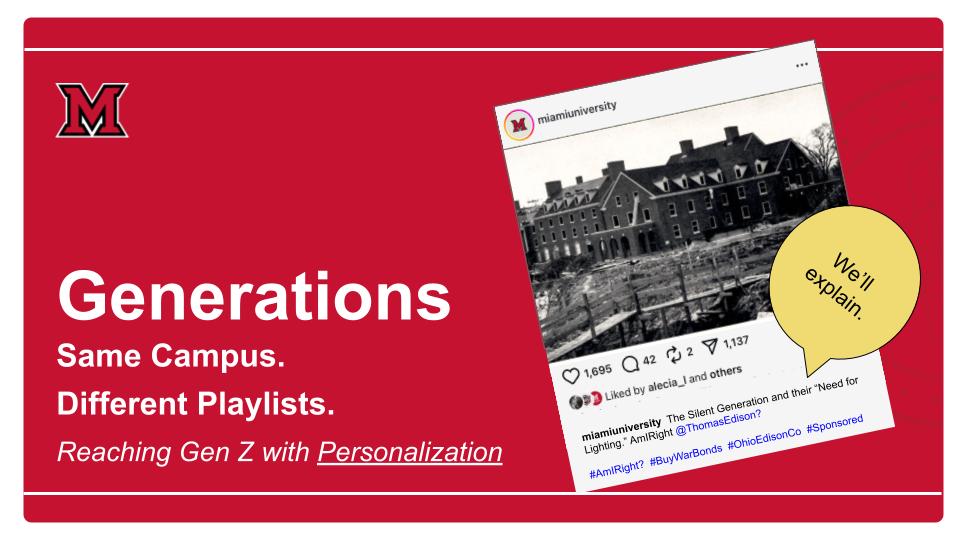
Every generation arrives on campus with its own soundtrack—shaped by the world they grew up in, the technology they embraced, and the values they carry. Understanding those differences isn’t just interesting; it’s essential for communicating with students in meaningful, effective ways.
Today’s prospective students—especially Gen Z—expect more than good marketing. They expect content that feels tailored, relevant, and personal. Even when institutions don’t have personal data like names or preferences, students still respond when a message signals, “We see you, and we get you.”
This blog breaks down how generational differences influence communication preferences and how universities can use these insights to craft more resonant and personalized content.
Why generations matter in higher ed communication
Generational identity forms through shared cultural moments, technological shifts, and life experiences. These collective influences impact how people learn, communicate, and make decisions—including decisions about college.
Thinking generationally helps us:
- Understand expectations around technology and communication
- Anticipate what styles and formats will resonate
- Identify the tone, pacing, and channels students trust
- Personalize messaging in ways that feel authentic to the audience
It’s not about stereotyping; it’s about meeting people where they are.
A quick tour through the generations
Each generation grew up in its own communication environment—and that shapes how they engage with messages today.
Silent Generation (1928–1945)
Values: Duty, discipline, loyalty, respect for authority
Communication Style: Formal, private, and rooted in handwritten letters, phone calls, and in-person conversations
Their mantra: “Don’t air your dirty laundry in public.”
Baby Boomers (1946–1966)
Values: Optimism, ambition, activism, status
Communication Style: A blend of calls, letters, and early digital communication; warm and community-oriented
Boomers pioneered “Keeping up with the Joneses”—and became the first TV-shaped generation.
Generation X (1967–1980)
Values: Independence, skepticism, work-life balance, loyalty to close relationships
Communication Style: Casual, straightforward, shaped by landlines, email, and early digital tools
They may as well have coined the phrase “Whatever.”
Millennials (1981–1996)
Values: Collaboration, social justice, innovation, meaningful experiences
Communication Style: Fast, emoji-filled, digital-first—but also adaptable to professional tones
The “YOLO” generation expects both convenience and authenticity.
Gen Z (1997–2012)
Values: Individuality, digital creativity, wellness, practicality, activism
Communication Style: Memes, videos, group chats, DMs—brief, visual, authentic
If Millennials said “YOLO,” Gen Z says, “It’s giving…” and moves on.
This generation has grown up in an always-on world. They don’t remember life without smartphones. As a result, they expect communication to be fast, visual, relevant, and personalized—even at scale.
Gen Alpha (2013–2025)
Values: Deep digital fluency, personalization, inclusivity, creativity
Communication Style: Video-first, interactive, multimodal
They’re already reshaping how we think about engagement—and they’re still in elementary and middle school.
The science of personalization
In marketing and storytelling, personalization isn’t simply knowing someone’s name. It’s signaling relevance—showing that you understand their hopes, questions, concerns, and where they are in the decision-making process.
Even when we don’t have personal data, we can personalize through:
- Voice and tone
- Visuals that reflect identity and aspiration
- Stories shaped around generational values
- Formats designed for how that audience consumes content
Students pay more attention when content feels like it was made for them—not for everyone.
Putting it into practice: A generational approach to content
Even a simple message can be tailored by generation.
Example: Postcard
Start with a warm campus photo and the line “Imagine Yourself Here.” Then shift emphasis based on audience:
- Gen X families: outcomes, stability, practicality.
“Discover a campus where hard work pays off and support leads to real results.” - Millennial parents: experiences, belonging, values.
“Find a campus where your student can be themselves, feel supported, and thrive.” - Gen Z students: individuality, authenticity, opportunity
“Imagine a place where you can build your own path, find your people, and try what’s next.”
Key takeaways
1. It’s not about you.
Your audience has different references, expectations, and assumptions than you do.
2. They know different things than you know.
Each generation arrives with its own context. Tailor messages to what they understand naturally—and what they don’t.
3. Meet them where they are.
Different generations use different platforms, seek different tones, and expect different levels of personality, polish, and speed.
4. Personalization drives engagement.
Not because you know their name—but because you know them.
Final thoughts
Students may share the same campus, but they show up with different playlists, worldviews, and communication preferences. When universities take the time to understand those differences, they build stronger connections, strengthen trust, and ultimately help students see themselves reflected in the institution.