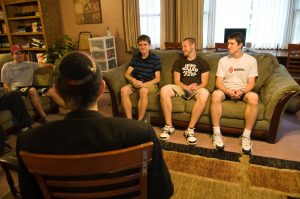
For the August 2018 trip, I visited with 3 student research assistants from 2017 and 5 students who were new to the WBC-Topeka encounter. It was clear to those from 2017, including myself, that the Church was presenting a different look and feel than last summer. Indeed, it’s fair to say that a couple of Church members confirmed that their approach to us had shifted.
Our project aims to carry out a methodology that is adapted from known methods, but not heretofore applied to WBC, one of the most hated, provocative, and isolated religious groups. The methodology calls for us to:
- Stick to the role of a critical-empathetic observer, in order to understand cognitively and emotionally their perspectives, attitudes, feelings, and idears.
- Speak and engage with church members, and publicly, in a nonjudgmental manner. Refrain from any direct or implied condemnation or praise of the Church or its activities.
- Be warm, friendly, attentive, respectful, and curious, as with any religious and ethnic group one might study.
- Do more listening than telling. Be open-hearted and, in effect, open-minded.
Our rapport, relationship-building, and improved interactions with WBC may be indicated by the following:
- WBC members appeared friendlier, more cooperative, less combative, hostile, or aggressive.
- This was true of every church member in my rough age cohort. While Steve Drain expressed disdain for academia, he did so in perhaps a softened way. (Some pointed comments about Jews may have been intended to test or unsettle me, but there were far less than in the past.)
- I hadn’t spoken before (except incidentally) with the younger generation interviewees. A few came across as distrustful or combative, but such behaviors mostly dissipated during our encounters.
- This kinder conduct toward outsiders does fit with my article’s analysis of their picketing signs, with their heightened emphasis on scriptural charity, and (as I heard described) as a gentler or softened style in the Westboro Baptist Church.
- Caveat: Interviewees were self-selected, not chosen randomly. Members who declined to be interviewed could be those more antagonistic to my project or more hostile to outsiders. Nonetheless, at a communal level, isn’t such self-selection (hostility avoidance) by individuals itself a form of cooperation and hospitality?
- My recent article, front page of the Capital-Journal of Topeka, was favorably received and discussed with WBC. Even their criticisms were framed as minor. See RNS version.
- Before the visit, Steve Drain cooperated with info and photos for the RNS article. This article (and social media posts) could have disposed WBC favorably to us.
- Eight student research assistants helped create goodwill by assiduously following the protocol. They did not report any hostile or aggressive questioning or confrontations with any WBC members.
- Our 2018 team built upon the 2017 work of five students, three of whom returned, though that 2017 group had reported hostility from WBC on a number of occasions.
- Two collaborative projects were discussed:
- With Tim, a co-authored article on (Jewish eschatology) and the Zionist movement;
- With Margie, a co-authored article on the draft Principles of Harmful Speech and Nonviolence toward WBC.
- Caveat: In 2011, I discussed their participating in demonstration interviews at Miami. I never proposed such collaboration because they never seemed so responsive and cooperative to me before. I may have been wary
- Three families brought children (including minors) to interview. I had seen interest from families in 2010 but not in recent years.
- A couple of minors were enthusiastic to speak with me. Family interviews: Shirley and 3 sons; Sam/Jen and 1 minor (another watched); Charles/Rachel and 5 children.
- Interviewees discussed the project in neutral or favorable terms.
- Several talked about their “interest” or “curiosity” in where I am going with this project, viewing the inquiry as academic (e.g., Tim, Charles, Steven H). We sensed a consistent and rather favorable narrative about me and the project.
- Charles compared our inquiry favorably to media and other scholarly projects, which have a clear (and perhaps incompatible) end product (Charles). Whereas the past trope was to portray my inquiry as the same as anyone’s and not memorable, this year a few interviewees treated our project as different than what they get from other outsiders.
- In his sermon, there was Jon’s explicit positive reference and a double coding to the Miami team. He also said that a hymn was chosen for us.
- Paulette said that Dr. Gray’s descriptive work is fair, though not necessarily accurate.
- WBCers appear to trust me more, some said as much [check]. Nobody openly broached the possibility that I am a wicked or satanic threat, even if they still feel it.
- There are numerous examples of new information shared with us, which is indirect evidence of trust and relationship-building.
- Biographical info, including many incidents of harmful behavior toward them
- Examples of open expression of feelings and experiences: Abigail, Becky P-D, Bethany, Brent (about Fred Sr.), Jen, Margie, Steve H, and possibly Tim.
- WBC collected and destroyed a set of picketing signs that it no longer uses. I can now ask Steve Drain for this list, which could justify a follow-up to the article cited above.
- More “social” interactions.
- The interview with young women was fairly casual and free form.
- Drains invited the project team to dinner. (Granted, I had not asked in the past.)
- The Bible reading invitation was not offered last year. (At Ben & Mara’s in 2016.)
- Jon invited students to swim in the pool.
- WBC invited us to the church service, where a few people interacted with us.
- They also invited us ad hoc to their group singing.
- Shirley lent my female students scarves as head coverings.
- Jon referred to Dr. Gray as possibly one of God’s army, etc. While consistent with the sharp dualism of WBC theology (elect vs reprobate, sheep vs goats, Good vs Wicked, Church vs Enemies), this still hints at a category for the more trustworthy or fair-minded non-elect.
- A picket to KC with my students was canceled, they said, so as to avoid risk to the students. To be sure, WBC cooperates with the policy to ensure their safety at pickets. But it’s uncommon for them to assert or even communicate that they made a change for the sake of outsiders.
- In its place, two WBCers agreed to an open-ended interview, which lasted 3 hours.
Overall, the evidence strikes me as fairly strong: there is increased trust, openness, and cooperation. It takes two to tango: folks from both WBC and our Miami team have taken steps and made overtures to improve our personal and working relationships.
Perhaps a foundation is being built, stone by stone, line by line, conversation by conversation, with this strange work, listening to each other. Even if we mess up and fall backward, maybe we can get back on track by not making haste.
This blog post is a work-in-progress. It may be edited as we assimilate the data and student reports.


 .
.