Author Archives: grayhc

The impact of in-person encounters: Topeka 2023

While Topeka, Kansas may not be high on everyone’s list of travel destinations, I was thrilled when Dr. Gray invited me to conduct field work interviewing members of the Westboro Baptist Church. I am so grateful to have had the opportunity to challenge my perspectives and improve my research skills in a unique setting. I have been a research intern with the Empathy and the Religious “Enemy” for almost 2 years. Through my work, I have practiced critical distance by taking the position of a non judgemental outsider and learned how to avoid using prescriptive language by refraining from making moral or theological statements. I was surprised by how much I felt that having possessed these skills benefited me when interacting with church members in person. 
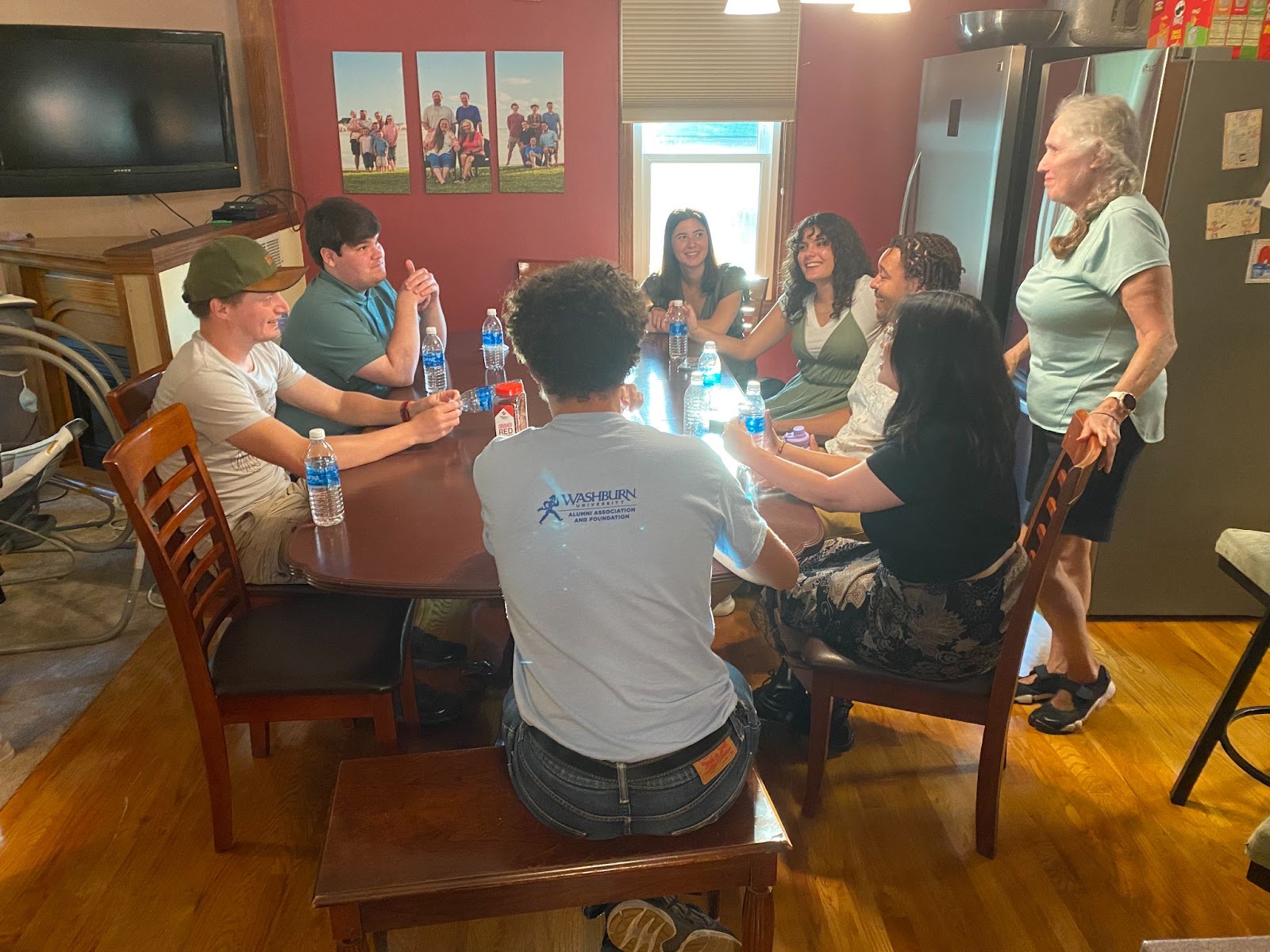
One of the most fascinating parts of the field work was noticing how my preconceived notions of the church members were contradicted by how I felt when interacting with them in person. The church has historically had a significant amount of representation in the media in response to their public protesting and anti-LGBT, anti-military, and anti-Catholic beliefs. I had seen videos of Westboro Baptists shouting homophobic slurs and other controversial language, which caused me to expect hostile and rude behavior from the church members. To my surprise, many of them were excited to engage in conversations and let us see a glimpse of their lives. We were often greeted with hospitality; one church member, Margie Phelps, even offered us homemade zucchini muffins when we interviewed her in her home. This simple gesture made me feel welcomed in an environment in which I would typically feel rather uncomfortable, as I was in a stranger’s home with a woman whom I had no idea how to interact with. Over the course of 4 days in Topeka, I learned practical skills, such as how to foster productive conversations and ask probing questions that will lead our team to develop connections with the church members. I also developed less tangible skills, as I tuned into my emotions and found ways to relate to those with whom I disagree. I have surrounded myself with like-minded individuals for my whole life, and I realize now how important it is for me to go out of my way to expose myself to other perspectives, cultures, and lifestyles. 

As someone who doesn’t typically enjoy “small talk”, I knew that this research would be out of my comfort zone, as I was challenged to engage with people with whom I thought I had nothing in common. However, ultimately this challenge allowed me to learn more about myself and others. I gained confidence in my own abilities as an interviewer, researcher, and team member. I expected to struggle to come up with questions to ask, and I dreaded the inevitable awkward pause in a conversation. To my surprise, I found that the opposite was true, and I usually had a hard time stepping back to give someone else a turn. We collected over 10 hours of interview footage, plus many more minutes spent engaging in side conversations between our scheduled meetings, and I was easily able to maintain engagement the entire time and often felt like I played an active role in the discussions.

I felt the greatest sense of empathy on this trip during moments when I sensed familiarity. One night, we went to Shirley Phelps’ (WBC member) house for dinner with her family. I was transported back to my childhood, and I immediately thought about how my family would attend dinner parties at neighbors’ houses. I was reminded of being forced to hang out with kids I didn’t know well, and how we always found ways to play together and have fun. At Shirley’s, we chatted with 3 of her sons (and a fiance) about all kinds of things, such as the current popular movies, school courses, and even anime. It was a situation so unique in nature that I know I would likely never experience this again, and I found myself feeling sad as we left the get together because I had felt a personal connection with these people who I had just met. That evening, I felt empathy as the evident familiarity reminded me of the many life experiences that I did share with the WBC members, who I had initially perceived as so different from me. 

We had the unique opportunity to travel with church members to Kansas City for a picket, which presented the opportunity to converse in the car for a few hours. I rode in the car with Tim Phelps and several other students, and I was surprised by the familiarity I felt at that moment. Going into the car ride, I was nervous as I expected not to have any idea what to talk about. I soon realized that I had done this a million times before – it reminded me exactly of riding in the back seat of my friends’ parents’ cars as we carpooled to after school activities. The small talk about weather, local sports, and electric cars felt like a conversation that I could have had with anyone’s Dad, and I felt a personal connection with Tim as I was reminded of many relationships I have in my own life. Looking back, the reason that I was nervous was due to the preconceived notion that I could never have a comfortable conversation with Tim Phelps in a casual setting because we have extremely different values and ways of life. The experience led me to modify the judgments that I had made, and I was able to see a side of Tim that was different from what the public typically sees. 

One of my main takeaways from this trip is that you cannot pretend people who are different from you don’t exist and that having different values does not make someone less of a person. It is incredibly important for me to immerse myself in difficult, uncomfortable, and unique situations so that I can not only enhance my empathy for others but also to learn more about myself and grow as an individual. There were certainly times during my time at Westboro that I felt extremely out of place, such as when everyone mingled after the church students and several other students and I had to nudge our way into conversations. At times, the trip felt emotionally draining and I found myself nervous of saying the wrong thing, but I adjusted to this feeling and became more comfortable as the weekend progressed. I enjoyed working with all of the other ERE student researchers on the team, and we learned a lot from each other in various ways throughout the trip. The team was composed of a variety of different people, including from science majors like myself, humanities majors, and a Miami graduate. Our unique identities and interests led us to have a variety of perspectives when we discussed and analyzed each day’s activities, and we built up a sense of trust with each other as we collectively processed our emotions. 

Relating to WBC sisters Kathy and Shirley

With groups as controversial as Westboro Baptist Church (WBC), it can be easy to focus solely on divisive beliefs. WBC members are known to the general public for sharing controversial messages about God and the LGBTQ+ community. Despite this, WBC members’ vulnerability and openness in over a decade of interviews with Empathy and the Religious “Enemy” (ERE)  has allowed our team to access a uniquely human perspective on their lived experiences. In Kathy and Shirley Phelps’ interview in the summer of 2022, both sisters openly reflect on personal memories of their late mother (Marge Phelps, wife to WBC founder, Pastor Fred Phelps Sr.), sharing their emotional experience caring for her during her last few months. I was surprised to see them become deeply emotional throughout the conversation, describing  shockingly relatable experiences. 

Though many people take on a caretaker role for an elderly parent at some point in their lives, it is seldom discussed in casual conversation due to the sensitive nature of the subject. I would have expected Kathy and Shirley to deflect such emotionally probing topics and avoid talking about personal matters. However, they willingly opened up about their own experiences caring for their mother as she grew older. These women demonstrated vulnerability, not just with each other, but also with the interviewers. The majority of their personal memories were noticeably intertwined with religion. For example, when talking about her mother’s fading memory, Shirley highlights the fact that even when she forgot other things such as the names of her grandchildren, she always remembered every detail about scripture. Similarly, Kathy mentions that she read to her mother during the last few days, specifically passages from the Bible “that would comfort her”. Later, Shirley talks about a scripture app she used to share with her mom, sharing that she can no longer use this specific app because it makes her feel too sad. 

These repetitive mentions of scripture demonstrate the value placed upon religion by Shirley and her mother, especially given that her mother’s longest memories were in regards to religious beliefs. Other memories shared also strongly highlight the importance of family in their lives. Despite the underlying sadness in the conversation tone during this interview, Shirley maintained a mood of positivity, especially when discussing how helpful it was to have all of the family members working together. She described the various ways her sisters helped, such as with her mother’s meal planning and nutrition. It is clear that her sisters continue to provide her a strong support system and community. 

I found it especially moving when ERE team member, Jason, shared his own personal story relating to caring for his father, reflecting on a similar memory he remembered when speaking with Kathy and Shirley. Hearing Jason’s memory, Jason, Shirley, and Kathy collectively reflect upon the responsibilities of caring for a parent who is becoming forgetful, seeming to bond over their experiences of this stressful yet common life event. When I was reviewing the footage of this interview, I was moved by the personal connection that this emotional discussion led to, thanks to Kathy and Shirley’s vulnerability and willingness to open up. I found myself personally relating to the emotions they felt as I reflected on my own aging family members, and was surprised to find myself relating so deeply to their experiences. Scott, another ERE team member, recalled how Shirley’s vulnerability made him feel comfortable about opening up about his own feelings during the conversation. When asked about this specific moment months later, he shared, “Because she had already talked about her own experiences, it made it a lot easier for me to tell her a bit about some of the hardships I had gone through with my own mother. When Shirley and Kathy decided to take on the role of opening up emotionally in the discussion, it made it easier for everyone else to do the same!”

Kathy and Shirley were physically moved during the interview, as their voices broke up and tears were shed while they attempted to put their feelings into words. They clearly reflected deeply in order to answer our questions with great consideration, as evidenced by long pauses before responding to questions and pensive facial expressions. 

Yet Differences in Kathy and Shirley’s personalities were exhibited through different behaviors throughout the interview. Notably, they demonstrated by varying ways of managing the discomfort in emotional reflection. Kathy continuously played with her hands, exhibiting anxious behaviors as the conversation progressed to a deeper emotional level. She teared up when recalling how she was separated from her mother for a period of time, struggling to find words to express her emotions until she simply stated, “I mainly cry because I miss her”. While this emotional discussion seemed to make Kathy a little bit uncomfortable, she did not deflect questions and instead openly expresses her emotions. Kathy remained quieter throughout the interview, yet Shirley rarely held back when she had thoughts to share. Shirley also became emotional, seen when she too teared up, but she lightened the mood through humor. Speaking to both parents’ passing, she joked, “Now I’m an orphan. I’m an old orphan, but I’m an orphan”. The use of humor may demonstrate her comfort in the interview environment, but could indicate a strategy to distract from the sadness that she feels, as she appeared quickly ready to switch conversation topics as soon as she is able to. Another ERE team member, Annalise, described her own reflection to the emotions expressed in this interview – “I completely understand that caretaking is a gratifying and healing, yet frustrating and painful experience. It is a hard adjustment when the person who used to take care of you is now the one being taken care of, and there’s a mixture of emotions involved. In that way I think it was easy for me to relate to Shirley and Kathy’s feelings, because they are complex and often indescribable, and so is a lot of life.” 

Groups may be dehumanized when their emotions are not acknowledged, such as is often seen in the case of the WBC. While it can be much easier to separate yourself from people that you refuse to relate to in any way, this leads to a divisive culture that will ultimately only become further polarized. Practicing critical distance in situations such as interviewing the WBC members allows our team to have productive and insightful conversations. By approaching subjects from a non-judgemental and academic standpoint, we are able to facilitate a conversation in which our team can focus on lived experiences rather than controversial theologies. Interacting with people on an emotional level can be an excellent exercise in empathy and will help bridge the gap between people with different views. It is inevitable that groups of people will disagree on values and beliefs, but connecting with others in a way that reveals their emotional vulnerability may reduce hostility and result in an overall more empathic environment.

By Emily Ennis, intern, Miami University

January 2020 trip to Topeka, KS

They’re back! On January 9-13, Dr. Hillel Gray and a team of seven student research assistants will conduct field work in Topeka. The team will meet with a few Topeka residents from the LGBT and Jewish communities, while focusing primarily on interviews and observations at the controversial Westboro Baptist Church.

We anticipate interviewing two daughters of founder Fred Phelps, Sr., as well as members of three churchgoing families. Students will also observe a home Bible reading, the WBC’s emblematic street preaching, an evening get-together for singing hymns, and a Sunday worship service.

The schedule is organized thanks to Steve Drain, one of eight Elders who rotate preaching responsibilities at Westboro Baptist Church.

During the spring semester, several student researchers will be doing follow-up research on Westboro Baptists.

Observable shifts in our interactions with Westboro Baptists (draft)

For the August 2018 trip, I visited with 3 student research assistants from 2017 and 5 students who were new to the WBC-Topeka encounter. It was clear to those from 2017, including myself, that the Church was presenting a different look and feel than last summer. Indeed, it’s fair to say that a couple of Church members confirmed that their approach to us had shifted.

Our project aims to carry out a methodology that is adapted from known methods, but not heretofore applied to WBC, one of the most hated, provocative, and isolated religious groups. The methodology calls for us to:

  • Stick to the role of a critical-empathetic observer, in order to understand cognitively and emotionally their perspectives, attitudes, feelings, and idears.
  • Speak and engage with church members, and publicly, in a nonjudgmental manner. Refrain from any direct or implied condemnation or praise of the Church or its activities.
  • Be warm, friendly, attentive, respectful, and curious, as with any religious and ethnic group one might study.
  • Do more listening than telling. Be open-hearted and, in effect, open-minded.

Our rapport, relationship-building, and improved interactions with WBC may be indicated by the following:

  • WBC members appeared friendlier, more cooperative, less combative, hostile, or aggressive.
    • This was true of every church member in my rough age cohort. While Steve Drain expressed disdain for academia, he did so in perhaps a softened way. (Some pointed comments about Jews may have been intended to test or unsettle me, but there were far less than in the past.)
    • I hadn’t spoken before (except incidentally) with the younger generation interviewees. A few came across as distrustful or combative, but such behaviors mostly dissipated during our encounters.
    • This kinder conduct toward outsiders does fit with my article’s analysis of their picketing signs, with their heightened emphasis on scriptural charity, and (as I heard described) as a gentler or softened style in the Westboro Baptist Church.
    • Caveat: Interviewees were self-selected, not chosen randomly. Members who declined to be interviewed could be those more antagonistic to my project or more hostile to outsiders. Nonetheless, at a communal level, isn’t such self-selection (hostility avoidance) by individuals itself a form of cooperation and hospitality?
  • My recent article, front page of the Capital-Journal of Topeka, was favorably received and discussed with WBC. Even their criticisms were framed as minor. See RNS version.
    • Before the visit, Steve Drain cooperated with info and photos for the RNS article. This article (and social media posts) could have disposed WBC favorably to us.
  • Eight student research assistants helped create goodwill by assiduously following the protocol. They did not report any hostile or aggressive questioning or confrontations with any WBC members.
    • Our 2018 team built upon the 2017 work of five students, three of whom returned, though that 2017 group had reported hostility from WBC on a number of occasions.
  • Two collaborative projects were discussed:
    • With Tim, a co-authored article on (Jewish eschatology) and the Zionist movement;
    • With Margie, a co-authored article on the draft Principles of Harmful Speech and Nonviolence toward WBC.
    • Caveat: In 2011, I discussed their participating in demonstration interviews at Miami. I never proposed such collaboration because they never seemed so responsive and cooperative to me before. I may have been wary
  • Three families brought children (including minors) to interview. I had seen interest from families in 2010 but not in recent years.
    • A couple of minors were enthusiastic to speak with me. Family interviews: Shirley and 3 sons; Sam/Jen and 1 minor (another watched); Charles/Rachel and 5 children.
  • Interviewees discussed the project in neutral or favorable terms.
    • Several talked about their “interest” or “curiosity” in where I am going with this project, viewing the inquiry as academic (e.g., Tim, Charles, Steven H). We sensed a consistent and rather favorable narrative about me and the project.
    • Charles compared our inquiry favorably to media and other scholarly projects, which have a clear (and perhaps incompatible) end product (Charles).  Whereas the past trope was to portray my inquiry as the same as anyone’s and not memorable, this year a few interviewees treated our project as different than what they get from other outsiders.
    • In his sermon, there was Jon’s explicit positive reference and a double coding to the Miami team. He also said that a hymn was chosen for us.
    • Paulette said that Dr. Gray’s descriptive work is fair, though not necessarily accurate.
    • WBCers appear to trust me more, some said as much [check]. Nobody openly broached the possibility that I am a wicked or satanic threat, even if they still feel it.
  • There are numerous examples of new information shared with us, which is indirect evidence of trust and relationship-building.
    • Biographical info, including many incidents of harmful behavior toward them
    • Examples of open expression of feelings and experiences: Abigail, Becky P-D, Bethany, Brent (about Fred Sr.), Jen, Margie, Steve H, and possibly Tim.
    • WBC collected and destroyed a set of picketing signs that it no longer uses. I can now ask Steve Drain for this list, which could justify a follow-up to the article cited above.
  • More “social” interactions.
    • The interview with young women was fairly casual and free form.
    • Drains invited the project team to dinner. (Granted, I had not asked in the past.)
    • The Bible reading invitation was not offered last year. (At Ben & Mara’s in 2016.)
    • Jon invited students to swim in the pool.
    • WBC invited us to the church service, where a few people interacted with us.
    • They also invited us ad hoc to their group singing.
    • Shirley lent my female students scarves as head coverings.
  • Jon referred to Dr. Gray as possibly one of God’s army, etc. While consistent with the sharp dualism of WBC theology (elect vs reprobate, sheep vs goats, Good vs Wicked, Church vs Enemies), this still hints at a category for the more trustworthy or fair-minded non-elect.
  • A picket to KC with my students was canceled, they said, so as to avoid risk to the students. To be sure, WBC cooperates with the policy to ensure their safety at pickets. But it’s uncommon for them to assert or even communicate that they made a change for the sake of outsiders.
    • In its place, two WBCers agreed to an open-ended interview, which lasted 3 hours.

Overall, the evidence strikes me as fairly strong: there is increased trust, openness, and cooperation. It takes two to tango:  folks from both WBC and our Miami team have taken steps and made overtures to improve our personal and working relationships.

Perhaps a foundation is being built, stone by stone, line by line, conversation by conversation, with this strange work, listening to each other. Even if we mess up and fall backward, maybe we can get back on track by not making haste.


This blog post is a work-in-progress. It may be edited as we assimilate the data and student reports.


Recap: Interviews and other interactions

Our trip to Topeka was very productive. It demonstrated significant and observable progress. While progress comes partly through the quality of interactions that we’re pleased to have with the WBC community, it helped to have a good quantity of interactions. We recorded more than 20 hours of interviews.

We appreciate WBC for its hospitality, cooperation, and devoting so much personal and family time to the interviews.

Here’s a breakdown of the main interactions in the field, with (random) highlights:

  • Steve Drain, welcoming interview, 0:30 hr:min
  • Tim Phelps, scheduled interview, Thursday, 1:54
    • Understanding employees; personality traits; childhood and young adult experiences; Israelite tribes and priestly classes; idea of co-authoring an eschatology piece with Dr. Gray; “you write one article a week and I got your back” (1:31); interest and curiosity about where our project is going
  • Abigail Phelps, scheduled interview, Thursday, 1:50
    • Her work on offender re-entry; knowing someone with an abusive father; understanding personality types (My True Colors, e.g., helper, right thing to do, control, cerebral); experiences of prejudice; compartmentalization and Others; she recommends distributing our “Principles of Harmful Speech and Violence” to SPLC, ADL, etc.
  • Rebekah Phelps and Kathy Griffin, scheduled interview, Thursday, 1:49
    • Kathy into and through law school, with Becky’s help; Kathy’s journey in and out of the church; family relationships; Becky’s work in family law, its stress and emotions; “he took my client’s child when she was nursing that baby” (1:40)

  • Singing hymns in the church (not recorded,  ad hoc participation)
  • Jonathan and Paulette Phelps, ad hoc scheduled interview, Friday, 2:53
    • Students conducted this interview on their own.
    • Originally, six students were to accompany Jon and Paulette to Kansas City and observe their picketing. WBC canceled it, they said, due to safety concerns for our students.
    • School situations and family relationships; Paulette’s joining the church; racism and class; doctrinal matters; their impressions of our project, “fair not accurate,” Ps. 68:11 and “he’s simply enrolled in the army of the lord”  (2:42:28)
    • “What possessed you to traipse across [many] miles… to come here and to want to sit through this? Seriously.” (2:43) As a teacher, I appreciate that Jon took the time to listen to the students reflect on their reasons for voluntarily signing up for this trip.
  • Field-observation of WBC picketing, Friday morning (not filmed)
  • Shirley Phelps-Roper and Brent Roper, scheduled interview, Saturday, 1:40
    • Charity in the WBC sense; Brent’s relations at work and charitable volunteerism; their early relationship; personality, temper, passion; Brent’s love for Pastor Phelps; posters that were eliminated; newborn babies’ names
  • Jonah, Gabe, and Noah Phelps-Roper, with Shirley, scheduled interview, Saturday, 2:02 (G and N after 1:40)
    • experiences at school and college (e.g., bullied to “say you’re gay”); career plans; their questions about practicing Jews; participation with our project
  • Margie Phelps, scheduled interview, Saturday, 2:26
    • her work on the SCOTUS Snyder v. Phelps case, “I gotta know the story” (1:54:15 to 2:06:01); anti-WBC prejudice in agencies; managing chaos; style to improve: “how to effectively navigate a negative, disruptive, bullying person” (~32); possibility of co-authoring an op-ed on the draft “Principles of Harmful Speech and Violence”
  • Spaghetti dinner with Steve, Luci, Boaz, and Faith Drain (not filmed), Saturday. Thank you!
  • Family Bible reading led by Steve Drain, Saturday, 1 hour. Ecclesiastes ch.5
  • Bekah Phelps-Roper, Deborah Phelps-Davis, Faith Drain, Becky and Julia Jaques, Esther Griffin. Scheduled interview, Saturday, 1:08 hr:min
    • This was, in effect, a “bridging conversation” conducted by the Miami student team. Topics included personal interests, career ideas, relations within the church and with schoolmates, and popular culture.
  • Field-observation of WBC picketing, Sunday morning (not filmed)
  • Church service, including sermon by Jonathan Phelps, prayers by Steven [H] (07:00) and Brent (39:50), two hymns, 0:49 min.
  • (Tim Phelps and Hillel Gray, ad hoc planning of a co-authored article on eschatology and Zionism, Sunday, 0:33 min)
  • Sam, Jen, Isaac, and Moriah Phelps, (minors in room), scheduled interview, Sunday (1:42)
    • Hospice and nursing work; transgender girl in school and other challenges (“Why do you believe in a God that created people just to destroy people?” 19:05); dealing with emotions and religion in the workplace; missing the Hockenbarger parents; their “courtship” narrative
    • Value of retelling emotional stories and participating in the project’s interviews (Jen, Isaac, and Sam separate times)
  • Charles, Rachel, Steven, Ruth, Bethany, (Jeremiah and Gideon) Hockenbarger, scheduled, Sunday, 2:10 hr:min
    • Rachel as a Judge Pro Tem working on state custory; Steven at work (40:20) “I am a robot” <joke>, Bethany at 47:30; Charles on our project different than media, and other scholars, by not having a certain end-product

This is a work-in-progress. We hope to prepare better summaries down the road.

Interview plans for WBC, Aug 9-13

Our interview schedule is getting set up!

In Topeka, the Westboro Baptist interviewees will include, among others:

  • 8 children of Fred Phelps, Sr. (Abigail, Elizabeth, Katherine, Margie, Rachel, Rebekah, Shirley, Tim)
  • 8 or more Phelps grandchildren
  • 4 married couples
  • 1 dinner & family Bible reading with The Drains
  • and a trip with a WBC picketing team to Kansas City, accompanied by Jon and Paulette Phelps. (Students will probably visit a picket in Topeka, too.)

Our team members may also meet with some non-WBC residents of the area, informally. We’re in the process of arranging these.

WBC reacts to our analysis of the church’s gradual rebranding

Yesterday, Religion News Service published our analysis of Westboro Baptist Church’s recent shifts in its messaging, especially its controversial picketing signs.

Basic premise: Since founder Fred Phelps, Sr., died, the church has softened its image and moved in several new directions with its signs. WBC seems to be responsive to public concerns, which may point to a day when the public itself notices that the church might be open to meaningful conversations.

On Twitter, WBC’s reaction to our article was swift!

Jael as a bride

From Jael Holroyd on Twitter:

This article by is not terrible: [link to article]

From Jael again, simply quotes and gives a thumbs up to a crucial caveat in the article:

“Make no mistake, Westboro Baptists’ anti-gay message is as blunt and offensive as ever, and the new signs seem designed not to move toward the mainstream, but to more fully reflect the church’s Calvinist theology, which appears unchanged.” [and two emojis:]

Tim (@WBCApocalypse) retweeted Jael with the comment:

“… as it ever should, and by God’s mercy will, ever be.”

From the official WBC twitter account, WBCSaysRepent:

“We are always only interested in preaching the truth of the Scripture.” —Westboro Baptist Church.

I think he gets it! Excellent article via and @hgray: [link to article]

From Matthias Holroyd on Twitter:

“For though I preach the gospel, I have nothing to glory of: for necessity is laid upon me; yea, woe is unto me, if I preach not the gospel!” (1 Corinthians 9:15)

From Steve Drain on another Twitter account:

Funny speculation by : “We can wonder if the gradual reworking of Westboro’s messaging might point to a day when outsiders think of the church not as irredeemable sociopaths. […]” We wonder when the media will stop painting this little church as such! 

[Steve included a two minute video clip that ended in a curiously careful way, referring to authentic news with proper sources, in contrast to media bias. I’m tempted to take that as an ambiguous compliment.]

[“Funny speculation” is also a careful phrase. It doesn’t question my framing or facts, just teases perhaps about the likelihood of outsiders ever viewing in a better light. See the continuation of the quote, at the end of the original article.

From @WBCRejoice on Twitter:

This [article] is good, especially for a Christ rejecter; but nix the psychobabble already, friend . [Link to article]

In addition, a number of other Westboro Baptists retweeted, liked, or (more rarely) commented on the items above.

In short, we hope the article meets journalistic, critical-distance standards, advances public understanding, and does not unnecessarily annoy WBC, perhaps even improving our rapport with them.

  • For civil and respectful discussion of our critical-empathetic approach to WBC, and of our upcoming WBC interviews in Topeka Aug 9-13, join our Facebook group! Or comment on our posts here.

P.S. I also forwarded the RNS daily digest, with our article as a the lead item, to Steve Drain. His reply was typically concise: “We saw it. Thanks man.”

7-15 WBC sermon on moral duty to the elect insiders… and also to outsiders (!?)

Yesterday’s WBC sermon focuses mainly on their duty toward other church members. I posted my explanation on Twitter.

However, the sermon also deals with Westboro Baptists’ duties to “do good unto all men” (Gal 6:10), including outsiders, who are presumably unsaved (and damned) due to their unrepentant sinning. The sermon recognizes that this issue — of charity toward others — is sometimes a set-up to make the WBC look bad. Yet the preacher also see this as a real duty. And pro-active. Read my analysis on Twitter.


Dr. Gray’s WBC blog at Quora

Listening to 3rd generation WBC’ers

For a few years, Dr. Gray wrote posts about Westboro Baptist Church on the Q&A website Quora. A few examples:

How does the Westboro Baptist Church think they’re doing good?

Does the Westboro Baptist Church have any redeeming qualities?

What is it like to meet Fred Phelps in real life?

What does it feel like to be part of the Westboro Baptist Church or know somebody who is part of the WBC?

Do Christian theologians think Fred Phelps will go to heaven or hell?

Will Fred Phelps’ funeral be picketed? Have the funerals of other members of WBC been picketed?

Why is the Westboro Baptist Church so hyper-focused on homosexuality as the crux of its doctrine, protesting, and picketing?

What are the third-generation Phelps family members like in person?

What do you think about Planting Peace’s choice to buy a house opposite Westboro Baptist Church?

Have you, or anyone you know, ever verbally engaged a member or members of the Westboro Baptist Church during a picketing of theirs?

How did the Westboro Baptist Church come to choose Kabel Ultra as the typeface for their protest signs?

Please let us know if you would like more information about one of these posts, if you notice any mistakes, or if you have your questions about WBC.


Response from Westboro Baptists about August ’18 trip

Our summer 2018 research team had its first meeting yesterday evening, May 10th. We’ve got 7-8 students planning to go!

By coincidence — or divine ordination, depending on one’s perspective — that same evening, Steve Drain of WBC emailed me about expectations and options for the visit.

Besides whatever interviews that WBC members choose to schedule, students may be invited to some meals with church members and to attend a family’s evening Bible reading. I think we’d learn a great deal from these opportunities.

Steve also reiterated that the church’s sole interest is in preaching (i.e., teaching) the Gospel and “serving the Lord.” He views scholarly research in a rather dim light, based partly on his own insider experience in academia.