Miami University

Daniel E. Meyers

Dan's Home on the W3

Skip to content

Section 05 – The 1940s

Irvin Hall’s Centennial: 1925-2025
Miami University, Oxford, Ohio

Home
Previous Section
The 1940s
CLASS IMPRISONED

With faces drawn and anxious, Mr. E. J. Brawn’s math review class waited with halted breath for Jim Ross and his rescue party to help them to escape from the room In which they had been trapped for an hour and a half.

When Mr. Brown's class attempted to leave room 103 Irvin hall, where they had been reviewing math since four o'clock, they found that the door had been locked by janitor Jim Ross.

While waiting for Jim's return, after Prof. G. W. Spenceley had called him, several boys made good their escape through the windows. In despair for fear that Jim would not arrive in time to liberate them for dinner, the trapped mathematicians had some friends on the outside remove the door from its hinges and release them from their educational tomb.
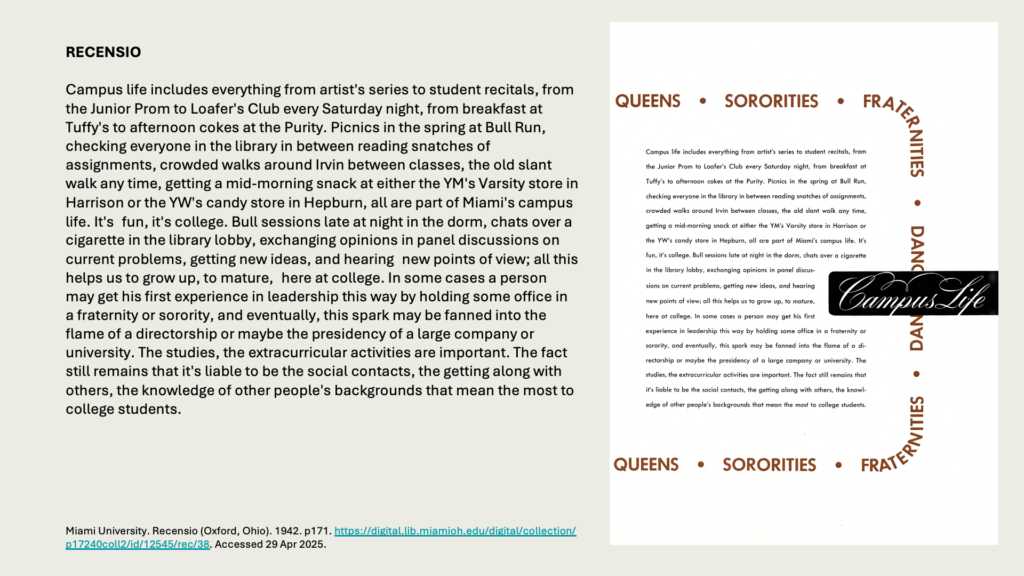
RECENSIO

Campus life includes everything from artist's series to student recitals, from the Junior Prom to Loafer's Club every Saturday night, from breakfast at Tuffy's to afternoon cokes at the Purity. Picnics in the spring at Bull Run, checking everyone in the library in between reading snatches of assignments, crowded walks around Irvin between classes, the old slant walk any time, getting a mid-morning snack at either the YM's Varsity store in Harrison or the YW's candy store in Hepburn, all are part of Miami's campus life. It's
fun, it's college. Bull sessions late at night in the dorm, chats over a cigarette in the library lobby, exchanging opinions in panel discussions on current problems, getting new ideas, and hearing
new points of view; all this helps us to grow up, to mature,
here at college. In some cases a person may get his first experience in leadership this way by holding some office in a fraternity or sorority, and eventually, this spark may be fanned into the flame of a directorship or maybe the presidency of a large company or university. The studies, the extracurricular activities are important. The fact still remains that it's liable to be the social contacts, the getting along with others, the knowledge of other people's backgrounds that mean the most to college students.
MIAMI UNIVERSITY M-BOOK, 1943-1944

Back to another romantic tradition. Stretching from Irvin Hall to the Campus Gates at High Street, is Slant Walk, undoubtedIy the most frequented stretch of sidewalk on the campus. Slant Walk leads a varied life. Mornings, students rush its entire length in "nothing flat." Evenings are different. Then, students may spend hours just walking from one end to the other. It is not the walking that makes the tradition; it is the numerous stops.

If you're newspaper minded, wander down to the Miami Student office in Room 9 Irvin Hall, and a sopho-more desk editor will put you to work. In a few weeks you'll learn to love the smell of printer's ink and the sound of rolling presses. And by the time you're a sophomore, you'll be pounding out copy like a veteran. 

Recensio is Miami's yearbook. All year the Recensio staff slaves away in the basement of Irvin, working on photographs and layouts and continuity. Freshmen take care of the detail work, striving to be appointed office managers for their sophomore year. 

The "M" Book is planned and edited by students through the YMCA and YWCA. We call it the "Freshman Bible" and you already know how important it is!
WINTER FROLIC

The weather is doing its part to liven up the dull season after exams. It’s been some time since we’ve had so much free between-class entertainment. The greatest booby-trap, surrounded by the most enthusiastic audience, was the inclined and extremely icy stretch between Irvin and the library.

We watched one coed start down the treacherous path, slip, slide, execute a tricky one-step, claw at the air, fight frantically, then collapse and slither downward. She arose at the foot of the hill to the thunderous applause of the servicemen audience, bowed, and continued her homeward trek with a dignified and cautious tread.
FIRE ALARM

Cigarettes not quite out, dropped nonchalantly into the wastebasket by coeds in a hurry to make class before the ten-after bell, started fires in Irvin and Harrison this week. Not big. No damage, except for blackened wastebaskets and smoky classrooms to be aired. Luckily discovered in time, especially in the case of Harrison—how quickly that sentimental relic of earliest Miami could go up in smoke. Maybe not so lucky next time.

Granted smoking facilities in many dormitories and classroom buildings are inadequate. Most campus structures were built in the days when “decent” women didn’t smoke. Too bad. But it is absurdly impractical to build an annex on each building, and surveys show that there are no rooms which could be converted into smokers.

If rumblings among the powers that be are indicative of anything—a word to the wise, you know (but to date that hasn’t been sufficient). Conditions in women’s lounges this year have been worse than sloppy. Too many holes have been burned in leather cushions which can’t be replaced because of inadequate funds. Women’s League’s clean-up campaign seems to have fizzled. Ash trays might as well not be there. If students are not more careful about where they toss their cigarette butts, they may find some over-harsh rules clamped down on them which will seek to limit places on campus where they may smoke.
INTRODUCING…

(Ed’s note: With this article we initiate a series of articles introducing our readers to a personal side of our professors and members of the University staff.)

"University presidents are the chief troubleshooters of the campus," declared President A. H. Upham. "They are supposed to know all the answers.”

But it’s hard to find a man around the University who knows more of the answers than President Upham. He has had, as he puts it, three reincarnations on the campus. After receiving his Bachelor of Arts degree, he spent three years here as an instructor in the preparatory school. He then attended Harvard university graduate school. After teaching at Utah Stale university, Pres. Upham returned east to Columbia university, from which he received his doctor's degree. He returned here for the first time as a member of the English department.

[…]  He has watched the University grow, from the time when it had 11 faculty members and 127 students. "But sometimes I prefer not to remember it," he says. "It makes me feel entirely too old.”

Aside from being a troubleshooter, presidential duties are many and varied, Dr. Upham represents the University before the board of trustees, who are appointed by the governor and approved by the state senate. Furthermore, ho initiates changes of policy on campus and approves or disapproves plans and policies of the faculty.

Campus Changes

Many of the changes that Dr. Upham has observed have come while he has been president. The University merged with Oxford College; Elliot and Stoddard halls were rebuilt; Hughes and Irvin halls were completed; North and South halls and New Men’s Dorm were built; and the Food Service Building was constructed. The Schools of Business and Fine Arts were added to the curriculum. The freshmen adviser system was utilized, wherein the advisor actually lives in the freshmen dormitory. And the enrollment has increased from approximately 1750 to 3300, where it stood directly before the war. Of course, at the present time the enrollment is about 1950, due to the loss of civilian men. However, with the job of adjusting to the navy the University works at full capacity all the time.

The president’s politics? Well, on that subject he would only say “I think my scottie Tammas is a Republican, because ho barks when he hears Falla’s name mentioned.”
SPORTS SLANTS

By Tom Joyner

Another small step in Miami’s reconversion was taken last week. Once again the quadrangle in front of Stoddard and Elliot resounds to the thud of running feet and the crunch of shoe leather striking a football.

The revival of this once traditional sight on the Miami campus brings back memories of pre-war days. In the present college generation there are only a few who can remember seeing such a tangled mass of civilians as there was In front of Irvin over the weekend.
HOWARD PREVIEWS POSSIBLE POST-WAR SEA FOOD MENU

Numerous servicemen may owe their lives to the work being done one of Miami’s graduates, Capt. [?] Howard, '38, who is training sailors to meet the survival problems the southwest Pacific.

After leaving Miami as one of A T. Evans’ budding botanists he spent four years at Harvard acquiring more botanical information into eventually a degree. Part of his years were spent in the American tropics doing field work. This background paid dividends when he broke out and “I went into a different commission and was given the task of organizing a training program in tropical survival,” writes Captain Howard.

Instructs Instructors

The program has expanded so it now Captain Howard trains mainly Instructors who in turn teach live flying personnel both in this in this country and overseas. "Having the instructors’ school gives me a chance to keep my finger in the direction to prove that by really living off the land.”

University ‘Gets Around’

The Captain claims that "all this started in the botanical laboratory on the top floor of Irvin hall. The information may end up in the jungles of Burma or the coral atolls of the Pacific but Miami's training like Miami's men really get around.”

Captain Howard enclosed a menu of foods which might be available to a stranded flier or sailor in the Pacific. The meal was served to 25 colonels and three generals recently. Of the so-called emergency foods, he says, "I claim you will find some of them on your post-war menu . . . for the present they save the Howard family quite a few red points.”

Contacts Miamians

Though he thinks himself one of the unlucky graduates, because he has not been back to campus in recent years, he admits that he has been more fortunate than some in many ways.

"I have had more than my share of contacts with Miami graduates since I have been in the Army because I am teaching flying personnel, and there are a lot of Miamians in the AAF, I know” he wrote. Besides managing to keep in contact with Miami, his friends and classmates, he has even made new University friends in the approximate seven years since he graduated.
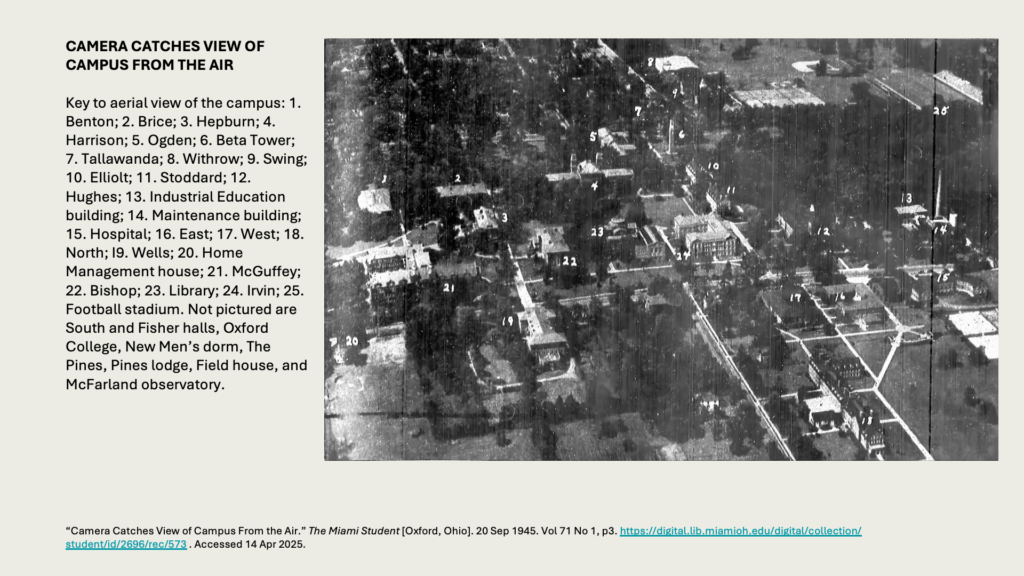
CAMERA CATCHES VIEW OF CAMPUS FROM THE AIR

Key to aerial view of the campus: 1. Benton; 2. Brice; 3. Hepburn; 4. Harrison; 5. Ogden; 6. Beta Tower; 7. Tallawanda; 8. Withrow; 9. Swing; 10. EIliolt; 11. Stoddard; 12. Hughes; 13. Industrial Education building; 14. Maintenance building; 15. Hospital; 16. East; 17. West; 18. North; I9. Wells; 20. Home Management house; 21. McGuffey; 22. Bishop; 23. Library; 24. Irvin; 25. Football stadium. Not pictured are South and Fisher halls, Oxford College, New Men’s dorm, The Pines, Pines lodge, Field house, and McFarland observatory.
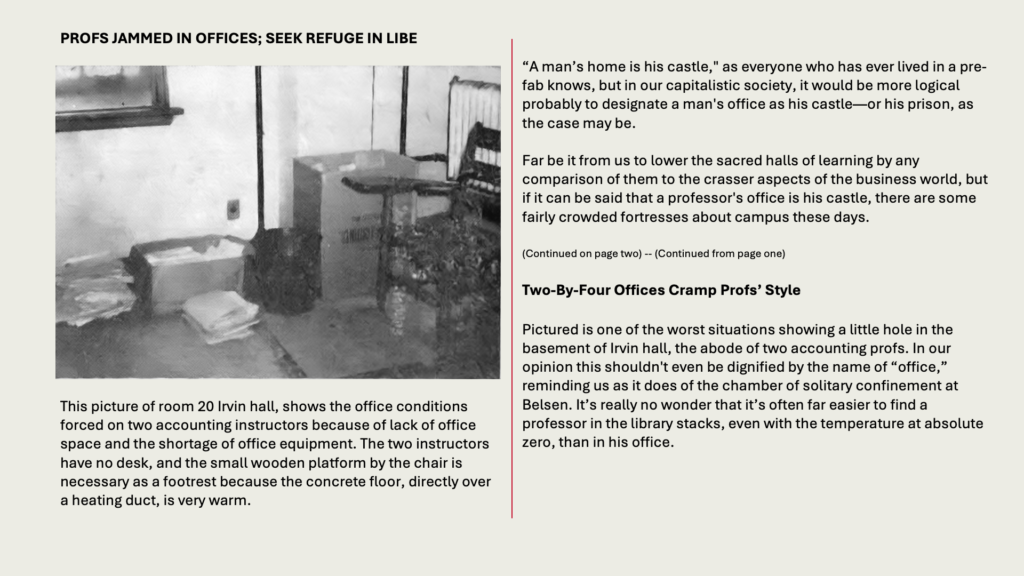
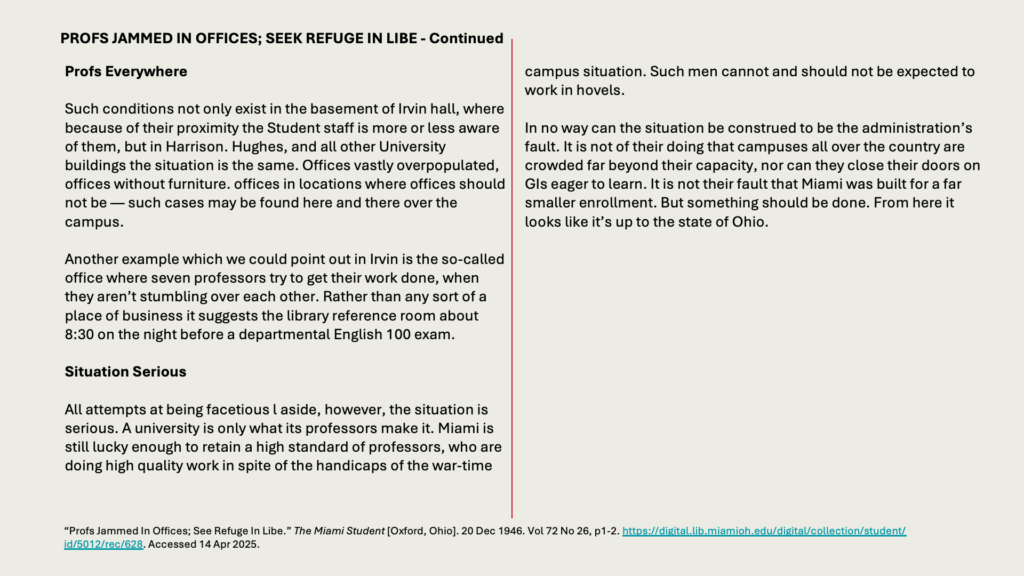
PROFS JAMMED IN OFFICES; SEEK REFUGE IN LIBE

This picture of room 20 Irvin hall, shows the office conditions forced on two accounting instructors because of lack of office space and the shortage of office equipment. The two instructors have no desk, and the small wooden platform by the chair is necessary as a footrest because the concrete floor, directly over a heating duct, is very warm.

“A man’s home is his castle," as everyone who has ever lived in a pre-fab knows, but in our capitalistic society, it would be more logical probably to designate a man's office as his castle—or his prison, as the case may be.

Far be it from us to lower the sacred halls of learning by any comparison of them to the crasser aspects of the business world, but if it can be said that a professor's office is his castle, there are some fairly crowded fortresses about campus these days.

(Continued on page two) -- (Continued from page one) 

Two-By-Four Offices Cramp Profs’ Style

Pictured is one of the worst situations showing a little hole in the basement of Irvin hall, the abode of two accounting profs. In our opinion this shouldn't even be dignified by the name of “office,” reminding us as it does of the chamber of solitary confinement at Belsen. It’s really no wonder that it’s often far easier to find a professor in the library stacks, even with the temperature at absolute zero, than in his office.
PROFS JAMMED IN OFFICES; SEEK REFUGE IN LIBE - Continued

Profs Everywhere

Such conditions not only exist in the basement of Irvin hall, where because of their proximity the Student staff is more or less aware of them, but in Harrison. Hughes, and all other University buildings the situation is the same. Offices vastly overpopulated, offices without furniture. offices in locations where offices should not be — such cases may be found here and there over the campus.

Another example which we could point out in Irvin is the so-called office where seven professors try to get their work done, when they aren’t stumbling over each other. Rather than any sort of a place of business it suggests the library reference room about 8:30 on the night before a departmental English 100 exam.

Situation Serious

All attempts at being facetious l aside, however, the situation is serious. A university is only what its professors make it. Miami is still lucky enough to retain a high standard of professors, who are doing high quality work in spite of the handicaps of the war-time
campus situation. Such men cannot and should not be expected to work in hovels.

In no way can the situation be construed to be the administration’s fault. It is not of their doing that campuses all over the country are crowded far beyond their capacity, nor can they close their doors on GIs eager to learn. It is not their fault that Miami was built for a far smaller enrollment. But something should be done. From here it looks like it’s up to the state of Ohio.
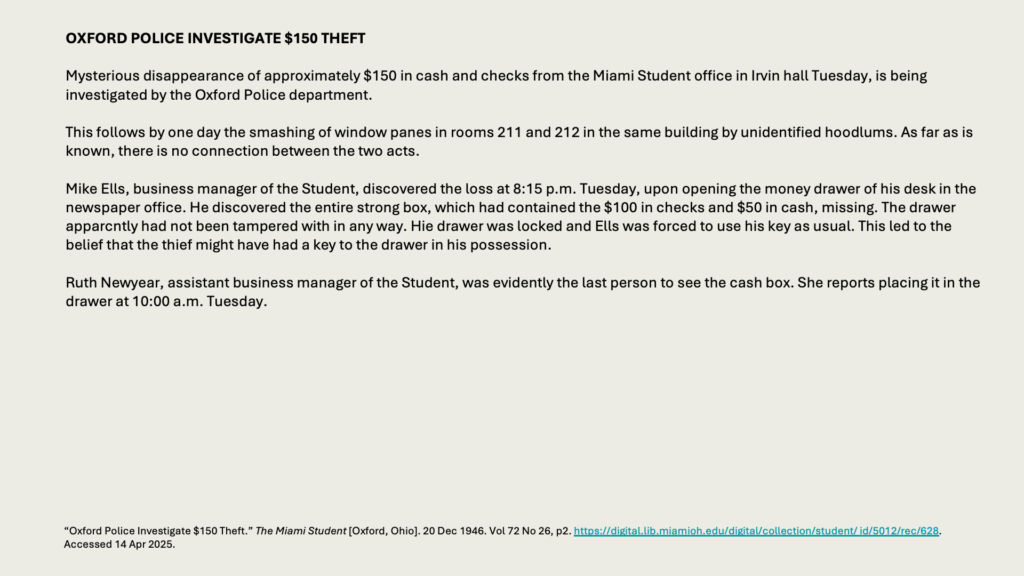
OXFORD POLICE INVESTIGATE 0 THEFT

Mysterious disappearance of approximately 0 in cash and checks from the Miami Student office in Irvin hall Tuesday, is being investigated by the Oxford Police department.

This follows by one day the smashing of window panes in rooms 211 and 212 in the same building by unidentified hoodlums. As far as is known, there is no connection between the two acts.

Mike Ells, business manager of the Student, discovered the loss at 8:15 p.m. Tuesday, upon opening the money drawer of his desk in the newspaper office. He discovered the entire strong box, which had contained the 0 in checks and  in cash, missing. The drawer apparcntly had not been tampered with in any way. Hie drawer was locked and Ells was forced to use his key as usual. This led to the belief that the thief might have had a key to the drawer in his possession.

Ruth Newyear, assistant business manager of the Student, was evidently the last person to see the cash box. She reports placing it in the drawer at 10:00 a.m. Tuesday.
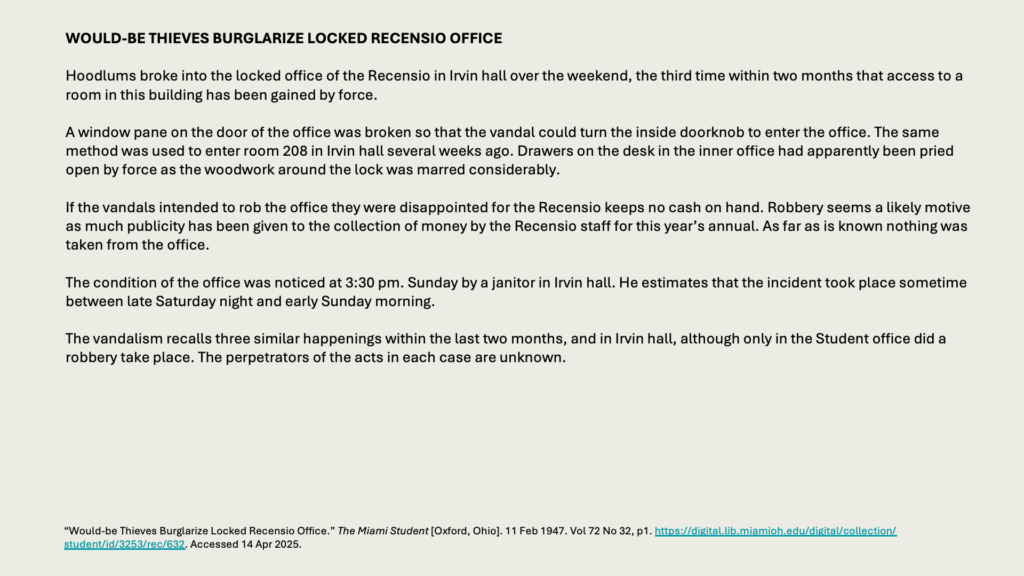
WOULD-BE THIEVES BURGLARIZE LOCKED RECENSIO OFFICE

Hoodlums broke into the locked office of the Recensio in Irvin hall over the weekend, the third time within two months that access to a room in this building has been gained by force.

A window pane on the door of the office was broken so that the vandal could turn the inside doorknob to enter the office. The same method was used to enter room 208 in Irvin hall several weeks ago. Drawers on the desk in the inner office had apparently been pried open by force as the woodwork around the lock was marred considerably.

If the vandals intended to rob the office they were disappointed for the Recensio keeps no cash on hand. Robbery seems a likely motive as much publicity has been given to the collection of money by the Recensio staff for this year’s annual. As far as is known nothing was taken from the office.

The condition of the office was noticed at 3:30 pm. Sunday by a janitor in Irvin hall. He estimates that the incident took place sometime between late Saturday night and early Sunday morning.

The vandalism recalls three similar happenings within the last two months, and in Irvin hall, although only in the Student office did a robbery take place. The perpetrators of the acts in each case are unknown.
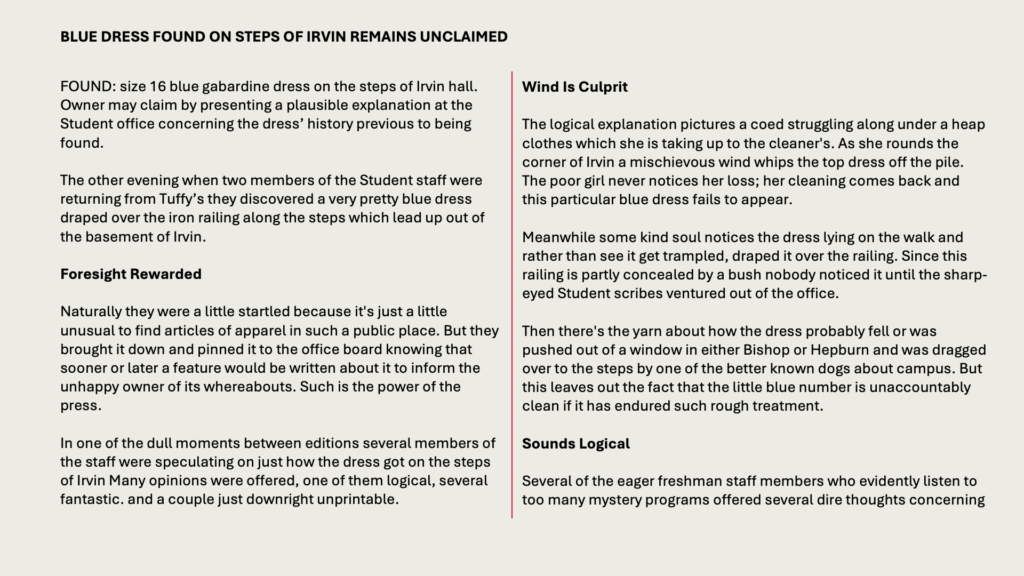
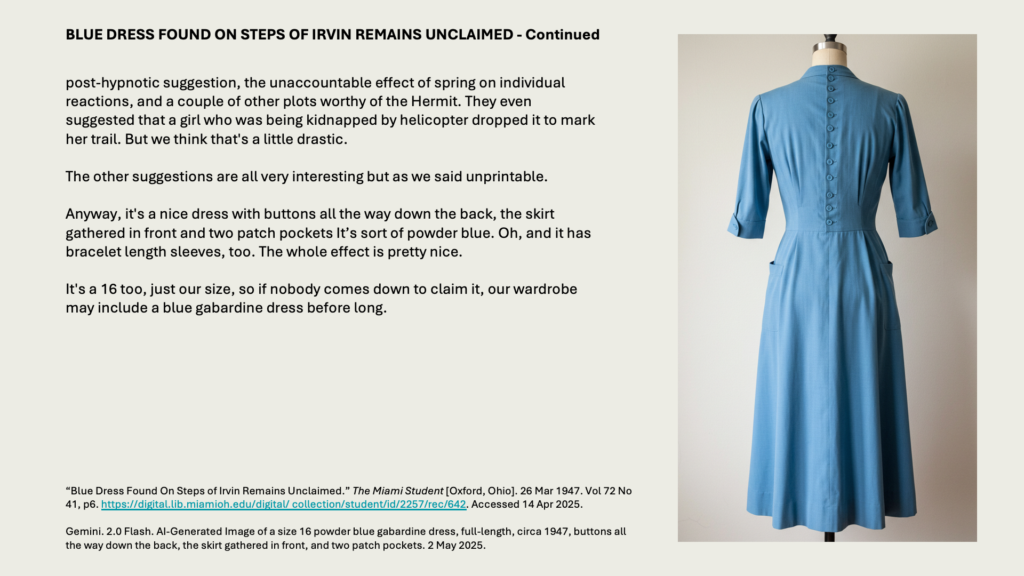
BLUE DRESS FOUND ON STEPS OF IRVIN REMAINS UNCLAIMED

FOUND: size 16 blue gabardine dress on the steps of Irvin hall. Owner may claim by presenting a plausible explanation at the Student office concerning the dress’ history previous to being found.

The other evening when two members of the Student staff were returning from Tuffy’s they discovered a very pretty blue dress draped over the iron railing along the steps which lead up out of the basement of Irvin.

Foresight Rewarded

Naturally they were a little startled because it's just a little unusual to find articles of apparel in such a public place. But they brought it down and pinned it to the office board knowing that sooner or later a feature would be written about it to inform the unhappy owner of its whereabouts. Such is the power of the press.

In one of the dull moments between editions several members of the staff were speculating on just how the dress got on the steps of Irvin Many opinions were offered, one of them logical, several fantastic. and a couple just downright unprintable.

Wind Is Culprit

The logical explanation pictures a coed struggling along under a heap clothes which she is taking up to the cleaner's. As she rounds the corner of Irvin a mischievous wind whips the top dress off the pile. The poor girl never notices her loss; her cleaning comes back and this particular blue dress fails to appear.

Meanwhile some kind soul notices the dress lying on the walk and rather than see it get trampled, draped it over the railing. Since this railing is partly concealed by a bush nobody noticed it until the sharp-eyed Student scribes ventured out of the office.

Then there's the yarn about how the dress probably fell or was pushed out of a window in either Bishop or Hepburn and was dragged over to the steps by one of the better known dogs about campus. But this leaves out the fact that the little blue number is unaccountably clean if it has endured such rough treatment.

Sounds Logical

Several of the eager freshman staff members who evidently listen to too many mystery programs offered several dire thoughts concerning
BLUE DRESS FOUND ON STEPS OF IRVIN REMAINS UNCLAIMED - Continued

post-hypnotic suggestion, the unaccountable effect of spring on individual reactions, and a couple of other plots worthy of the Hermit. They even suggested that a girl who was being kidnapped by helicopter dropped it to mark her trail. But we think that's a little drastic.

The other suggestions are all very interesting but as we said unprintable.

Anyway, it's a nice dress with buttons all the way down the back, the skirt gathered in front and two patch pockets It’s sort of powder blue. Oh, and it has bracelet length sleeves, too. The whole effect is pretty nice. 

It's a 16 too, just our size, so if nobody comes down to claim it, our wardrobe may include a blue gabardine dress before long.
PUBLICITY OFFICE MOVES TO IRVIN

University News bureau has moved from its old offices in Ogden hall to new quarters in room 6, Irvin hall.

Director of the News bureau is Prof. Gilson Wright, who shares his new offices with Mr. Robert T. Howard, who is in cargo of athletic publicity. The old News bureau office has been taken over by Mr. John E. Dolibois, executive secretary of the Alumni association, in an expansion of the Alumni association's offices.

-----

Thobe’s Fountain out to be familiar now so we’ll continue from there. This time we walk down Slant Walk until it ends at Irvin Hall. Irvin contains classrooms and laboratories for the College of Arts and Science and the School of Business Administration. Offices of the three student publications the Miami Student, Recensio, and Tomahawk are located in this building.

-----

On the west side of Irvin is the Alumni Library. [...] On the east side of Irvin is Hughes hall. Hughes contains offices, laboratories, and classrooms of the department of chemistry, mathematics, accounting, secretarial studies, and government.
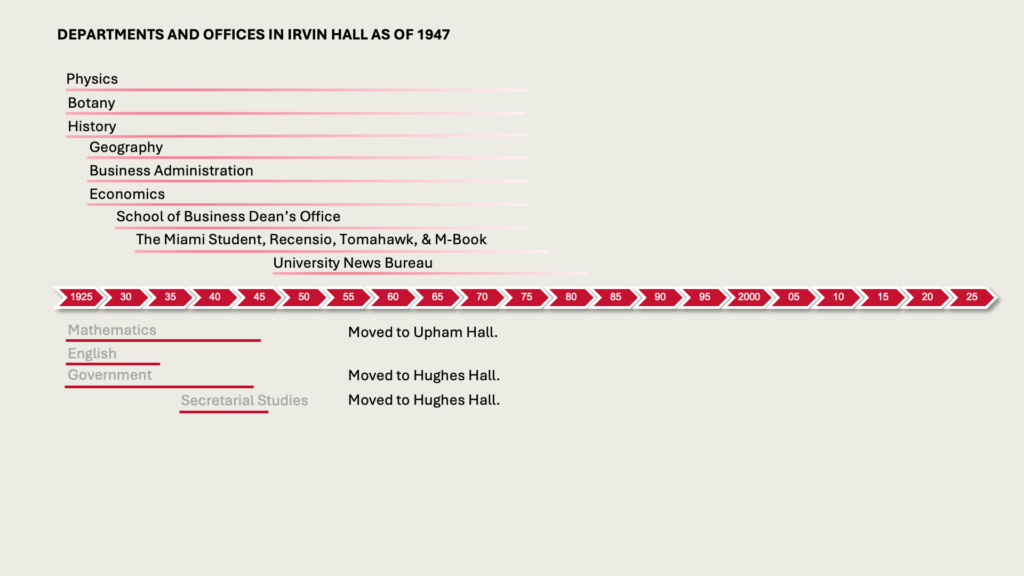
DEPARTMENTS AND OFFICES IN IRVIN HALL AS OF 1947

Physics
Botany
History
Geography
Business Administration
Economics
School of Business Dean’s Office
The Miami Student, Recensio, Tomahawk, & M-Book
University News Bureau
WRITER HITS CHRONIC PROBLEM OF LIBRARY, CLASSROOM LIGHTS

To The Editor:
It seems that this problem of lighting in our library has come up almost every semester, at least once, for as long as I can remember, but I take it upon myself to bring it up again. Each and every time in the past when some student has mentioned the poor lighting in the library, the administration has made some half-hearted attempt at improvement, such as cleaning walls, washing globes, and increasing the size of bulbs. To my mind, such attacks are analogous to throwing water on a fire with a thimble . . . such tactics will get results if continued long enough, but in the meantime, conditions are little improved.

Improve Facilities

We have heard many times over that the university is overcrowded, and not possessed of adequate facilities to handle such a crowd. Since this is admittedly the case, why can't such facilities as we have be improved to the point that they will benefit the majority?

Lighting in the library, especially the reserve room has gotten to the point that it is actually detrimental to study there at night, and even in the day time, one must find a seat near the windows. 

Such a state of affairs is inexcusable. Granted, materials and new lighting fixtures are hard to get, but even such a simple thing as lowering the lights by lengthening the chains by which they are suspended would be a marked improvement.

Classrooms Also Suffer

And the library is not the only place where lighting is bad. Classrooms are in many cases far below standards of adequate lighting for rooms of this type. Last year, several rooms in Irvin and that antiquated museum piece, Harrison, were fitted with fluorescent fixtures, which made these few rooms quite pleasant. But what of the other rooms? Bare bulbs, hanging two feet from the ceiling, give little if any beneficial light. Last years' new fluorescent fixtures, through improper care, or negligence, are dirty and in at least one case, burnt out, or flickering badly.

As long as this institution is to remain primarily an educational one, it would seem to me that the officials in administration, and the professors themselves would try to do as much about our study conditions as they have about our “moral tone,” driving regulations, and social regulations. There can be no question about it . . . lighting in our library and many of our classrooms is poor, and should be radically improved.
John B. Whitlock
LOCAL BIRDS PREFER MIAMI TO CAPISTRANO
By Bill Braun

Just to prove that the housing shortage isn't as bad as it seems to be, two families of birds have moved into Irvin hall and Lodge E.

The Irvin hall clan has settled in the upper right-hand corner of the west door and is growing rapidly. Only two birds could be seen a month ago busily flitting in and out of the nest, but now if you look very closely, you can barely distinguish the small heads of four baby bunches of feathers.

Birds Invade Lodge

Lodge E has something new in the line of birdlore in the lodge itself. Last February a noise was heard between the inside and outside wallboards of the building.

After two weeks of this nerve racking occurrence, Ed Russell, 4 A-S, investigated and found the disturbance to be caused by two birds who had settled on a short wall brace in the lodge structure. Russell named them “wallbirds."

Guests Chirp Warily

About two weeks ago. several baby birds joined the family and the clan has now grown even larger. The men cut a small hole in the wall and inlaid a piece of glass so that the progress could be better observed. Now when the men tap on the glass, the birds jump up, open their mouths and chirp for mama in bird dialect.

All this merely proves that the Lodges are still for the birds.
STUDENTS WARNED

Students using the study rooms in Irvin hall have been scattering cigarette butts, paper wrappings and other debris on the floors.

Unless this practice is stopped immediately by the students using these rooms, the privilege will be withdrawn and the rooms will be locked in the evening, according to Dr. C. W. Kreger, vice-president.
QUIET PLEASE! MOB STUDYING...

A recent survey of alumni showed that their opinion of the future would be one in which living accommodations are not overcrowded. Conditions on campus at present bear out the efficacy of this decision, one serious area of overcrowding being the Library.

With three persons assigned to a room for two, there is not space for all to study efficiently at the same time. This situation necessitates the use of outside facilities by at least one person.

The great amount of required reading from sources in the Library make it necessary for many to study there. Yet the problem remains that often a student, after getting a reserve book, is unable to find a place to sit down to study. It is not an uncommon sight to see someone sitting on the steps to study.

There are two factors to be considered in the problem of study conditions in the Library. The first is the maintenance of relative silence at all times. Too many students are utilizing the Library as a convenient place for meeting friends or holding informal seminars, to the distress of those sitting nearby. The period from five minutes before the hour until ten minutes after the hour is one of the noisiest.

Groups of women who appear to be coerced into spending time at the Library by sorority rules chatter and create disturbances rather than study. Often several people desiring to use a single reference work huddle over it and discuss it in extremely audible tones.

Much is said and written about the honor system among college students; here is a place to put it into effect. The librarians are too busy to act as proctors. It is up to the individual to consider others and maintain relative silence.

More is needed to solve the overcrowding than maintenance of silence, however. The second factor to be considered is getting some of the students out of the Library.  Methods or the accomplishment of this are immediately available.

A more wide-spread use of study facilities provided in dormitory dining rooms would relieve some of the congestion. Rooms opened in the evening in Irvin hall also are not used to the extent possible, though the Administration could help matters here by opening rooms with fluorescent lighting, rather than with dim bulbs.

The University is trying to ameliorate study condition by these methods. It only remains for the student body to use them, at the same time exercising some restraint as to conduct in present facilities. RS
RECENSIO

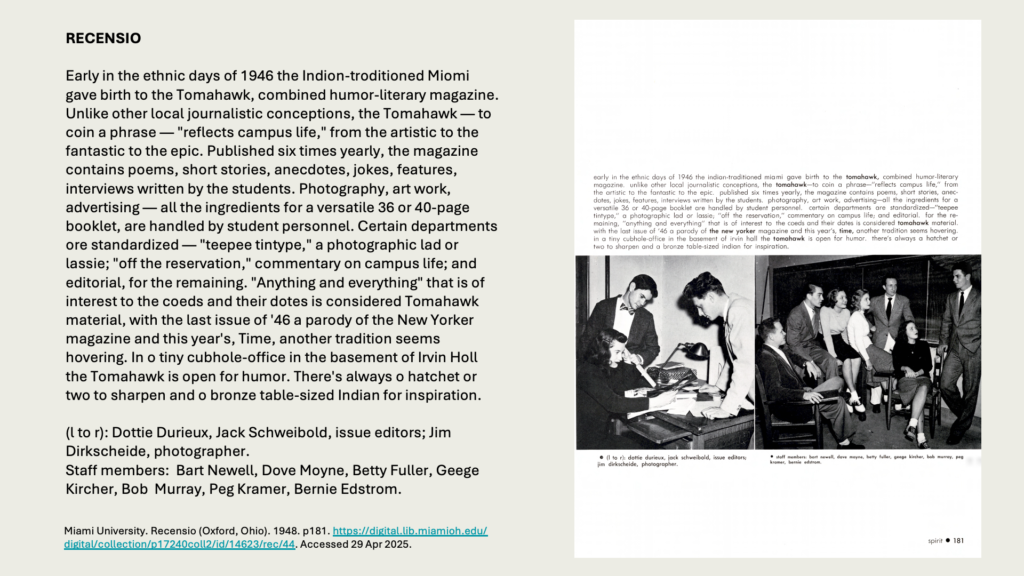
Early in the ethnic days of 1946 the Indion-troditioned Miomi gave birth to the Tomahawk, combined humor-literary magazine. Unlike other local journalistic conceptions, the Tomahawk — to coin a phrase — "reflects campus life," from the artistic to the fantastic to the epic. Published six times yearly, the magazine contains poems, short stories, anecdotes, jokes, features, interviews written by the students. Photography, art work, advertising — all the ingredients for a versatile 36 or 40-page booklet, are handled by student personnel. Certain departments ore standardized — "teepee tintype," a photographic lad or lassie; "off the reservation," commentary on campus life; and editorial, for the remaining. "Anything and everything" that is of interest to the coeds and their dotes is considered Tomahawk material, with the last issue of '46 a parody of the New Yorker magazine and this year's, Time, another tradition seems hovering. In o tiny cubhole-office in the basement of Irvin Holl the Tomahawk is open for humor. There's always o hatchet or two to sharpen and o bronze table-sized Indian for inspiration.

(l to r): Dottie Durieux, Jack Schweibold, issue editors; Jim Dirkscheide, photographer.
Staff members:  Bart Newell, Dove Moyne, Betty Fuller, Geege Kircher, Bob  Murray, Peg Kramer, Bernie Edstrom.
PROFESSOR CONFIRMS RUMORS

July 4 should usher in the first frost of 1949 if one believes the old saying which predicts that the first frost will fall exactly six months after the first electrical storm.

By the use of mysterious instruments such as a yardstick and a tin can left standing in back of Building C, Prof. Ernest Dix of the geography department has come up with the announcement that the rainfall of 4.22 inches of Tuesday, is the greatest in the past six years.

Others of us having no technical instruments were forced to base our opinions of Mother Nature’s latest contribution on the canals surrounding the Lodges, the steaming Turkish bath effect caused by hot pipes coming in contact with a convenient puddle in the Anderson hall smoker and the lovely waterfall that tumbled down the steps between Bishop hall and McGuffey.

Other campus buildings were also honored by that back-to-nature appearance with the basements of Irvin and Harrison halls and various unlucky dormitories which were plagued with a rippling high tide last Tuesday.

Not to be forgotten also is the Abe Lincoln style of studying in Wells hall — ah, yes, “candles out at 10:30!” Lack of electricity caused grief in Ogden hall and McGuffey. In Benton hall kerosene lamps seemed to be the order of the day.
MIAMI’S SHINY NEW OFFSPRING, UPHAM HALL, ENTERS CAMPUS LIFE
By Bernie Hiatt

Learned art historians tell us that the tower on brand-new, shiny Upham hall, Miami's new offspring, is classified as a derivative of the Choragic monument of Lysicrates.

Most Miamians, however, are satisfied to give the tower and the structure beneath it the earthy description of “sharp or “neat.”

Especially “sharp” are the new classrooms in which the students have bade adieu to Town hall, Stoddard lounge and the west porch of Wells hall. The plush seats in the pre-Upham lounge-classrooms were nice, though.

The total number of classrooms in use at Miami's new landmark is 18. Seminar rooms reach the grand total of two, with 29 faculty offices completing the set-up.

[…] 

Another problem presented by the entry of Upham hall into campus life was the task of moving professors' office equipment, etc., to their new homes. Ambitious young students were recruited to give the profs a hand. Some of the books on the Irvin hall shelves seemed to literally cling to the walls. Funny how one can become attached to a place.
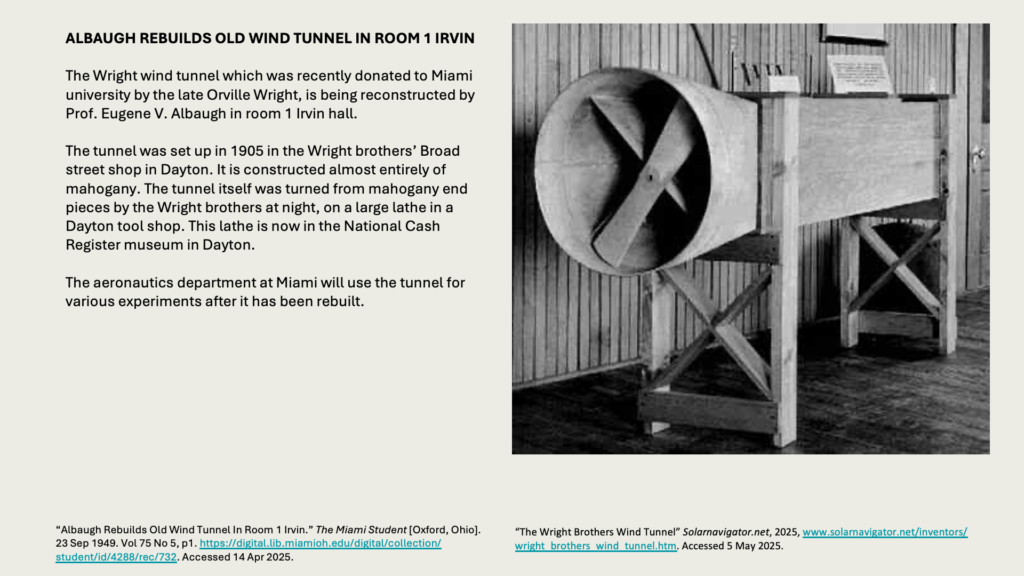
ALBAUGH REBUILDS OLD WIND TUNNEL IN ROOM 1 IRVIN

The Wright wind tunnel which was recently donated to Miami university by the late Orville Wright, is being reconstructed by Prof. Eugene V. Albaugh in room 1 Irvin hall.

The tunnel was set up in 1905 in the Wright brothers’ Broad street shop in Dayton. It is constructed almost entirely of mahogany. The tunnel itself was turned from mahogany end pieces by the Wright brothers at night, on a large lathe in a Dayton tool shop. This lathe is now in the National Cash Register museum in Dayton.

The aeronautics department at Miami will use the tunnel for various experiments after it has been rebuilt.
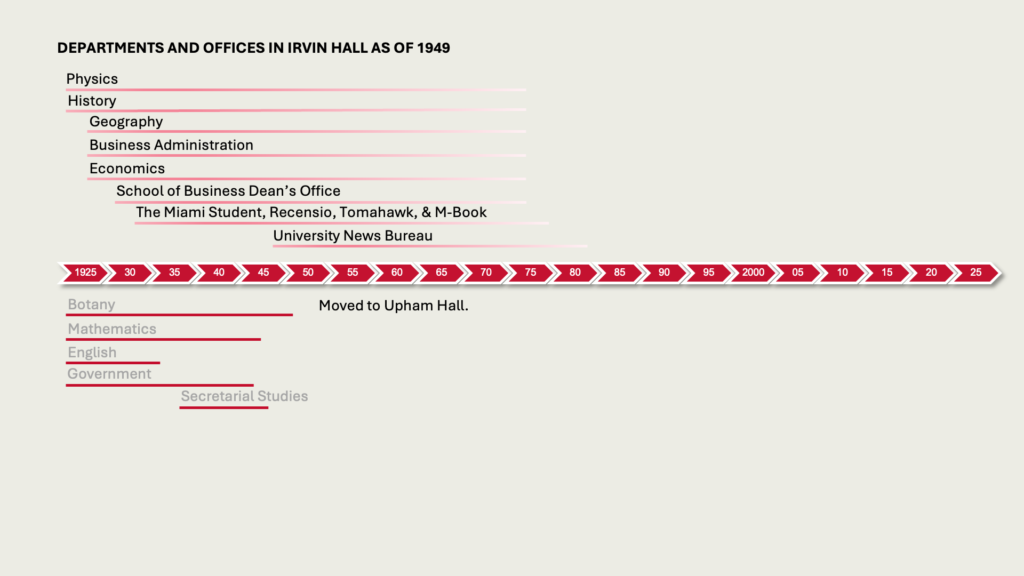
DEPARTMENTS AND OFFICES IN IRVIN HALL AS OF 1949

Physics
History
Geography
Business Administration
Economics
School of Business Dean’s Office
The Miami Student, Recensio, Tomahawk, & M-Book
University News Bureau
Next Section

About Me

  • Home
  • Lebenslauf
  • Personal Arms
  • Word Clouds

Academic

  • Technology in Language Learning
  • Determinants of Gender in German
  • German Two-Way Prepositions
  • The Collective Noun Catalog
  • Using English Apostrophes Correctly
  • Spelling (or “Phonetic”) Alphabets
  • Crayola Color Names
  • RAL Color Names

Miami Univ

  • Irvin Hall’s Centennial: 1925-2025
  • Lyrics for the Alma Mater
  • Campus Cuisine

Music

  • The Star Spangled Banner
  • O Canada
  • Pfft! You were gone!
  • Gloom, Despair and Agony on Me!

Miscellania

  • Popular Baby Names
  • The Little List of Phobias
  • Treegonometry
  • UK Confusion
Proudly powered by WordPress