Miami University

Daniel E. Meyers

Dan's Home on the W3

Skip to content

Section 07 – The 1960s

Irvin Hall’s Centennial: 1925-2025
Miami University, Oxford, Ohio

Home
Previous Section
The 1960s
MILLER ADVISES STUDIES ABROAD

Adviser to students abroad will be Prof. W. Marion Miller of the French department, Pres. John D. Millett has announced.

Prof. Miller has been official adviser for foreign students at Miami for many years, He also acted as Liaison man between the university and the Fulbright program for foreign study grants.

In his office, room 109 Irvin, he will maintain a file of Information about European universities and American colleges and universities abroad.

Any students or department chairmen interested in these schools should contact Prof. Miller as he will be prepared to discuss awarding of credit for study abroad.
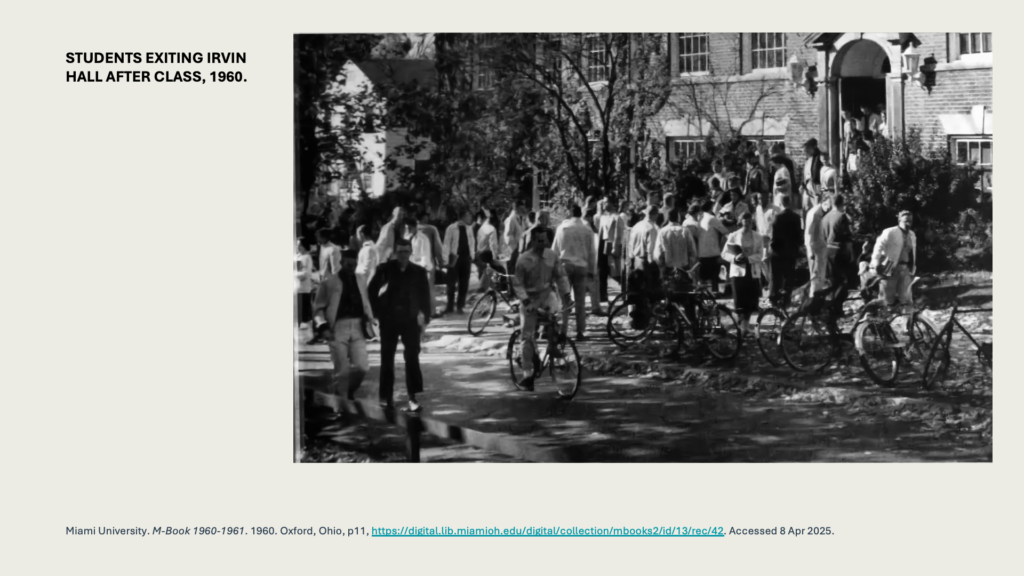
STUDENTS EXITING IRVIN HALL AFTER CLASS, 1960.
NEW BUILDINGS RAISE ENROLLMENT, BUDGET

Miami’s biggest year in terms of new buildings completed and occupied will raise the enrollment to an estimated record of 7,500, with increases in enrollment at the five academic centers bringing the total to more than 11,000 students.

It follows that fees and room-board-bills of those added students will boost Miami's budget above ,000,000 for the first limo.

Culler Hall, for physics, mathematics and aeronautics, is to be occupied for the beginning of the second semester.

Coeds To Move

This makes space available to other departments in Upham and Irvin Halls, thus making it possible to tear down the Faculty Office Building, converted World War II barracks near Irvin.

During spring vacation, co-eds now occupying Stanton, Anderson, and Hepburn Halls will be moved Into Women's Hall No. 8 and the new section of MacCracken Hall.


[...]

Building Part of Plan

The new buildings are part of a long-range capital plan which Miami has submitted to the Governor through finance director James Maloon.

This plan includes a request for funds in 1961 for a building in Dayton and in 1963 for a building in Butler County. Other needs Include a dramatics arts building with auditorium, increased library facilities and completion of Upham Hall.

Emphasis on Ph.D. Program

New buildings tor geology-geography, education and music, plus an assembly hall tor concerts and basketball arc included in the plan.

Academically. 1961 will see increased emphasis on the P.D. program which Miami is conducting with Ohio State, and the strengthening of the honors program for the superior student.

[...]
BOARD OF TRUSTEES MINUTES
January 28, 1961

Mr. Fairley moved and Mr. Hiestand seconded that Resolution R61-57 be adopted. Mr. Listerman moved to use "Parking Area" instead of "Lot" in the resolution. Mr. McNamara seconded the motion and it was carried. The resolution was adopted.

RESOLUTION R61-57

WHEREAS, traffic conditions on the Miami University campus are becoming increasingly congested, and

WHEREAS, efforts have been made by the University to provide off-street parking facilities for various categories of automobiles, and

WHEREAS, some definite regulation for the control of traffic and parking are now required, now therefore

BE IT RESOLVED:

1. 	That the following designations are hereby given to the campus drives of Miami University:

a. 	Old Campus Drive (Campus Avenue to Bishop Hall to Spring Street or to Harrison Hall and Irvin Hall Drive)
b.	Irvin Hall Drive (Spring Street to High Street from Irvin Hall to Ogden Hall)
c. 	Laws Drive (from High Street to Spring Street from Laws Hall to Culler Hall)
d. 	Cook Drive (from High Street and Patterson Avenue to Rt. 73)
e. 	Fisher Drive (from Cook Drive to Patterson Avenue from McBride Hall to Symmes Hall)
f. 	Bishop Drive (circular drive from Patterson Avenue to Patterson Avenue passing in front of Upham Hall)
g. 	Central Drive (from Oak Street to Maple Avenue south of MacCracken Hall)
h. 	South Drive (from Maple Avenue to Oak Street south of South Dining Hall);	•

2. That off-street parking areas are designated as follows:

a. 	Administration Parking Area
b. 	High Street Parking Arez
c. 	Bonham House Parking Area
BOARD OF TRUSTEES MINUTES
RESOLUTION R61-57 - Continued

d.	Gaskill Parking Area
e.	Maple Avenue Parking Area
f.	University Center Parking Area
g.	Robertson Parking Area

3. 	That the speed limit on all campus drives shall not exceed 20 miles per hour;

4. 	That parking on all campus drives is prohibited except where parking spaces have been clearly designated or when a car is being loaded or unloaded, not to exceed 30 minutes;

5. 	That parking on sidewalks or on the grass is prohibited except when directed by University officials for special occasions such as Alumni Day, commencements, convocations, or athletic events;

6. 	That parking by staff members in the Administration Parking Area, the Gaskill Parking Area, the Robertson Parking Area, and on Laws Drive and Bishop Drive shall be limited to numbered spaces assigned by the President or his designated representative, and that a reasonable charge per year (.00) may be collected for such assignment and expended for parking improvements;

7.	That staff parking without assignment of space may be permitted in the High Street Parking Area, the Bonham House Parking Area, the Maple Avenue Parking Area, and the University Center Parking Area;

8.	That all staff members parking on campus shall be expected to register their cars and display identification stickers;

9.	That student parking for approved student-owned automobiles shall be restricted to streets and areas adjacent to the campus or their residence, including Cook Drive, and the Maple Avenue Parking Area and the University Center Parking Area;

That visitors shall be expected to park at the head of Bishop Drive, and that staff and students shall not parkin the visitors' area;

That one-way traffic only shall be permitted on the following drives:

a.	Old Campus Drive - east bound only
b.	Irvin Hall Drive - north bound only
BOARD OF TRUSTEES MINUTES
RESOLUTION R61-57 - Continued


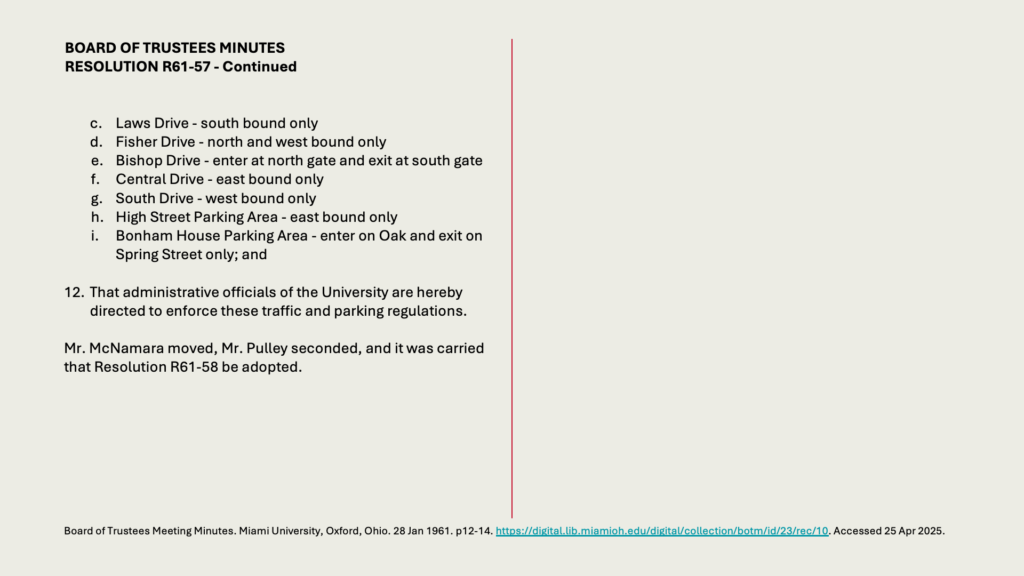
c.	Laws Drive - south bound only
d.	Fisher Drive - north and west bound only
e.	Bishop Drive - enter at north gate and exit at south gate
f.	Central Drive - east bound only
g.	South Drive - west bound only
h.	High Street Parking Area - east bound only
i.	Bonham House Parking Area - enter on Oak and exit on Spring Street only; and

12.	That administrative officials of the University are hereby directed to enforce these traffic and parking regulations.

Mr. McNamara moved, Mr. Pulley seconded, and it was carried that Resolution R61-58 be adopted.
BOARD OF TRUSTEES MINUTES
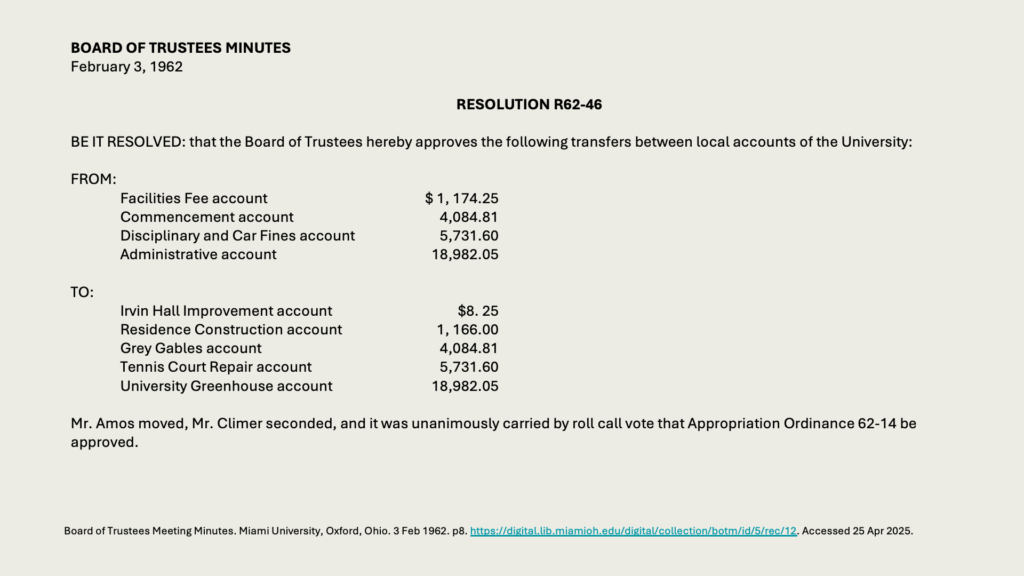
February 3, 1962

RESOLUTION R62-46

BE IT RESOLVED: that the Board of Trustees hereby approves the following transfers between local accounts of the University:

FROM: 
Facilities Fee account	$ 1, 174.25
Commencement account	4,084.81
Disciplinary and Car Fines account	5,731.60
Administrative account	18,982.05

TO:
Irvin Hall Improvement account 	. 25
Residence Construction account	1, 166.00
Grey Gables account	4,084.81
Tennis Court Repair account	5,731.60
University Greenhouse account	18,982.05

Mr. Amos moved, Mr. Climer seconded, and it was unanimously carried by roll call vote that Appropriation Ordinance 62-14 be approved.
WARFIELD HALL BECOMES STUDENT SERVICE CENTER
By Joel Sugarman

In the basement of Irvin Hall several alumni noticed two mislabeled rooms which now house the switchboards of the University telephone exchange.

"That's where the Miami ‘Student' and the Reconsio offices used to be," reminisced one old gentlemen as he marveled at the growth of his Alma Mater. But that was before there was a University Center.

Next year students and returning alumni will be making similar comments about the Student Counseling Service, now in Ogden Hall, the Dean of Women’s office, Administration Building and the Student Senate office on the second floor of the Center.

These offices and others now in the Administration Building are scheduled to move into the new Student Services Building, Warfield Hall, during the first part of January, 1963.

[…]
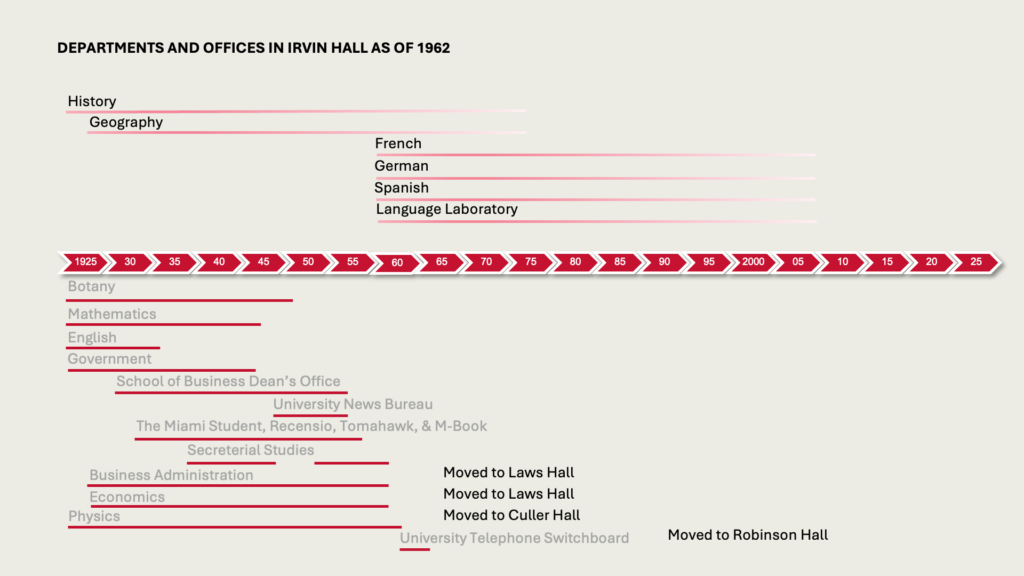
DEPARTMENTS AND OFFICES IN IRVIN HALL AS OF 1962

History
Geography
French
German
Spanish
Language Laboratory
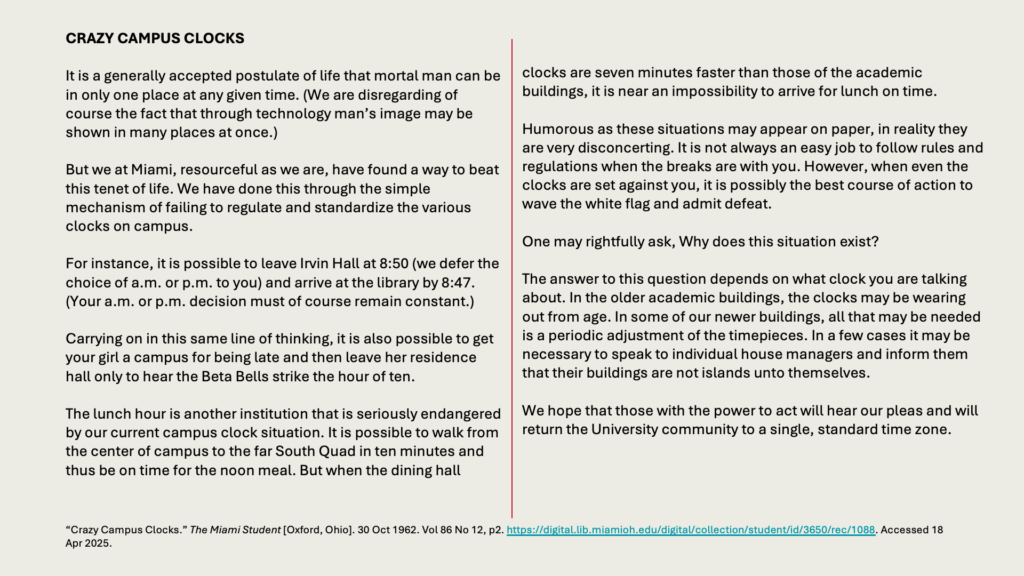
CRAZY CAMPUS CLOCKS

It is a generally accepted postulate of life that mortal man can be in only one place at any given time. (We are disregarding of course the fact that through technology man’s image may be shown in many places at once.)

But we at Miami, resourceful as we are, have found a way to beat this tenet of life. We have done this through the simple mechanism of failing to regulate and standardize the various clocks on campus.

For instance, it is possible to leave Irvin Hall at 8:50 (we defer the choice of a.m. or p.m. to you) and arrive at the library by 8:47. (Your a.m. or p.m. decision must of course remain constant.)

Carrying on in this same line of thinking, it is also possible to get your girl a campus for being late and then leave her residence hall only to hear the Beta Bells strike the hour of ten.

The lunch hour is another institution that is seriously endangered by our current campus clock situation. It is possible to walk from the center of campus to the far South Quad in ten minutes and thus be on time for the noon meal. But when the dining hall clocks are seven minutes faster than those of the academic buildings, it is near an impossibility to arrive for lunch on time.

Humorous as these situations may appear on paper, in reality they are very disconcerting. It is not always an easy job to follow rules and regulations when the breaks are with you. However, when even the clocks are set against you, it is possibly the best course of action to wave the white flag and admit defeat.

One may rightfully ask, Why does this situation exist?

The answer to this question depends on what clock you are talking about. In the older academic buildings, the clocks may be wearing out from age. In some of our newer buildings, all that may be needed is a periodic adjustment of the timepieces. In a few cases it may be necessary to speak to individual house managers and inform them that their buildings are not islands unto themselves.

We hope that those with the power to act will hear our pleas and will return the University community to a single, standard time zone.
STATE ISSUE NO. 1

For the next six weeks Miami students will find themselves immersed in a campaign to promote State Issue No. 1.

[…]

The funds would come from the continuation of a 1955 penny-a-pack tax on cigarettes that is expected to expire in 1968. The need for the funds is illustrated in the fact that colleges and universities are promoting the continuation of the tax now because the money is needed now. If successful on Nov. 5, the state may borrow and distribute the §250 million immediately.

The issue provides for the construction of academic buildings that Miami certainly needs at this point. Increased enrollment and living quarters are fine and necessary. However, a student cannot obtain a good education, one of discussion, argument and thought, when he is forced to attend a literature class of 60 students. Class scheduling has become a major problem because no available classrooms exist. Academic facilities are cramped and worn, especially in Upham, Hughes and Irvin Halls and the Library.

Concerning other grants, Ohio is eligible for federal funds if the state provides % of the cost of construction. Unless State Issue No. 1 is passed, Ohio will not have enough money to match the federal aid.

How unfortunate that higher education must be subjected to a popularity contest. It seems that education is still considered a luxury, not a necessity, a factor that can easily be ignored and left to the popular vote.

And what happens if State Issue No. 1 fails to pass? The legislature will not pass an appropriations bill when it reconvenes in December. Will it be necessary to arrange a system of halfday sessions so that each college may have two shifts of students? If the influx of students continues to grow, and is not met with adequate academic space, a catastrophe is in sight. Miami is already mapping out a trimester program to increase the number of students receiving diplomas in the least possible time. At the same time, funds must be contributed to the five academic centers, especially for classroom expansion in Middletown, and the new joint university. with Ohio State University now under construction in Dayton.

[…]
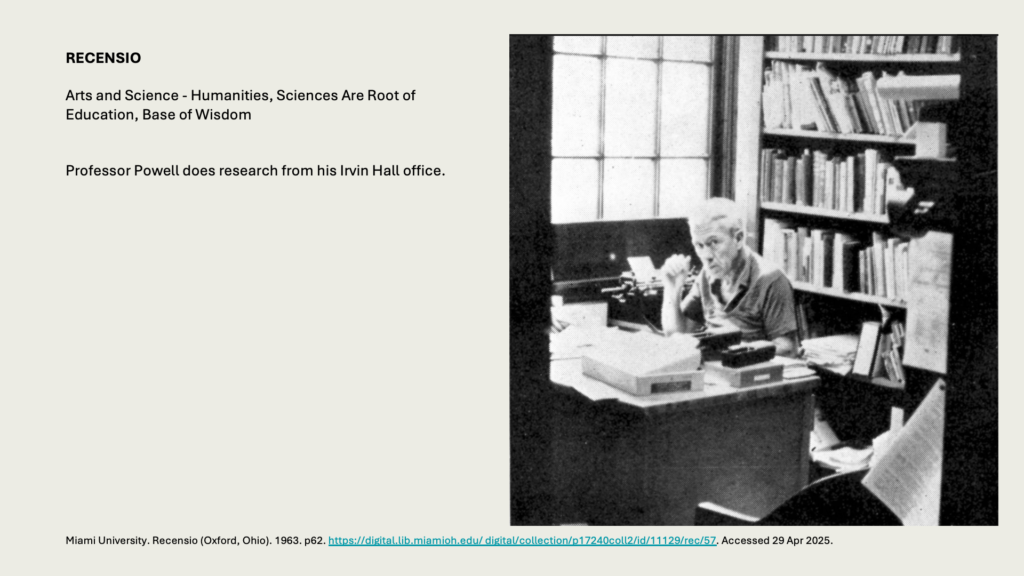
RECENSIO

Arts and Science - Humanities, Sciences Are Root of Education, Base of Wisdom 

Professor Powell does research from his Irvin Hall office.
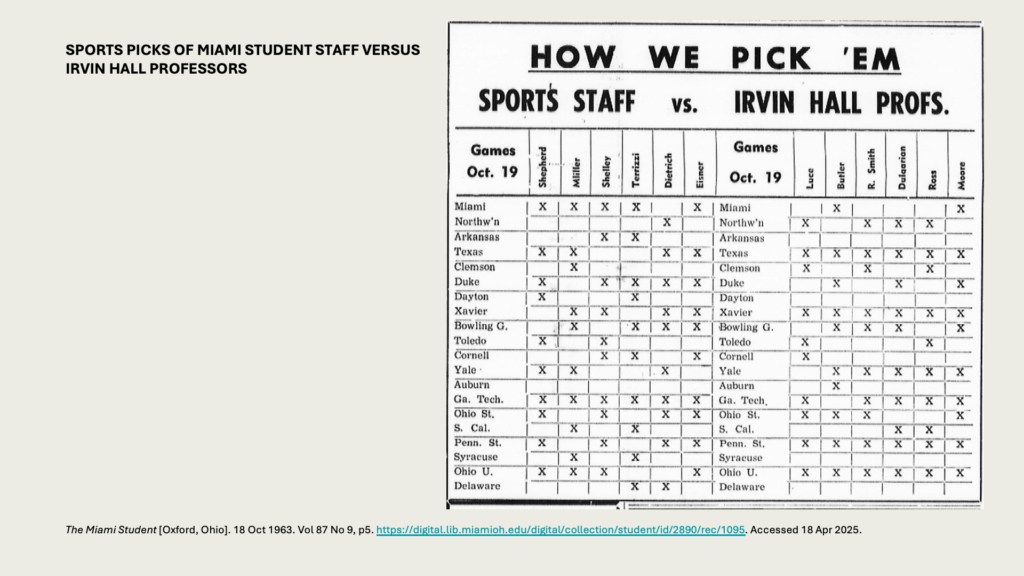
SPORTS PICKS OF MIAMI STUDENT STAFF VERSUS IRVIN HALL PROFESSORS
SPORTS STAFF TIES IRVIN HALL PROFS. IN PICK ’EM CONTEST

Irvin Hall fought the Miami 'Student' Sports staff to a draw in Friday's weekly Pick ’Em contest. The final score was 27 correct and 33 wrong for both sides.

Prof. Martin Bulgarian of the geography department headed the list for Irvin Hall with a 6-4 ledger. Hot on his heels was Prof. Charles Butler of the Spanish department with an even 5-5 mark.

The Sportswriters were led by Sports Editor Frank Torrizzi and writer George Dietrich who both carded a 6-4 slate.

Auburn’s stunning upset of nationally ranked Georgia Tech caused 11 wrong guesses while the Delaware victory over Conference rival, Ohio University and Syracuse’s toppling of Penn State brought 10 wrong guesses apeice.

The Sports staff now boasts the inglorious record of no wins, two losses and two ties.
RIGHT-HANDED DESKS PROVE PAINFUL FOR LEFTIES
By Judy Brophy

If you have sinistral tendencies you are not required to wrap yourself in a black cloak and slink around corners carrying a dagger. It simply means your arc one of the 11 percent of Americans who are left-handed. It also means that if you attend Miami and take a lecture course in almost any of her beautiful, modern, well-equipped classrooms you will practically have to stand on your head to take notes. For a left-handed person to write on a right-handed desk chair requires utmost patience and co-ordination. He must drag his hand from the left to the right of his paper instead of swinging it along with the elbow as a pivot as right-handers do.

[…]

Miami can do nothing to change a person’s natural writing tendencies but they could make it a little more comfortable for the "marked ones' . There is a terrible paucity of left-handed desks.

This statement could be called an over-generalization for there arc some rooms blessed with left-handed desks. But as things usually go, these rooms are half filled with them. First floor of Irvin abounds with them while Harrison Hall suffers in silence. 

In these times great steps are being made toward universal equality. Wouldn’t it be great if lefthanders could gain the freedom from acute back ache and needlessly messy notes.
EXISTENTIAL SYMBOL? SNAFU? SIDEWALK RAISES EYEBROWS
By Chuck Fortier

In Pittsburgh, Pa., there is a bridge which is approached by broad entrance ramps, sweeps grandly across the Allegheny River —and stops.

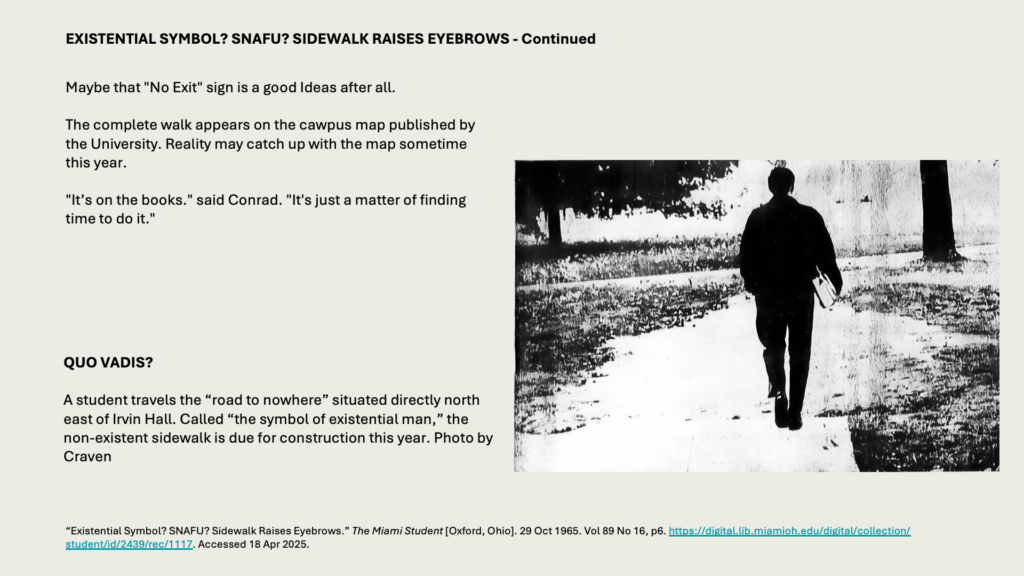
A similar condition at Minmi, fortunately on a smaller scale, has been raising eyebrows and questions among students for the past year. On the sidewalk directly northeast of Irvin Hall a turnoff branches bravely away in the direction of Harrison Hall — and stops.

One student described the function of the truncated path as being ‘‘a symbol of existential man."

A more common reaction of students is to regard it as a "typical Miami snafu." Some have suggested that a "No Exit" sign be erected to warn unwary pedestrians of the situation.

The student cynicism is unjustified. As hard as it may be to credit, there is good reason for the apparently superfluous outgrowth on the walk. Two years ago, the Department of Maintenance undertook an extensive program of sidewalk construction and renovation.

Included in the plans was a walk to connect the corner northeast of Irvin Hall with the north-south walk across the drive from Stoddard  Hall.

The intersection now In existence was laid down early last year with a view to completing the walk later.

"However." said Arthur Conrad, Director of Grounds, "other jobs came up that we had to do first."

"We could get a lot more of this new construction done if we didn’t have to do so much repair work," he added.

Much of the work of Conrad’s crew consists of repairing damage to University grounds. One particular item which takes a lot of their time is the repetitious replacement of green fences destroyed by students.

"We have just ordered 4000 feet of lumber for fences." said Conrad. This will cost the University about 0.

”It’s interesting to notice,” Conrad added, "that there was no path worn across the grass there before the end of the new walk was put in. Now there is."
EXISTENTIAL SYMBOL? SNAFU? SIDEWALK RAISES EYEBROWS - Continued

Maybe that "No Exit" sign is a good Ideas after all.

The complete walk appears on the cawpus map published by the University. Reality may catch up with the map sometime this year.

"It’s on the books." said Conrad. "It's just a matter of finding time to do it."

QUO VADIS?

A student travels the “road to nowhere” situated directly north east of Irvin Hall. Called “the symbol of existential man,” the non-existent sidewalk is due for construction this year. Photo by Craven
BOARD OF TRUSTEES MINUTES
Special Meeting
December 10, 1966

RECOMMENDED APPROPRIATIONS FOR CAPITAL IMPROVEMENTS

[…]

C. 1971-73
	1. Top Priority
a. Replacement of obsolete Facilities
(1) Campus Improvements (Tennis Courts, etc.)	0,000
(2) 3200 Seat Auditorium	4,550,000
b. Renovation of Buildings Not Classified as Obsolete
(1) Gaskill Hall	260,00
(2) Alumni Library	1,140,00
(3) Irvin Hall	550.000
		$ 6,760,000
2. Second Priority
(1) Library - Phase IV	$ 2,925,000
(2) Classroom and Office Building	2,600,000
(3) Herron Hall - Phase II	455,000
(4) Chemistry Building – Phase II	1,950,000
(5) Land Purchases	325,000
(6) Campus Improvements	780,000
(7) Indoor Cage	1,170,000
(8) Speech and Hearing Center	975,000
(9) Classroom and Laboratory Building – 
	 Middletown Campus	,000,000
(10) Classroom and Laboratory Building – 
	    Hamilton Campus 	2,000,000	,180,000

Total 1971-73	,940,000
GRAND TOTAL (1967-69, 1969-71, and 1971-73) 	,610,000

[…]
CONCRETE PROGRESS

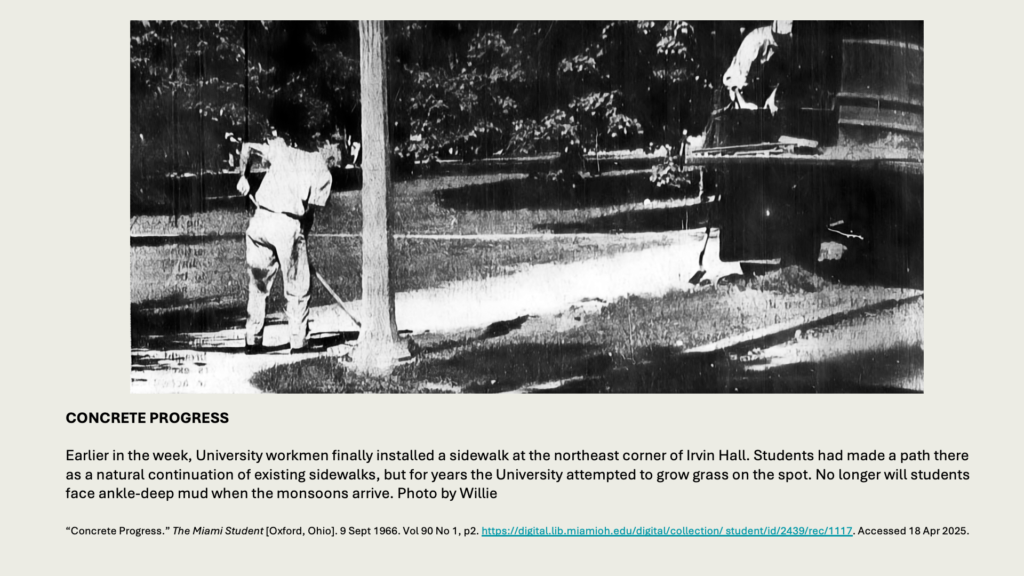
Earlier in the week, University workmen finally installed a sidewalk at the northeast corner of Irvin Hall. Students had made a path there as a natural continuation of existing sidewalks, but for years the University attempted to grow grass on the spot. No longer will students face ankle-deep mud when the monsoons arrive. Photo by Willie
“THE OLD PROFESSOR” ENDS 25 YEARS WITH THE STUDENT
By Gary Luhr

With this, the final edition of the STUDENT for this trimester Prof. Gilson Wright will retire after a quarter of a century as advisor to the Miami paper. Replacing Professor Wright will bo the newly-appointed coordinator of student publications, Hon Geiser, who also takes over as advisor to Recensio and Miami Dimensions. "1 don’t suppose anybody else in the United States has been crazy enough to be an advisor to a college paper lor 25 years,” Professor Wright stated. "But I liked it.” In his heart the 6l-year-old Journalist will probably consider himself a reporter first, last and always. But in and out of class, he proudly refers to himself as "the old professor.”

[...]

Twenty-five years ago the professor’s office was in Benton Hall, he reported, and the Student office was "down in the bowels of Irvin Hall" where any time it rained the water would get in.

Professor Wright looked back on those times as "happy days” when student reporters took their copy up to Oxford Printing Company on bicycles, then rode the bikes back down Slant Walk and through the south door and down the hall of Irvin.

From the beginning, professor Wright said, he has insisted that the paper be kept free of administrative control. "I believe in giving the kids the freedom to make mistakes,” he stated. Professor Wright said that even though he would "blow his stack” at some of the things the paper wanted to do ho defended its right to do them.

[...]
SAFETY CHIEF CALLS CAMPUS DEFENSE 'ADEQUATE’; 
31 SHELTERS IN EXISTENCE
By Gary Luhr

Ed. Note: This the firnt tn a serles of articles by STUDENT staffer Gary Luhr on civil defense problems and preparedness for them on the Miami campus.

Thirty-one buildings on Miami’s campus have been inspected and approved by Civil Defense offices to serve as protective shelters in the event of a national emergency.

Approval was granted and suplies moved on campus in April this year following a recommendation by the Butler County Civil Defense office that existing facilities be made available for this purpose.

All of the shelters are underground and are identified by identical yellow and black "Fallout Leiter" signs.

Buildings in which shelters exist Include Benton, Billings. Bishop, Brandon, Collins, Culler, Dodds, Dorsey, Flower, Gaskill, Hamilton, Harrison, Hiestand, Hepburn, Hughes, Irvin, the old library, MacCracken, McFarland, McGuffey, McMillan, Ogden, Porter, Richard, Reid, Robertson, University Center, Upham, Withrow and Wells.
[…]

Supplies for all 31 buildings, including food, toilet and medical stock, are stored in two central on-campus locations. Radiological surveying equipment for Miami is currently on requisition.

The only shelter requirement not presently in storage is water, widen could not be kept for prolonged periods. Water cans are available, however, to be filled if and when needed. Supplies are inspected by Civil Defense officials and are replaced periodically. As the University expands, the amount of supplies on hand is increased.

New buildings at Miami are designed with the idea of the areas below ground serving as shelters. Facilities in new structures are inspected by Civil Defense officials as soon as possible once the buildings are completed.

Wallace Miller, superintendant of safety and security, has reported that present facilities are adequate for a university the size of Miami.

[...]
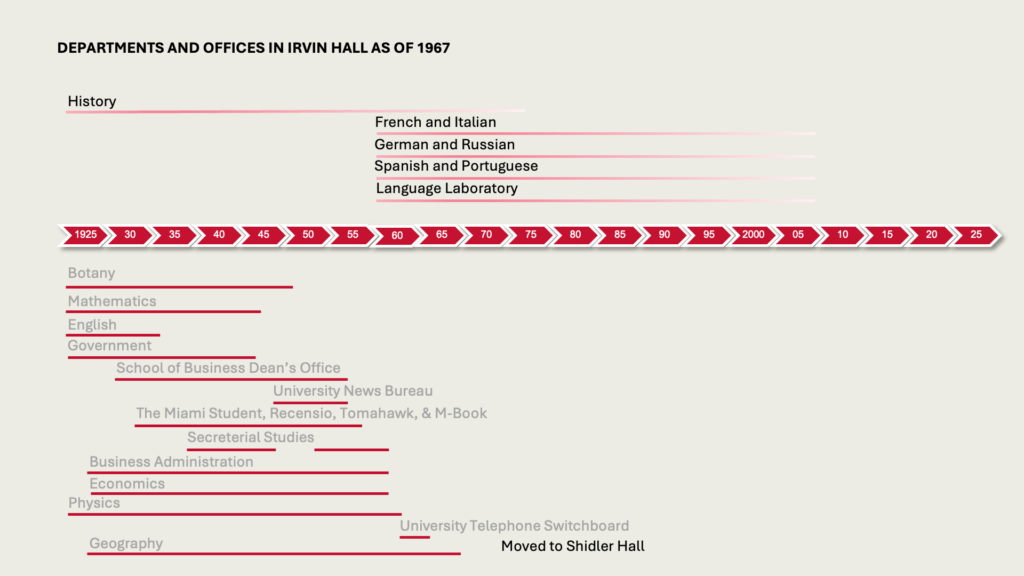
DEPARTMENTS AND OFFICES IN IRVIN HALL AS OF 1967

History
French and Italian
German and Russian
Spanish and Portuguese
Language Laboratory
FORCING THE ISSUE

Ohioans put their vote for progress in at least one place last Tuesday with the passage of Issue No. I. The state legislature now has the authority to issue bonds to the sum of 9 million on capital improvements on everything from pollution control to improving highway construction.

Nearly  million of that total is earmarked for Miami from a grand total of 0 million for educational and correctional institutions. Irregardless of the lumping together of the two categories, the money is needed and welcome at Miami.

The decision of what to do with the money is the University officials alone. The state legislature gives the money to Miami with no instructions on how it is to be allocated.

Part of the money will be spent on capital improvements in already existing structures. Rejuvenation jobs in Irvin and old Hughes Hall should make the buildings far more useful and usable than they have been. But those are secondary expenditures.

The main decision now forced on Miami’s financial wizards is what to do with the library situation. The future of the library at Miami is a two-way path, and now the University will have to decide which path to follow.

Present plans are for the funds to be used on Phase II expansion of the King Library. King Library, although only two years old, might become a relic before its time, however, if the other alternative is taken.

The “other alternative’’ is a centralized library located somewhere on the northeast end of campus, probably on the present site of Miami Field.

The final decision might come from the state legislature in this case.

If Columbus promises Miami funds in the dimension of  million, you can probably expect immediate plans to be made for the centralized library. If Miami gets the  million it expects, continuation of Phase II will probably be the final commitment to King Library as the central library of sorts.  […]
HEANON WILKINS

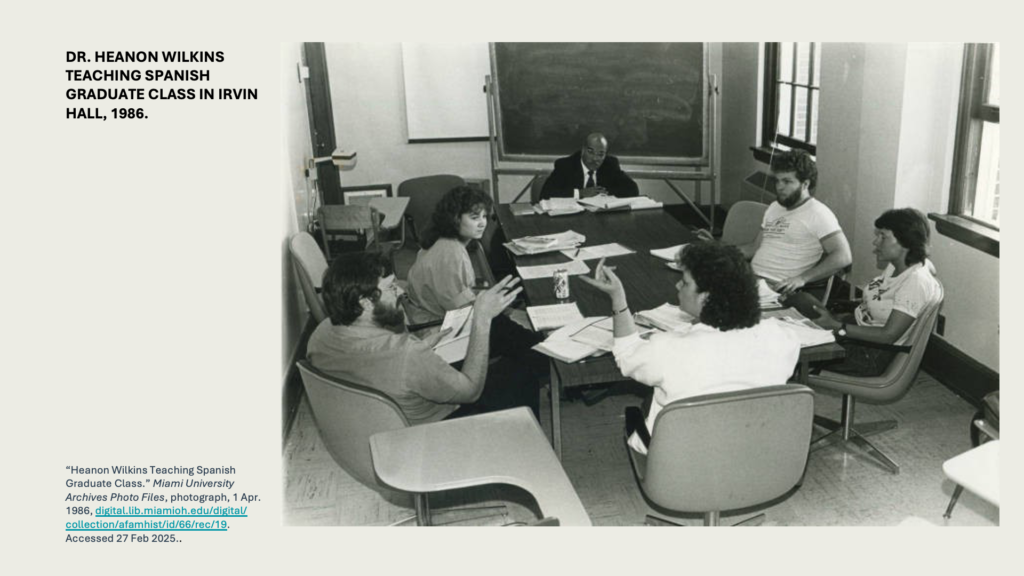
In the center of Miami University, Irvin Hall plays a significant role in the history of African American faculty. Irvin Hall was where the first African American faculty member, Heanon Wilkins, taught [Spanish and] Portuguese.

Wilkins is vital to Miami’s story of Black faculty and staff since he represents the very first Black professor to be hired. Wilkins was born in 1927 in the Pittsburgh suburb of Neville Island, Pennsylvania. He started his career with Miami in 1968 when he was hired on as a professor of Spanish in the Department of Spanish and Portuguese. Wilkins taught at Miami University’s Dayton campus for two years prior to arriving at the Oxford Campus in 1968 as Miami’s first tenure-track African American professor. Soon after arriving at Miami Wilkins established and directed the Equal Opportunity Office on campus. This program was built to encourage minority students to come to Miami and then support their needs as they navigate life in college. He retired from teaching while still at Miami in 1992, then continued to live out the rest of his life in the city of Oxford.
DR. HEANON WILKINS TEACHING SPANISH GRADUATE CLASS IN IRVIN HALL, 1986.
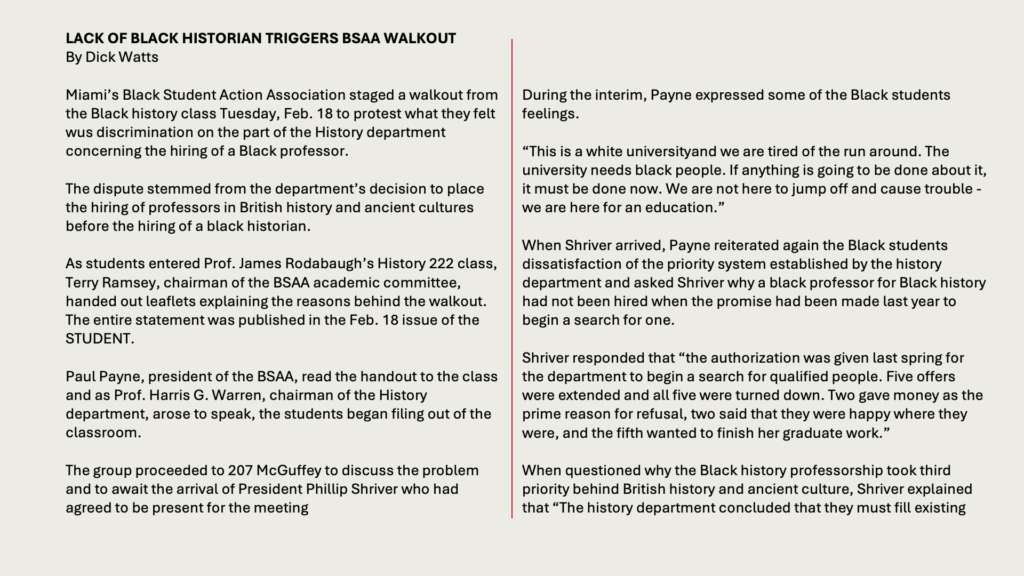
LACK OF BLACK HISTORIAN TRIGGERS BSAA WALKOUT
By Dick Watts

Miami’s Black Student Action Association staged a walkout from the Black history class Tuesday, Feb. 18 to protest what they felt wus discrimination on the part of the History department concerning the hiring of a Black professor.

The dispute stemmed from the department’s decision to place the hiring of professors in British history and ancient cultures before the hiring of a black historian.

As students entered Prof. James Rodabaugh’s History 222 class, Terry Ramsey, chairman of the BSAA academic committee, handed out leaflets explaining the reasons behind the walkout. The entire statement was published in the Feb. 18 issue of the STUDENT.

Paul Payne, president of the BSAA, read the handout to the class and as Prof. Harris G. Warren, chairman of the History department, arose to speak, the students began filing out of the classroom.

The group proceeded to 207 McGuffey to discuss the problem and to await the arrival of President Phillip Shriver who had agreed to be present for the meeting.

During the interim, Payne expressed some of the Black students feelings.

“This is a white universityand we are tired of the run around. The university needs black people. If anything is going to be done about it, it must be done now. We are not here to jump off and cause trouble - we are here for an education.”

When Shriver arrived, Payne reiterated again the Black students dissatisfaction of the priority system established by the history department and asked Shriver why a black professor for Black history had not been hired when the promise had been made last year to begin a search for one.

Shriver responded that “the authorization was given last spring for the department to begin a search for qualified people. Five offers were extended and all five were turned down. Two gave money as the prime reason for refusal, two said that they were happy where they were, and the fifth wanted to finish her graduate work.”

When questioned why the Black history professorship took third priority behind British history and ancient culture, Shriver explained that “The history department concluded that they must fill existing
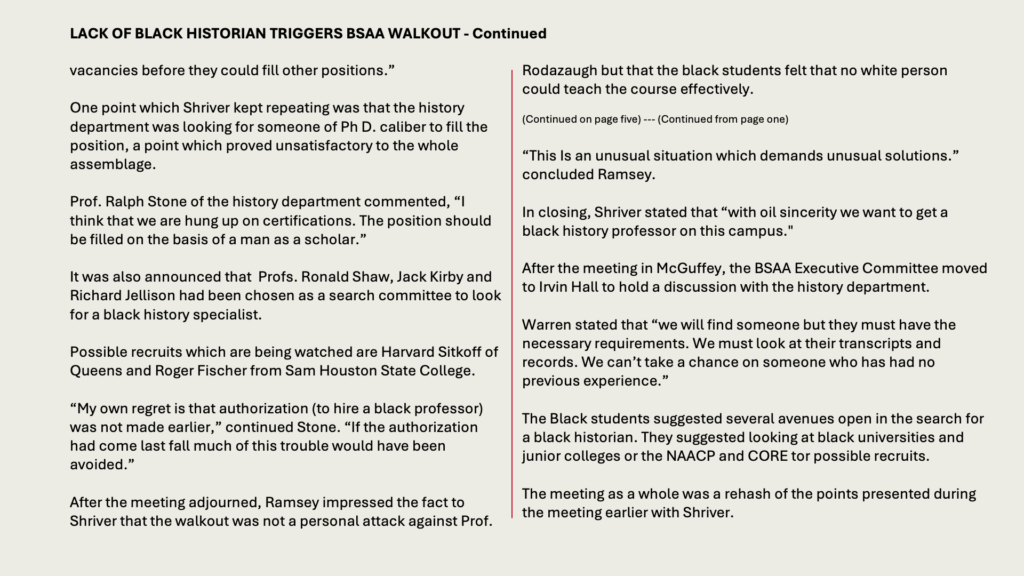
LACK OF BLACK HISTORIAN TRIGGERS BSAA WALKOUT - Continued

vacancies before they could fill other positions.”

One point which Shriver kept repeating was that the history department was looking for someone of Ph D. caliber to fill the position, a point which proved unsatisfactory to the whole assemblage.

Prof. Ralph Stone of the history department commented, “I think that we are hung up on certifications. The position should be filled on the basis of a man as a scholar.”

It was also announced that  Profs. Ronald Shaw, Jack Kirby and Richard Jellison had been chosen as a search committee to look for a black history specialist.

Possible recruits which are being watched are Harvard Sitkoff of Queens and Roger Fischer from Sam Houston State College.

“My own regret is that authorization (to hire a black professor) was not made earlier,” continued Stone. “If the authorization had come last fall much of this trouble would have been avoided.”

After the meeting adjourned, Ramsey impressed the fact to Shriver that the walkout was not a personal attack against Prof.

Rodazaugh but that the black students felt that no white person could teach the course effectively.

(Continued on page five) --- (Continued from page one)

“This Is an unusual situation which demands unusual solutions.” concluded Ramsey.

In closing, Shriver stated that “with oil sincerity we want to get a black history professor on this campus."

After the meeting in McGuffey, the BSAA Executive Committee moved to Irvin Hall to hold a discussion with the history department.

Warren stated that “we will find someone but they must have the necessary requirements. We must look at their transcripts and records. We can’t take a chance on someone who has had no previous experience.”

The Black students suggested several avenues open in the search for a black historian. They suggested looking at black universities and junior colleges or the NAACP and CORE tor possible recruits.

The meeting as a whole was a rehash of the points presented during the meeting earlier with Shriver.
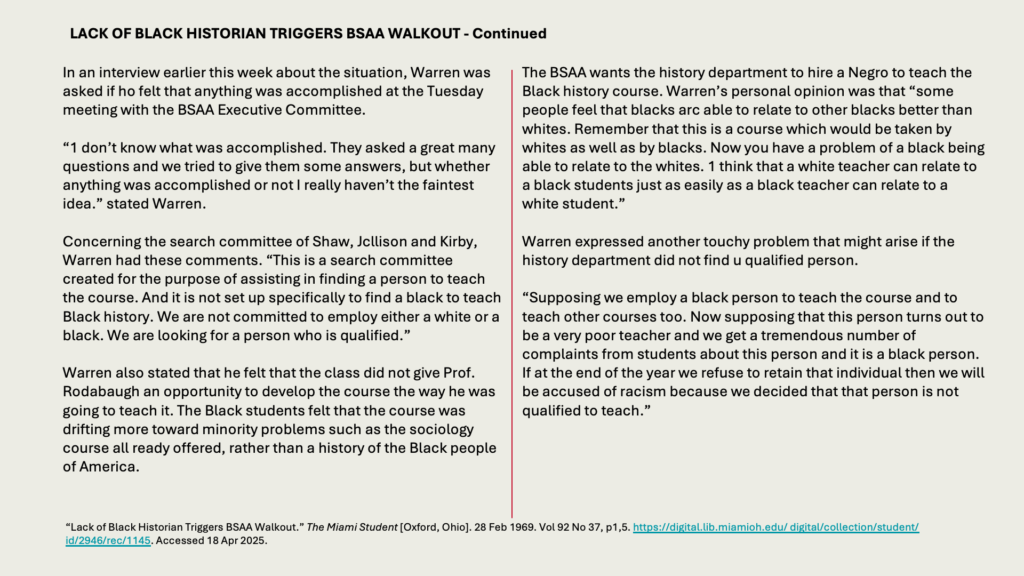
LACK OF BLACK HISTORIAN TRIGGERS BSAA WALKOUT - Continued

In an interview earlier this week about the situation, Warren was asked if ho felt that anything was accomplished at the Tuesday meeting with the BSAA Executive Committee.

“1 don’t know what was accomplished. They asked a great many questions and we tried to give them some answers, but whether anything was accomplished or not I really haven’t the faintest idea.” stated Warren.

Concerning the search committee of Shaw, Jcllison and Kirby, Warren had these comments. “This is a search committee created for the purpose of assisting in finding a person to teach the course. And it is not set up specifically to find a black to teach Black history. We are not committed to employ either a white or a black. We are looking for a person who is qualified.”

Warren also stated that he felt that the class did not give Prof. Rodabaugh an opportunity to develop the course the way he was going to teach it. The Black students felt that the course was drifting more toward minority problems such as the sociology course all ready offered, rather than a history of the Black people of America.

The BSAA wants the history department to hire a Negro to teach the Black history course. Warren’s personal opinion was that “some people feel that blacks arc able to relate to other blacks better than whites. Remember that this is a course which would be taken by whites as well as by blacks. Now you have a problem of a black being able to relate to the whites. 1 think that a white teacher can relate to a black students just as easily as a black teacher can relate to a white student.”

Warren expressed another touchy problem that might arise if the history department did not find u qualified person.

“Supposing we employ a black person to teach the course and to teach other courses too. Now supposing that this person turns out to be a very poor teacher and we get a tremendous number of complaints from students about this person and it is a black person. If at the end of the year we refuse to retain that individual then we will be accused of racism because we decided that that person is not qualified to teach.”
MILLETT TO RECOMMEND BONUS TO MIAMI AT BOARD OF REGENTS SESSION TODAY
By David Pollak, Editor

A proposal to tap additional funds for Miami to help reduce the loss of out-of-state subsidies is to be brought up before the Board of Regents meeting today in Columbus.

President Phillip R. Shriver expects the recommendation which would give Miami an added 0,000 in the budget to cover about half the amount lost by the University through the out-of-state subsidy cut.

Miami is one of three universities scheduled to receive the bonus aid recommended by Chancellor John D. Millett. Ohio University is to receive an added .2 million, and Youngstown an added 0,000.

“The added revenues would definitely soften the blow,” Pres. Shriver stated.

Also slated for passage today is a recommendation which would allot  million to Miami for capital improvements over the next six years.

Of the  million, a total of  million would be earmarked for completion of Phases II and III of King Library, with .5 million of that expenditure to be spent within the next two years.

Miami originally requested .4 million for capital improvements, but the figure released today represents a significant increase of the .2 million total first announced by Governor James A. Rhodes.

In addition to library completion, the funds will be earmarked for remodeling McGuffey Hall and renovation of Upham, Kreger and Irvin Halls.

“The chancellor told me, however, that there was room for flexibility in the amounts to be spent on each need,” the president added.

[…] 

Al this time no bill has officially been introduced to the legislature on higher education, but the president said that individual legislators may be waiting for today’s Regents meeting for any last minute inclusions.

“There is a strong possibility that the proposal will be officially introduced after our meeting today,” the president said.
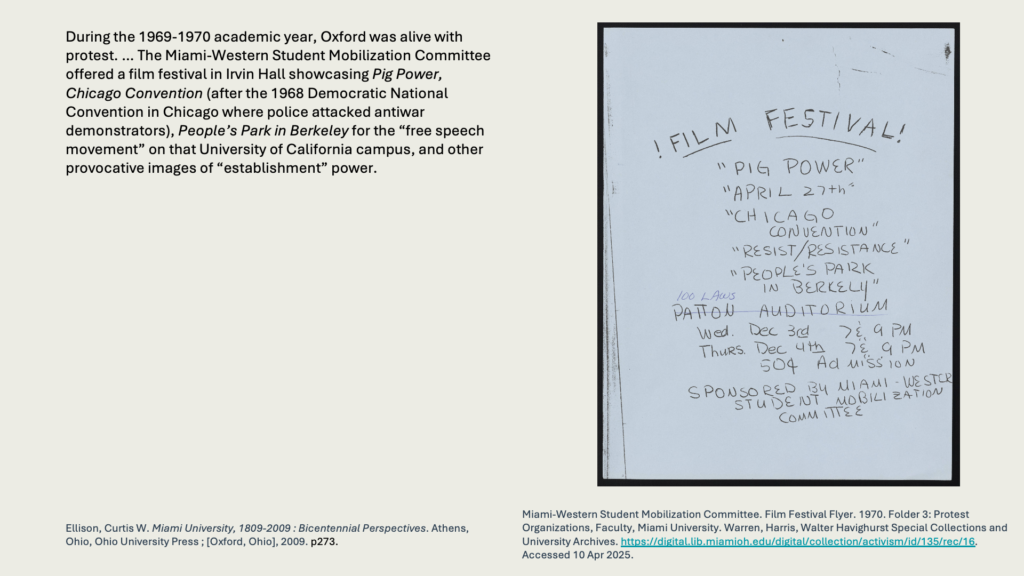
During the 1969-1970 academic year, Oxford was alive with protest. … The Miami-Western Student Mobilization Committee offered a film festival in Irvin Hall showcasing Pig Power, Chicago Convention (after the 1968 Democratic National Convention in Chicago where police attacked antiwar demonstrators), People’s Park in Berkeley for the “free speech movement” on that University of California campus, and other provocative images of “establishment” power.
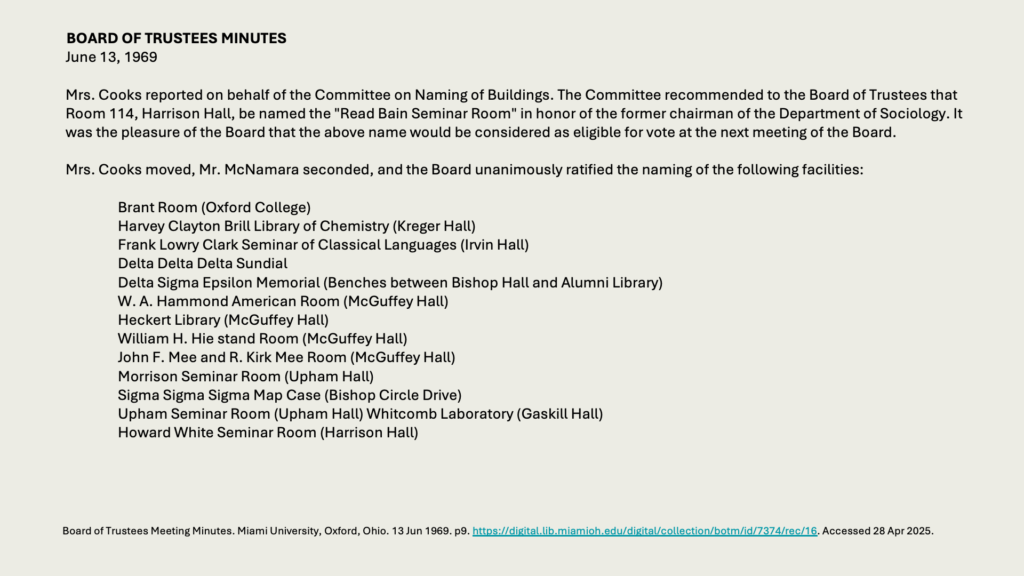
BOARD OF TRUSTEES MINUTES
June 13, 1969

Mrs. Cooks reported on behalf of the Committee on Naming of Buildings. The Committee recommended to the Board of Trustees that Room 114, Harrison Hall, be named the "Read Bain Seminar Room" in honor of the former chairman of the Department of Sociology. It was the pleasure of the Board that the above name would be considered as eligible for vote at the next meeting of the Board.

Mrs. Cooks moved, Mr. McNamara seconded, and the Board unanimously ratified the naming of the following facilities:

Brant Room (Oxford College)
Harvey Clayton Brill Library of Chemistry (Kreger Hall) 
Frank Lowry Clark Seminar of Classical Languages (Irvin Hall)
Delta Delta Delta Sundial
Delta Sigma Epsilon Memorial (Benches between Bishop Hall and Alumni Library)
W. A. Hammond American Room (McGuffey Hall)
Heckert Library (McGuffey Hall)
William H. Hie stand Room (McGuffey Hall)
John F. Mee and R. Kirk Mee Room (McGuffey Hall) 
Morrison Seminar Room (Upham Hall) 
Sigma Sigma Sigma Map Case (Bishop Circle Drive) 
Upham Seminar Room (Upham Hall) Whitcomb Laboratory (Gaskill Hall) 
Howard White Seminar Room (Harrison Hall)
Next Section

About Me

  • Home
  • Lebenslauf
  • Personal Arms
  • Word Clouds

Academic

  • Technology in Language Learning
  • Determinants of Gender in German
  • German Two-Way Prepositions
  • The Collective Noun Catalog
  • Using English Apostrophes Correctly
  • Spelling (or “Phonetic”) Alphabets
  • Crayola Color Names
  • RAL Color Names

Miami Univ

  • Irvin Hall’s Centennial: 1925-2025
  • Lyrics for the Alma Mater
  • Campus Cuisine

Music

  • The Star Spangled Banner
  • O Canada
  • Pfft! You were gone!
  • Gloom, Despair and Agony on Me!

Miscellania

  • Popular Baby Names
  • The Little List of Phobias
  • Treegonometry
  • UK Confusion
Proudly powered by WordPress