
by Gillian Davis
“You can’t divorce yourself from the fact that Tyson is integrated deeply into the community.”
– Art Cullen
There is the perception that Tyson and the community of Storm Lake rely on one another to keep a stable and profitable business and town thriving. Without town residents, specifically immigrant workers, Tyson could not sustain itself in Iowa. Storm Lake, on the other hand, needs the company, too. It provides incentives for immigrants to arrive and maintain (or increase) the population, providing a boost to the local economy. However, might the relationship be co-dependent and toxic? Are community members exploited regularly, fitting a pattern of other meatpacking towns? We focused on these questions this week, reading the first five chapters of Dr. Timothy Pachirat’s Every Twelve Seconds, and speaking with Art Cullen, editor of The Storm Lake Times.
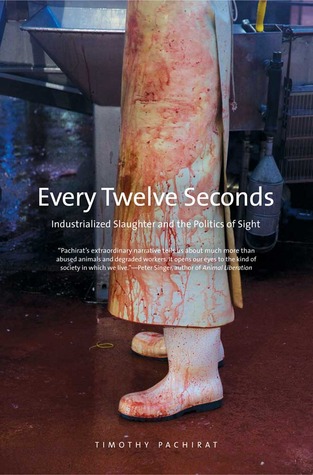
Pachirat’s book provided fascinating insights into meatpacking plants and the towns that host them. Pachirat is a political scientist who decided to go undercover as a worker in an Omaha slaughterhouse for five months, working on the kill floor. The author went undercover to understand the realities of routinized animal killing, hidden from view, while also analyzing the impact it has on the workers and how consumers are able to remain ignorant to this violent production process. His book also seeks to understand how society and even the workers can maintain a distance—spatially and psychologically—from the realities of routinized slaughter. The author highlights this distance by beginning his book with an anecdote of police shooting a cow that had escaped in Omaha, Nebraska, and the revulsion that slaughterhouse workers felt for the act; yet these same people were forgetting their daily involvement in a job that has an animal killed “every twelve seconds.”
Pachirat wrote the book narratively and from the perspective of a slaughterhouse worker. His conversations with fellow employees, witnessing the day-to-day life in the slaughterhouse, “challenges the reader to use these narratives as a way to think through what it means, from the perspective of a lived experience, to perform the daily work of industrialized killing.” He also does not sanitize any of his experiences or conversations, instead including all the gory and graphic details. In doing so, he ensures that readers cannot maintain a distance from the truth of his experiences, and those of all other workers. This decision was his tool to force society to remove the veil from meatpacking plants and slaughterhouses, and to think about the truth behind each piece of meat purchased. Low-priced protein, in fact, comes with very high costs. The author writes, “The detailed accounts that follow are not merely incidental to or illustrative of a more important theoretical argument about how distance and concealment operate as mechanisms of power in contemporary society. They are the argument.”
The author highlights how, even though towns and plants need one another, consumers really perpetuate the troubled relationship. Americans want to ignore the truths of the meatpacking industry, which is bolstered by the government and powerful lobbies. Pachirat describes how most Americans’ “demand for a cheap, steady supply of physically and morally sterile meat” is “fabricated under socially invisible conditions.” This willful ignorance allows the meatpacking plants, for example, to impede union formation, necessary to ensure worker rights and the ability to make a livable wage. As we have recognized before, if unions could reestablish themselves, the price of meat would rise to an “unacceptable” price for everyday Americans, who typically have the privilege of demanding cheap meats. This privilege allows most of us to ignore the need of the workers to survive on a living wage, unmet by companies working to meet consumer demand.
Our thoughts this week formed around a concept presented in Every Twelve Seconds: the “politics of sight.” Pachirat defines the term as “organized, concerted attempts to make visible what is hidden and to breach, literally or figuratively, zones of confinement in order to bring about social and political transformation.” In other words, this concept brings the public’s attention to hidden aspects of society, like meatpacking plants in nondescript places, hiding routinized killing from society. Doing so can push for change, socially and politically.
The class used this analysis to examine meatpacking plants in rural areas. Even though Tyson’s turnover rate is around 100%, it continues to manufacture meat cheaply and efficiently in conditions that, to many, are troubling. On this topic, we also watched a couple of YouTube videos this week. One, “An Inside Look at U.S. Poultry Processing,” left much of the class troubled and led to a conversation on the ethics of meat consumption. In this video and another, we were confronted with the practice of production. Indeed, Pachirat’s “politics of sight” forced us to reconcile a habit of meat consumption with the truth hidden behind factory walls. Our class has not abruptly converted to vegetarianism, of course; but making the hidden visible will, at the very least, lead us to better informed decisions as consumers.
Art Cullen, as a proponent of open discussion and access to information, certainly knows the importance of this issue. He spoke freely with our class on the potential for Storm Lake and the challenges it faces with the meatpacking industry. “It’s really the responsibility of Tyson to pay their workers twenty-five bucks an hour,” he said, “so they can pay somebody a decent amount of money to care for their family or, perish the thought, one parent might be able to actually afford to stay at home and raise the kids themselves, like I was.”
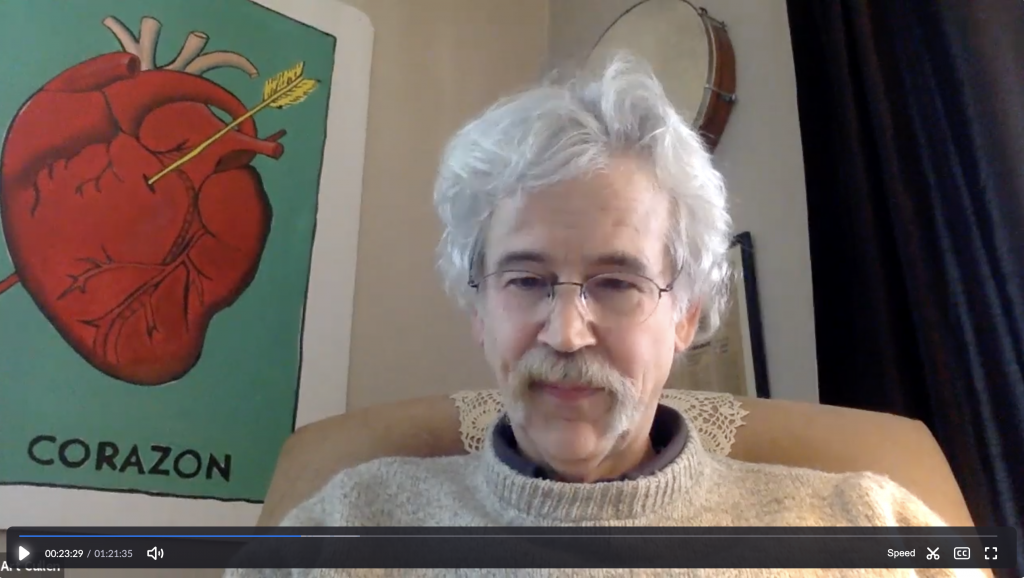
Cullen was noticeably frustrated by a recent phone call with a Tyson media relations representative. We asked him bluntly if Storm Lakers should ever be nervous that Tyson would relocate and threaten residents’ livelihoods. That view “really goes back to busting the Union in 1980,” he said. “The bullshit was instilled in our heads that they’ll leave Storm Lake, [that] ‘we’ve got to give away the farm to IBP to come in here to bust the union and pay half the wages. Otherwise, we wouldn’t have any jobs at all.’ Well, hello, wake up! We are growing two hundred bushels [per acre] of corn here. Nobody is more efficient at feeding hogs. There’re going to be hogs here as long as there’s corn. What were we thinking?”
At the heart of this issue, in Cullen’s view, is workers’ lost trust in the good-faith direction of their employers. “Trust with Tyson (or JBS of Brazil or Smithfield of China) is something that needs work,” he wrote in his recent editorial, “Trust is the Issue.”
“It’s really the responsibility of Tyson to pay their workers twenty-five bucks an hour, so they can pay somebody a decent amount of money to care for their family or, perish the thought, one parent might be able to actually afford to stay at home and raise the kids themselves, like I was.”
– Art Cullen
At the same time, Cullen recognizes the importance of diversity to Storm Lake, how it has revitalized the town to create a thriving place for many to live. At what cost, though?
In the past, Tyson “did offer solid guaranteed employment to a paranoid community that never wanted to see another layoff again,” he said. “That was a horrible experience for Storm Lake, for that meatpacking plant to shut down for a year. And so nobody ever wanted to see that thing shut down again, and Tyson came in, and they cleaned up the plant, and they made it look better. Planted some flowers and raised wages. But it’s still, you know, an average of 18 bucks an hour, and that’s just not enough, and I’ve just had to wake up to the fact that, when are we going to pay the real patriots in this country a living wage?”
It’s hard to ignore, to put out of sight: the town has been revitalized in part by the exploitation of the many people who have come for work opportunities and to have a place to settle and raise their children. Yet they are compelled to do so on a wage that cannot even let them afford child care, or for one parent to stay home for a few years, as Cullen was able to do.
Cullen recognizes that, for years, he (like others) had lived under the fear of layoffs, as in 1981, or a fear that the town would die without continual plant operations. However, is the threat of closure necessary, or would consumer pressure and unionization be able to fix the issue? How can the town trust the company to do the right thing? “Who’re you going to believe,” Cullen asked rhetorically, a company “that just paid a $221 million fine for price fixing and which fights their employees’ wages for putting on and taking off their equipment at the beginning and end of the shift? A company that uses Donald Trump to order its employees back into work without personal protective equipment? You know, is this the kind of people you want to do business with?”
The discussion we have had all week as a class, and the insights gleaned during the interview with Art Cullen and the book Every Twelve Seconds, lead to a very important question: is Tyson truly integral to Storm Lake, now in 2021? The immigrant workers have now formed a tight-knit community and have built successful small-town businesses, and many of their children are going to college and returning to begin addressing key issues in the community, like Joanne Álvorez, a leader of SALUD!
Or is there, perhaps, a more symbiotic relationship between Storm Lake and Tyson, where one relies equally on the other for prosperity? The town is now thriving and has established that Tyson needs its workers, and the company needs the town. Why hasn’t there been significant change to wages and protections for employees?
This year, the pandemic has revealed much of the vulnerabilities of the industry. The “politics of sight” have shown the American public, even if briefly, that the industry’s business policies can be highly questionable, if not morally compromising. Perhaps Tyson needs Storm Lake more than the town needs the company.
Gillian Davis is a history and American studies double-major who plans to enter law school in the fall of 2021. She anticipates specializing in international law. Gillian is currently involved in the History Department’s Honors Program and is researching hair shearing in post-Occupied France from 1944-1945. She enjoys women’s and European history, as well as American history (any era).
