Serving Community to Build Community


by Logan Kelleher


More diversity in the workforce. Daycare options at Tyson. Increased housing in Storm Lake. Injuries on the job being swept under the rug. Topics like these arose in discussions with Fred Moore, former BVU president, and four board members from SALUD!, the Multicultural Health Coalition of Storm Lake.

While speaking to our guests took up the majority of our class time this week, we also discussed two materials to aid in our research: Any Way You Cut It: Meat Processing and Small-Town America, an edited collection of academic articles on the meatpacking industry in a national context, by Donald D. Stull, Michael J. Broadway and David Griffith; and a CNN Special Report, “The Hidden Workforce: Undocumented in America.”

Within the articles, the authors discuss the “dangerous nature of meat-processing work and call into question the packers’ commitment to safety” (67). One article in particular highlights the minimal change that has happened over time in the meatpacking industry: “reading and rereading The Jungle over the last six years, while studying beef packing and beef packing workers,” the authors write, “we have been struck with how little has really changed” (62).

Students agreed that these problems arise frequently, yet little is done to remedy them. While many of us believe that the meatpacking industry should be under pressure to solve these issues, we also recognize a lack of factors motivating change. The best thing going for the industry is that people need jobs, and will continue to work at various meatpacking plants as long as they can receive an income and are able to put food on the table.

We also focused on the inspections of plants throughout the region. “Industries have not been sufficiently vigorous in enforcing standards,” the authors write (64). According to them, meatpacking plants do not see their inspections completed at a high level. “For logical reasons, then, most American consumers choose not to be reminded of the ‘facts’ of the meat and poultry industry,” readers are reminded, “though their reasons are not necessarily in consumers’ best interests” (44). Although people know the problems associated with the meatpacking industry, the door tends to be kept closed on revealing issues to the public.

The risks are perilous, too. Many workers can get injured on the job, because the work can be tiresome and accompanied by movements with sharp objects. When workers do get injured, they receive little compensation for that injury. Hospital visits are rare. The companies would rather have first aid administered in the plant, putting a bandaid on a cut that otherwise needs stitches. Sometimes, workers are even cut by others’ knives nearby, due to the confined space and nature of the job. Immigrant workers not only risk daily injury, they also face not making enough money to live with financial comfort.

Our other material we discussed, the CNN investigation “The Hidden Workforce: Undocumented in America,” looked at immigrant workers in the agriculture industry. This video showed us how prevalent undocumented immigrants are in agriculture. An immigrant worker interviewed, who remains unnamed, talks about his experience, saying “I asked the person, ‘you need to pay us,’ and he told us ‘I know you are illegal’…’if you do something’…’you will be deported.’” Such farmers, and their employers, know that their jobs are among the few available without requiring proper documentation, so it is easier for the farmers to get away with paying them lower wages. But for these workers, even the smaller pay is worth it to eke out a living.

Wages and finances are in large part taboo to discuss, e.g., how much money people make or pay. This particular farmer in the CNN investigation resisted disclosing how much he was paying his immigrant workers. “Because when we say that we’re in dire need of more people to help us do the work and we talk about them being immigrants,” he said, “not a lot of people want to hear that.” The farmer could be either paying them close to what the workers in the Tyson meatpacking plant make, which is closer to $16 an hour, or they could be making well under the federal minimum wage. 

Why doesn’t a union simply take over? If a union were to try to come into Storm Lake, for example, Tyson could stop any of the efforts in its tracks. It would be easy to replace the workers because the turnover rate is already high. If a company like Tyson had to deal with unionization in its plant, it would be an inconvenience only so long as it takes to hire more willing workers with fewer options. This is a “white” or “American privilege” that we discussed, where the advantaged population often assumes it can get better jobs than ones at Tyson or other businesses in the agriculture industry. Much of the immigrant population, on the other hand, sees these meatpacking plants as their best and sometimes only option.

Former President Fred Moore, now a resident of Florida, shared with students a slice of paradise via his Zoom background. (Oxford, Ohio, had just received seven inches of snow.)

As our discussions came to a close, we moved on to a first guest speaker for the class last week, a man whose job changed rapidly in his years in Storm Lake. Fred Moore, former president of Buena Vista University, served from 1995 to 2017, and therefore was a useful contributor to our class research. When he first moved to Storm Lake, Moore noticed quickly that it was not what he was used to. Growing up in the South, Moore noted that the diverse population he experienced had included African-Americans, but when he moved to Storm Lake he saw a larger mix of ethnicities and nationalities, a “global melting pot,” as he put it. 

One of the things Moore spoke most highly of was that a student organization, Student MOVE (Mobilizing Outreach & Volunteer Efforts), continues to contribute greatly to the local community. He said that as a student body, BVU tallies in over 10,000 hours of community service in a year, a tremendous number for a school with a student body of around 1,546 students (2018-19).

An effort that Moore made with his time in the presidency was to see more diversity in new hires at the university. “A place where we started to do better was what we called the physical plant,” he said. “That would be facilities, housekeepers, maintenance.” 

BVU does recruit from Storm Lake High School. It makes recruiting efforts at the school, and sees many first generation students, from both the recent immigrant population as well as Storm Lakers with deeper local roots. Regardless, many local students are going to college for the first time in their family. One of our classmates asked if the school sees the Presbyterian religious affiliation as a contributor to the students admitted, but Moore informed us that Catholic, Lutheran, and Methodist affiliated students have higher percentages of entry. “In that part of Iowa, the Catholic Church and the Lutheran Church are very prominent,” he said.

From a former professor to a former president of BVU, to former and current police chiefs, to the Storm Lake Local School District superintendent, our class has talked to many important members of the Storm Lake community. This past Wednesday, for the first time, we spoke with residents working on the ground to improve the lives and health of all Storm Lakers. Four board members of SALUD!, which “believes in collaboration rather than competition” and “serves the community by building community,” shared their stories with us, including Joanne Alvorez, Di Daniels, Emilia Marroquín, and María Ramos.

Joanne Alvorez spoke of the various health initiatives supported by SALUD!

Each had a different journey to Storm Lake and to SALUD!, but all shared a common goal of working with the organization to create a better community. Daniels explained how the organization aspires to meet the needs of the population when they arise, on an ad hoc basis. In a light-hearted but insightful moment, Alvorez brought up that she was very hesitant at first to join the organization. “I actually avoided joining SALUD! for a few months because I was kind of assigned to it,” she said, “because it was the multicultural committee, and I was the only brown person at the place I was working.” However, Alvorez would be convinced to stay. “I knew [the organizers] from the community and just knowing that the people that were included in the coalition were people in my community, and people that I trusted, was super important to me and the reason I stayed.”

María Ramos, on the Storm Lake City Council, shared anecdotes from her time in town and from her work with SALUD!

Ramos, born in Mexico and on the City Council of Storm Lake, brought up the number of health screenings that the organization has facilitated at places like Tyson. This leads to patient/worker peace-of-mind, to be aware of any potential health problems.

Marroquín spoke of how she moved to Storm Lake with her family after a friend told them about Tyson hiring, and how she has been active in the community since then. On the organization and its ability to address challenges, Marroquín said, “I don’t know all of [the needs in Storm Lake] because we discover those as we go. Sometimes we don’t know these things are happening. Right now needs are pretty obvious. Child care is a big need in the community. Housing is another big need.”

One student, Anna Rottenborn, mentioned that all of the board members of SALUD! are women, and asked if that is the primary target for the organization. Daniels told us that they do welcome men, but they want to create a safe space for women first and foremost. “I am very cautious about bringing immigrant women…alongside with men because there seemed to be this automatic submission to the male,” she said. “I want to make sure every woman feels safe saying what they want to say.”

Emilia Marroquín, not to be outdone by Fred Moore, had a sunset behind Storm Lake for her Zoom background. She discussed her arrival years ago from El Salvador.

Marroquín mentioned that the people who come to the meetings need to be committed to the organization, and the majority of the time that is the women in the community. There are men that do come to meetings with reasonable frequency, but the women tend to be the most committed.

Another question, raised by Dr. Offenburger, was one that was helpful to our research. He noted that some of the more important things that the organization has done were aimed at Tyson workers, and he asked if they believed that there were shortcomings in what Tyson was doing for its employees. The answer was a resounding yes. Alvorez believed that Tyson should be more focused on child care and housing, the former being a problem for hesitant parents who do not want to, or cannot afford to, leave their children at home or at other area daycares. She felt Tyson should take the initiative to help its employees in that way. And when Ramos was talking about the various things SALUD! has done for Tyson, the list was long. “We have done a bunch of different types of screenings at Tyson: hypertension, BMI, diabetes…We had done a healthy activity that was called ‘Sunday Funday’ and invited local health centers to come in and do blood pressure and diabetes checks.”

Di Daniels, co-creator of SALUD!, learned important lessons about integration and community building from previous experiences in Sioux County.

Daniels also spoke about previous times when SALUD! has called out Tyson for these shortcomings, but because it is such a large employer, it is hard to make change on a grand scale. Housing availability may be one discrete issue that needs to be addressed in Storm Lake, yet larger, more general challenges, like racism, remain. Little by little, meeting by meeting, SALUD! leaders and others in town are working to find–to create–a sense of community.

Logan Kelleher is a junior history major and enjoys learning about Native American history. After graduating from Miami, Logan plans to attend law school and concentrate in environmental law. On campus, he is involved with the Amicus Curiae Pre-Law Society, where he serves as the Vice President of Programming, and is a member of the Miami University Men’s Glee Club.

A Long Way to Go


Justin Hobart


Racial politics and policing are two interconnected subjects that have gripped our nation, particularly after last summer. This week, we explored these and other subjects through interviews with two informants: Storm Lake Police Chief Chris Cole, and former Chief Mark Prosser. We posed some difficult but necessary questions to our guests, who have had to deal with these issues every day in a local context. 

Before our conversation with Cole, we began class on Monday discussing Princeton sociologist Robert Wuthnow’s The Left Behind, a short book that investigates the decline of rural life in America. Wuthnow’s study relies on interviews and case studies from various small towns, similar to our project.

When you look at a picture of an American farm, Wuthnow writes, it could be from the 1910s or the 1980s, and you wouldn’t be able to tell much difference. During our conversation with Dr. Whitlatch, he had brought up something along these same lines, saying that Storm Lake in the 1980s was practically identical to Storm Lake thirty years later, a trend that would be nigh impossible to find in any big American city in the 20th century.

While farms might not have changed much in the middle twentieth century, businesses did. It is very difficult for mom-and-pop-type stores to thrive in rural America, where they are competing against the likes of Walmart, which can offer a seemingly endless variety with unmatched prices. Small-town shops must therefore provide some sort of niche service unmet by big companies. The resulting loss of businesses and jobs not only causes economic decline, it also has significant cultural impacts as well. In these small towns, everyone tends to know each other, and so when someone loses their job, people talk, and “the conversation can quickly shift from what happened to them to what could happen to me,” causing fear among townsfolk. Referring back to our discussion with Dr. Whitlatch again, Wuthnow made a very similar point: many of the local businesses in Storm Lake are very niche and pertain to Storm Lake’s diverse culture, such as a Hispanic bakery.

In Wuthnow’s work, many of his informants were kept anonymous, and towns were left unnamed (e.g., a New England town”). We understood how this added to the argument that the scholar was trying to make: it doesn’t matter who said what or where they’re from, because these themes are happening all across rural America. Wuthnow aims to recognize these shared problems. Talon Wolter, a fellow student, put it nicely: “This is looking at the microcosm that is the macro of the entire United States and…rural zones in general.”

While Storm Lake and other towns like it may be experiencing some of the effects of this decline , the town is embracing its unique and diverse population to try and counter the trend.

Police Chief Chris Cole joined us on February 15.

Police Chief Chris Cole spoke to this in a far-ranging conversation on topics such as the COVID-19 pandemic, racial issues and reactions to Black Lives Matter, community relations, and his various experiences over the past twenty-five years. From the outset, we sensed how Cole embraces his role within the Storm Lake community. He detailed some of his past and how he has grown as a person and police officer. He recalled one of his first days on the job when he had chased down and tackled a man. Upon identifying him, a Hispanic man with the name Jesús, Cole declared, “You’re in trouble now Jesus!”  (Cole had used the Anglo pronunciation, ‘gee-zus,’ as opposed to the correct Spanish pronunciation, ‘hay-soos.’) Cole laughed at the memory.

As an outsider coming into Storm Lake, Cole experienced a bit of a culture shock, but thanks to the rigorous diversity training that all Storm Lake officers had been undergoing for years (before required by law), Cole quickly acclimated. Talking with a lot of the people he had arrested also helped him out, he said. Officers can have a lot of down-time when taking people to the station for processing. (Officers have to drive them to the station, file paperwork, fingerprint them, and, if they are injured, officers must take them to the hospital and stay with them while they are being helped.) Cole thereby accumulated hours upon hours of conversations with Storm Lake locals, he said, “and so I’ve learned a lot about different cultures and different peoples’ experiences just based on…basic conversations.”

When we interviewed Cole’s wife, Dr. Stacey Cole, last week, it was clear that she was very aware of her schools’ shortcomings and had plans to improve upon them, so I posed a similar question to Chief Cole: what challenges were his officers facing? One of his biggest ongoing challenges is the need to maintain good relations with the local community. Despite having two community relations officers, Cole has felt a disconnect; a fair number of crimes go unreported. Cole attributes this in part to the current level of distrust that many communities across America have with police officers. In Storm Lake, as a town with an extremely diverse community, some of those feelings are represented. Another factor is that Tyson’s aggressive campaigning south of the border has resulted in a significant undocumented immigrant community, which in turn has resulted in immigrants fearful of reporting crime, in order to avoid the spotlight.

Despite these fears, Cole made it clear that tracking down and rounding up undocumented immigrants is not in his job description. His job is to protect the entire community, not just those who “won the birth lottery,” and he wants to protect “with equity.”

Cole intends to continue to strengthen his department’s community relations, and he will do so in various ways. He reaches out to community leaders to anticipate and resolve any issues, and he also talks with other police chiefs, though they tend to be from larger cities. Cole gives back to the community on his own time, as well. He mentors young athletes in Storm Lake, who experience both implicit and explicit racial bias when traveling to other towns.

Cole also struggles to recruit people of color to join the force. Despite the town’s population, with an estimated 70% to 80% people of color, the police department does not reflect that level of diversity. Cole recognized that his POC officers have significantly better relations with their respective communities than his white officers. He also appreciates the value of having diverse role models for children, and he is working hard to diversify his department as much as possible.

Storm Lake Chief of Police Chris Cole (right) at his swearing-in ceremony with his predecessor, Mark Prosser (left). Photo courtesy of The Messenger.

On Wednesday, we got the chance to talk with former Chief of Police Mark Prosser, who retired in January of 2020. Prosser currently works as a deacon in Sioux City while also serving on the board of the National Immigration Forum. His career in Storm Lake aligned with the heavy influx of Hispanics to town, and we focused on his relations with the Hispanic community in particular.

We were curious as to when Prosser first noticed changes affecting Storm Lake. He said it was pretty early on in his career, in the early 90s, when they had arrested an undocumented immigrant who spoke very little English. Prosser thought, “What the hell do we do?” He quickly came to a conclusion that Chief Cole later reached. In his words, it came down to “communication, communication, communication.” That is the key to maintaining good, strong relationships with the community they swore to protect. Later in his career, there were instances when he was notified of a new racial group moving en masse into Storm Lake. Well-versed in working with a multicultural community, Prosser didn’t break a sweat, saying, “Been there, done that, business as usual.”

Former Chief of Police Mark Prosser spoke with our class on February 17.

Prosser also spoke of lessons he learned on the force. In a poignant moment, he reflected on one of the biggest detriments to community relations: when his department assisted an Immigration and Naturalization Service (INS) raid at IBP, where officials detained about 200 people. Although almost all of the people were released within a couple days, it stoked fear within the community and “it really negatively damaged relations” and had profound consequences, he said. Prosser recalled, “We scared the hell out of the people, and we put a lot of families in fear.” From that day on, though, he knew that he had made a mistake facilitating the raid. He made it known loud and clear to the public that his department would no longer assist such raids. “It was the worst professional decision of my life to be involved with the raid,” he said.

When asked about some of the best strategies that he employed to try and rebuild his department’s trust with the community, Prosser said that he realized Storm Lake’s police couldn’t do business like they would in “white America.” The SLPD accomplished this through all kinds of diversity training and cultural humility training. He even brought in experts on ethnic groups present in Storm Lake to train his officers to best serve and protect this community. “It’s the infamous marathon, not a sprint,” he said. “It has to be infused into what you do every day.”

Prosser also made sure that his officers and he participated in as many communal events as possible, and that they never turned down an invitation to be with their immigrant communities. Whether it was a festival or a church function, SLPD “wanted to be there, so [immigrant populations] knew we were part of the community as their brothers and sisters.”

Other than people like Cole and Prosser, who promote change and diversity, there are still those who wish to “turn back the clock,” in Dr. Whitlatch’s words, to the time before Storm Lake was host to thirty different languages. Prosser recalled that during the INS raid in the 1990s “there were people standing on the streets, cheering when they saw the INS buses coming through.” Even to this day, Cole expressed that some resentment persists, and “that there’s definitely people that have that mindset.”

 “We have a long ways to go,” Cole said. “America has a long ways to go.”

Justin Hobart is a junior at Miami University studying History

The Power of an Ampersand


by Joey Puckett


This past week, we student researchers were delighted to have our drab, physically-distanced lecture hall filled with lively discussions about Storm Lake’s history, national politics, and education.

Class opened on Monday with news from Dr. Offenburger. He had transcribed our interview with Dr. Michael Whitlatch, and the process took around seven hours. Mindful of students’ time, he therefore decided each of us will only have to transcribe two interviews this semester, rather than three. (This process was supposed to be made easier by Zoom’s automatic voice-to-text transcription service, but the software proved less reliable than expected.)

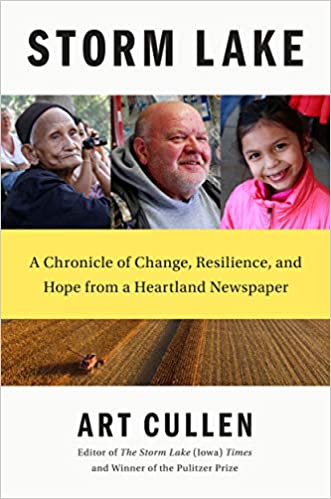
Once this business was settled, the class launched into a long discussion about Art Cullen’s recent book, Storm Lake. In fact, before Dr. Offenburger’s arrival, we already had begun to discuss Cullen’s book.

Typical of college students, we opened by bonding over the parts of the text we struggled with most. Once the discussion formally started, we were ready with a series of critiques. For one, we thought Cullen occasionally oversimplified complex dynamics, paving over broad claims with a humorous and folksy “that’s just the way it is” kind of tone. Other students noted that some chronological jumps felt choppy and disrupted reader immersion. Many also felt drained of precious time by various anecdotes. Of course, we didn’t fault the book itself for this. It’s a research problem: sifting the wheat from the chaff, searching for evidence to meet our own particular needs.

Nevertheless, our praise far outweighed the criticisms. It was a well-written, well-structured book. It served as a compelling, cogent introduction to Storm Lake, its history, and how economic circumstances brought it unexpected changes. Students were especially impressed by Cullen’s retelling of the public affairs reporting on Big Agriculture that earned his paper the Pulitzer Prize. Fellow student Adam Kimble told the class he “wanted to underline the whole section.”

Students were captivated by the chapter “We Can’t Go On Like This,” which detailed the environmental history, degradation, and future in Storm Lake and the surrounding region. Also noted were the innumerable mini-profiles of area residents prominent throughout the book. I (Joey Puckett) likened his style to Gene Weingarten of the Washington Post, and students took note of his anecdotal structure for their own forthcoming profiles of Storm Lakers.

The text’s broad political scope raised questions among students curious about Iowa and its people within the national political scene. Specifically, students inquired about immigrant gun ownership, housing divides, the police force, and the protection of the lake. Michel Reising observantly commented on Cullen’s politics, “I know where he stands on some issues. I know how he feels about guns, because nobody in my community at home would use the phrase, ‘assault weapon.’” Our discussion about national politics highlighted a welcome challenge for the class: addressing hot-button political and racial issues directly. These questions are front and center in the study of Storm Lake. Whereas most history courses avoid discussion of current events, our course demands we work through these questions, without evasive or couched language.

Our many political questions spurred interest for us to speak with other residents of conflicting experiences: an unabashedly anti-immigrant resident, for example, or a former subordinate of Steve King, or a Tyson executive. Dr. Offenburger mentioned that he reached out to Tyson, but has received no response to date. Only time will tell if these interviews come to pass.

Much like last week’s guests, Cullen’s love for Storm Lake radiated throughout the text. Our admiration grew for him as a loyal local, a dogged editor, and an eternal optimist.

On Wednesday, the class was joined by Dr. Stacey Cole, Superintendent of the Storm Lake Community School District, for a discussion on education. She spoke about her experiences running the district during the pandemic, working with a diverse student body, and serving underprivileged students.

In her introductory remarks, Cole said she was “really all about the underdog, and thinking about how to help people win who don’t have as clear of a path to winning options as others.” Cole said of Storm Lake’s unique challenges, “One of the things that I know is true in Storm Lake, that I don’t believe is true in every Iowa community, is what we do in Storm Lake matters every single day, the decisions that my teachers make every single day.” The decisions they make determine whether the kids will succeed and graduate with options, or struggle in the transition from high school to adulthood. Parents who lack the social capital to make informed big decisions usually place enormous trust in Storm Lake schools to help.

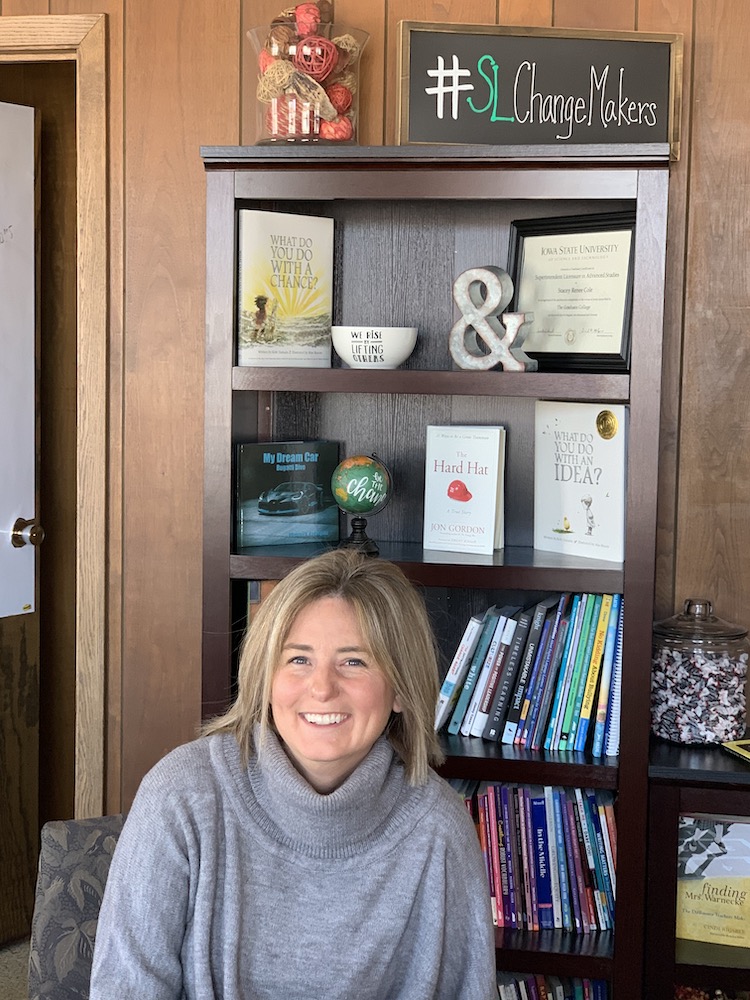
Superintendent Dr. Stacey Cole leads the Storm Lake Community School District with a philosophy of “and” rather than “or,” symbolized by the ampersand on her shelf.

Her student-centric mantra shined through as she talked about the many ways schools in Storm Lake adapted to recent challenges. The district’s response to COVID, as described by Cole, is a case study in flexibility and creative logistics. She noted with pride that the SLCSD tries to answer every question of “how” with a response of “yes.”

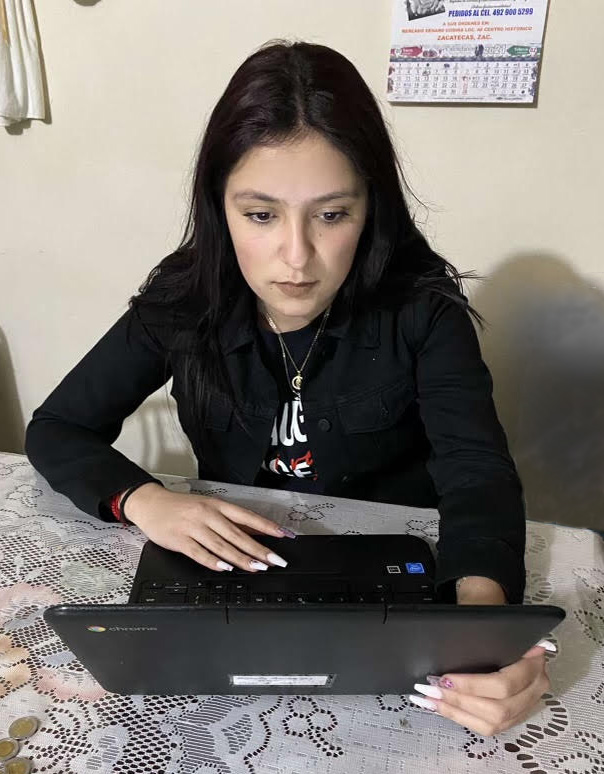
One surprise: some students, who started the year in Storm Lake but were on a trip to Mexico, have been allowed to complete the school year virtually from Mexico. The district has responded to their needs by sending technology to them, whenever possible, so they can work virtually. This aid raised some controversy in the community, Cole recognized, but she believed the rewards far outweigh the risks. “If I have a hotspot and it’s sitting here on my table next to me, but it could be in Mexico helping a kid get their diploma, it should be in Mexico,” said Cole.

This shift online has actually reaped unexpected rewards for the district, which may continue in years to come. The changes have addressed the issue of the district’s overcrowded classrooms. The staff has adjusted well, and has been relieved of certain pressures. The district is also responding to kids who help support their families by working with the addition of night classes, and changing to a model of taking one class per month with daily three-hour periods. This massive rethinking of what school can be has turned an otherwise dreadful past year into one with some blessings for the SLCSD.

Storm Lake student Michelle Ramirez works on her courses while on a trip in Mexico.

Cole also spoke about the recent statewide law which mandates schools to provide a 100% in-person educational experience. She expressed frustration with the law, which she believes is the state government’s headstrong way of improving Des Moines schools at the expense of other communities. “They continue to move a target that we have been trying to hit since June,” she said.

Of central concern for our class: how is the district working to serve such a diverse body of students and families? Cole said that children who come from different backgrounds and regions tend to deal with different sets of issues. Her goal is to uplift students from Asian, African, and Micronesian backgrounds to the same levels of success the district has seen in Latino students. She invoked author James Collins’ Good to Great to explain how “good” can be, in fact, the enemy of “great.” Another way to put it: “good” isn’t good enough. Cole questioned whether Storm Lake can celebrate its diversity when the district is struggling to meet the needs of non-Latino, non-Caucasian minorities. “I think diversity has become the ‘good of the great’ in Storm Lake,” she said. “I think being great at diversity is when everybody is being successful,” she said.

In Storm Lake, we learned, Micronesian students are the fastest-growing student population. Cole expressed tremendous adoration for these students, saying, “I love our kids from Micronesia. They are so much fun. … They are all-in with everything they do.” But such an affable sociability, when met with the implicit bias of others, can sometimes hamper perceptions of student performance. She believes that the structure of the district has not quite adapted to the needs of this relatively new minority population.

Cole is working hard to train staff and teachers—and herself—to identify and question implicit bias. She believes that students from Africa and Micronesia, with their own cultural expressions that can appear more boisterous than those of white Americans, are misunderstood as in-need of remedial instruction. She leads a team of anti-implicit-bias staff, which is working to change the perception of employees one interaction at a time. Cole is optimistic about this grassroots approach to combatting bias, saying, “What I know hasn’t worked is you hire someone and call them an ‘equity coordinator,’ whose job is to create equity throughout the district … That person isn’t going to be in the hallway when someone says something negative about a Black kid who just walked by.”

The anti-bias push also involves a public relations campaign. Until recently, the only stories of students in regional news outlets have tended to be negative ones, highlighting crimes or other transgressions. In the past three years, she and others in the district have been placing students in the spotlight not for extraordinary achievements, but simply as a celebration of their everyday positive contributions to the community. She believes this has already improved the wider perception of Storm Lake’s students and shrunk implicit biases.

As Cole spoke, she referenced an ampersand—a real, decorative sculpture of an ampersand—sitting on a shelf behind her. She keeps it there to orient her thinking on how to create an inclusive community. Instead of questioning, “How can we do this or this?” she said, the ampersand reminds her to ask, “How can we do this and this?” In a district where over 70% of students are on free or reduced lunches (and whom, by Iowa law, cannot be charged for any other activities necessary to their education), the financial strain is sometimes tough to manage. Financial reality confronts buoyant optimism. Cole has done what she can personally, too, like bringing four or five students along when she and her daughter visited potential colleges.

More importantly, she has worked to address the lack of “social capital” that students from impoverished families face, particularly those whose parents come from foreign countries. Cole says parents from different cultures often don’t know the “invisible rules” of high school: which classes to take, how to prepare for and apply to college, or how to navigate the stressful, complex environment of American high schools. Though these families might not know the answers, they know there are people in the district who can help.

“Right now, [immigrants in Storm Lake] are essential workers who probably—not probably—who absolutely do not get the respect that they deserve, for what they have done for their family. And the fact that many of them are here without papers but are still doing the right thing by their kids…that is actually courageous and brave and not spiteful and deceitful as some of the national narrative would suggest.”

— Dr. Stacey Cole

Unfortunately, Iowa’s social services system are broken, according to Cole. Knowing how to get help doesn’t mean it is on the way. No matter how desperate parents or the district is for assistance from the state, kids often can’t get the help they need without first entering the criminal justice system. She likens this to criminalizing poverty and mental health issues. It’s an ongoing challenge not unique to Storm Lake.

Her goal is to educate and provide students with as many options as possible.  Cole said there is a lot of work to be done in this area. Storm Lake schools recently created a program with the local community college to offer training in hands-on careers to kids who want to move on from the classroom. They are also offering a financial literacy class and other classes which are career-focused. They are also developing a tiered diploma system.

Cole also touched briefly on the district’s relationship to Tyson. When asked about the company’s role in the community, Cole laughed and responded, wryly, “That is a loaded question.” She continued, “I wish that [the parent company of] Tyson was a more community-oriented organization. And by that I mean really loving the communities that they have put their plants in, and really thinking about what the needs of that particular community are, so I will say that I think that that it could be improved.” However, Cole is immensely grateful that the company has appointed a new community liaison, Cynthia Trujillo, a “Godsend” who works to bridge the gap between the district and the plant’s working parents. “Especially during the pandemic,” she said, “I don’t know what we would have done without Cynthia.” Cole hopes that once the pandemic is over, Trujillo will have more time to focus on strengthening the community’s relationship to Tyson.

Cole said her biggest takeaway from living in Storm Lake is the incredible courage and bravery of the immigrants who come to live there, whom she is proud to serve. “Living here now, for as long as I have lived here,” she said, she is inspired by “the courage and bravery that comes from every family that is an immigrant or a refugee that steps into this community to live…Right now, they are essential workers who probably—not probably—who absolutely do not get the respect that they deserve, for what they have done for their family. And the fact that many of them are here without papers but are still doing the right thing by their kids…that is actually courageous and brave and not spiteful and deceitful as some of the national narrative would suggest.”

Joey Puckett is a sophomore at Miami University majoring in history and English literature.

What does it mean to be a “Storm Laker?”


by Olivia LeRoux


Last week, our class got to view Storm Lake from two distinct perspectives. On Monday, we interviewed Dr. Michael Whitlatch, Professor Emeritus of Performing Arts at Buena Vista University, and Matthew Marroquín, a current BVU student who grew up in Storm Lake. Through these two guests, our class got a glimpse at how interpersonal connections and treatment within the community may have differed. One thing remained clear, though: both individuals carry a great deal of love and passion for the town and its vibrant community. These interviews came on the heels of a conversation two weeks ago with Patricia Cohen of the New York Times, and we had been eager to gain a better understanding of community, diversity, and tension within the small meatpacking town.

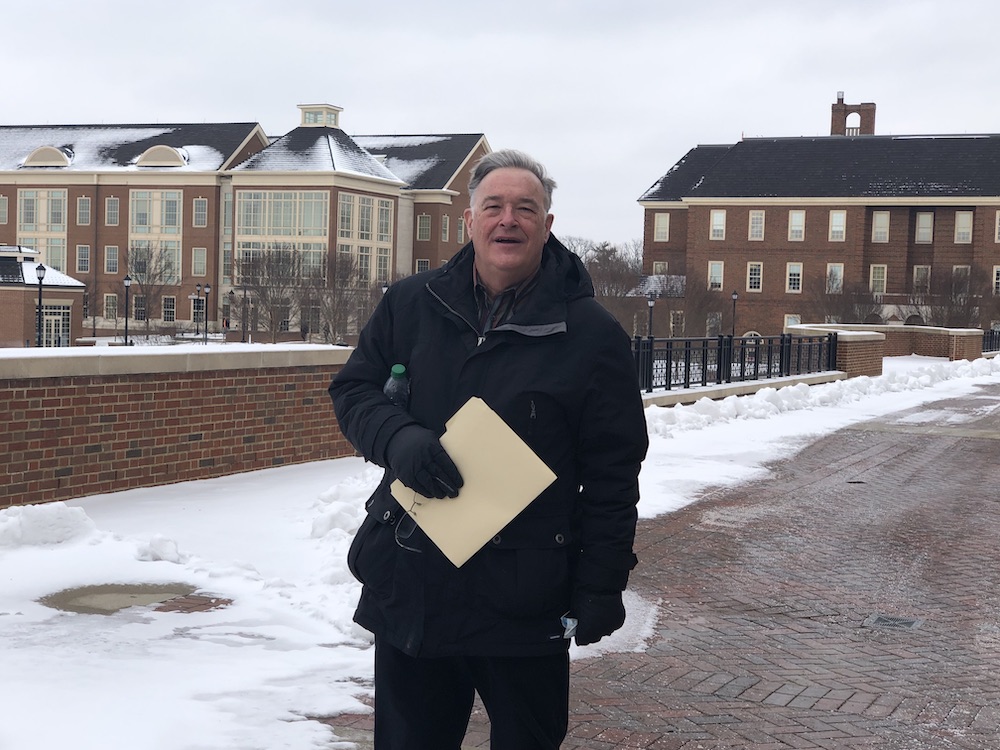
Whitlatch had been at BVU for 39 years. He received his undergraduate degree at Miami University before venturing out to Storm Lake in 1977. After retiring, he returned to Ohio to be closer to family, which allowed him to visit our class in person (while masked and distanced). A resident of Storm Lake from 1977 to 2016, Whitlatch witnessed first-hand the rapid and impressive change in the town.

He began by describing Storm Lake, upon his arrival, as a town from a 1950s sitcom like “Leave It to Beaver” or “Father Knows Best.” According to Whitlatch, the traditional midwestern town was made up of nearly 100% Caucasian residents, and people pursued simple, quiet ways of life.  The narrative of the quaint town began to shift when Governor Robert Ray facilitated the relocation of 1500 refugees from Southeast Asia, with the support of local churches, to Iowa and to Storm Lake. Some citizens were disgruntled. “This was rather controversial in the state,” he said. “There were people that were unhappy about that, that [the refugees] are going to begin to take away the jobs from everybody else.” However, the churches welcomed these refugees with open arms and provided them with housing and work.

Dr. Michael Whitlatch visited the class on February 1, 2021.

Whitlatch then gave a detailed overview of the meatpacking industry’s history. What he remembered aligned seamlessly with our recent reading of Art Cullen’s Storm Lake. Unionized workers, mostly white, earned salaries of $35,000-$40,000 in 1981, while Whitlatch was hired at $12,000 in 1977 at BVU. Life for the meatpacking workers was relatively comfortable, and they were able to afford middle-to-upper-class luxuries.

However, such comfort did not last long for plant workers. When the Hygrade pork plant closed in 1981, Iowa Beef Processors (IBP) bought the plant and introduced more efficient methods of meat production. It revolutionized the industry. Whitlatch pinpointed this transition as a major turning point for the small Iowa town. The white, well-paid union workers were not hired back at the rebranded plant. Instead, IBP began recruiting a global workforce. People immigrated from all over the United States, Southeast Asia, and Latin America. These workers were hired for low wages and worked long, hard hours with no hope of unionization. “There was ungodly high turnover in that plant,” Whitlatch said. “The manager, many of the workers, did not stay. I don’t know if you know anything about working in a plant like that. It’s not fun work. It’s as tough as it is anywhere. I would love to know how many workers end up with carpal tunnel because of the repetitive fashion. I mean that’s an assembly line, and you’re “boom boom boom boom boom boom boom” all day long, and repetitive with pork or beef or chicken or whatever. It’s repetitive. It’s tough.” In 2001, Tyson bought the plant from IBP and the tide of change gained momentum.

Whitlatch’s late wife, Jean, was an educator at the Storm Lake elementary school. Jean had a front-row seat to the change occurring within the community. Her classrooms became filled with children of Tyson workers, which led to an explosion of languages and cultures that were entirely new to Storm Lake. The teachers found themselves with the responsibility of teaching these new students to speak English. Whitlatch recalled that many parents did not speak English, so they had to rely on their children to communicate for them within the town. “The world’s changing,” he said. “The medical services had to change… the doctors in town, the hospital in town initially were not particularly well equipped to handle the influx of immigration, because there were just simply not Hispanic nurses, and so what happened is (and again I’m stereotyping for the sake of argument): Mom is pregnant and she doesn’t speak English. You might have a young, her youngest daughter or a teenage daughter going with Mom in to see the doctor, to translate for mom. That was what was going to happen.”

As Tyson continued to hire and recruit immigrants, long-established residents of Storm Lake found that they needed to adjust their ways of life and businesses. “And that began to spread everywhere in town, with businesses,” Whitlatch said. “If somebody wants to get a car loan to buy a new car or whatever, you might have to have somebody in there, a child to translate for Mom and Dad, whose English would be limited there. So the doctors’ offices have gotta adapt to the businesses in town. Banking and auto and the grocery stores all had to change… The [job seeking] ads in the paper reflected the changing nature of the town.”

“Doc” Whitlatch at Miami University, his alma mater.

As a class, we found ourselves curious whether this rapid change in the town caused any frustrations within the community. Whitlatch answered us with a brief pause, a sigh, and then explained that, while of course tensions existed, the people who held frustrations were in the minority of the population. A majority of Storm Lakers were excited about the change and embraced their new neighbors. However, Whitlatch recalled that there was frustration around the lack of support for local businesses and the idea that the money being earned in Storm Lake was not being spent in town. “But for many years, if you went into the post office on Friday afternoon or Saturday morning, there would be a long line, and it would be a lot of Hispanics primarily getting money orders made or cashier’s checks being made, and they were sending money back home,” he said. “And this was on the Saturday on a weekend. I mean the feeling was it was probably hundreds of thousands of dollars out. There was somebody someplace that needed money… But I knew enough that if I had something to mail out on a weekend, don’t go to the post office on a weekend.” Whitlatch also recounted an incident where two young Hispanic children were playing in the aisles of a grocery store when a white woman became annoyed and screeched, “Why don’t you go back to where you belong?!”

The Whitlatches were among the majority of the population that truly enjoyed the experience of a newly diversified Storm Lake. Being avid walkers, they befriended a Hispanic couple, Gloria and George, with whom their walks often crossed paths. They looked forward to conversations with the couple and catching up on Storm Lake news. “I mean, that’s kind of how you break down barriers,” he said, “how you get to know other people there. When we moved, we felt terrible that we did not get to see them [George and Gloria] before we left.”

Whitlatch reminisced about a time when he was blessed with the opportunity to attend a grand quinceañera: “You know what? It’s kind of wonderful to be in a place where nobody speaks your language. We were amongst the few people whose native language was English that night. We were in a sea of Hispanics. Now fortunately Jean knew a little bit of Spanish, so she could help out of there, but that was wonderful. That was wonderful, and we talked about that night for weeks after that, as we took our walks through Starr Park, our usual walking path, to be invited to that event.”

When asked about the relationship between BVU and Storm Lakers, he suggested that the university has constructed programs that reach out to the Storm Lake Hispanic community. There are scholarship opportunities, festivals, and speakers that are meant to include the community on the BVU campus. However, Whitlatch recalled that the university and its students remained somewhat of an island in the middle of Storm Lake. “It wasn’t like we did not try to reach out to this Spanish population,” he said. “Some of that could have been cultural, some of it could have been language. I’m not real sure what happened, but I just know that the administration and faculty and others really tried to do things.”

One of those BVU students, Matthew Marroquín, moved to Storm Lake with his family, as a one-year-old, from Los Angeles in 2000. When his father heard from friends about the opportunity to work for Tyson, he was eager to complete the short application and physical required by company recruiters. For the family, Storm Lake represented the promise of safety and security, which his family yearned for in Los Angeles. When the Marroquín family arrived, Matthew’s father spoke a little bit of English, and his mother spoke nearly none at all. He grew up speaking “Spanglish” within his home and around many of his friends.

Matthew Marroquín, who grew up in Storm Lake and attends Buena Vista University, spoke with us via Zoom on February 2.

Marroquín is proud to consider himself a Storm Laker. He realizes now that his childhood was filled with much more diversity than a typical small-town child would ever experience. However, he said that as a child he was not aware of the “differences” between him and his classmates. “I didn’t really understand race or the idea of it,” he said. “I just knew that if I go over to this friend’s house I just say hello to their mother in this way, and if I go to a different friend’s house I had to learn sabaideebor for Laos, or xin chào for Vietnamese, just like things like that…hola for Spanish. I just knew that I couldn’t talk all the languages that were around me, but everyone tried to figure out English and, if not, we tried to figure out each other’s languages.” 

It wasn’t until high school that he began to realize how different Storm Lake was from its surrounding communities. Neighboring high schools would send over groups of students to “tour” Storm Lake High School to experience the diversity, “and the teacher that brought them in was the husband of a teacher I had for a freshman class,” he said. “And his wife would tell me the three things that he was wowed about was, ‘First off, you guys didn’t have metal detectors.’ They thought Storm Lake would. [They were surprised] that we didn’t have police walking around all the time, and that we all sat together during lunch. That was the biggest thing: that we actually, you know, were integrated…they thought [seating] was gonna be like by population of color… And that’s just what they assumed, and that’s what they were told…That’s when I started becoming conscious of Storm Lake as a whole, being very diverse, because other people around us–by other people I mean these other towns–were looking at us a little bit differently, treating us a little bit differently.”

“That’s when I started becoming conscious of Storm Lake as a whole, being very diverse, because other people around us–by other people I mean these other towns–were looking at us a little bit differently, treating us a little bit differently.”

— Matthew Marroquín

Marroquín and Whitlatch both mentioned the hostility that was occasionally displayed by opposing schools and their fans during athletic competitions. Aside from some of these tensions, Marroquín thinks the combination of the Latinx community and the other cultures within Storm Lake generally mesh well because, he said, “I think the reason why our culture and Iowans got so close so fast, especially in Storm Lake,  is because the concepts of “Iowa Nice” and that small town community is very similar to the community concept of Latinos… So, I guess when they enter a small town community, I think that’s the thing that really meshed everyone together.” When we asked him whether or not he sees himself moving away from Iowa after graduation, he said that although he would like to experience a new environment after graduating from BVU, he would be happy to eventually return to Storm Lake and build a family there. “Even now it’s all about the community. We’re talking about not ourselves, but the community. so that’s why I really want to raise those values in…let’s say my kids in the future…”

In some ways, Marroquín has some differing views on Storm Lake than Whitlatch. The college student finds that BVU remains in its own bubble despite being smack dab in the middle of the Storm Lake community. “Have you ever seen those TV shows where it’s like a separate world, where you just go through a bubble, and next you know you’re in a whole different dimension?” he asked. “That’s how I feel whenever I leave campus or come back to it. It’s just a whole different world.” Marroquín explained that the Storm Lake community does not go out of their way to be involved with the university because “there is no reason to.” He mentioned that while BVU does put on luncheons for community members, they are not attainable events for plant workers. “They would do it over lunch…let’s say ‘oh, Friday over lunch we’re going to have people in the community come over.’ That’s great if you work a regular nine-to-five, but you don’t get a lunch like that at Tyson. You don’t get a lunch like that the Cherokee distribution center.  You get to go and get your lunch box real quick. You have like 20 minutes to eat. You still have your full uniform on. Basically, you just got done killing pigs or cutting them up or doing something… and then you go back to work… so we can’t attend your late brunch or your ‘lunch at BV’ to  celebrate something about the community.”

Marroquín gained further insight into the way minorities are treated at the Storm Lake plants when he worked a summer job at one of the feed mills. Almost all of the people who worked on the line were minorities who had been there for many years and never saw any raise in pay. He thought it was odd that all of the office workers at the mill were white. He reflected, “The only person of color in the offices was a secretary. Now she’s Asian okay… that’s cool…interesting. But where’s, like, everyone else? There’s so many other people who’ve worked at this feed mill. I’m working alongside people who’ve worked there for years, and, you know, they’re good workers. They know everything about that mill. Yet they haven’t been raised up at all…but what I was talking about, too, they didn’t really even get wage raises either. They just have been there doing the same thing for so long. It’s like, oh, that’s kind of weird.” He senses this lack of representation as a trend in the city council, state politicians, and the student body at BVU. An article in the Storm Lake Times recently detailed the death of a Tyson employee caused by the novel coronavirus. Tyson was hesitant to close the plant for any amount of time during the midst of the pandemic, which led to elevated health risks for some workers. The class looks forward to digging deeper into the meat packing plants and feed mills’ protocols and history to understand the experiences of employees.

Marroquín’s and Whitlatch’s interviews were successful in providing the class with a better understanding of how Storm Lake operates. While the diverse Iowa town is special in so many ways, there is still work to be done when it comes to ensuring the many populations are equally represented in the community.

The class finished off the week and developed these thoughts by chatting with producer Hyunsoo Moon of Anchor Pictures, who is creating a documentary on Storm Lake in the coming years. Moon has enlisted the class’ help to provide a detailed and accurate history of the town within the production. Moon shared his goal for the documentary. While still a work in progress, he intends to expand the idea of “new Americans.” In his words: “The DNA of America is built on immigration, so to me it’s just that these [Laotians and Hispanics] are new Americans. And that was really the intention that I went into the documentary with, and showing that these are, you know, let’s stop just calling them immigrants, as if there’s us Americans, and they’re immigrants. No, these are just new Americans…these are people that just started their American journey.” Moon hopes to illustrate the story of Storm Lake through the eyes of the meatpackers themselves, the people who truly put this town on the map.

Now that our class has learned about Storm Lake from a couple of residents, we are ready to continue diving into the rich history that developed one of the most uniquely diverse small towns in America. While there are tensions and inequalities to explore, we have learned that the strong base of neighbors, inclusion, and understanding is what keeps this community afloat.

Olivia LeRoux is a senior English Literature and Psychology double-major planning on attending law school in the Fall of 2021. She will be studying law over the next few years; her current focus is on juvenile and family law. She is a member of the Miami University Equestrian Team and serves as its current vice president. She also enjoys being involved in her community and helping out wherever possible.

A frustrating story. Or one of great hope. Or both.

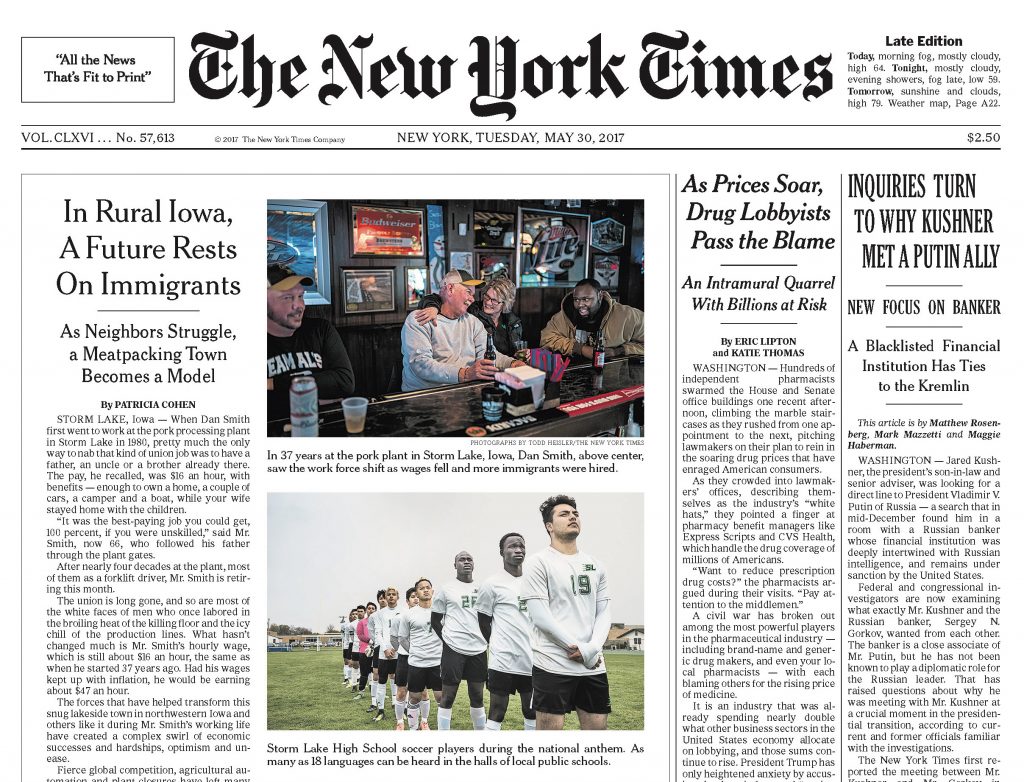
On the front page of the May 30, 2017, New York Times, a headline summarized contemporary Storm Lake: “In Rural Iowa, A Future Rests On Immigrants.”

It’s a story known to many in Buena Vista County, an impressive and concise summary of the strengths and weaknesses of Storm Lake’s economy and community. We read this piece this week, which led to a conversation on the paradox of the town’s history. When Hygrade closed in 1981, and union jobs vanished, the city found itself all the more vulnerable to the vagaries of industrial forces. Enter IBP, which hired non-union workers and recruited heavily among Latino populations for less pay.

Looking at this moment now, decades later, it was perhaps the pivotal moment for the community in the twentieth century. But was it the apex or the nadir of Storm Lake’s story? Can one lament a deteriorating labor environment while simultaneously feeling inspired by the community?

We were fortunate to have the article’s author join us for a conversation by Zoom. Patricia Cohen covers the national economy for the Times, and her article prompted a wide-ranging conversation on immigration, the forces of capitalism, and generational change.

Students heard of her time in Storm Lake, and they also learned how a consummate professional (yet outsider) managed to capture, in relatively few words, the heart of the Storm Lake story. Her secret? “What I did for Storm Lake is what I would say any good reporter does for anything: … I come really prepared, and I do all the research that I can possibly do.” Yes!

It’s a good reminder as students embark upon their own research this semester. Students Anna Rottenborn, Adam Kimble, Michel Reising, and Nathaniel Hieber put various questions to Cohen: why were younger white generations more likely to move out of town, and children of recent immigrants more likely to return? Did she encounter any episodes of explicit racism? What were her impressions of Storm Lake?

Patricia Cohen joined our class for a discussion. Jan. 27, 2021.

Cohen explained how her experience writing the piece demonstrated that journalists, like historians, can’t always anticipate the results. That’s why she went to Iowa: to listen. She met with church and police leaders, and with locals of Latin American and Southeast Asian origins. She struck up conversations in markets. She chit-chatted over sips of joe at the Grand Central Coffee Station.

She had gone to town anticipating writing a profile on Storm Lake’s embrace of multiculturalism. But she was astonished by the economic past that had led to such a present. “I thought that was a really fascinating part of the story,” she said, “which was, in the popular belief, that immigrants came and undercut the jobs. But, in fact, it was the reverse that happened. The companies had essentially busted the unions and cut pay, and then nobody wanted those jobs, and so immigrants were willing to take them at a lower wage.”

Her published article’s first featured interviewee, Dan Smith, appeared on her radar during a conversation with Art Cullen. She recalled Cullen saying, “You know, you should call this guy because he’s been [at Tyson/IBP/Hygrade] for 40 years now, and I think he’s retiring next week.” Cohen then continued, “And so, you know, my journalistic spidey-sense just went like, ‘bing bing bing bing bing,’ like, that’s the perfect guy, the magic notebook you hope to have someone come across.”

A detail provided by Mr. Smith, in fact, stood out in students’ minds and represents much of Storm Lake’s economic history: he worked as a forklift driver for most of his career, and made the same wage ($16 per hour) the entire time. Were this adjusted for inflation, it would have been triple the amount in 2017.

It’s emblematic of economic changes—for the worse, one could say—that are responsible for Storm Lake’s development in the last 40 years. And yet, without this, the city wouldn’t be thriving, albeit imperfectly, with a growing multicultural community. The other stories that Cohen found wouldn’t have been possible: the example of Silvino Morelos’s “Valentina’s Meat Market,” or the success of Abel Saengchanpheng.

Our 15 students, socially distanced, listened as Anna Rottenborn asked Patricia Cohen a question.

Is Storm Lake the realization of the American dream, born from economic vulnerabilities? A student, Joey Puckett, put this question to Cohen. What did she think? Was this a tale of disappointment or of hope?

“The first thing I would say to you is,” she said, ever the journalist, “what you guys think is actually more important. It’s what are you taking away from the story. But I would have to kind of say both [hope and disappointment]. It’s one of the reasons I like that story, and I think that it got the attention that it did because it captured so many things that were going on in terms what had happened to union jobs in this country, not only meatpacking plants but in manufacturing plants and elsewhere, all over. As globalization occurred and jobs were exported abroad and unions were broken.”

“On the other hand,” Cohen continued, “if you look at kind of what we generally call ‘the crisis of rural America,’ which is that demographic trend of communities getting smaller and smaller, and aging, and people not wanting to move there, and no industries, then Storm Lake is a success story in that it has managed, however fitfully and however bumpy and lumpy along the way, to create this thriving community which, unlike a lot of others, is growing.”

Off to class…

The books have been chosen, the interviews scheduled, and the syllabus finalized. A half hour from now, my class will embark on an investigation into Storm Lake history, and I’m betting—hoping—the students will be as amazed, challenged, and invigorated about the region’s past as I am.

Our books will include Art Cullen’s recent Storm Lake, of course, and additional studies will provide students with broader historical context. We will read Dr. Timothy Pachirat’s Every Twelve Seconds to understand the meatpacking industry and its relationship to agriculture and the environment, as well as how the industry distances the violence of production from consumers. Dr. Pachirat received his Ph.D. at Yale and worked undercover at a processing plant in the Midwest as part of his dissertation research. He will join our class via Zoom in March.

Students will also encounter Dr. Robert Withnow’s The Left Behind, on urban/rural divides and the politics of resentment, as well as an edited volume from Drs. Donald Stull, Michael Broadway, and David Griffith, Any Way You Cut It: Meat Processing and Small-Town America. Among the many contributions in the latter book is a chapter explaining—from an industry perspective—the small margins of error, and tight labor-profit constraints, that confront meatpacking management.

In addition to these works, we will also read some articles by Dr. Mark Grey, a professor anthropology at the University of Northern Iowa, who has written on immigration in Iowa (and specifically Storm Lake). He will join us for a conversation in February.

Beyond these readings and others, the majority of our class will be spent analyzing news from Storm Lake papers, and interviewing Storm Lakers via Zoom from afar. At present we have 15 interviewees set for group discussions, another 15 for individual conversations, and 15-30 additional folks for oral history interviews. More on these as they develop.

One of the most exciting components of the class relates to our partnering with four entities:

  • With the Storm Lake Community School District, we will launch a new series of online profiles, entitled “Small Town, Big World,” highlighting current and recent SLCSD students and families.
  • With Dr. Andrea Frantz’s “Digital Journalism” class at Buena Vista University, my students will collaborate to produce written profiles with an audio component similar to StoryCorps.
  • With Anchor Films, a production company in Los Angeles, students will provide historical research to help form the historical narrative of a new documentary on Storm Lake in the works, “The Americans.”
  • And for the Buena Vista County Historical Society, all of these materials will be donated at the end of the semester for future safekeeping.

We will be in touch on a weekly basis. Off to class!

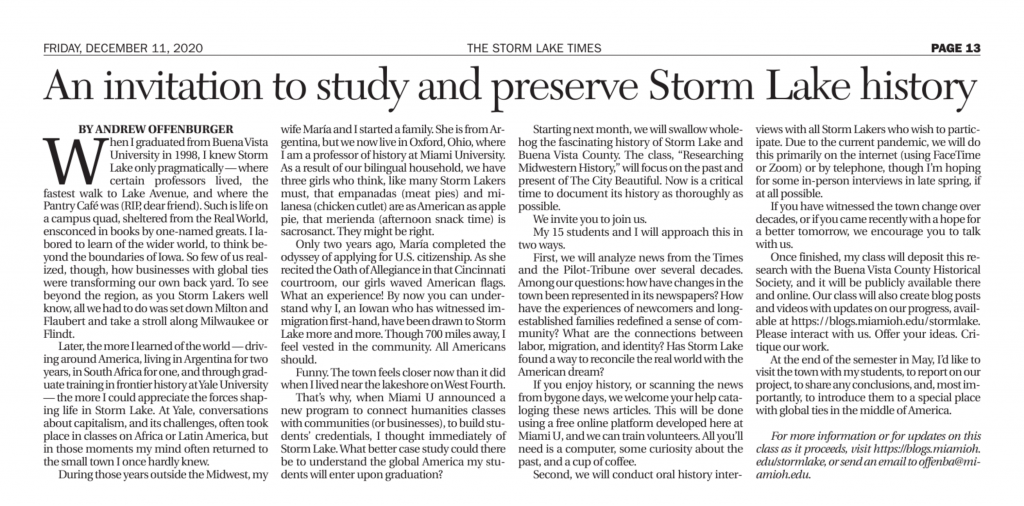
An invitation to study and preserve Storm Lake history

Published in the Storm Lake Times (December 11, 2020)

When I graduated from Buena Vista University in 1998, I knew Storm Lake only pragmatically – where certain professors lived, the fastest walk to Lake Avenue, and where the Pantry Café was (RIP, dear friend). Such is life on a campus quad, sheltered from the Real World, ensconced in books by one-named greats. I labored to learn of the wider world, to think beyond the boundaries of Iowa. So few of us realized, though, how businesses with global ties were transforming our own back yard. To see beyond the region, as you Storm Lakers well know, all we had to do was set down Milton and Flaubert and take a stroll along Milwaukee or Flindt.

Later, the more I learned of the world—driving around America, living in Argentina for two years, in South Africa for one, and through graduate training in frontier history at Yale University—the more I could appreciate the forces shaping life in Storm Lake. At Yale, conversations about capitalism, and its challenges, often took place in classes on Africa or Latin America, but in those moments my mind often returned to the small town I once hardly knew.

During those years outside the Midwest, my wife María and I started a family. She is from Argentina, but we now live in Oxford, Ohio, where I am a professor of history at Miami University. As a result of our bilingual household, we have three girls who think, like many Storm Lakers must, that empanadas (meat pies) and milanesa (chicken cutlet) are as American as apple pie, that merienda (afternoon snack time) is sacrosanct. They might be right.

Only two years ago, María completed the odyssey of applying for U.S. citizenship. As she recited the Oath of Allegiance in that Cincinnati courtroom, our girls waved American flags. What an experience! By now you can understand why I, an Iowan who has witnessed immigration first-hand, have been drawn to Storm Lake more and more. Though 700 miles away, I feel vested in the community. All Americans should.

Funny. The town feels closer now than it did when I lived near the lakeshore on West 4th.

That’s why, when Miami U announced a new program to connect humanities classes with communities (or businesses), to build students’ credentials, I thought immediately of Storm Lake. What better case study could there be to understand the global America my students will enter upon graduation?

Starting next month, we will swallow whole-hog the fascinating history of Storm Lake and Buena Vista County. The class, “Researching Midwestern History,” will focus on the past and present of the City Beautiful. Now is a critical time to document its history as thoroughly as possible.

We invite you to join us.

My 15 students and I will approach this in two ways.

First, we will analyze news from the Pilot-Tribune and the Times over several decades. Among our questions: how have changes in the town been represented in its newspapers? How have the experiences of newcomers and long-established families redefined a sense of community? What are the connections between labor, migration, and identity? Has Storm Lake found a way to reconcile the real world with the American dream?

If you enjoy history, or scanning the news from bygone days, we welcome your help cataloging these news articles. This will be done using a free online platform developed here at Miami U, and we can train volunteers. All you’ll need is a computer, some curiosity about the past, and a cup of coffee.

Second, we will conduct oral history interviews with all Storm Lakers who wish to participate. Due to the current pandemic, we will do this primarily on the internet (using FaceTime or Zoom) or by telephone, though I’m hoping for some in-person interviews in late spring, if at all possible.

If you have witnessed the town change over decades, or if you came recently with a hope for a better tomorrow, we encourage you to talk with us.

Once finished, my class will deposit this research with the Buena Vista County Historical Society, and it will be publicly available there and online. Our class will also create blog posts and videos with updates on our progress, available at https://sites.miamioh.edu/stormlake. Please interact with us. Offer your ideas. Critique our work.

At the end of the semester in May, I’d like to visit the town with my students, to report on our project, to share any conclusions, and, most importantly, to introduce them to a special place with global ties in the middle of America.