
by Olivia LeRoux
Last week, our class got to view Storm Lake from two distinct perspectives. On Monday, we interviewed Dr. Michael Whitlatch, Professor Emeritus of Performing Arts at Buena Vista University, and Matthew Marroquín, a current BVU student who grew up in Storm Lake. Through these two guests, our class got a glimpse at how interpersonal connections and treatment within the community may have differed. One thing remained clear, though: both individuals carry a great deal of love and passion for the town and its vibrant community. These interviews came on the heels of a conversation two weeks ago with Patricia Cohen of the New York Times, and we had been eager to gain a better understanding of community, diversity, and tension within the small meatpacking town.
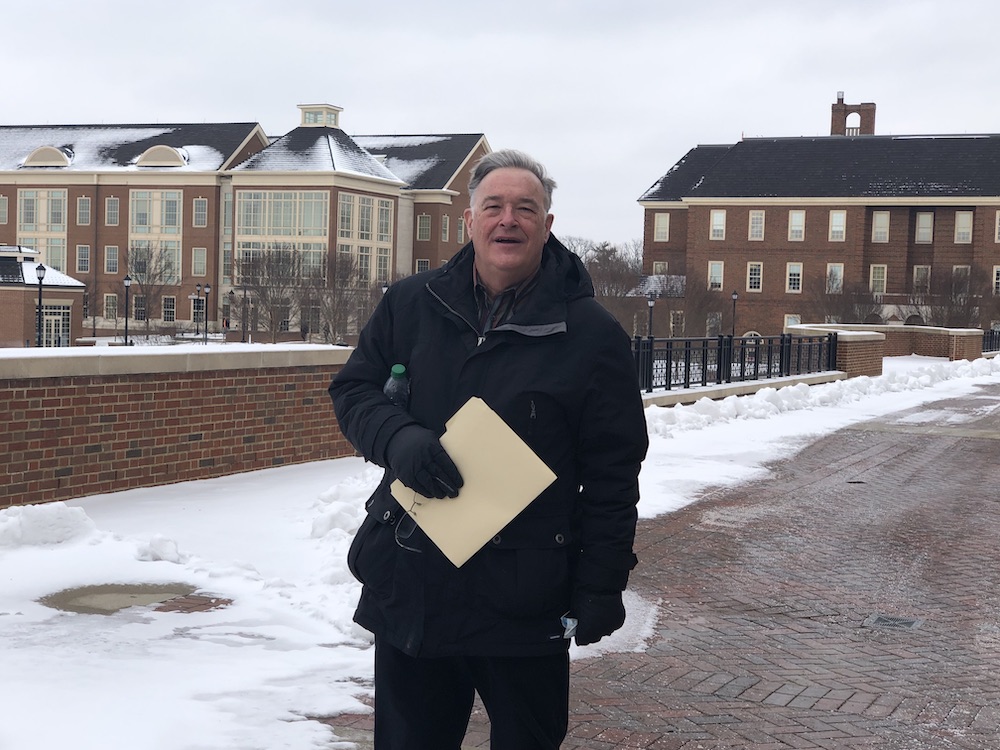
Whitlatch had been at BVU for 39 years. He received his undergraduate degree at Miami University before venturing out to Storm Lake in 1977. After retiring, he returned to Ohio to be closer to family, which allowed him to visit our class in person (while masked and distanced). A resident of Storm Lake from 1977 to 2016, Whitlatch witnessed first-hand the rapid and impressive change in the town.
He began by describing Storm Lake, upon his arrival, as a town from a 1950s sitcom like “Leave It to Beaver” or “Father Knows Best.” According to Whitlatch, the traditional midwestern town was made up of nearly 100% Caucasian residents, and people pursued simple, quiet ways of life. The narrative of the quaint town began to shift when Governor Robert Ray facilitated the relocation of 1500 refugees from Southeast Asia, with the support of local churches, to Iowa and to Storm Lake. Some citizens were disgruntled. “This was rather controversial in the state,” he said. “There were people that were unhappy about that, that [the refugees] are going to begin to take away the jobs from everybody else.” However, the churches welcomed these refugees with open arms and provided them with housing and work.

Whitlatch then gave a detailed overview of the meatpacking industry’s history. What he remembered aligned seamlessly with our recent reading of Art Cullen’s Storm Lake. Unionized workers, mostly white, earned salaries of $35,000-$40,000 in 1981, while Whitlatch was hired at $12,000 in 1977 at BVU. Life for the meatpacking workers was relatively comfortable, and they were able to afford middle-to-upper-class luxuries.
However, such comfort did not last long for plant workers. When the Hygrade pork plant closed in 1981, Iowa Beef Processors (IBP) bought the plant and introduced more efficient methods of meat production. It revolutionized the industry. Whitlatch pinpointed this transition as a major turning point for the small Iowa town. The white, well-paid union workers were not hired back at the rebranded plant. Instead, IBP began recruiting a global workforce. People immigrated from all over the United States, Southeast Asia, and Latin America. These workers were hired for low wages and worked long, hard hours with no hope of unionization. “There was ungodly high turnover in that plant,” Whitlatch said. “The manager, many of the workers, did not stay. I don’t know if you know anything about working in a plant like that. It’s not fun work. It’s as tough as it is anywhere. I would love to know how many workers end up with carpal tunnel because of the repetitive fashion. I mean that’s an assembly line, and you’re “boom boom boom boom boom boom boom” all day long, and repetitive with pork or beef or chicken or whatever. It’s repetitive. It’s tough.” In 2001, Tyson bought the plant from IBP and the tide of change gained momentum.
Whitlatch’s late wife, Jean, was an educator at the Storm Lake elementary school. Jean had a front-row seat to the change occurring within the community. Her classrooms became filled with children of Tyson workers, which led to an explosion of languages and cultures that were entirely new to Storm Lake. The teachers found themselves with the responsibility of teaching these new students to speak English. Whitlatch recalled that many parents did not speak English, so they had to rely on their children to communicate for them within the town. “The world’s changing,” he said. “The medical services had to change… the doctors in town, the hospital in town initially were not particularly well equipped to handle the influx of immigration, because there were just simply not Hispanic nurses, and so what happened is (and again I’m stereotyping for the sake of argument): Mom is pregnant and she doesn’t speak English. You might have a young, her youngest daughter or a teenage daughter going with Mom in to see the doctor, to translate for mom. That was what was going to happen.”
As Tyson continued to hire and recruit immigrants, long-established residents of Storm Lake found that they needed to adjust their ways of life and businesses. “And that began to spread everywhere in town, with businesses,” Whitlatch said. “If somebody wants to get a car loan to buy a new car or whatever, you might have to have somebody in there, a child to translate for Mom and Dad, whose English would be limited there. So the doctors’ offices have gotta adapt to the businesses in town. Banking and auto and the grocery stores all had to change… The [job seeking] ads in the paper reflected the changing nature of the town.”
As a class, we found ourselves curious whether this rapid change in the town caused any frustrations within the community. Whitlatch answered us with a brief pause, a sigh, and then explained that, while of course tensions existed, the people who held frustrations were in the minority of the population. A majority of Storm Lakers were excited about the change and embraced their new neighbors. However, Whitlatch recalled that there was frustration around the lack of support for local businesses and the idea that the money being earned in Storm Lake was not being spent in town. “But for many years, if you went into the post office on Friday afternoon or Saturday morning, there would be a long line, and it would be a lot of Hispanics primarily getting money orders made or cashier’s checks being made, and they were sending money back home,” he said. “And this was on the Saturday on a weekend. I mean the feeling was it was probably hundreds of thousands of dollars out. There was somebody someplace that needed money… But I knew enough that if I had something to mail out on a weekend, don’t go to the post office on a weekend.” Whitlatch also recounted an incident where two young Hispanic children were playing in the aisles of a grocery store when a white woman became annoyed and screeched, “Why don’t you go back to where you belong?!”
The Whitlatches were among the majority of the population that truly enjoyed the experience of a newly diversified Storm Lake. Being avid walkers, they befriended a Hispanic couple, Gloria and George, with whom their walks often crossed paths. They looked forward to conversations with the couple and catching up on Storm Lake news. “I mean, that’s kind of how you break down barriers,” he said, “how you get to know other people there. When we moved, we felt terrible that we did not get to see them [George and Gloria] before we left.”
Whitlatch reminisced about a time when he was blessed with the opportunity to attend a grand quinceañera: “You know what? It’s kind of wonderful to be in a place where nobody speaks your language. We were amongst the few people whose native language was English that night. We were in a sea of Hispanics. Now fortunately Jean knew a little bit of Spanish, so she could help out of there, but that was wonderful. That was wonderful, and we talked about that night for weeks after that, as we took our walks through Starr Park, our usual walking path, to be invited to that event.”
When asked about the relationship between BVU and Storm Lakers, he suggested that the university has constructed programs that reach out to the Storm Lake Hispanic community. There are scholarship opportunities, festivals, and speakers that are meant to include the community on the BVU campus. However, Whitlatch recalled that the university and its students remained somewhat of an island in the middle of Storm Lake. “It wasn’t like we did not try to reach out to this Spanish population,” he said. “Some of that could have been cultural, some of it could have been language. I’m not real sure what happened, but I just know that the administration and faculty and others really tried to do things.”
One of those BVU students, Matthew Marroquín, moved to Storm Lake with his family, as a one-year-old, from Los Angeles in 2000. When his father heard from friends about the opportunity to work for Tyson, he was eager to complete the short application and physical required by company recruiters. For the family, Storm Lake represented the promise of safety and security, which his family yearned for in Los Angeles. When the Marroquín family arrived, Matthew’s father spoke a little bit of English, and his mother spoke nearly none at all. He grew up speaking “Spanglish” within his home and around many of his friends.
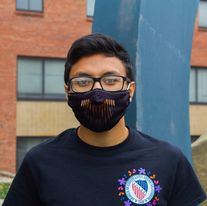
Marroquín is proud to consider himself a Storm Laker. He realizes now that his childhood was filled with much more diversity than a typical small-town child would ever experience. However, he said that as a child he was not aware of the “differences” between him and his classmates. “I didn’t really understand race or the idea of it,” he said. “I just knew that if I go over to this friend’s house I just say hello to their mother in this way, and if I go to a different friend’s house I had to learn sabaideebor for Laos, or xin chào for Vietnamese, just like things like that…hola for Spanish. I just knew that I couldn’t talk all the languages that were around me, but everyone tried to figure out English and, if not, we tried to figure out each other’s languages.”
It wasn’t until high school that he began to realize how different Storm Lake was from its surrounding communities. Neighboring high schools would send over groups of students to “tour” Storm Lake High School to experience the diversity, “and the teacher that brought them in was the husband of a teacher I had for a freshman class,” he said. “And his wife would tell me the three things that he was wowed about was, ‘First off, you guys didn’t have metal detectors.’ They thought Storm Lake would. [They were surprised] that we didn’t have police walking around all the time, and that we all sat together during lunch. That was the biggest thing: that we actually, you know, were integrated…they thought [seating] was gonna be like by population of color… And that’s just what they assumed, and that’s what they were told…That’s when I started becoming conscious of Storm Lake as a whole, being very diverse, because other people around us–by other people I mean these other towns–were looking at us a little bit differently, treating us a little bit differently.”
“That’s when I started becoming conscious of Storm Lake as a whole, being very diverse, because other people around us–by other people I mean these other towns–were looking at us a little bit differently, treating us a little bit differently.”
— Matthew Marroquín
Marroquín and Whitlatch both mentioned the hostility that was occasionally displayed by opposing schools and their fans during athletic competitions. Aside from some of these tensions, Marroquín thinks the combination of the Latinx community and the other cultures within Storm Lake generally mesh well because, he said, “I think the reason why our culture and Iowans got so close so fast, especially in Storm Lake, is because the concepts of “Iowa Nice” and that small town community is very similar to the community concept of Latinos… So, I guess when they enter a small town community, I think that’s the thing that really meshed everyone together.” When we asked him whether or not he sees himself moving away from Iowa after graduation, he said that although he would like to experience a new environment after graduating from BVU, he would be happy to eventually return to Storm Lake and build a family there. “Even now it’s all about the community. We’re talking about not ourselves, but the community. so that’s why I really want to raise those values in…let’s say my kids in the future…”
In some ways, Marroquín has some differing views on Storm Lake than Whitlatch. The college student finds that BVU remains in its own bubble despite being smack dab in the middle of the Storm Lake community. “Have you ever seen those TV shows where it’s like a separate world, where you just go through a bubble, and next you know you’re in a whole different dimension?” he asked. “That’s how I feel whenever I leave campus or come back to it. It’s just a whole different world.” Marroquín explained that the Storm Lake community does not go out of their way to be involved with the university because “there is no reason to.” He mentioned that while BVU does put on luncheons for community members, they are not attainable events for plant workers. “They would do it over lunch…let’s say ‘oh, Friday over lunch we’re going to have people in the community come over.’ That’s great if you work a regular nine-to-five, but you don’t get a lunch like that at Tyson. You don’t get a lunch like that the Cherokee distribution center. You get to go and get your lunch box real quick. You have like 20 minutes to eat. You still have your full uniform on. Basically, you just got done killing pigs or cutting them up or doing something… and then you go back to work… so we can’t attend your late brunch or your ‘lunch at BV’ to celebrate something about the community.”
Marroquín gained further insight into the way minorities are treated at the Storm Lake plants when he worked a summer job at one of the feed mills. Almost all of the people who worked on the line were minorities who had been there for many years and never saw any raise in pay. He thought it was odd that all of the office workers at the mill were white. He reflected, “The only person of color in the offices was a secretary. Now she’s Asian okay… that’s cool…interesting. But where’s, like, everyone else? There’s so many other people who’ve worked at this feed mill. I’m working alongside people who’ve worked there for years, and, you know, they’re good workers. They know everything about that mill. Yet they haven’t been raised up at all…but what I was talking about, too, they didn’t really even get wage raises either. They just have been there doing the same thing for so long. It’s like, oh, that’s kind of weird.” He senses this lack of representation as a trend in the city council, state politicians, and the student body at BVU. An article in the Storm Lake Times recently detailed the death of a Tyson employee caused by the novel coronavirus. Tyson was hesitant to close the plant for any amount of time during the midst of the pandemic, which led to elevated health risks for some workers. The class looks forward to digging deeper into the meat packing plants and feed mills’ protocols and history to understand the experiences of employees.
Marroquín’s and Whitlatch’s interviews were successful in providing the class with a better understanding of how Storm Lake operates. While the diverse Iowa town is special in so many ways, there is still work to be done when it comes to ensuring the many populations are equally represented in the community.
The class finished off the week and developed these thoughts by chatting with producer Hyunsoo Moon of Anchor Pictures, who is creating a documentary on Storm Lake in the coming years. Moon has enlisted the class’ help to provide a detailed and accurate history of the town within the production. Moon shared his goal for the documentary. While still a work in progress, he intends to expand the idea of “new Americans.” In his words: “The DNA of America is built on immigration, so to me it’s just that these [Laotians and Hispanics] are new Americans. And that was really the intention that I went into the documentary with, and showing that these are, you know, let’s stop just calling them immigrants, as if there’s us Americans, and they’re immigrants. No, these are just new Americans…these are people that just started their American journey.” Moon hopes to illustrate the story of Storm Lake through the eyes of the meatpackers themselves, the people who truly put this town on the map.
Now that our class has learned about Storm Lake from a couple of residents, we are ready to continue diving into the rich history that developed one of the most uniquely diverse small towns in America. While there are tensions and inequalities to explore, we have learned that the strong base of neighbors, inclusion, and understanding is what keeps this community afloat.
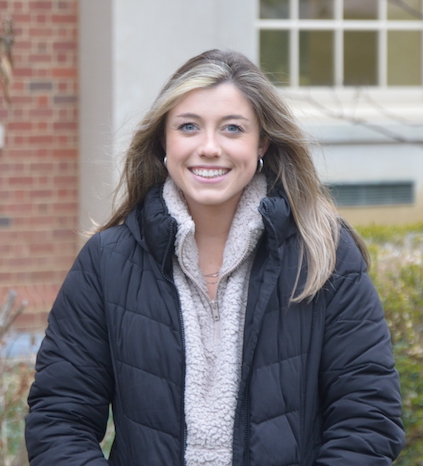
Olivia LeRoux is a senior English Literature and Psychology double-major planning on attending law school in the Fall of 2021. She will be studying law over the next few years; her current focus is on juvenile and family law. She is a member of the Miami University Equestrian Team and serves as its current vice president. She also enjoys being involved in her community and helping out wherever possible.
