
Rock climbing is statistically one of the fastest growing sports in the United States, with the number of participants around the country estimated to be upwards of 6 million. Climbing gyms, the figurative hubs of the sport’s advancement and popularity, currently exist in practically every major metropolitan area. More globally, a World Cup circuit of climbing competitions spans multiple continents each year, and sport climbing is an Olympic event. Suffice to say, climbing—as a recreational activity and a global phenomenon—is booming.
What many Miami University alumni might not realize is that Miami played a crucial role in climbing’s storied evolution. One could even claim that climbing would not be the international sensation that it currently is, and in the contemporary manner that it is, if the Miami community had not actively embraced the activity decades ago.
In order to trace Miami’s vital contributions to climbing’s storied history, one needs to turn back the clock to the mid-1980s. At the time, climbing gyms were non-existent. (The first climbing gym—Vertical Club in Seattle, Washington—was founded in 1987.) Like most Midwestern towns, Oxford, Ohio, didn’t feature any place to climb legally. Miami students sometimes climbed the stone arches of the bridges on Western Campus—a practice referred to as bridgering—but this rogue activity was frowned upon by both Miami’s administration and campus police.
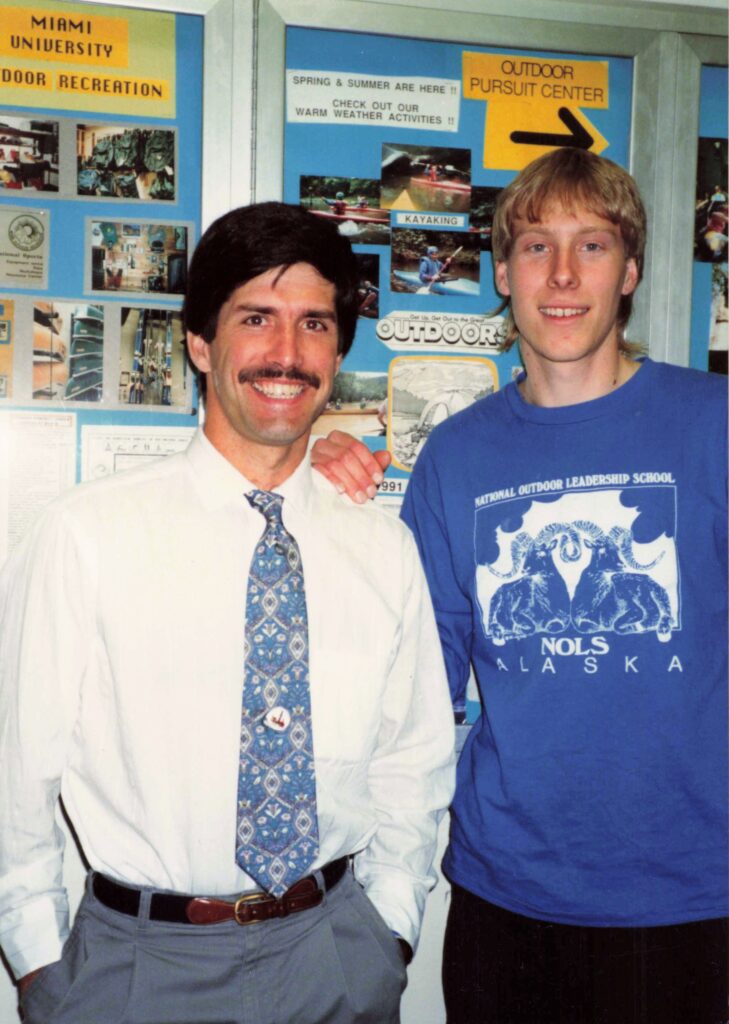
Eventually a novel idea was hatched by some forward-thinking Miamians and endorsed by the program coordinator of the Outdoor Pursuit Center at the time, Wayne Morford: To glue small rocks and stones onto a cinder block wall in the hallway of Withrow Court, where the Outdoor Pursuit Center (and a lot of the university’s exercise equipment) was located. The epoxied rocks and stones would function as handholds and footholds on the hallway’s cinder blocks. The result was the creation of a climbable wall, per se, inside Withrow Court. The wall was not very tall, but students could use the holds to climb laterally—traversing, in climbing’s parlance.
The scalable interior cinder blocks of Withrow Court proved serviceable in an era when climbing was thought to be predominately an outdoor activity. “I literally spent hundreds of hours traversing that hallway wall starting when I was in high school—well before I even went to Miami,” remembers K.C. Kopp, who grew up in Oxford and trained to become an elite climber. “I used to go there after school in wrestling shoes and spend a couple hours traversing back-and-forth. Eventually, when I started working at the OPC, we expanded that wall to the other side of the hallway, and added a little 45 degree wall in the hallway as well. The Miami wrestling team would practice just across an adjacent hallway every afternoon, and sometimes they’d stop and watch us climb—because it seemed so strange for people to be climbing in a basement hallway.”
As an activity, climbing on the cinder blocks in Withrow Court was short-lived, as a more official climbing wall—21-feet tall—was built in the east gym of Withrow Court in the late-1980s. This was groundbreaking in its own right, with a “moveable” slab wall mounted on steel tracks that could be raised or lowered at will by a boat winch, in order to create varied wall angles. (This climbing wall winch system was similar to a training structure that had once existed on campus in Phillips Hall as a training mechanism for the OPC’s outdoor climbing trips.) Useful equipment, such as climbing shoes and chalk bags, could be rented at Withrow Court’s slab climbing wall as well.
Throughout 1988 and 1989, Miami students expanded the Withrow Court climbing wall to fill the end of the gym; a more vertical section of wall was added, as well as a prominent overhead section, and even a crack-climbing area. The climbing handholds and footholds on the Withrow Court climbing wall were made by Entre-Prises, one of the few companies at the time that produced artificial and “rotatable” climbing holds.
Constructed at a total cost of “between $5,000 and $7,000,” this elaborate climbing wall inside Withrow Court was an instant hit. In November, 1989, some Miamians even taught a two-day climbing workshop at the wall. This class included instruction, demonstrations, and an overview of climbing terminology and fundamentals. Some of the advanced climbing techniques taught to students included mantle-shelving, traversing, jam-cracking, and down-climbing. The workshop was a success and spawned other, similar showcases and demonstrations at the wall.
Withrow Court’s climbing wall “featured all kinds of nooks, crannies, footholds and levels of difficulties,” according to one newspaper article, although the wall’s location complicated matters. “The east gym of Withrow Court was a multi-use gym,” recalls Tim Steele, who started climbing at the wall in 1990 during his sophomore year and began working at the wall the following year. “We had to take the climbing ropes down after each use. In fact, the baseball team had a batting cage/net that they pulled out right next to the climbing wall and occasionally the baseballs would hit the climbing holds and blow them apart.”
Despite the limitations, the climbing wall served a greater purpose than providing exercise; it became a de facto social center for students. “I think if the climbing wall had been open all the time, there would not have been as much of the camaraderie,” reflects Amy Somer Kopp, who decided to give climbing a try as a Miami student upon seeing a flyer in a campus dining hall in 1990. “But the fact that the wall was only open for a few hours in the evening on Tuesday, Thursday, and Saturday—a total of maybe 10 hours—made it the place where everybody met. We didn’t have cell phones back then, but usually you just knew that someone was going to be climbing at the wall when it was open.”
Welcoming to Whole Community
The popularity of the Withrow Court climbing wall quickly expanded beyond Miami students. Revolutionary as it was, the wall was later opened to the public on Monday and Wednesday evenings—and since climbing gyms of any sort were still rare around the United States, Miami’s climbing wall provided newfound climbing opportunities to enthusiasts from all corners of the Midwest.
Ted Welser, who worked at the Withrow Court climbing wall with Tim Steele at the time, recalls people traveling to climb at Miami from Cincinnati, Dayton, Columbus, Indianapolis, and elsewhere. “People would drive in from the surrounding area, especially through the winter when outdoor climbing was less hospitable,” Welser explains.
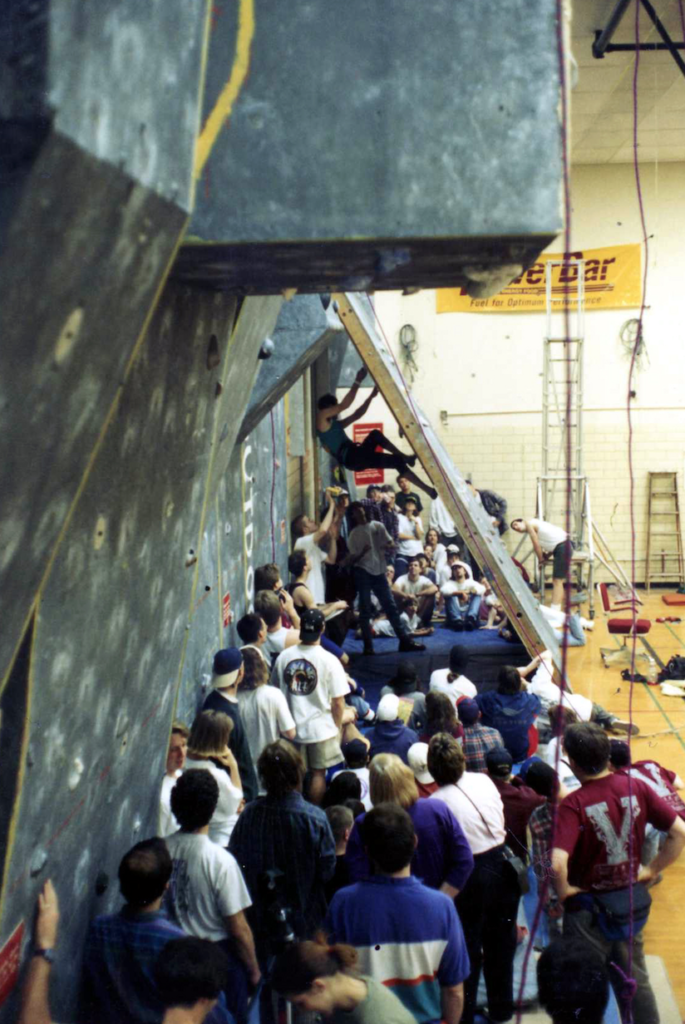
The fact that Withrow Court’s climbing wall became such a trendy place for the greater climbing community also opened up possibilities for climbing competitions. Miami students K.C. Kopp, cousins Tony and Todd Berlier, and Andy Beerman are credited as being the early spearheads for the creation of competitive climbing events at Miami. “Miami had its first regional climbing competition in 1990 or 1991—it was a big deal in those days,” recalls Beerman, who worked at the OPC in the late 1980s, then spent extended time living in Montana and Alaska before returning to Miami to finish his senior year. “K.C. Kopp, Tony Berlier, and Todd Berlier were starting to compete and wanted to host a competition. There were very few indoor walls in the Midwest at the time. It was well-attended. A guy named Eric Ulner from Illinois won it. He was stuck at the crux, chalked up, and leapt upward smacking the wall and leaving a clear hand-print, marking his victory.”
Miami’s popular climbing competitions mirrored larger scale climbing events that were starting to pop up around the United States. And the professionally organized competitions at Miami paralleled some increasing professionalism of American climbing at large, as the sport’s first governing body, the American Sport Climbing Federation (ASCF), was soon founded. Moreover, the results of the competitions at Miami often received national press in Climbing magazine and other publications.
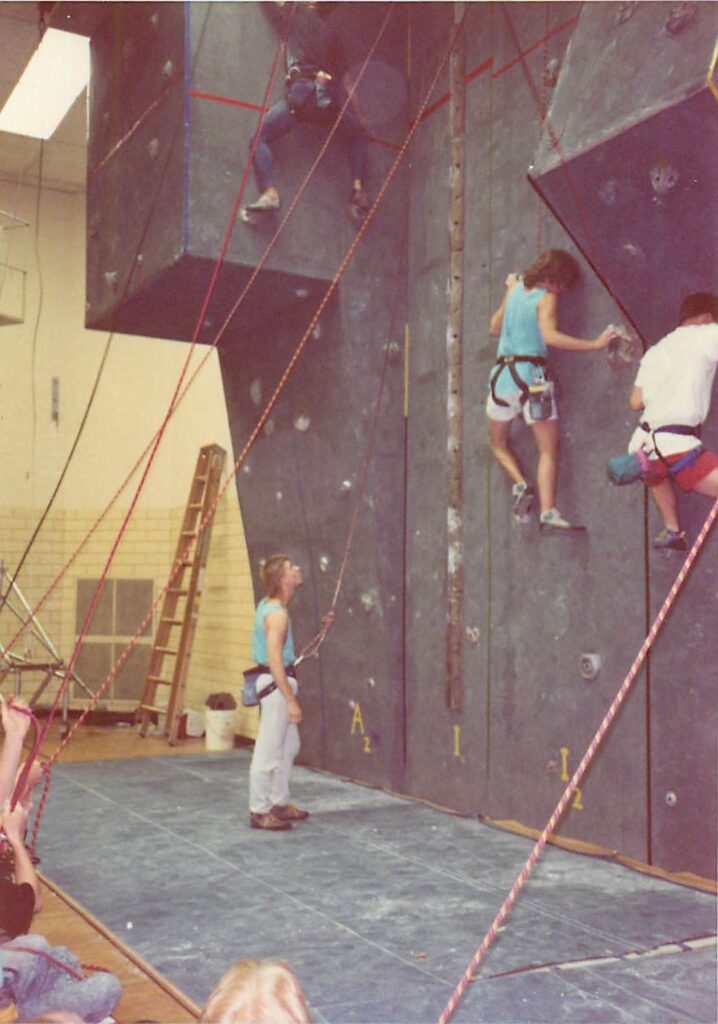
In one instance, an upcoming Miami climbing competition was promoted in an article titled, “Up Against the Wall,” in the Dayton Daily News: “Today, Miami University will host the annual MidEast Indoor Climbing competition,” stated author Lolita M. Rhodes in the newspaper profile. “About 125 climbers from all over the country and Canada are expected. Prizes will be awarded for each level of competition. In the preliminaries, climbers get four tries to reach the top [of the wall]. Those who do the best go on to the finals. A speed competition is also planned.”
Miami students who were consistently enmeshed in the climbing activities of the OPC—Amy Somers Kopp, Laura Black, Eric Lavalette, Tyler Wolfe, Amy Zink, Sara Reeder, Sarah Segrist, in addition to Andy Beerman, K.C. Kopp, and Tony and Todd Berlier—were some of the student-standouts of Miami’s earliest climbing competitions. Several of the Miami students were among the best American male and female climbers of their generation, even if the climbing world was yet to comprehensively track and systematically maintain national collegiate climbing competition results. And the inclusive nature of climbing and competing at Miami stood out. “We actually had a lot of women that were climbing, which was an odd thing [for the era],” explains Amy Somers Kopp. “I think if you’re a female, especially a younger female, and you walk into a situation where there are a lot of men, it can be intimidating. But it just so happened that a lot of us women got into climbing at Miami at the same time, so when even more women would show up to climb, there were enough of us that it was welcoming and there wasn’t that intimidation factor. And all the women pushed each other to get better and better. The mindset was, ‘Well, if she can do it, I can do it.’”
Offering Indoor and Outdoor Climbing Options
More than a sport saturated with competition results and analytics, climbing was seen as a recreation that epitomized an entire lifestyle in the 1980s and early 1990s; many Miami students were drawn to climbing because it was rough-around-the edges, more of a fringe activity when compared to other club sports like volleyball, basketball, and baseball.
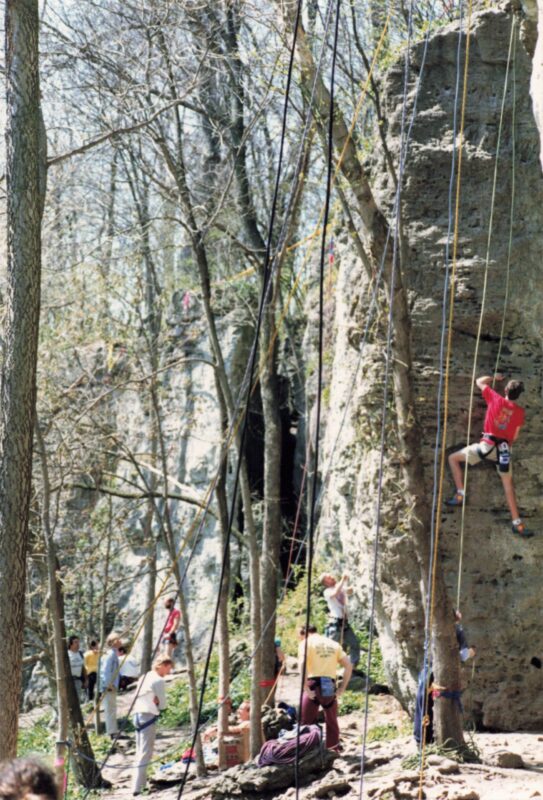
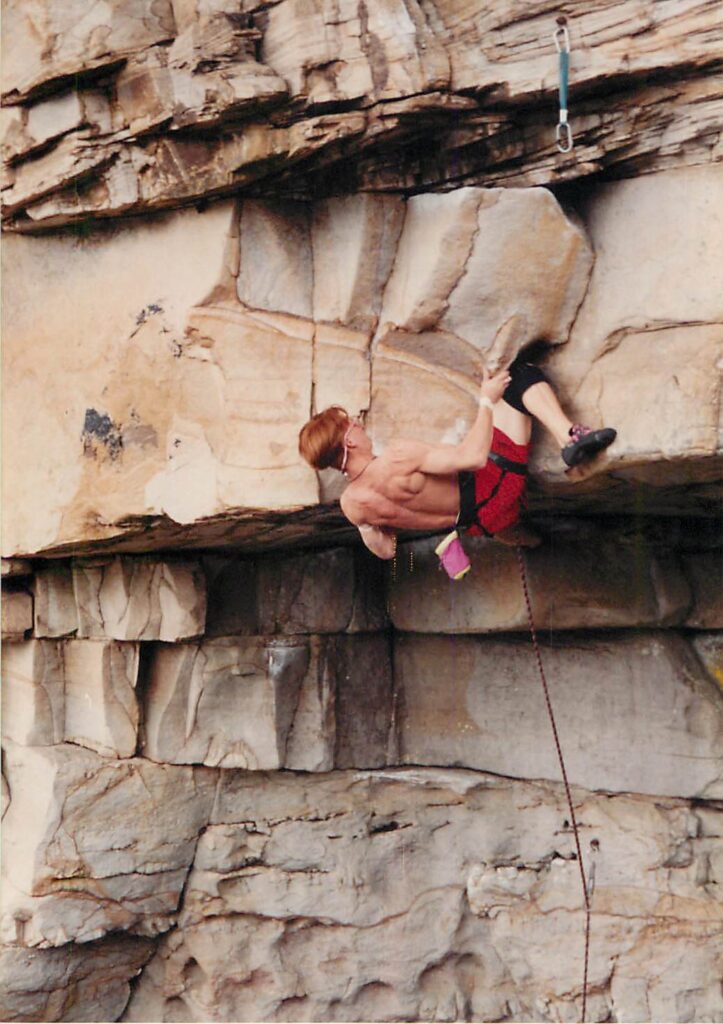
In addition to climbing on the wall at Withrow Court, Miami students occasionally took trips through the OPC, as part of Miami’s Outing Club, to outdoor climbing destinations like Red River Gorge, Springfield Gorge, Clifton Gorge, and elsewhere. “We had a posse of motivated climbers and frequently roadtripped to Kentucky and West Virginia on the weekends,” remembers Andy Beerman. “Seneca [in West Virginia] was impressive; New River Gorge was vast, and the Red River Gorge was scary loose climbing with bad protection.” In other words, the great American landscape, beyond Oxford, Ohio, was largely untapped and underdeveloped, in terms of outdoor rock climbing offerings and possibilities. The outdoor destinations were well-suited for Miami’s OPC climbers who were on the cutting-edge of the sport. But the gritty nature of Miami’s Withrow Court wall—a multi-section combination of concrete and plywood, with the belay anchors set directly into the gym floor—also epitomized the roughhewn climbing lifestyle.
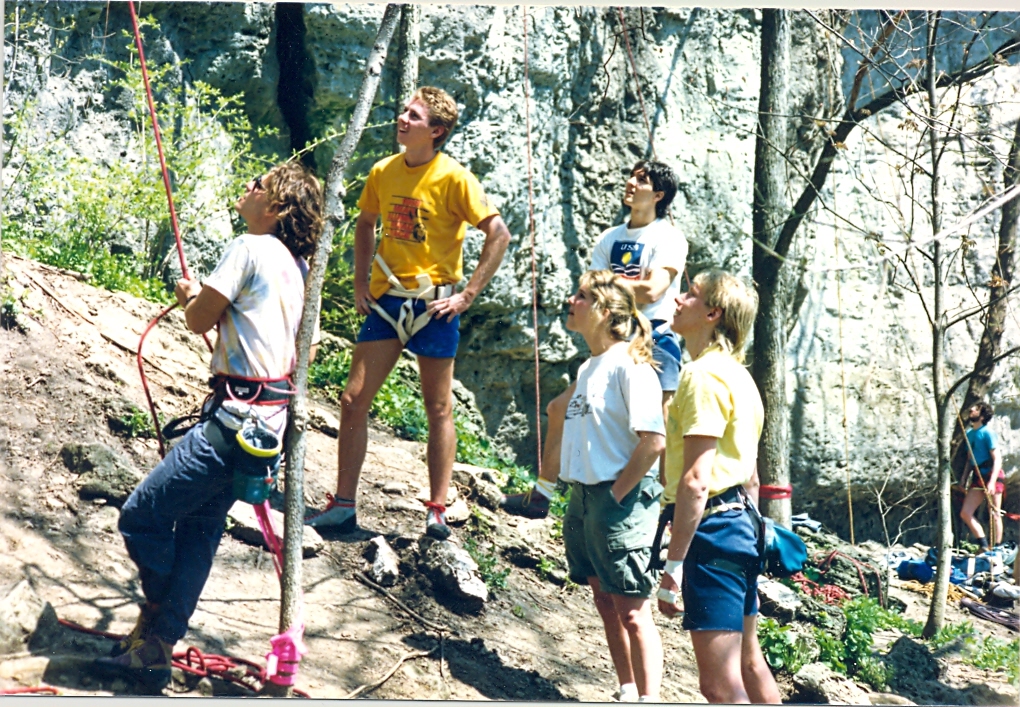
Yet, precisely because climbing on an artificial wall indoors (as opposed to climbing on real rock cliffs outdoors) was so nascent, there was no blueprint for skill-set development at the climbing wall inside Withrow Court. For instance, students Tim Steele and Ted Welser took over the hefty task of organizing the Miami climbing competitions, following in the footsteps of their climbing mentors Andy Beerman and K.C. Kopp. In doing so, Steele and Welser essentially taught themselves how to set various vertical courses for the climbers (known as routesetting) in a manner that was fun, challenging, and not overly risky.
Steele, incorporating many of the ideas spawned while working at Miami’s climbing wall, soon authored a brief guide to routesetting. Titled the Route Setting Sermon, it was among the first-ever documents to codify routesetting’s tenets and principles.
Steele and Welser also mentored incoming students, thus passing on their invaluable and ever-growing knowledge of routesetting to the next cohort of Miami climbers. One of their protégés, Chris Danielson, cut his teeth at Miami before going on to routeset for the most prestigious climbing competitions and becoming one of the most revered and sought-after routesetters in the world.
Creating Something New and Innovative
Climbing was all the rage for many Miami students and enthusiasts around the Midwest in the early 1990s. But this meant that a bigger and better climbing wall was needed to meet such great demand. Fortunately, Miami was about to have a new Rec Center, which would have ample space. At a logistics level, the OPC’s new director at the time, Tim Moore, helped plan out a new OPC headquarters inside the forthcoming Rec Center. One of the other aforementioned figureheads of Miami’s climbing culture, Andy Beerman, graduated from Miami in 1991 with a degree in Interdisciplinary Studies; his academic work had focused on outdoor education and environmental studies. However, following a climbing injury, Beerman returned to Oxford in the fall of 1992 to recuperate—just in time to aid in the design Miami’s new Rec Center climbing wall. K.C. Kopp, another recent graduate, serendipitously returned to Oxford too and assisted in the planning.
The actual construction of the climbing wall inside the Rec Center was outsourced to a company called Radwall; the company had recently completed a climbing wall inside a Las Vegas shopping mall, which rose up through multiple floors. Radwall’s owner, Wayne Campbell, envisioned something comparable for Miami. However, the assembly of the new climbing wall inside the Rec Center proved to be a complicated process that required multiple student helpers and a small work crew. Much of the arduous labor—people hanging from rigging in order to attach massive panels, handholds, and footholds to a fixed wall—was done during spring break. At the suggestion of OPC students, the reddish-brown surface of the wall was modeled after the Corbin Sandstone of Red River Gorge, and the structure was given an impressive roof feature. One particularly unique design idea was to include a clear window within the climbing wall’s paneling. Conceivably, this window would allow patrons of the Rec Center an unobstructed view to the other end of the building, which was a broad design aim of the Rec Center’s construction.
Distinctive and well-intended as the idea was, the window’s installation stressed out the climbing wall’s creators, who harbored fears of climbers someday falling through the “token window.” Fortunately, such concerns were unfounded. “Despite that [window] feature, when we finally saw the design of the wall and toured the space, we were extremely psyched and blown away, to say the least,” recalls Tim Steele. “We were super excited that we would actually have a true lead wall, and we knew that the wall was going to up our level of training and the type of competitions we could host. We were especially excited to try out the roof feature under the track as that was certainly the crown jewel of the new wall.”
Tim Moore, who had succeeded Wayne Morford in heading up Miami’s OPC and worked extensively in outdoor leadership, knew an imperative design point of any new climbing wall at Miami would be its accessibility for all skill levels. “Many people can take credit for creating the wall,” Moore explains. “Students and staff were directly involved in the design process. We wanted a comprehensive climbing wall design that was going to be effective for instructional purposes and fit all levels of ability from recreational to competitive. We wanted climbers and students to have a voice in finalizing the design. I really let them take the lead on that and I think they did an amazing job.”
The result, unveiled to the public with the entirety of the Rec Center in 1994, was an extravagant climbing wall that was among the most impressive of its day. It measured 40 feet high and 44 feet wide, remarkable dimensions for a university climbing wall of the period. As envisioned, it rose up multiple stories with a summit near the Rec Center’s upper-level jogging track, and was one of the steepest artificial climbing walls in the region at the time. “At track- level, you’d be right there with the climber,” says Moore. “So, you could get great images of the climbing—photographic or videographic images when we had competitions. And it was also neat to see the interface between people running or jogging and people climbing—that cross-pollination, cross-appreciation, that happens when you get people with different passions together in the same place.”
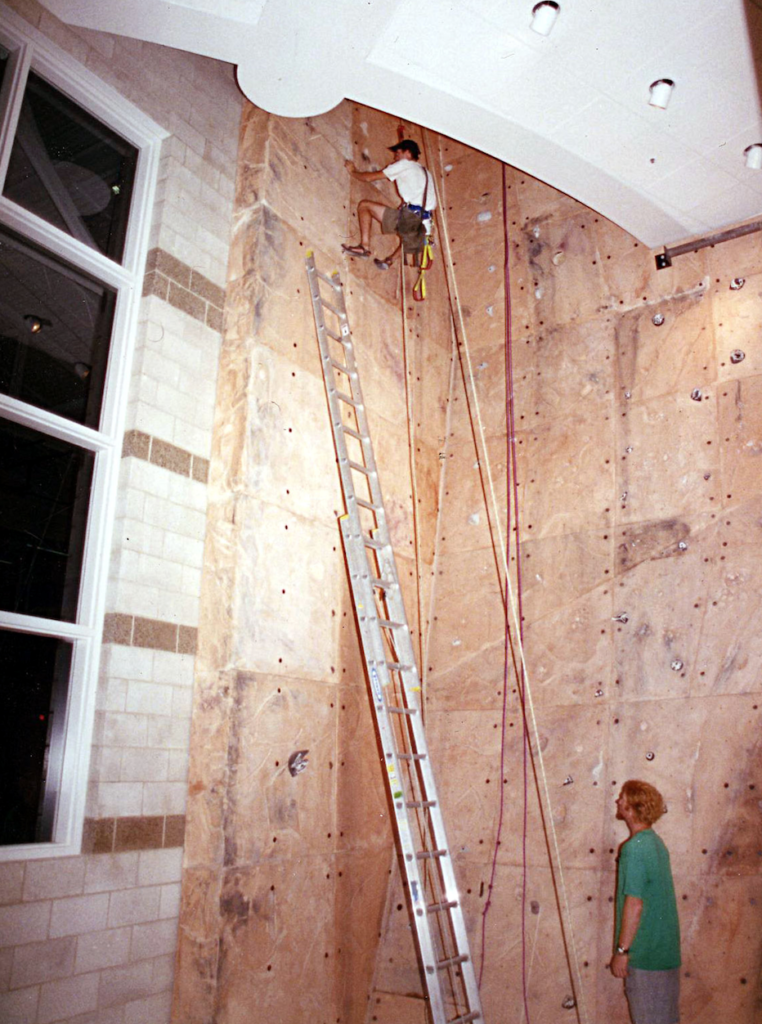
Routesetting on the new climbing wall required routesetters to hang from ropes and use ascenders, as using ladders was no longer sufficient for reaching the highest sections of the wall. And the climbing competitions at the Rec Center continued to attract Miamians and professional climbers from afar. In fact, two of the most noteworthy professional climbers to compete on the climbing wall of Miami’s newly built Rec Center were Katie Brown and Lynn Hill, widely regarded as two of the best in the world at the time. (Hill made history in 1994 as the first person to free-climb The Nose of El Capitan in Yosemite in a single day, and Brown, a teenager, was the leader of a new, youthful generation of climbers.)
By the mid-1990s, climbing was gaining traction around the United States and especially in American pop culture. Cliffhanger, a climbing-themed movie starring Sylvester Stallone, became a cultural touchpoint. ESPN started to include climbing as an event in its popular X Games, a showcase of “extreme sports” that spawned video games, music CDs, and merchandise. Climbing gyms began to populate the country in greater numbers, and many colleges and universities built their own climbing walls.
Undoubtedly Miami University had been at the vanguard, but the rest of the United States was falling in love with the sport of climbing and its rugged, trendy lifestyle.
Adding to the History
Today, approximately four decades after the first climbable wall was constructed inside Withrow Court, Miami’s contributions to climbing are clear.
Myriad instructional routesetting classes and certifications are now offered by many different entities, including USA Climbing, the sport’s national governing body. (And USA Climbing now has a Collegiate division of climbing competitions.) In many ways the modern-day routesetting classes are extensions of the collaborative embrace of routesetting by Tim Steele, Ted Welser, Chris Danielson and others at Miami in the 1990s. And many of the routesetting materials currently available are formalizations and expansions of the routesetting concepts first recorded by Steele in his groundbreaking Route Setting Sermon.
Miami still holds climbing competitions on its Rec Center wall—the most recent being the Spring Send Fest in March, 2026, organized by the Miami Climbing Club. It’s worth noting that the lineage and heritage of all present-day climbing competitions at Miami date back to the 1980s—more than 30 years before the Olympics embraced competitive climbing (and at a time when the sport of climbing did not even have a national or international governing body).
Even certain modern-day climbing gym accoutrements (such as movable and adjustable climbing walls) were utilized at Miami and embraced by Miami climbers decades before becoming de rigueur for the rest of the climbing industry.
Tim Moore credits the students, and their continuous desire to share the sport with others, for giving Miami such a significant role in climbing’s history. “You have these educated people, motivated people, that are into problem-solving, stretching themselves, growing and developing a variety of different skills,” Moore explains, “and they come to a great university, and they conveniently have a similar interest and they climb together. It seems logical they’d want to recruit more people to do that and share their excitement for the sport with other students.”
About the Author: John Burgman (’04) has written articles for Outside, Climbing, Men’s Health, Trail Runner, and other magazines. His book, High Drama, chronicles the history of American competition climbing. In 2019, he authored an article in Miamian titled, “A Traveler’s Tale,” about his time living in South Korea.