

Current Projects
The Biomechatronics System Design Lab conducts research at the intersection of rehabilitation robotics, exoskeleton design, control systems, sensing, artificial intelligence, digital twins, and IoT-enabled intelligent mechatronic systems. Our current projects focus on developing human-centered robotic technologies that can support rehabilitation, improve movement assistance, enable data-driven therapy, and advance the scientific foundation of safe physical human-robot interaction.
These projects combine mechanical design, dynamic modeling, nonlinear and adaptive control, sensor integration, experimental validation, and intelligent decision-making. A major emphasis is placed on wearable robotic systems that interact directly with the human body, where safety, comfort, adaptability, and personalized assistance are essential.
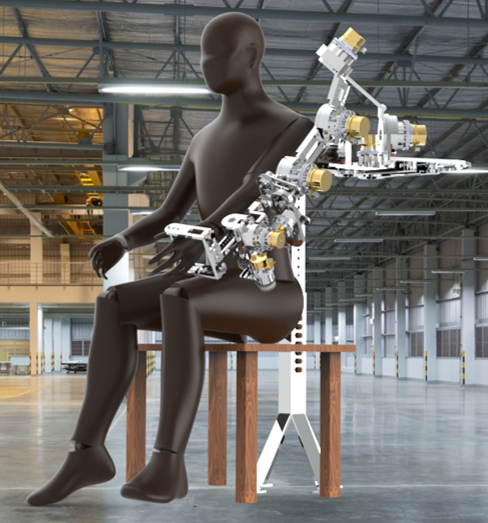
Human Upper-Extremity Rehabilitation Exoskeleton Robot
The integration of robotics into rehabilitation has created new opportunities for delivering intensive, repeatable, and personalized physical therapy. This project focuses on the design and development of a human upper-extremity rehabilitation exoskeleton robot intended to support therapeutic movement of the shoulder, elbow, forearm, and wrist. The system is being developed to assist rehabilitation-relevant tasks while preserving natural arm motion, anatomical compatibility, user comfort, and safe human-robot interaction.
The upper-extremity exoskeleton research addresses several major engineering challenges, including multi-degree-of-freedom mechanical design, joint alignment, range-of-motion compatibility, actuator selection, sensor integration, and safe assistance delivery. The project aims to provide controlled support for reaching, lifting, positioning, forearm rotation, wrist movement, and other upper-limb rehabilitation exercises. By enabling active, passive, and assist-as-needed modes, the robot can potentially adapt to different user capabilities and therapy goals.
A key objective of this project is to develop intelligent control strategies that allow the robot to provide smooth, stable, and responsive assistance. Advanced control methods, including model-based control, nonlinear control, impedance control, and adaptive assistance strategies, are being investigated to improve trajectory tracking, reduce interaction risk, and support user participation. The long-term goal is to create an upper-limb robotic platform that can support rehabilitation research, clinical technology development, and future home- or clinic-based assistive systems.
Human Lower-Extremity Rehabilitation Exoskeleton Robot
Robot-assisted physical therapy has gained significant attention because of its ability to provide repetitive, measurable, and task-specific rehabilitation exercises. This project focuses on the development and control of a human lower-extremity rehabilitation exoskeleton robot designed to support movement of the hip, knee, and ankle joints. The system is intended to investigate how wearable robotic assistance can support lower-limb rehabilitation, mobility training, and human-robot interaction research.
The lower-extremity exoskeleton project emphasizes dynamic modeling, trajectory generation, actuator coordination, sensor-based feedback, and controller evaluation. The robot is designed to support multiple rehabilitation modes, including passive motion, active motion, and active-assist motion. These modes are important because users may have different levels of voluntary motor ability during different stages of recovery.
A central research component is the development of nonlinear and adaptive control algorithms that can improve trajectory tracking while maintaining safe interaction with the user. The project also supports investigation of torque estimation, motion smoothness, controller robustness, and joint-level performance. Through this work, the lab aims to contribute to the broader field of wearable lower-limb robotics and rehabilitation engineering.
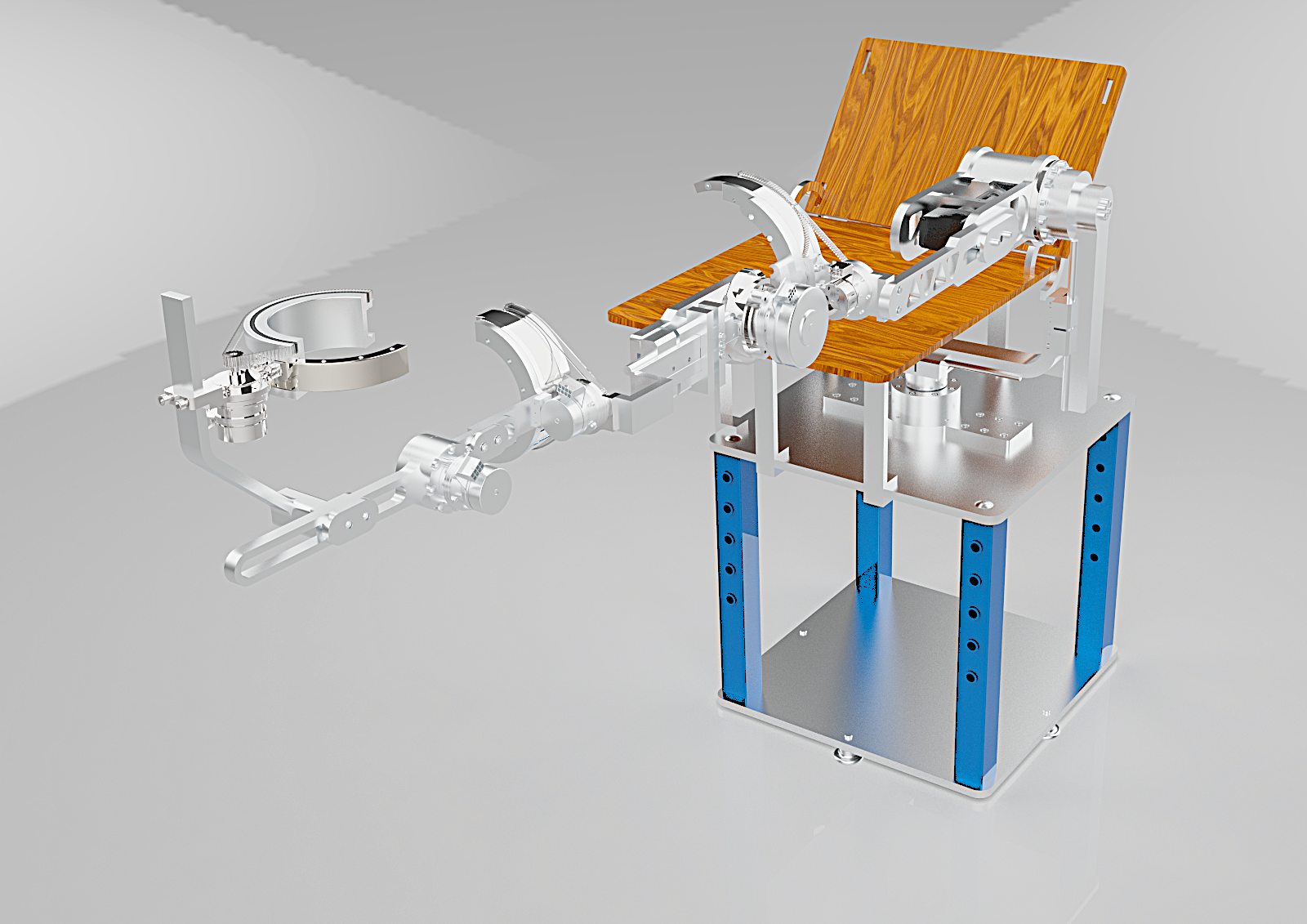
Digital Twin of Rehabilitation Exoskeleton Robot
This project focuses on developing a digital twin framework for rehabilitation exoskeleton robots. A digital twin is a virtual representation of a physical robotic system that can be used for real-time monitoring, simulation, prediction, optimization, and decision support. In rehabilitation robotics, a digital twin can help connect physical robot behavior, user movement data, sensor measurements, and computational models into a unified intelligent system.
The digital twin framework integrates robotic system data, biomechanical modeling, sensor feedback, and AI-driven analytics to monitor robot-user interaction during rehabilitation tasks. It can support real-time tracking of joint motion, trajectory accuracy, interaction forces, actuator behavior, and therapy performance. This information can help researchers and clinicians better understand how the robot performs and how users respond to robotic assistance.
A major goal of this project is to use predictive analytics to improve therapy personalization and system safety. By comparing physical robot data with virtual simulations, the digital twin can help identify performance deviations, estimate future system behavior, optimize control parameters, and support data-driven rehabilitation planning. This project contributes to the development of intelligent rehabilitation systems that are more adaptive, measurable, and responsive to patient-specific needs.
IoT-Enabled Rehabilitation Exoskeleton Robot
The integration of Internet of Things technology with rehabilitation robotics is transforming how therapy data can be collected, shared, analyzed, and used for decision-making. This project focuses on the development of IoT-enabled rehabilitation exoskeleton systems that combine smart sensors, embedded computing, wireless communication, cloud connectivity, and real-time data exchange. The objective is to make robotic rehabilitation more connected, intelligent, and accessible.
An IoT-enabled exoskeleton robot can continuously monitor patient movement, robot performance, sensor signals, therapy progress, and system health. Data from joint sensors, force sensors, electromyography, pressure sensors, and other measurement devices can be transmitted to remote platforms for analysis and visualization. This creates opportunities for remote supervision, long-term progress tracking, personalized therapy adjustment, and early detection of abnormal or unsafe system behavior.
This project also investigates how AI-based analytics can use IoT data to support adaptive rehabilitation. For example, movement resistance, assistance level, speed, range of motion, and exercise intensity may be adjusted based on user performance and therapy goals. By combining IoT, robotics, sensing, and intelligent control, this research aims to improve the efficiency, accessibility, safety, and personalization of robotic-assisted rehabilitation.
AI-Based Adaptive Control for Rehabilitation Robotics
This project investigates artificial intelligence and machine learning methods for adaptive control of rehabilitation robots. Human movement ability can vary across users, therapy sessions, fatigue levels, and recovery stages. Therefore, a fixed control strategy may not provide the most effective assistance for every user. AI-based adaptive control seeks to address this limitation by allowing the robot to adjust its behavior based on real-time information from the user and the robotic system.
The research explores the use of multimodal sensing, learning-based estimation, and adaptive impedance or assist-as-needed control. Potential input signals include joint kinematics, interaction forces, muscle activity, cuff loading, task performance, and other human-state indicators. These signals can be used to estimate user intent, movement quality, assistance need, fatigue-related changes, and possible unsafe interactions.
The long-term goal is to develop robotic control frameworks that are not only accurate but also safe, personalized, and responsive. Such controllers may help rehabilitation robots encourage active user participation, reduce unnecessary assistance, improve comfort, and support more effective therapeutic movement practice.
Human-Robot Interaction, Safety, and User-Centered Design
Because rehabilitation exoskeleton robots physically interact with the human body, safety and user-centered design are essential. This project focuses on understanding and improving physical human-robot interaction in wearable robotic systems. Research topics include mechanical alignment, cuff comfort, interaction force monitoring, joint range-of-motion safety, user feedback, and safe controller behavior.
The project also examines how users interact with robotic systems during rehabilitation exercises. User-centered design requires attention to comfort, usability, confidence, perceived effort, and ease of operation. By combining engineering measurements with user feedback, the lab aims to develop exoskeleton systems that are technically effective and practical for real-world rehabilitation contexts.
This research supports the development of safer wearable robots by integrating hardware safety features, sensor-based monitoring, adaptive control, and experimental validation. The broader objective is to ensure that rehabilitation robots can provide meaningful assistance while respecting human movement, comfort, and autonomy.