
by Tim Bredemeier, Junior History Major
We all know that Storm Lake has a rich culture of service through its many clubs and groups. It also has a long history. Through my research this semester, I have come across one such organization, the “Wa Tan Ye Club” (WTY) founded in Mason City, Iowa, in 1921. (You may have heard of it from Meredith Willson’s The Music Man. Willson was born in Mason City.) Its name apparently comes from that of a Native American leader of the Ioway Indians and translates as “One always foremost” (this according to George Catlin in the 1840s).
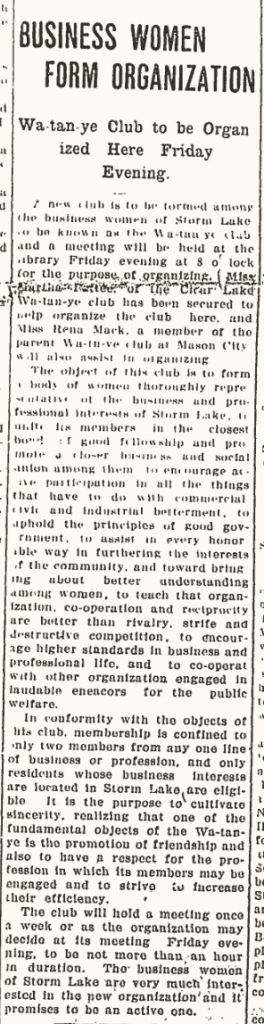
In Storm Lake, the first record of WTY comes in the Register of January 25, 1923. It was composed exclusively of women and was meant to promote them in business, as well as to advocate for women’s rights. The article explains that the club’s guiding principle is service to the community, and it speaks favorably of the women’s business organization. When flipping through old newspapers, an article like this instantly caught my eye. I had not expected to find an article, in a rural town like Storm Lake, on women in business following World War I. I decided to research more into the club in the following weeks. The short article in The Storm Lake Register is the first we had read of WTY, but it is far from the last, as the club wasted no time making friends and enemies within the community.
This devotion to service is exemplified through various activities covered by Register. The first of these community service events came three months after the club’s founding. The club donated to the juvenile library fund at the Storm Lake Public Library. An article makes note that this is the first substantial funding that the library had received. Clearly, the club was making its presence felt early on in its existence.
There are many incidents throughout the rest of 1923 that the Register and other newspapers cover where the library was able to purchase new wings, books, and other additions with the donation. It also participated in a fundraiser to place flags along the streets of town. Finally, it hosted the Rotary Club for a hotel luncheon.
WTY’s commitment to service as traced through the newspaper archives of 1923 shows a commonality with the community service organizations of today’s Storm Lake. One such example of this is SALUD!. It is an organization dedicated to diversity that promotes inclusive dialogue and leadership through its continued events and service. To say that SALUD! and WTY are exactly the same would be misleading. However, there are some interesting things to consider.
Let’s start with the similarities. First, both were groundbreaking organizations that challenged the status quo. In the case of WTY, it was a women’s business organization attempting to gain traction in a male dominated business world. It was conceived merely three years after women even received the right to vote. To say that they were swimming against the stream would be an understatement. WTY’s very creation was rejected by certain community members. One such example of this rejection came in The Storm Lake Register. In the article a female resident advocated for women to maintain their homemaker role in the man’s household. However, WTY’s creation allowed women in business to become a topic on the mind of Storm Lakers. One can only assume that through its various community service efforts, a dialogue began to emerge about the rights of women in Storm Lake. SALUD!, as you likely know, is also very involved in the community, as it attempts to create a dialogue of acceptance surrounding members of the Storm Lake community.

At the same time, WTY and SALUD! Have some glaring differences that need to be addressed. First, WTY likely gained its name from a band of Iowa Native Americans. Women in WTY chose to take the culture of the Natives and use it to their own image. This is the exact type of stereotyping that an organization like SALUD! would seek to dissolve through its service. (It’s also why the scene from The Music Man involving WTY has been removed or modified in recent productions.)
The problems of WTY and SALUD! are quite different. For WTY, library funds and Rotary luncheons were of the utmost importance. Through these donations and conversations with prominent men of Storm Lake, WTY was able to break down the barriers for women in the community. However, it’s less likely that you’d see SALUD! accomplishing its goals through raising funds for American flags like WTY did. (I could be wrong on this assumption.) Instead, SALUD! accomplishes its goals through anti-bias training, open conversations, and meeting basic social needs where gaps present themselves.
To say that these clubs are the same would be an overstatement. However, it certainly is clear to see how these two organizations grow from similar roots. The Wa Tan Ye Club, despite its shortcomings, was a groundbreaking effort in Storm Lake. As the community has grown, the challenges WTY faced have begun to be addressed. Thus we have seen a decline in its membership statewide. However, organizations like SALUD! have taken up that mantle in solving new problems that the city, state, and nation now face. As Storm Lake grows in its diversity, so too does its need for a powerful voice. SALUD!, like WTY, continues to create an environment for change.
Tim Bredemeier is a junior history and integrated social studies education major. He enjoys film and music as well as American and local history. He is a member of the Miami Council for the Social Studies and the Honors History Colloquium on campus. In his free time, you can find him in downtown Cincinnati at the local sports game or playing games with his friends. After graduation, he hopes to work as a high school social studies teacher or an archivist in Cincinnati.
