
By Paige Auxier —
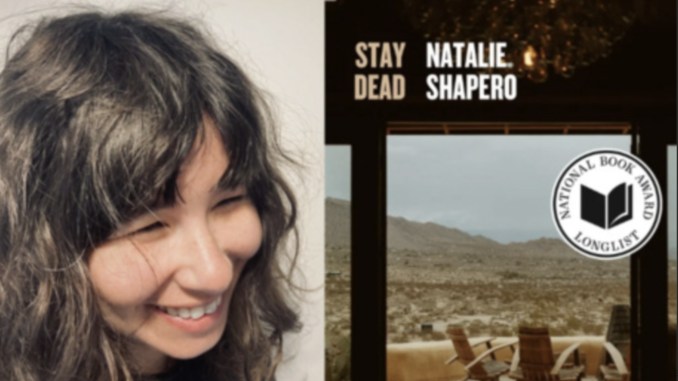
The Miami University Creative Writing Program recently hosted a “Creative Writing & Performance” event funded by university alum Marianne D. McComb. At this event, Los Angeles-based poet and UC Irvine writing instructor Natalie Shapero gave a virtual reading of selected pieces of poetry from her latest book Stay Dead, followed by a brief Q&A regarding writing technique, process, and performance.
The book she read from for this performance, Stay Dead, was longlisted for both the National Book Award and the National Book Critics Circle Award and was shortlisted for the T.S. Eliot Prize. Her work extends beyond this particular poetry collection, though, as she has also written and published three others–No Object (2013), Hard Child (2017), and Popular Longing (2021). Throughout her career as a writer, her work has made appearances in esteemed literary magazines such as The New Yorker, The London Review of Books, The Paris Review, and The Nation. She’s also impressively had the opportunity to perform at arts centers such as The Pulitzer Arts Foundation and The Poetry Project at St. Mark’s.
After being introduced by Professor Emily Spencer, Shapero began the process of selecting, performing, and explaining the meaning of the poems included in her collection. In these explanations, she dissected her work with detailed descriptions, providing context for how each poem or set of poems connected to the overarching themes of her book, the research she did in relation to those themes, the reasoning behind her inclusion of different references to media and popular culture, and the personal thoughts and experiences that inspired her work. This cycle of reading and explaining her poems persisted for the bulk of her allotted time; however, she made sure to set aside twenty minutes at the end of her performance to accept and thoughtfully respond to inquiries posed by audience members.
Shapero relayed to viewers that Stay Dead largely revolved around the synthesis of questions surrounding the concepts of labor politics and performance. To do this, she researched social labor, which she described as the duty one has in professional settings to maintain a certain emotional state, and how that task can become draining over time. She also researched the history of method acting and related it to the aforementioned concept of social labor, in an attempt to compare social performance in professional settings to method acting. However, she also used her research on this concept in connection with research on abstract expressionist painting. Shapero felt that the two art forms mirrored each other because they’re both used as a way to create physical representations of abstract thoughts or ideas. She further connected them too by noting that both tend to have an unconventional appearance due to their being based on concepts that are too complex to take on an orderly shape.
In response to being asked how she would characterize her writing style, she explained that her work tends to be concise, associative, figurative, and resistant to hard conclusions, which is why she feels most at home in the genre of poetry. She’s able to create work that sits in ambiguity, multiplicity, and difficulty. This is also, she explained, why she struggles to write in alternative genres, like essays, for example, even in instances where the topic of her writing feels too involved or complex to be fully encapsulated by an individual poem. It was because of this that she left her old profession as a civil rights lawyer. In that line of work, she was expected to write definitively, even at times when she didn’t feel as such.Shapero was very engaging throughout her performance, and her attentiveness during both her active readings and descriptions of her poems made it evident that she takes great care and pride in the art she creates, and this passion undoubtedly enhances the quality of her work. So, for anyone interested in poetry, her book Stay Dead may be worthwhile to check out.
Leave a Reply