
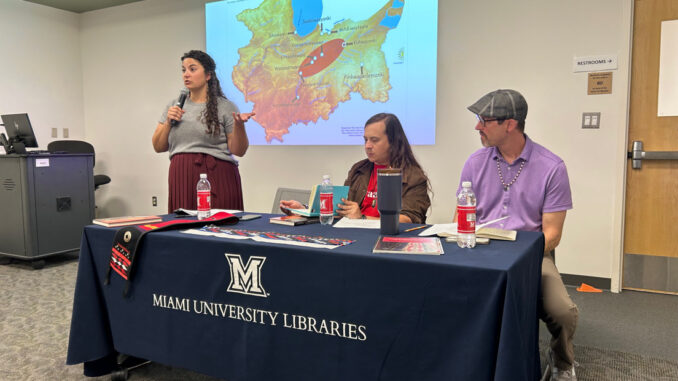
By Sara Sparling — King Library recently gave a warm welcome to Kara Strass, George Ironstack, and Chris Bowyer of the Myaamia Center, located on Miami University’s Oxford campus. On October 16th, audience members gathered to listen to the stories of “aacimoona” (in myaamiaataweenki, the native language of the Myaamia people, capital letters are not used). “aacimoona” means, “Historical Narratives.” These are stories of who the Myaamia are as a people, that members of the Myaamia community have passed down over hundreds of years.
Strass started out by greeting the audience and explained more about aacimoona, and prefaced that there are also “aalhsoohkaana,” or “winter stories,” that they are not allowed to talk about or share with others until the first frost, a hard sign that winter stories can begin. These stories can be shared until frogs start to sing and the first major thunderstorm hits, which will then allow the transition to a new set of stories. Strass exclaimed that while she is excited to begin telling these stories, she doesn’t quite think she’s ready for the cold weather to strike, much to the audience’s disgruntled agreement.
Strass welcomed George Ironstack, her relative “meemeehšhkia,” to tell the oldest known Myaamia story: their coming out story by Gabriel Godfroy. Ironstack explained that while there are certain visuals that go along with stories they tell, the interpretation of visuals is up to the imagination of the audience. Ironstack then told the full story in “myaamiaataweenki,” followed by the English translation. The full story can be viewed here. This story takes place somewhere between present day South Bend, Indiana and Michigan, and is also where the first village was built, but the exact location remains unknown. This story is used today to remind themelves, and others, where they come from and where their origins lay. There are no known memories before this.

Strass returned to the stage and described what are called “sign posts,” or things the Myaamia people look for that connect stories to each other; they are usually connections to places, people who told stories, and names. An interesting fact shared by Strass was when he told the audience, “We don’t have a story about our name for ourselves today, Myaamia. At the time of that story, we were referring to ourselves mainly as ‘mihtohseeniaki’ or human beings. We know our name came to us at some point, and it refers to the ‘Downstream People.’ That’s what Myaamia means.”
There are many connections to rivers, two of which are The Great Miami and the Little Miami Rivers, which is also how Miami University got its name. Strass also mentioned that “we don’t have a story about the name Myaamia, but we do have a story about a name that other people called us, which is ‘Twightwee.’”
Ironstack was then welcomed back up to tell a story about a name Myaamian people were given by others; they did not give themselves this name. This story involved “cecaahkwaki,” sandhill cranes, which are very important birds as they represent a time of renewal. Ironstack played a recording of the sound this bird makes so the audience could visualize and understand where the sound in the story comes from. A fascinating fact Ironstack shared with the audience was that “sometimes [the cranes] fly over Oxford in small groups.” The audience found it very amusing that these birds remind him of dinosaurs due to their size and stature.
The “ceecaahkwa” is the symbol of the Myaamia community today as a nation. It is a form of decoration or art expressed through “painted trees,” where tribes would carve various symbols and markings into beech trees and then paint and burn them. More information about the significance of these trees. The Cherokee, and ceecaahkwaki, can be found here.
Bowyer told the story, “teekwaakia aacimooni,”, which in English translates to “story about Teekwaakia”, which talks about Teekwaakia and his wife Kiihkinehkiišwa out fire hunting at night. There was a very deep spot in the river where it was said a spirit used to live. People would go to this deep spot and cut tobacco in exchange for things they wanted. Teekwaakia asked for a buck and two catfish. Those were caught with ease, but then he noticed a white perch that he did not ask for. That did not come so easily.

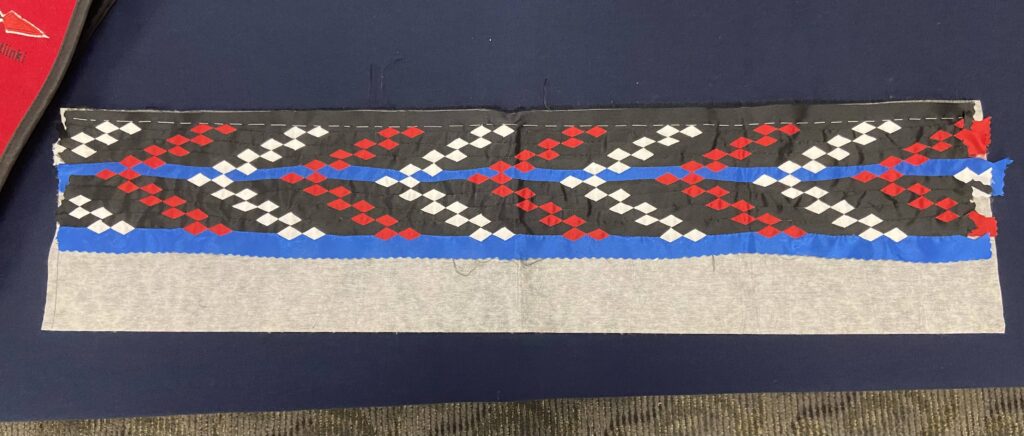
Strass then discussed “ribbonwork”: a form of art that involves layering, cutting, and folding ribbon to create beautiful geometric patterns. It was not a story told by the Myaamia people but they are actively working towards revitalization and reclaiming the works, and teaching new generations about the gift of ribbonwork. Families used to sell these pieces for various reasons. There was significant poverty and they needed money to support their families. Many of these pieces were sold to institutions like museums and archives. In contemporary times, the process of creating ribbonwork was unfortunately lost. Strass showed a piece of ribbonwork to the audience that she had been working on herself for about fifty hours, and it was clear that she appreciates the hard work that goes into it.
The process of revitalization involved going deep into archives and studying pieces of ribbonwork to understand more about them and collect knowledge. Searching and studying has been going on for decades. By going into archives, the sizes, shapes, colors, and patterns are able to be studied in detail. There isn’t an abundance of knowledge about who created these historic pieces. It is rare to learn where a piece was collected, and it’s even more rare to learn who it was collected from. Each diamond has to be cut and folded very delicately and it’s the process of layering that allows patterns to be created. It’s not like traditional quilting as we understand it.
The reason Myaamia people were making these patterns was to be able to clothe their loved ones. “This is a very special piece of clothing. It’s not an everyday piece of clothing.” There are Myaamia people today who attend workshops to learn how to do ribbonwork and appreciate the art. “I think if the takeaway from these workshops is that ‘this is really difficult, and that I admire the people who have that skill and left behind this art form for us.’ I think that’s a reasonable takeaway.” More about Myaamia Ribbonwork can be read here.
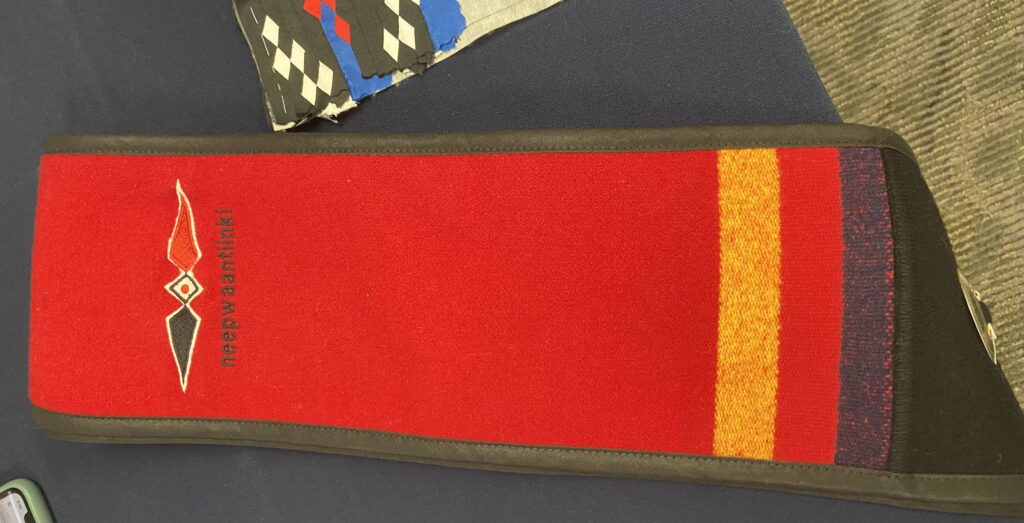
Another strong connection of the Myaamia community to Miami University is that each Myaamia student receives a stole at graduation that has hand-sewn Myaamia ribbonwork on it. It’s a reference to clothing their people, and spending time and energy to recognize special occasions and significant accomplishments.
The presentation was then opened to any questions the audience may have had about stories, ribbonwork, geography, university collections, and more. Strass, Ironstack, and Bowyer hope to continue to do this in the future and continue to share stories and discuss the Myaamia people, culture, and traditions. To learn more, or to visit University collections of documents and other artifacts, please visit the Myaamia Center located in the Bonham House on the Oxford campus.