
By Sara Sparling — Recently, students and faculty from Miami’s Regional campuses gathered to listen to Aidan Oglesbee, an Applied Biology major, discuss everything a beginner would need to know about mushrooms and fungi: what mushrooms are, how to forage for them, how to identify them, and more. He has been foraging for mushrooms for over ten years and hopes that through his presentation, the knowledge of mycology—the study of fungi and mushrooms—will only continue to expand. Aidan’s presentation was based on the climate and conditions of Butler County as it “has a very specific microclimate that is very good for fungi.”
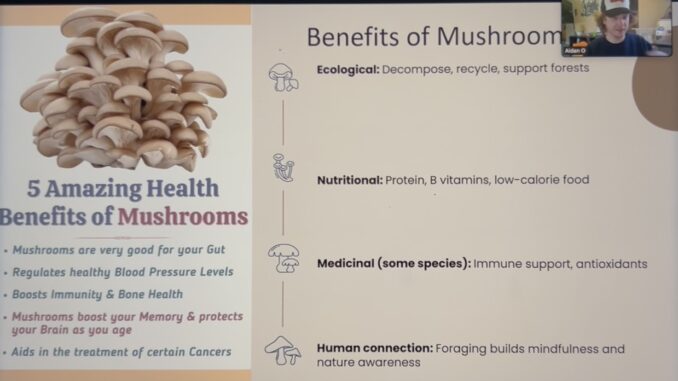
Aidan shared that talking and learning about fungi is something he is very excited and passionate about. He wants everyone to care about mushrooms because “they’re the great unseen processors of life.” They’re crucial for an ecosystem’s survival as they’re the main decomposers in an ecosystem that break down nutrients for other organisms to use. Without them, forests especially would be covered in debris. Aidan explained that while they can provide great benefits for humans such as food and healing properties, they can also seriously harm individuals if they’re not careful. He stated that it’s best to use caution when foraging, but to not be so overly cautious that you’re afraid.
There are two terms that need to be separated from each other: mycelium and mushroom. “Mycelium” is the main living organism that grows in networks and veins underground. It’s constantly feeding and growing. “Mushrooms” are like “fruit” that grow above ground, that are produced from mycelium when presented with ideal conditions. A mushroom’s purpose is to drop spores, which are like seeds that scatter to allow new mushrooms to grow. An analogy Aidan really likes to use is that “the mycelium is the apple tree and the mushroom is the actual apple containing the seeds.” Since the mycelium is underground, and it’s generally easy to pull up a mushroom, Aidan said people don’t have to worry about destroying an ecosystem because mycelium will reproduce very easily. In order to reproduce, there has to be a “mycorrhizal” relationship between fungi and plants: a symbiosis between fungi and plants where both species are benefitting mutually.
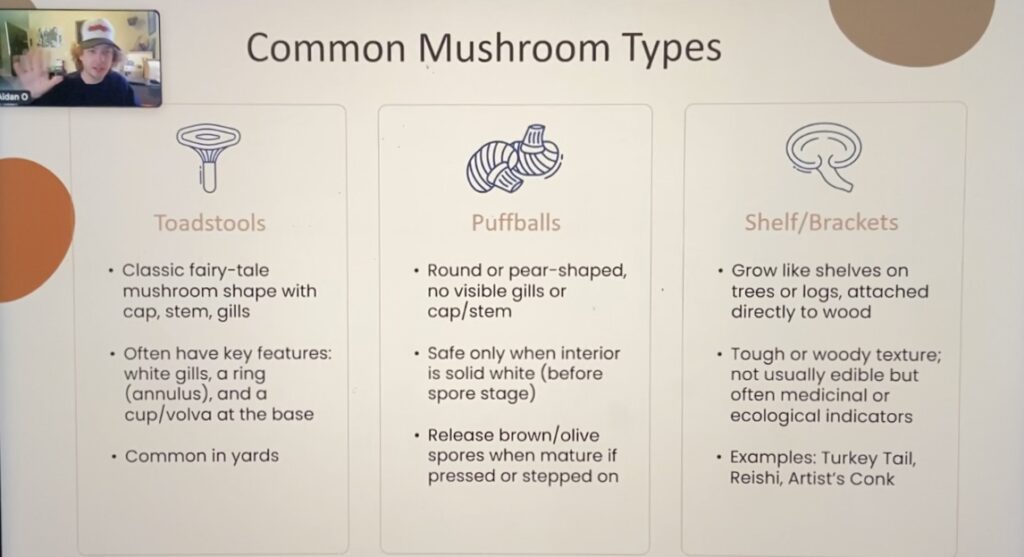
When foraging for mushrooms or fungi, there are numerous common species someone can encounter. A few examples include toadstools, puffballs, and brackets. Toadstools are what everyone thinks of when they think of mushrooms. They are very commonly found in yards and have a classic cup-shaped cap with stems and gills underneath, and usually are red with white spots. Puffballs are large and white with no visible stem or gills. They have very tiny pores that spores are released from when pressure is applied. They are only safe to eat when the inside is completely white, with no discoloration. Bracket mushrooms grow in rows like shelves on trees, with a tough, “woody” texture, and attach themselves directly to trunks of trees. These are usually not edible but can be used in medicinal practices. When these mushrooms are observed on trees, that means the wood is actively decaying. An important note to remember is that all mushrooms are fungi, but not all fungi are mushrooms.
The most ideal conditions for foraging occur when one notices active decomposition, usually close to oak and hardwood trees, sometimes after a recent rainfall, and before the sun comes out and dries any kind of moisture. When transitioning from winter to spring, the ground has to be at least 60 degrees Fahrenheit for a week before mushrooms will start to appear. Mushrooms like shaded, moist areas with consistent rain.
Another fascinating fun fact Aidan shared is that if you wish to grow your own mushrooms, take two wet pieces of cardboard and put a piece of stem in between them; mycelium will start to grow and mushrooms will eventually start growing as well.
When talking about supplements with mushrooms, Aidan advised, “Make sure you look at the back and make sure it says fruiting body and not mycelium. There’s a scam going on where companies will sell mycelium, which grows very quickly but does not have the same health effects as a fruiting body, which takes a lot longer to grow.”
Identifying a mushroom involves looking at all parts. It’s not possible to identify one just from looking at the cap. The cap, stem, gills/teeth, ring, cup, stem, and spores must all be studied for proper identification. Sometimes a mushroom will have scales. Think of the red Super Mario mushroom with white spots. Sacs will form on the mushroom to protect it when it’s young, but will eventually break off and leave behind white spots known as scales.
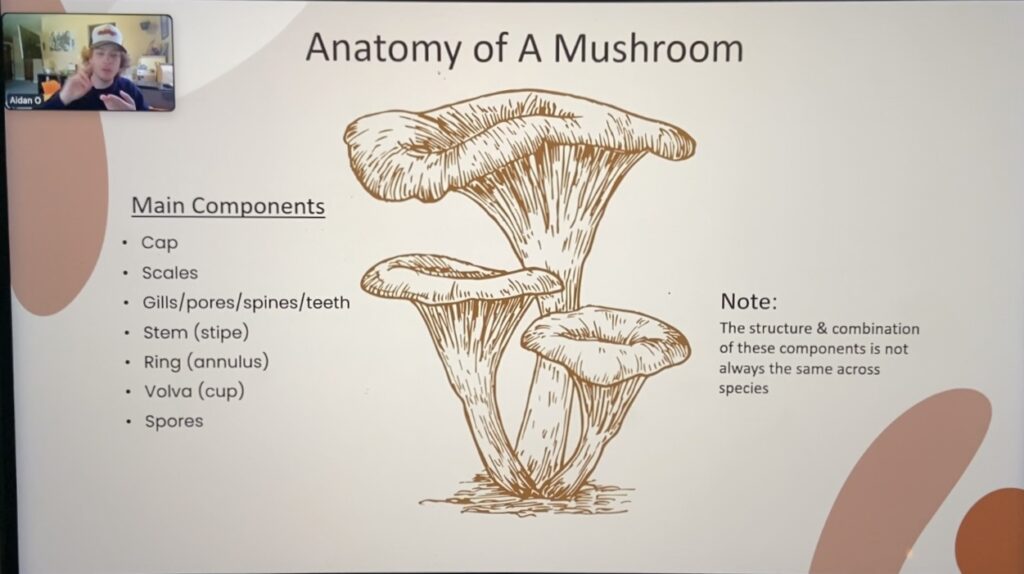
A key way to identify mushrooms is by looking to see if it has a ring and volva, as not all mushrooms have these. Spores are microscopic “seeds” of fungi and are carried by weather, animals, and humans. Each mushroom releases millions to billions of spores. This is why mushrooms do not require pollination. Creating a spore print is a crucial identification factor. To create one, take a fresh mushroom and cut the stem off at the cap. Take white paper and black paper and let it touch both sheets; the true color of the spores can then be studied by comparing the two sheets of paper. Aidan then showed a close-up video showing how spores are released.
Aidan also cleared up some common misconceptions about mushrooms. He says not all mushrooms are deadly. There are very few mushrooms that are truly deadly, such as the Amanita genus. However, as long as someone is being mindful and isn’t going around “taste testing them willy-nilly” as he joked, then there really isn’t anything to worry about. However, there are some kinds of mushrooms that have toxic and non-toxic twins, and the only way to tell the two apart is to taste them. This is a case where a person has to be aware and understand what they’re doing so they’re not harmed.
Many people also fear that mushrooms are dangerous to touch. Aidan reassured the audience that toxins have to be consumed to take effect, and a person cannot be harmed simply from touching them. While this is true, good handwashing is still important after foraging.
A final misconception is that AI can always identify a mushroom perfectly. Aidan stressed that this is absolutely false and one should never fully trust artificial intelligence to identify a mushroom fully. The results given can vary based on camera quality, lighting, or the software the AI is using. More often than not, a certain software is not designed solely to identify mushrooms, and if that’s not its focus, AI can be inaccurate.
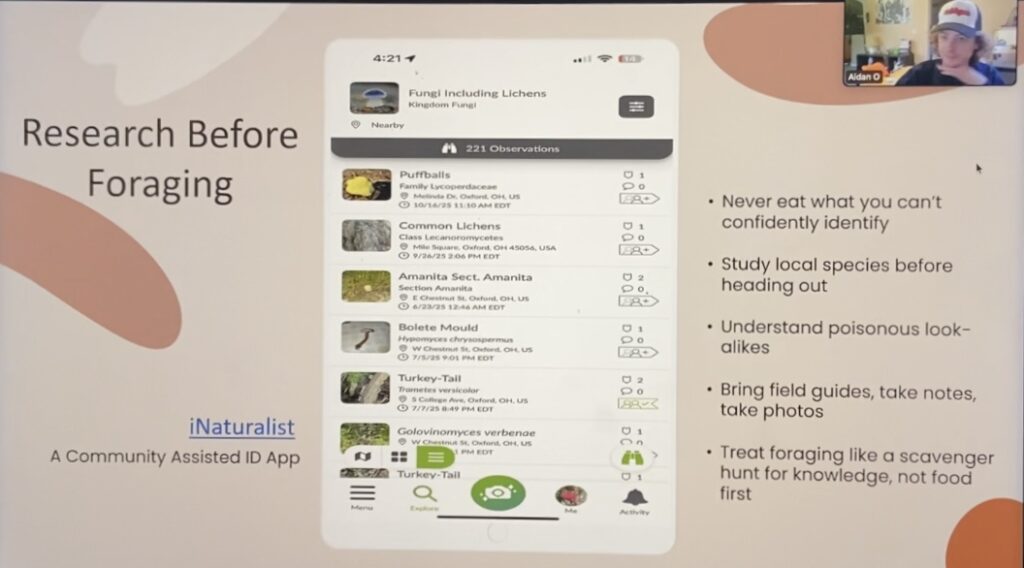
An identification app Aidan highly recommended is iNaturalist. This community-lead app gives a percentage regarding how sure the AI is on its identification. Other users can agree or disagree with the identification, and once three separate users have agreed, it goes in as a species observation. It can also tell the best times of year to look for certain species based on weather and temperature, and based on what other users in an area have reported. If a person identifies a specific geographic area, and then enters a species he or she is searching for looking for, it will then display a map of the chosen area with different dated observations, along with photos. There are also various social media groups across different platforms where people can connect with other mushroom enthusiasts.
Aidan talked about the benefits of finding mushrooms, specifically in areas in nature or in a yard. He said wherever mushrooms are found, that means there is a healthy ecosystem underneath and surrounding them.
Aidan hoped his presentation would inspire others to get into mushroom foraging and if they are already into foraging, hopefully they learned a few new tips or tricks.