
By Noah Neeley —
Recently, Middletown historian Sam Ashworth explained the history of Ohio’s canals and the impact they had on the community’s development. Ashworth is a Miami University graduate and a part of the Middletown Historical Society. Through his involvement with an Armco anniversary project for work, he became interested in the city’s history and joined the Middletown Historical Society. He has been working with the organization since the 1990’s as a designer for historical exhibits.
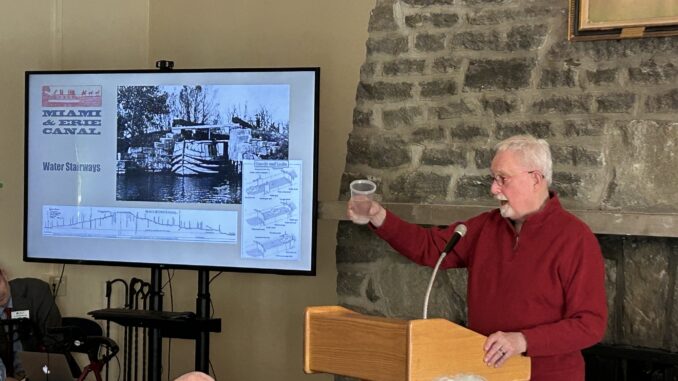
Held in Verity Lodge on the Miami Middletown Campus, Ashworth’s presentation described the history of the Miami Canal and the Ohio Erie Canal. These canals were used to connect Ohio trade routes for more efficient transportation of both cargo and passengers.
So why were the canals necessary? In the 1810’s, Ashworth explains, “Ohio was a primarily agricultural state, and the farmers had little access to different markets.” To remedy this problem, Senator Thomas Worthington proposed the digging of canals in Ohio after seeing their success in New York. With the help of the governor, a bill was passed allowing for the construction of canals in this state.
To plan the canals, the Ohio government hired James Geddes, the engineer behind the Erie Canal in New York. Geddes decided that two canals should be built. The Miami Canal would span from Ohio to Dayton, while the Ohio-Erie canal would connect Lake Erie and the Ohio River.
Prior to digging, Geddes put his focus on Middletown, which happened to be a convenient location to start construction. With its proximity to the Miami River and a small channel already dug out to power water mills, Middletown was the right choice. “The other factor was that the land was pretty flat right there, so they wouldn’t need to build locks right away,” Ashworth said. On July 21, 1825, Governor Clinton dug the first shovelful of dirt for the canal in Middletown.
The construction of a canal might seem relatively simple—just dig a big ditch in the ground and fill it with water. Of course, it wasn’t that easy. First, the water needed to come from somewhere. Luckily, being along the Miami River solved this potential problem. The other issue was elevation, which required its own system.
Locks were used to move boats up and down the water as the land elevation changed. Consisting of two massive gates and a space in the middle for a boat, locks would slowly pull in water to raise boats, or slowly release water to lower them. Boats would take anywhere from 10-15 minutes in each lock as the water slowly adjusted. Middletown had four locks when the canals were in operation, so boats would spend up to an hour navigating them.
Eventually, the Miami Canal had seen enough success to warrant an expansion. Spanning from Dayton to Toledo, the 1830 Miami extension connected it to the Erie Canal. With Southwest Ohio now linked to the rest of the state and to New York, trade was much more open to the rapidly industrializing cities of Southwest Ohio.
However, the canals’ success would be short-lived.
“By the time the Miami and Erie Canal was completed, what else was on the horizon?” Ashworth asked the audience, to which they responded, “Railroads.” Indeed, railroads would ultimately spell the end of the canals in Ohio during the mid-1800’s. Trains were faster, could carry more cargo, had more capacity for passengers, and they didn’t freeze during the winters. They were an upgrade in basically every way, which meant that the canals were abandoned as the railroad networks expanded.
Along with the railroads, automobiles were beginning to be introduced in the 1910’s, which caused bridges to be built over canals. Additionally, the Great Flood of 1913 eroded the sides and the canals and they became unusable. Ashworth explained that it eventually turned into a dump, filled with trash, and ultimately a health hazard that warranted a shutdown.
Middletown was one of the last cities in Ohio to close its canal, finally shutting it down in 1929, holding a great parade commemorating the end of the canal era. Over time, the canal was filled and replaced with roads and infrastructure. Though much of the canal is no longer visible, some sections of it can still be seen along roads. The Middletown Historical Society has plans to clean up and post signage around one of the locks that are still intact for the canal’s 200th anniversary.