
By Maureen Wilson —
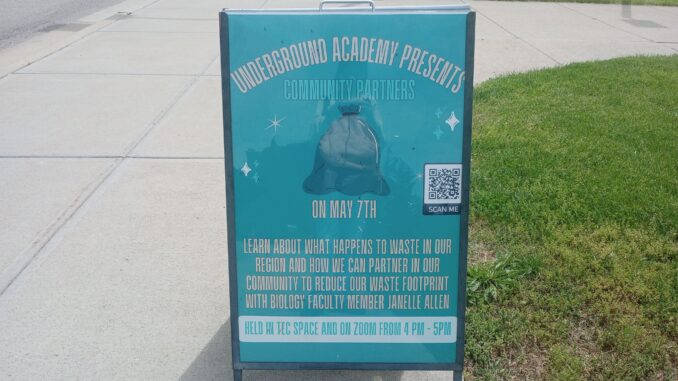
Annually, 60 billion garments are never sold, and in the United States, 30-40% of the food supply is wasted. There’s no doubt that current consumption in our society is becoming increasingly unsustainable, but how should we fix it? In her recent final installment of the “Underground Academy” series, Janelle Allen discussed the partners in our community that promote reducing, reusing, and recycling resources.
Allen first reintroduced several concepts for the newcomers, such as where our waste comes from and how we choose to use it. She reiterated the importance of soil nutrients and how they relate to the health of humans and animals alike, while mentioning the acronym CHNOPS (Carbon, Hydrogen, Nitrogen, Oxygen, Phosphorus, and Sulfur) to explain the core tenets of sustaining life. Recycling and composting were briefly reviewed, as covered in past “Underground Academy” talks, as solutions to the current degradation of natural resources. In summary, Allen provided her version of the five Rs: reduce, reuse, recycle, repurpose, and resource as a good point of reference.
In the second half of the presentation, Allen discussed the various community partners that aim to support local sustainability. AMVETS of Ohio, for example, is an organization that primarily accepts clothing donations. All profits (after expenses) fund service projects, programs, and scholarships that sponsor the veteran community. Catered towards parents, Once Upon a Child is a secondhand children’s clothing store that accepts furniture, toys, and baby gear in exchange for cash. Thread Up Oxford is a local success that focuses on reducing textile waste. They sell high-quality items in their thrift store while the rest are reduced through their Freejects tables. The Snooty Fox is a consignment company that accepts clothing and picks up furniture. St. Vincent de Paul, Salvation Army, and Habitat for Humanity ReStores are all thrift chains that root their sustainability efforts in charitable causes. Similarly, Freecycle is a program where community members give and receive free items within an online community.
Allen also listed a handful of recycling centers like Cincinnati Recycling and Reuse Hub, Eco Development, Terracycle, and programs supported by Cohen and Rumpke. Lastly, Queen City Commons is a compost drop-off program for those interested in recycling organic matter.
Concluding the presentation, Prof. Allen took questions related to the presentation. The first question pertained to how overconsumption is normalized in our society. Allen answered with the three Cs: colonialism, capitalism, and consumerism. She talked about how colonialism has ravaged native lands and their ways of life, often based on respecting nature and a spiritual connection to the land. Allen then mentioned the bartering system that dates back thousands of years, which was inherently bereft of capitalism and consumerism due to the direct exchange of goods and services. As a result, communities were built upon and survived by their willingness to share. Nowadays, overconsumption is promoted in modern capitalism as the model is perpetual growth. Needs vs. wants are blurred with marketing tactics that aim to make emotional connections with products. But, Allen continued, a transition could possibly occur within this century with the prevalence of companies adopting green plans. Still, it’s a double-edged sword, as consumers have concerns regarding “greenwashing” and misleading environmental messages these companies often project.
The second participant question was about the rise of online resell culture and its influence on the thrifting industry. Allen tied the topic back into consumerism and America’s “middle-man” reputation of always trying to turn a profit on otherwise straightforward exchanges. She said resell platforms aren’t necessarily bad, but cited her lack of experience with them. Regardless, authenticity and transparency should be prioritized in any market, and ultimately, any attempt to repurpose is at least a small step forward.
The third and final question concerned how participants can raise awareness about the aforementioned community partners, and how to convince corporations to do the same. Allen opened her response with an anecdote about last month’s Earth Day, where she shared and promoted multiple posts regarding the direct steps people can take to create a more sustainable future. She said it can be as simple as sharing information through word of mouth and social media platforms to make a difference.
Allen then brought up a story she saw about Japan’s “waste-free” town, Kamikatsu, and how impactful it was to her to realize the possibilities of its implementation. In her words, “storytelling and witnessing” are pivotal to uniting local environmental efforts and establishing an emotional connection to the issue. For corporations, Allen remarked, it’s “a harder sell,” as sustainability isn’t known to be a profitable practice. But, there have been instances where successful partnerships have been made with the community and recycling hubs. It’s partially the people’s responsibility, too, as we can choose to support and align ourselves with sustainable companies and motivate other companies to follow suit. We can also speak to state representatives to bring awareness and utilize their positions of power.
All participants couldn’t help but leave this presentation with the feeling that the future of the environment is clearly in our hands, but it all depends on how much we’re willing to invest in it.