
By Maureen Wilson —
While most people agree that recycling is important, only 32% do it according to the EPA’s 2018 National Overview. On March 5th, from 4 to 5 p.m., Janelle held her monthly “Underground Academy” talk regarding the importance of recycling in our modern age and how we can more meaningfully engage in this process.
The presentation began with establishing what we need as human beings, and how it depends on our relationship with the environment. Degrading our Earth through pollution and deforestation heavily impacts not only the cleanliness of our food and water, but also the quality of the food we consume. Allen emphasized that the nutrients we need to sustain ourselves such as vitamins (A, C, D, etc.), iron, calcium, and magnesium are resources that are being threatened by soil erosion. This is often caused by over-farming, which allows saltwater intrusions to occur (rising salinity levels) and creates unproductive land. Without addressing these concerns, life on Earth as we know it will become uninhabitable.
It’s easy to become hopeless in the face of issues we feel are out of our control. But, even a little action can go a long way. To address the current concerns of the food production industry, starting communal gardens or growing our own food are viable options. Even in smaller spaces like apartments, it’s still possible to have a garden indoors (through hydroponics, for example) and buy locally. Also, composting utilizes the waste we already have while producing nutrient-rich soil. But, one of the most important things we can do is reduce from the source. Don’t buy what you don’t need, and don’t eat out too frequently—these are good rules to follow. The process of change first starts within ourselves by identifying the purpose of the items we own and becoming aware of how our individual decisions impact the environment. When we don’t, our landfills become overwhelmed with waste, land becomes unusable, and it becomes harder for everyone to live a happy, healthy life.
Allen concluded the presentation by noting how long it takes for specific material to break down. Cardboard can take 2-3 months to degrade, while aluminum cans last 200-500 years. Both are easily recyclable.
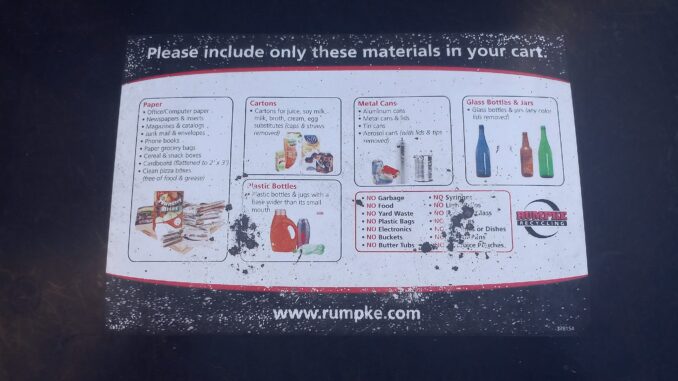
At the end of the talk, Janelle Allen took a couple of questions. The first question was about recycling incentives and their effectiveness. Allen replied, “If it’s a monetary incentive, Cohen [Recycling in Middletown] does take a wide variety of things and they will weigh them and pay you a differential, like a proportion of what they’re going to get paid from a vendor who’s going to buy their materials.” Additionally, people may not want to pay Rumpke to pick up their trash, so community recycle dumpsters are a way to save money. Someone in the audience built off this discussion, including their experience of turning in aluminum cans and how effective it was in their region. No one would discard them on the road if they knew they could get some money out of it in the process.
The second question asked regarded how we can incorporate recycling into elementary and high school curriculums. Allen prefaced her answer by indicating that it ultimately depends on the district. Some see the appeal in teaching sustainability, as it only becomes more relevant as time goes on and saves on cost. She brought up a specific example where a school supported the students taking initiative. Over a year, students collected their Lunchable plastic containers and were able to donate a truckload to the Recycle and Reuse Hub.
Finally, when asked about the future of e-waste (electronic waste), Allen mentioned generative AI and how its usage heavily impacts our electricity and water resources. This is due to the power necessary to maintain these facilities, and how data center cooling systems function. Allen elaborated on this further by saying, “I suggested to my students to use it as a research tool—something to guide your thoughts, create your outline, or give you ideas—then go to the library and find your resources.” She also recommended finding the most up-to-date information available. An audience member then added to the discussion, saying how Cohen Recycling accepts to recycle certain electronics, from computers to power strips, as many contain amounts of copper and other valuable metals.
Above all, we should consider the items we use every day and purchase such items with consideration. Remember the R’s: recycle, reduce, reuse, repurpose, and resource recovery throughout this process. Truly, the most fulfilling incentive for recycling is contributing to the common good of humankind.