
By Maureen Wilson —
Death Valley National Park is known for its rather “dry” reputation as North America’s lowest and hottest national park. But, is there more to it? On March 18th, Tammie Gerke presented a deep dive into the park’s rich geological history and distinctive features. Viewers watched and participated in the talk from 4:30 to 6:00 p.m.
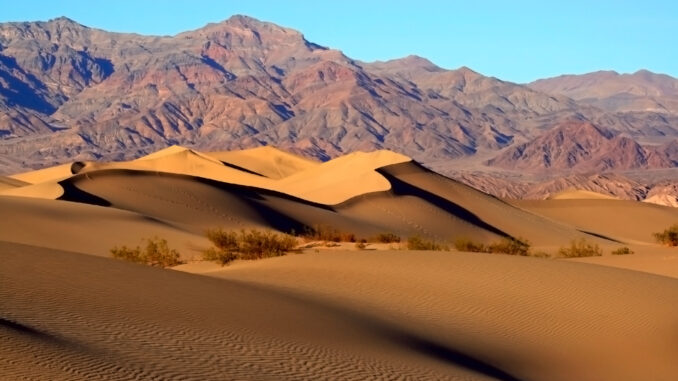
Death Valley National Park is mostly located in southwestern California, but a portion also resides within Bullfrog Hills, Nevada. At an impressive 5,156 square miles, it’s the fifth-largest national park overall and the largest national park in the contiguous United States. It became a national monument in 1933, but it wasn’t a year later that it was named an official national park. Since it’s situated in the Mojave Desert, many assume it completely consists of sand dunes, but they only occupy 1% of the land. The extreme temperatures are no exaggeration, though; summers are often lethally hot and regularly reach at least 120°F (compared to the world record of 134°F, which took place in 1913 at this very same park). The lowest point, specifically found in the Badwater Basin, plunges a staggering 282 feet below sea level.
Prof. Tammie Gerke took some time to introduce the general geologic history of the area and the unique circumstances that allowed Death Valley to form in the first place. The oldest rocks in the park have existed for at least 1.8 billion years, heavily metamorphosed by intense pressure and heat while eroding over time to create their more mountainous appearance. Its geologic record remains relatively consistent with only two major gaps caused by unconformities.
A convergent boundary emerged during the early-to-mid Mesozoic Era (251 to 65.5 million years ago) as the Farallon Plate, under the Pacific Ocean, started to subduct below the North American Plate. Faulting and the subsequent rock deformation started to build the mountains we know today, like the Sierra Nevada range. The two fractured remnants of the Farallon plate were renamed Juan de Fuca and Cocos plate respectively. The Tertiary Period (65.5 to 2 million years ago) brought about a volcanic era. As molten material accumulated from underneath the surface, eruptions occurred at its weak spots and left layers of cinder and ash. The hills of Artist’s Palette gained their vivid colors from its oxidation.
Basin and Range, which would come to define Death Valley, began its development three million years ago. The compression created chevron folds, and up to that point they started to pull apart instead, with masses of land sliding against each other’s faults. They formed alternating raised and lowered fault blocks, also known as horst and grabens. The valley floor continues to drop to this day, as water deposits sediment and salts into it. Lake Manly, which was located on the valley floor, started to dry up 10,500 years ago, along with other lakes subjected to the constant climatic changes during the Ice Age, leaving fields of salt deposits. The tectonic activity of Death Valley persists, though. One of the most recent formations is the 2,100-year-old Ubehebe Crater. It occurred from hot magma rising up and interacting with groundwater, creating steam that pressurized into an intense explosion.
The presentation shifted to the mining history of Death Valley National Park, beginning in 1849. Miners at that time were searching for lead, copper, silver, and gold. However, borax (along with halite and gypsum) was its greatest export, becoming the leading source of these minerals in the 1920s. Wildrose charcoal kilns were built in 1877 to create charcoal for lead-silver mines, but were only used up to 1879. Its preservation makes it a historical and architectural landmark for the park.
Prof. Gerke then examined the paleontological aspects of the park. Fossil groups like crinoids and trilobites, the footprints of now-extinct camels and dire wolves, and petrified wood were shown on-screen. She noted that the range of fossils found there is actually quite similar to ours here in Ohio—but of course, Death Valley has countless unique features that set it apart. Its singing sand dunes, sailing stones (that move by themselves), beautiful spring blooms, status as a dark-sky preserve, and endemic Devil Hole pupfish are all equally fascinating and continue to attract 1.1 million visitors a year.
Death Valley is much more than what its name suggests, and hopefully, presentations such as these will interest you to visit some of America’s iconic national parks. John Burke and Tammie Gerke are open to suggestions concerning what park or geologic topic should be covered next, but until then, the next National Park Talk will discuss the book The Year Without Summer: 1816 and the Volcano that Darkened the World and Changed History (April 22nd at 4:30 p.m).