

The Problem: The Daunting Financial Reality
By Kevin Matteson
You have finally found the perfect graduate program. You know that a master’s degree from Project Dragonfly will elevate your career, ignite your passion, and give you the tools to make a real environmental impact. But then you look at the tuition, and panic sets in.
Even though the tuition is reduced relative to many programs, we recognize that the financial element is daunting for so many. No one wants more debt, and no one wants more stress in their life when it comes to money.
Because of this fear, many motivated professionals—from K-12 teachers to NGO workers and zoo educators—assume that they have to shoulder the entire financial burden of a graduate degree themselves. They assume their organization’s “Professional Development” budget is only meant for $200 weekend workshops or mandatory CPR training.
This is a myth. Every year, thousands of dollars in professional development and continuing education funds go unused because employees simply don’t know how to ask for them. I recently worked with a student whose grandfather worked for a company that had a corporate fund set aside specifically for the descendants of its employees. No one really knew about this, and the money was just sitting out there unused until they asked! You really need to ask and see what’s available within your family, your network, your job, and all your people.
If you have the pull and the push, you can find a way.
The Concept: Pitch the ROI, Be the Squeaky Wheel
If you walk into your Director’s or Principal’s office and say, “I want to get my master’s degree because I want to learn more about conservation,” they will likely congratulate you and send you on your way. Employers don’t usually fund personal growth; they fund organizational growth.
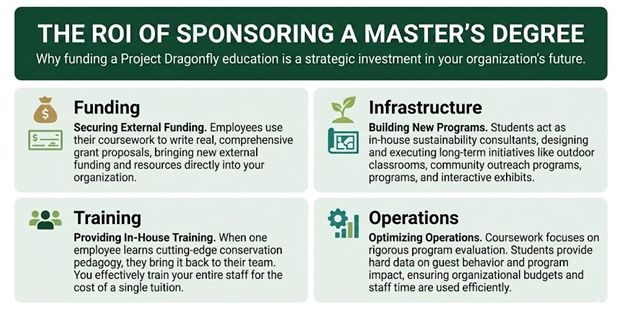
To unlock those funds, you have to frame your Project Dragonfly degree as a Return on Investment (ROI). You are not asking them to pay for your classes; you are asking them to invest in a resident consultant who will bring tangible value, funding, and innovation directly back to the workplace.
And, don’t just ask once. If you’re at a large organization, you should ask multiple supervisors and in different departments. One person may tell you “no,” but another person may tell you “yes.” You might even ask multiple times over a few months, because budgets shift, and money that wasn’t available in the fall might suddenly appear in the spring. Definitely don’t be afraid to be a squeaky wheel within your employment.
The Proof: What a Dragonfly ROI Looks Like
Project Dragonfly degrees are inherently designed to benefit your workplace. Through courses and the Community Leadership Challenge (CLC), students use their own institutions as living laboratories. Here is how actual Project Dragonfly students have delivered massive ROI to their employers during their studies:
- You Will Bring in Funding: Cady Breslin, an aquarium educator, didn’t just study conservation—she wrote a comprehensive grant proposal to a community fund requesting over $19,000 to build a nature playscape for her facility. The ROI: Your coursework literally pays for itself by bringing grant money into the organization.
- You Will Build Campus Infrastructure: Daniel Baker, a Biology teacher, utilized his coursework to design and execute a long-term vision for his low-income school, collaborating with different departments to build a campus pond and pollinator garden. The ROI: You act as a free Sustainability Coordinator, improving the school’s facilities and STEM capabilities.
- You Will Provide Staff Training: Kimberly Adkins, a High School Science Educator, used her master’s challenge to design and facilitate a professional development workshop for her fellow science teachers across Arizona. The ROI: The employer pays to send one person to grad school, but the whole staff gets trained in cutting-edge pedagogy.
- You Will Optimize Operations: Keriann Ballanco evaluated visitor participation during traditional zoo “keeper chats” versus interactive activities, providing hard data on what actually changes guest behavior. The ROI: You provide free program evaluation to ensure the institution’s budget and staff time are being used efficiently.
The Actionable Toolkit: Copy/Paste Email Templates
Ready to make the ask? The key is to be specific about what you will deliver. Use these templates to start the conversation.
Template 1: For K-12 Educators (Pitching to a Principal/Admin)
Subject: Proposal: Leveraging my Master’s Degree to advance [School Name]’s STEM goals
Hi [Principal’s Name],
As we look toward our goals for the upcoming school year, I have been researching ways to bring more hands-on, inquiry-based science programming to our students. To do this, I [am applying to/have been accepted into] the Project Dragonfly Master’s program through Miami University.
Unlike traditional degrees, this program is project-based, meaning I will use my classroom and our school grounds to complete my coursework. Over the course of the program, my goal is to deliver the following directly to our school:
- [Example 1: Write and submit at least one grant to secure funding for our school’s outdoor spaces/STEM equipment.]
- [Example 2: Develop a community science curriculum that aligns with NGSS standards and can be shared with the entire science department.]
- [Example 3: Lead an in-house Professional Development session next spring for our staff on place-based learning.]
I would love to set up a 15-minute meeting next week to discuss how we might be able to utilize our school’s professional development/continuing education budget to partially or fully sponsor my enrollment, given the direct return this will bring to our campus.
Let me know if [Day of week] or [Day of week] works best for a quick chat.
Best,
[Your Name]
Template 2: For Zoo, Aquarium, or NGO Professionals (Pitching to a Director)
Subject: Proposal: Strategic PD investment for [Organization Name]’s conservation goals
Hi [Director’s Name],
I am writing to share a professional development opportunity that I believe will directly benefit [Organization Name]’s strategic goals for this year. I [am applying to/have been accepted into] the Project Dragonfly Master’s program.
The program focuses heavily on community engagement, program evaluation, and conservation leadership. Because the coursework is highly applied, I intend to focus my master’s projects directly on our organization’s current needs. Through my enrollment, I plan to deliver the following:
- [Example 1: Design and execute a formal program evaluation of our current guest education programs to measure ROI and impact.]
- [Example 2: Write a grant proposal to secure external funding for [specific upcoming exhibit/project].]
- [Example 3: Build a new community partnership with a local school district or business to expand our conservation outreach footprint.]
Could we schedule 15 minutes next week to discuss how my participation in this program aligns with our departmental goals, and whether we could allocate professional development funds to support this initiative?
Looking forward to discussing this with you.
Best,
[Your Name]
Thinking Outside the Box: Family and Community Funds
If your employer truly cannot fund your degree, do not give up. You need to break out of your mold and your patterns and find different options.
Reach out to family members and your broader network. Also, look for small scholarships in your community. There are community foundations everywhere. Go to your local library and ask the librarians, “Can you help me find funding? I really want to do this graduate program.” See if they have resources or know anyone who might be able to help you.
The Take-Home Message
Funding a master’s degree takes creativity and persistence. Your employer has a budget to improve the organization. By presenting your Project Dragonfly degree as a vehicle for that improvement, you change the conversation from a “favor” to a strategic business decision.
Use the templates, highlight your planned ROI, and step into the leadership role you deserve. Ask multiple times, try to figure it out, and be the squeaky wheel so that you can follow your dreams, better yourself, and get that master’s degree that will open new doors for you.