
by Gina Roth
Freshman Journalism Major
Our job as students in this research seminar on Storm Lake, in part, is to digitally dig through old newspaper archives from Buena Vista County. As a collaborative project, each of us students is responsible for specific years between 1880 and 1940. I started my work focusing on 1893.
As I pored over digitally scanned pages of the Alta Advertiser, I searched for information on farming, interpersonal relationships, and immigration…something that I could compare to life in town today, to create some sort of trend line of events. I began noticing a pattern of what seemed to be strange behavior. The Advertisements.
In my own life, I have seen oodles of ads, likely millions in my 18 years. But these that I saw in the archives felt off-putting, even non-capitalistic. These ads were begging for shoppers.
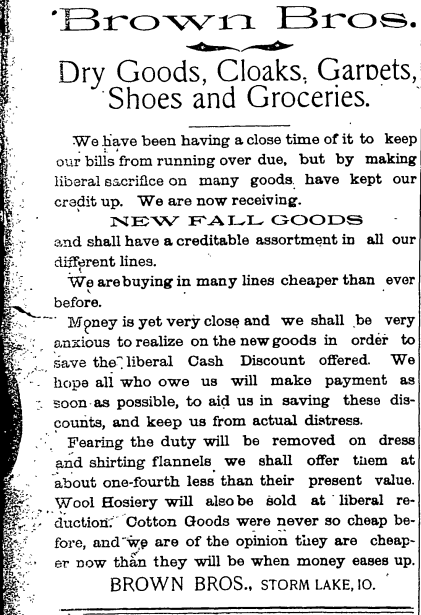
This ad (to the right) was mind boggling to me. “We hope all who owe us will make payment as soon as possible” nearly reads as a threat, and the fact that the ad opens with an admission of struggle? It didn’t read like anything I had seen before.
At first I brushed this off as just a struggling shop from, oh, hundreds of years ago, but then I started finding more ads, and from different places. Though none were as up front in their struggles as this Brown Bros ad, they still fit the same profile. There was a woman offering her goods in exchange for chickens and bread, saying that she couldn’t afford to keep the store open any longer. There were stores posting their closing notices. These were businesses clearly struggling to stay open.
You don’t really expect businesses to advertise hardships, especially going as far as admitting to a floundering bottom line. Intrigued by this, I decided to cosplay as a business-school student and look up good advertising practices online, to understand this article. One of the first things that came up was to “create positive associations.” Hm. That advertisement didn’t seem very positive.
As someone who greatly prefers ancient history to modern history, I didn’t really know the reason for this behavior. Until I showed Dr. Offenburger my discovery, and he just nonchalantly threw out, “Well 1893 was a depression year, so…”
Yeah, I probably should have thought of that.
But now I had a starting point, the beginning of the trail that I could follow back to modern America.
There have been 24 recessions, depressions, and panics since the Panic of 1893, spanning one to ten years each. It should come to no surprise to anyone that we are currently in the Covid-19 recession.
So, the next question: are small businesses handling this economic hardship in a similar way or not?
Turns out I didn’t have to look very far for my answer. As I was scrolling through Instagram recently, this ad (right) came up in my feed, almost miraculously.
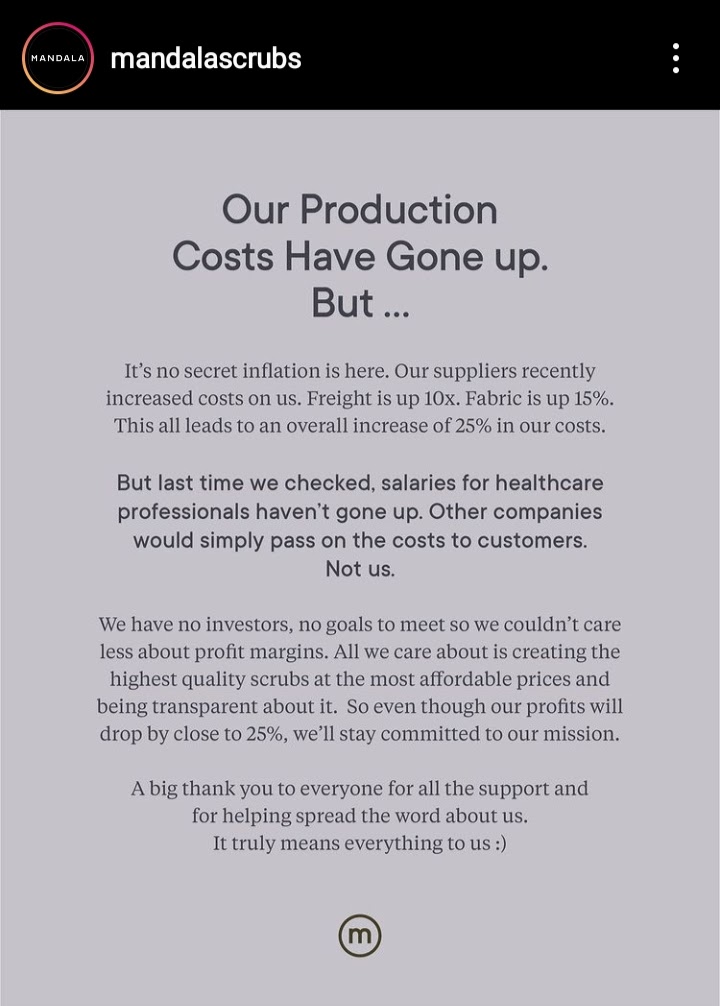
Is this ad exactly like the Brown Bro’s ad of 1893? Of course not, however the overall effect of the ad is similar. The point of both pieces is to make the consumer feel sorry for the business and appreciate its sacrifice in providing good service.
But were the businessmen making these strange ads in 1893 really desperate, or were they ahead of their time?
I can only conclude two things:
- From old newspapers to new social media, eerie similarities in economic recessions reverberate; and
- Whether history repeats itself or not, I should not go into advertising.
Gina Roth is a freshman majoring in journalism and individualized studies. She likes to focus her second major on researching underrepresented voices in history, just like the voices of Storm Lake. She also enjoys painting, drawing, writing, and getting lost in the forest.
