
by Rachel Rinehart
There’s no doubt that Tyson has enabled Storm Lake to become the diverse community it is today, but the town’s thriving has not come without problems. Like most meatpacking towns, the brutality of the industry remains understandably hidden from everyday sight. Workers are either exploited or given precious opportunities, depending on your perspective. Their jobs require them, in one form or another, to watch the life go out of a cow’s eyes, thousands of times over. These dynamics are beyond the sight of consumers, of course. But who bears the responsibility of this normalized violence? Does it end with the employees, the meatpacking plants, or the meat-eater?
This week, we finished Timothy Pachirat’s Every Twelve Seconds, a study on normalized violence in slaughterhouses and society. In the book, Pachirat examines the responsibility of killing in slaughterhouses, and how this contributes to the “politics of sight.” Pachirat, an Associate Professor of Political Science at the University of Massachusetts Amherst, joined us via Zoom.
In addition to our engagement with Every Twelve Seconds, some students (with their BVU partners) had interviews for our “Small Town, Big World” project. My partner, Max Oslan, joined me to interview Lori Porsch, a long time educator and leader in Storm Lake. Oslan is a sophomore digital media and sports business double major at Buena Vista University, and he’s on the basketball team. In addition to this, for our Miami class requirements, I also interviewed Dolores Cullen, a photojournalist and writer for The Storm Lake Times.
The second half of Pachirat’s Every Twelve Seconds details his time in a packing plant in Omaha. Pachirat worked in various positions, starting as a liver-hanger and working his way up to quality control (after only two months because of his English fluency). The author notes that, for his promotion, he had to prove to management he was “one of them,” that he should be on the “clean” (non-killing) side of the plant. Before his promotion, however, he witnessed and participated in animal slaughter first-hand, experiencing violence while working in the chutes.
“In any given situation, who functions as the knocker? Who functions as the individual on which we locate and bound our notions of guilt, blame, and responsibility?”
— Timothy Pachirat
Pachirat worked the chutes out of necessity. He had started as a liver line worker, hanging the internal organ thousands of times a day. But when no livers were being processed for a week at the plant, he was moved to the chutes. There, Pachirat prodded cattle with electric rods to keep them moving in a line for slaughter. The cattle are tightly packed, covered with feces, and moved along to the man holding a “knocker.” A knocker is a cylindrical gun that “is suspended in the air over the knocking box’s conveyor, balanced with a counterweight and powered by compressed air supplied via a yellow tube.”
Pachirat felt the rawness and violence of the confrontation between living animals and the men leading them to their death. However, only the knockers are provided psychological care by the company. Psychological care to other employees is on their own dime, because, to the company and other workers, the knocker stands alone as the real killer. This role is something that we discussed with the author during our interview. Pachirat extended his thinking from the book to society in general, asking, “In any given situation, who functions as the knocker? Who functions as the individual on which we locate and bound our notions of guilt, blame, and responsibility?”
Later in the book, Pachirat is promoted to a quality control position. As a QC, Pachirat worked with USDA inspectors, but there was a division of loyalty between the two groups. The QCs look for anything to avoid noncompliance reports, which can lead to fines or even a shutdown of the plant; the inspectors look for anything that would qualify for noncompliance reports. Loyalty is very important, and showing it means helping the plant move the line as quickly as possible. As a result, some things were overlooked, such as the deliberate practice of not reporting contamination of the meat found at two checkpoints. If contamination is found, the employees are just told to “do better,” because if the meat is thrown out, that is a waste product and the halting of the line slows down production.
The equipment itself is cleaned before inspection, and QCs examine it with flashlights alongside the USDA. At one point, the flashlight of the USDA leader, Donald, wasn’t working, and Pachirat offered him his own. Pachirat’s trainer, Jill, lashed out, “It’s not [their] job to help him.” The meatpacking plant believed that the USDA was not on its side, and workers attempted to take every advantage possible.
Pachirat reflected on his time as a green-hat, and felt that what was remarkable was not the massive food-safety procedure violations nor the deception and falsification by the managers, but how the focus on food safety deflects the attention away from the work of killing onto the technical realm of hygiene. The responsibility every worker has to the deceptions of food safety neutralizes the horror of the violent work being performed. Normalized violence in fact motivated Pachirat to go undercover. He wanted to study how it became acceptable in society to “raise and kill billions of sentient beings for the sole purpose of food consumption.” Slaughterhouses are sites of normalized violence, which Pachirat connected to executions of prisoners and wars fought by mercenary contracted armies, all of which are dangerous and violent works done on our behalf by others. “This was a kind of violence that I thought was so implicated into the fabric of normalcy that it would be really interesting to examine it,” he said.
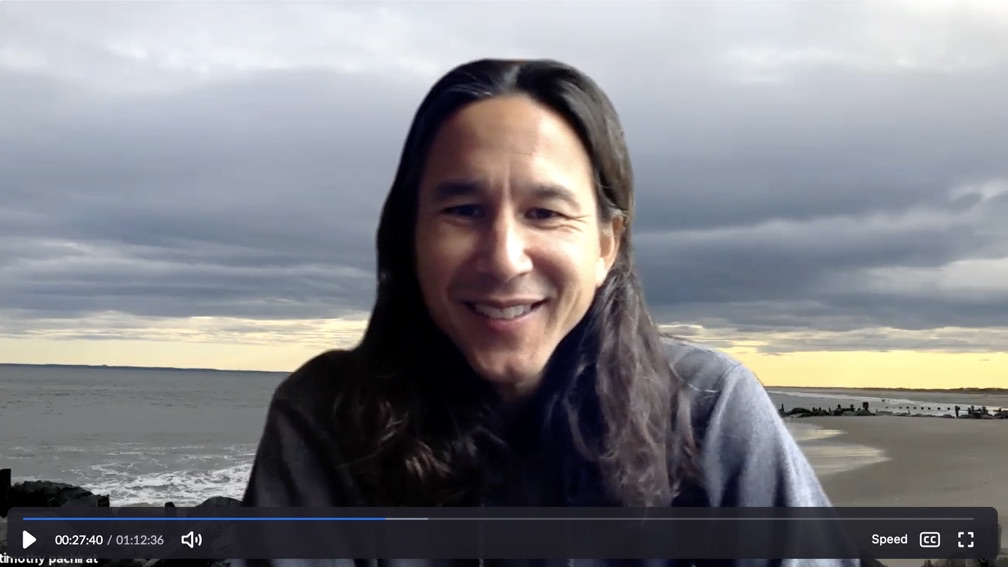
Pachirat’s scholarship leads us to ask where the responsibility of the killing lies: with those who eat meat or with the 121 workers who do the killing. He holds the position that those who benefit at a distance have a moral responsibility. “Human beings are capable of contributing to massive forms of violence without having a clear understanding of the overall process of what they are contributing to,” he said. In eating the meat that is abused while alive and sped through inspection after slaughter, meat eaters are bearing responsibility for the dirty work. This position prompted Pachirat to ask, “In what ways is the entire world constructed like a kill floor?”
The moral responsibility for the killing is an argument about the politics of sight. Pachirat calls it the “120 + 1” argument, where the work is being done by a select few and is out of sight of those who implicitly or explicitly authorize the work. The people who are able to evade responsibility are able to do so because “of their citizenship, the taxes they pay, their race, their sex, or the actions of their ancestors.” The slaughterhouses prey upon citizenship, he said, and “rely on a powerless labor force that is not going to raise political problems and look the other way as these corporations mass produce food as ‘cheaply as possible.”
Pachirat noticed that slaughterhouses code different jobs by race and gender. The actual killing is done only by men, and only a certain type of man. At his particular slaughterhouse, the men “manly enough” for the killing were refugees from East Africa. (They came from Sudan because there was a relocation center in Omaha.) These were men who had no other option due to no citizenship. They took whatever pay and working conditions they could. Pachirat did not want to ask about how the slaughterhouses prey upon gender because he said he “didn’t want to enter whatever safe space [the women] were able to form away from the male gaze and sexual harassment.” He acknowledged this bias in his ethnographic research.
Though Tyson drives Storm Lake’s population figures today, there are many frustrations about the working conditions and low pay. By the “120 + 1” logic, the people that eat the meat are not only taking moral responsibility for killing the animals, but also taking moral responsibility for the poor working conditions.
The poor working conditions caught the attention of Pachirat, and they are well known to the people of Storm Lake. One member of the community who knows this well, Dolores Cullen, is a photojournalist for The Times, and I had the pleasure of speaking with her last week. She has been looking into the inner workings of Tyson for years despite pushback from the company, and she says The Times “will not be frightened into submission.”
The paper has been in production for over 30 years, and Cullen has witnessed many changes during her career. She spoke of how corporations have tightened control on the free flow of information. Previously, Cullen had been able to go into sections of the Tyson plant and take pictures of employees for a story, but now she is not allowed entrance. The hospitals also stopped allowing the journalists in, even before COVID-19 struck, because everything was classified through HIPAA. Reporting general information to the public therefore has become a difficult task.

Cullen offered a more humanistic look at Storm Lake and the changes that Tyson has brought. She showed me a story for which she took a picture of a man who used to work at the Hygrade plant. She noted a key difference between then and now. When Cullen took the man’s photo, he had fond memories of his time at Hygrade, recalling the nicknames for his friends at work. He enjoyed his time there. Now, Cullen maintains, the working conditions at Tyson have snuffed out most comradery.
“If these were white people, these would be great tales of their survival. Instead, they’re just people on the lowest rung here.”
— Dolores Cullen
She said her goal in the paper is to “treat the Tyson workers as respected, valuable members of the community.” Part of this goal has been finding out who has died from COVID-19, especially those who had been working in the plants while they remained open. The hospitals were not releasing that information, so she scavenged Facebook and made her own records. She scrolled through the pages of family members, friends, and coworkers. “I realized that some of these Tyson workers, three of them worked on the same shift. They had to go to the same job and people were getting sick,” she said. The deaths of these three men were not previously reported. Cullen published the stories from the perspectives of those that knew them, to show that these were real people with personalities.
Though she has witnessed some racism, the community, like Cullen, values Storm Lake’s immigrant members. When the Trump administration was talking about rejecting and displacing the DREAMers, Cullen said, “It was unimaginable that the Republicans and Trump were talking about that,” because newcomers’ stories are so incredible. She said that she can still hear some of their voices from past interviews. “If these were white people, these would be great tales of their survival,” she said. “Instead, they’re just people on the lowest rung here.” Like Pachirat, Cullen also realized that the packing plants are taking advantage of refugees. “They have this low expectation of what life should offer, or like what a job should offer. [The plants] make you work in a dangerous environment, and [workers] won’t complain.”
These refugees are the powerless workforce that meatpacking plants rely on because of their race and lack of citizenship. The community is rallying around them, though, trying to make them feel important when work and politics don’t. Nevertheless, Storm Lakers like Cullen keep these injustices in view. For some, though, it’s far too easily out of sight, out of mind.
Rachel Rinehart is a freshman majoring in Journalism and Sociology. Her interests include running, doing yoga, cooking, and true crime. She aims to work for a newspaper as an investigative journalist in the future.
