
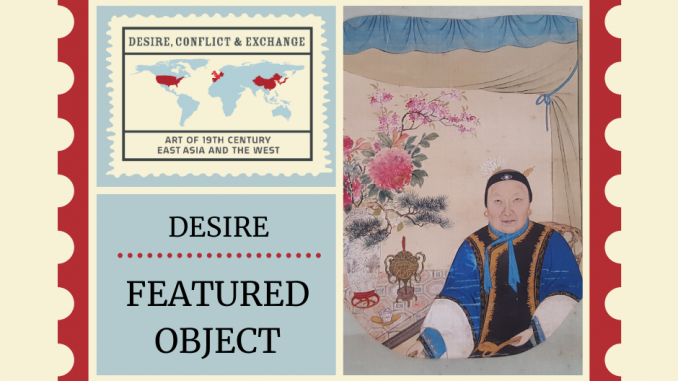

Portrait of An Older Manchu Woman, 1840-1870, Qing Dynasty (1644-1911)
Hanging scroll; ink, color, and gold on silk
Private Collection
The majority of Chinese portrait paintings are ancestor portraits. They served as links in familial lineages, which were important to Confucian culture. Ancestor portraits were also a means to reflect the social status and identity of the descendants. This older Manchu woman was from the upper classes, which is reflected in the luxury materials of her attire, accessories, and interior decoration. “Capturing appearances while transmitting spirit” 傳神寫照 (chuanshen xiezhao) was the core ideal of classical Chinese portraiture. Conveying the inner nature of the sitter was important, and realistic facial features were central to this. As photography entered into China after the First Opium War, painters used photographs to help create vivid and realistic portraits. One of the first terms for photography was adopted from a traditional term for portrait painting “capturing appearances” 寫照 (xiezhao). -Written by Xinyu Liu