
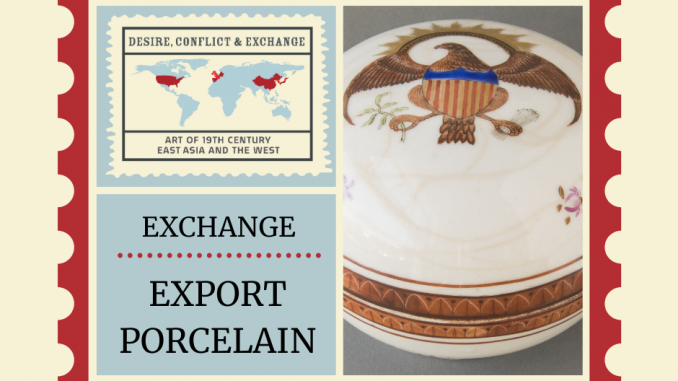
Although porcelain, silks, and teas were the fundamental luxury goods underpinning trade between East Asia and the West, the demand for Chinese-made items in England, Europe, and America in the 19th century created a market for a variety of decorative arts, including figurines, prints, fans, and monumental porcelains. Western demand caused merchants and artisans alike to market their wares to broader audiences, sometimes abandoning local taste and establishing new hybridized styles that combined Eastern and Western visual cultures. Porcelain was particularly susceptible to the exchange of mutual influences in China and the United States. Pieces like these combined East Asian forms and craftsmanship with Western motifs. They frequently incorporated family or patriotic crests and often played to Western fantasies about Eastern religion.

Export Porcelain with American Eagle, Qianlong period, late 18th century
Porcelain
Gift of Eva J. Hexter
MG.1989.37

Chinese Export Teapot with Family Crest, Qianlong period, late 18th century
Porcelain
Gift of Eva J. Hexter
1989.33

Guanyin, the Bodhisattva of Compassion, Qianlong period, late 18th century
Dehua whiteware porcelain
Gift of Eva M. Lande
1983.8

Vase with Fu Dog decoration, late Qing Dynasty (1644-1911)
Porcelain with underglaze red
Gift of Richard and Carole Cocks
1988.39

Large Pilgrim Bottle, Qing Dynasty (1644-1911)
Porcelain with overglaze enamel
Gift of Richard and Carole Cocks
1988.40