
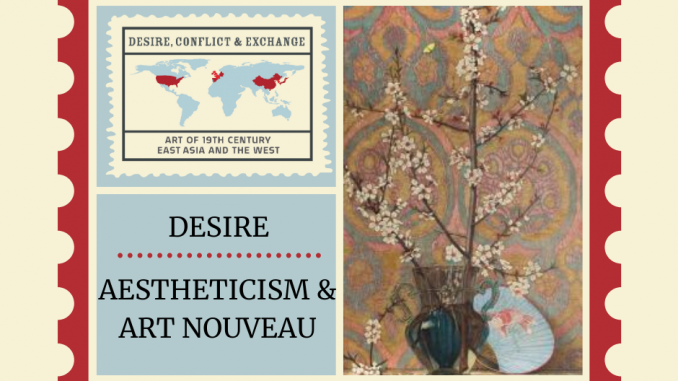
At the end of the 19th century, Western audiences were sated with East Asian artwork. The exotic had become the familiar, and gradually East Asian and Western styles had blended into an ambiguous middle ground. The growth of the Aesthetic movement, and from there Art Nouveau, demonstrated Western artists’ integration of East Asian patterns and form. These movements were often in ideological opposition to Western industrial mass-production. They emphasized Romantic naturalism, a belief in the moral power of beauty, and the value of the decorative arts, all of which were associated with East Asia. Painters like Mucha and Coleman used oriental patterns, natural motifs, and long hanging-scroll-like canvases to stress these connections. -Written by Libby Fischer

Still Life with Peach Blossoms, 1877
Oil on canvas
Loan courtesy of Art Bridges

Oeillet (Carnation), 1898
Lithograph on paper
Friends of Miami University Art Museum Purchase
1984.91.3