
By Whitney Wilson-Harris —
March 31, 2023
Have you ever wanted to dive deeper into what 3D printing is all about? How about doing that and getting certified in it at the same time? On Thursday, March 31st, some students sat down with John Burke, director of the Gardner-Harvey Library, to do just this.
The two student attendees listen as John Burke, director of the Garder-Harvey library, opens the event.
The event, planned weeks in advance, was designed to offer students who were interested in 3D printing a chance to try their hand at it, and if they had print jobs, get those started during the workshop. The workshop also included a short quiz that was part of the certification. Learning outcomes included understanding how 3D printing and 3D printers work, learning how to work with different settings on the printers, finding a 3D model, and loading and unloading filament. Also included were considerations of how to use 3D in your future, which varies for everyone.
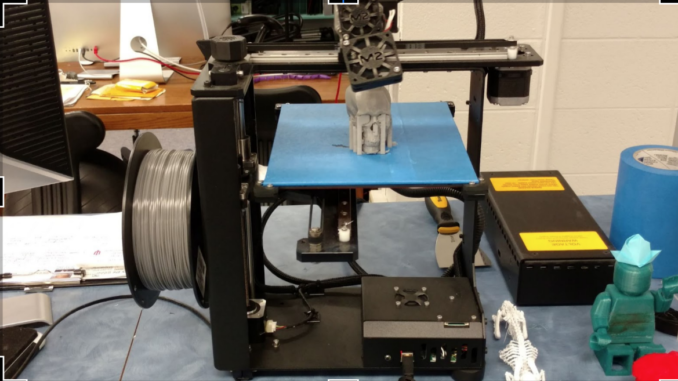
Mr. Burke began the workshop with an overview of the current “resident” printers of the Gardner-Harvey library, as well as the history of the library’s 3D printing program. Gardner-Harvey’s 3D printing program began nine years ago, and today it includes a total of five printers, consisting of MakerGear, Prusa, Raise 3D, and Flashforge models.
A picture of one of Garder-Harvey library’s current 3D printers. This picture is taken from the presentation Mr. Burke gave during the workshop, and is being used in his article with his permission.
Mr. Burke stated that the library’s 3D printing program began when 3D printers became “just cheap enough” for a library to be able to buy. When asked what “just cheap enough” meant, Mr. Burke replied, “Our original printer, the MakerBot 2, was around $2,000 in 2014. It was a serious investment for us at the time, but one we felt we could justify because it would allow us to bring this new technology into the reach of everyone who used the library (we would buy the printer, but then let people use it, just like we do our books.)” He stated that, after that investment, they began to see some printers decrease in price over time, one printer decreased in price to around $1,500 and another model to around $1,000.
The workshop not only focused on the 3D printer itself, but also on the material that eventually produces the finished product. This material is called filament. Mr. Burke explained to his attendees that, currently, the library has a “fair amount” of filament. After the event, Mr. Burke explained that a “fair amount” translates to the 57 rolls of filament, all of which are different colors, that Gardner-Harvey currently has in stock.