
By Olivia Gronvall —
The Michael J. Colligan History Project, organized by the Colligan Fund Committee of the Hamilton Community Foundation and the Hamilton Campus of Miami University, has brought a variety of speakers to Hamilton since its inception in 2000. Along with this valuable effort to nurture interest and enrichment in historical learning, the Project has presented the John E. Dolibois History Prize to historians in honor of their “substantial and sustained efforts to promote historical understanding in the community and nation” (as described in the official Michael J. Colligan History Project website). The most recent lecturer and winner of the Dolibois History Prize is David W. Blight, the Sterling Professor of History and Director of the Gilder Lehrman Center for the Study of Slavery, Resistance, and Abolition at Yale University. In addition to his teaching career, he is an author, writing numerous bestsellers on American history, including his acclaimed 2018 book, Frederick Douglass: Prophet of Freedom. The book has won many awards, including the Pulitzer Prize in History, the Gilder Lehrman Lincoln Prize, the Bancroft Prize for History, and the Francis Parkman Prize.
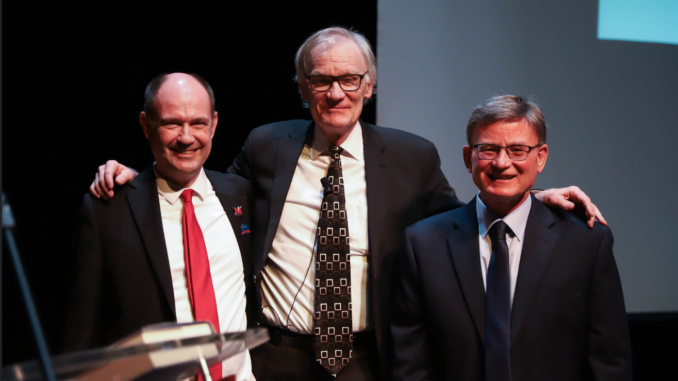
This same book was the focus of Blight’s lecture at the Parrish Auditorium on March 30th, where he accepted the prestigious award as well as spoke about his journey in creating the book, sharing his thoughts and perspective on the character and life of Frederick Douglass through his intensive study of him over the years.
Blight introduced his lecture by emphasizing the importance of one having “a sense of history”: to not only be aware of history but also understand that it matters because the past, rather than dead or static, is alive and active, having a pervasive influence on everything–the present and the future. “History is something that is everywhere,” he said when asked what main ideas he’d like Miami students to take away from his talk; “We’re all walking products of the past—the past of our families, where we’re from, the historical circumstances in which we grow up.” This is one of the reasons why knowing the past matters, he shows, as understanding the past can help one know how something or someone has become what/who they are today.
Additionally, being aware of the past helps one be more aware of how to shape the future, a lesson he feels Americans need to understand today. It’s easy to avoid the uncomfortable truths of history and only focus on what is “endearing” or “uplifting,” he notes, as “it makes us comfortable and helps us sleep at night,” something he has observed American culture today as doing. Although there is nothing wrong with finding hope and inspiration from the past, he notes that the danger is being unaware of the true roots of what has shaped the present—especially modern-day conflict and problems—in choosing to remain willfully ignorant. Quoting James Baldwin, he observes, “When Americans view history, they never use it to wake up the sleeper [but] use it to allow the sleeper to sleep.” With the past being “always intertwined” with the present, he argued that it is even more significant to be knowledgeable of all aspects of history, both inspiring and disturbing, and be aware of and discuss the parts we tend to want to ignore or gloss over. He noted that this is especially important in navigating today’s political conflicts anddebates regarding how “uncomfortable questions or truths” should be raised, taught, and discussed. In this way, Blight also argued that “divisive topics” can’t be avoided in education, as divisiveness cannot be sidestepped. Rather than fearing divisiveness, he argued, we can learn from the life and example of Frederick Douglass on how to be unafraid of speaking up about uncomfortable truths in history (ex. slavery) and seeking effective change while still keeping one’s respect for the good in one’s said history.
Having opened his lecture with that central theme in mind, Blight described how he came to write an autobiography about Douglass, recounting how he (Blight) traveled to Savannah, Georgia, sixteen years ago to talk to middle school and high school teachers about the fiery abolitionist. There, he met local collector Walter Evans through a friend, who informed him that Evans owned an extensive personal collection of Douglass manuscripts. This collection also contained nine huge Douglass family scrapbooks that were carefully kept and curated by two of Douglass’ sons during the last thirty years of his life. Containing letters, photographs, clippings, and even two handwritten narratives written by the sons about their parents, the books were a miraculous goldmine of information to Blight. “It was a historian ‘OMG’ moment,” he said, remembering his immense delight at the discovery. Although Blight wasn’t the first to see the collection, he was “the first who ever got to use it,” with Evans and his wife graciously allowing him to pore over the materials at their kitchen table for as many days as he wanted. Blight described that Evans allowed Yale to buy the Douglass collection, and the documents are now archived digitally online. For all his help and support, Blight dedicated the book to Evans.
Blight described how he took great care to organize and incorporate the wealth of the collection’s information into the autobiography. “When you write a biography, you have to kind of impose some order on a life,” he stated; “I didn’t know what my order was until I was somewhere in the middle of the book.” Ultimately, he organized the narrative into a set of major themes, one being words. “We know [Douglass] in his words. He is a creature of words,” he stated; “Words were the only weapon he ever had.” With that said, he described how Douglass learned to master and use the art of the word in speaking and writing, creating three autobiographies to keep telling his story as he felt obligated to represent his people. The next theme he described was the heavy influence of the Bible on Douglass in his speech and storytelling, such as the KJV translation influencing Frederick’s rich vocabulary and the “musical” quality of his language, as well as his core values.
Blight described that the more he studied the Biblical influence on Douglass, the more he could compare Douglass to Biblical motifs: in every way, Douglass seemed to Blight as imitating the role and character of the prophets found in the Bible as he boldly declared uncomfortable truths to others. Having taken the time to delve into theological studies of the Biblical prophets, Blight found Douglass perfectly fit the concept of a Biblical prophet being—quoting theologian James Darcy–a “sacred extremist” who assaults our minds and hearts to face the truths we wish to ignore. With that in mind, Blight firmly decided he could call Douglass a prophet in character and heart, incorporating that word into the book’s title.
Blight ended the lecture by regaling how Douglass, after President Lincoln’s reelection, returned to Baltimore, Maryland, where he was once enslaved, and spoke at Bethel AME church. There, he gave a moving speech praising Lincoln’s victory and looking forward to the revival of the American nation with slavery abolished, comparing it to being reborn in the way the Earth was in the Biblical account of Noah’s Ark. Near the end of his speech, Douglass compared himself to the dove that brought Noah hope that the flood was finally over, giving his people hope and a sign that American slavery was soon coming to an end. With this, Dr. Blight showed that with any great prophet, the purpose of speaking uncomfortable truths is to serve the greater good – to encourage people to be aware of and address evil and work towards hope and restoration. Americans can look to Douglass’ example in learning to face uncomfortable truths of the past to understand the true nature and causes of the problems and considerations of the present to press towards renewal and a hopeful future.
If Blight’s lecture whets your appetite for more discussion about American history, spirituality, and the writer’s journey, the next installment in the Michael J. Colligan History Project will be a talk given by Timothy Egan, a Pulitzer Prize-winning reporter, a popular columnist, and a bestselling author of nine books who will be discussing his work on his book, The Worst Hard Time: The Untold Story of Those Who Survived the Great American Dust Bowl. Being held on April 11th at 7 p.m. at the Parrish Auditorium, complete the RSVP form found on the official Michael J. Colligan History Project webpage or the Miami University Calendar webpage. One can also learn more about the upcoming Michael J. Colligan History Project events on the mjcolligan project blog.
Photographs generously supplied by photographer Megan Watterson and Miami University