
By Kara Reedy—
In the third and final edition of the National Parks Talk Series for the Fall 2022 semester, Dr. Tammie Gerke discussed one of the most diverse and fascinating national parks available to the North American public: Great Sand Dunes National Park. Initially established as a National Monument in 1932, the park was re-established as a National Park and Preserve in 2004, making it one of the most recent additions to the National Park Service repertoire. With the tallest dunes in North America, Great Sand Dunes have continuously attracted visitors worldwide for several decades, with numerous activities available to those attending, which Dr. Gerke discussed during her presentation last night.
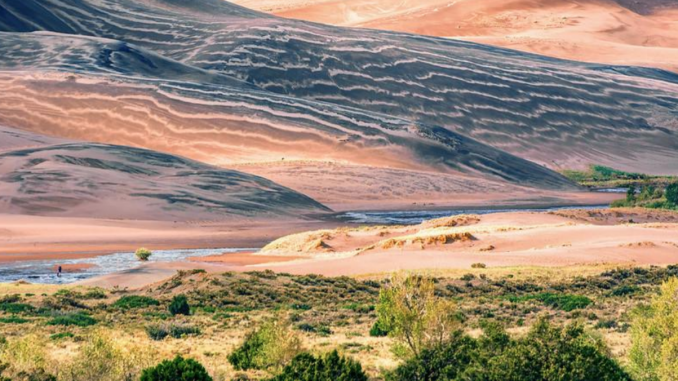
Many of Ohio’s residents will be familiar with the winter activities available to visitors of the Great Sand Dunes National Park and Preserve. Sand sledding, boarding, and skiing are all examples of what is available at this park. Aside from the dunes inhabited by wildlife and plant life, every sand dune within the park is offered for recreational use. There is a fascinating array of sand dunes scattered throughout the park, with Transverse Dunes being the most common; these are dunes created by a steady flow of wind, and they look like parallel waves moving softly across the sand in a rigid pattern. There are also Reversing Dunes, which are regularly compared to walls since they are formed by opposing winds forcing sand into a steep incline and decline. Perhaps one of the most interesting dune types at the park is the Star Dunes, created by multiple wind directions forcing the dunes to look geometrically unique.
Parabolic Dunes are relatively off-limits to people participating in the activities associated with the dunes, primarily because they rely on vegetation. The Parabolic Dunes are recognizable for the ‘U’ shape in which the tendrils of the dune are held in place by plants. The National Park Service members working within Great Sand Dunes ensure that visitors are aware of which sand dunes are available to them by using maps that provide the locations of the dunes that are accessible and those that are not. The portion of the park that contains the dunes is relatively tiny compared to the rest of the park, residing within only about 10% of the park’s total area in what is referred to as the “Dunefield.” The rest of the park can be found in what is known as the Sandsheet, the Mountain Watershed, and an area called the Sabaka.
One would assume that Great Sand Dunes National Park and Preserve was a desert, which would be partially correct since the sands can reach a heat index of 150 degrees Fahrenheit. However, the park is far more complex. As hinted at by the “Mountain Watershed,” the park does see a marginal amount of water, especially in Medano Creek. You might expect to see little water in such a sandy area. Yet, from April until the beginning of June, snowmelt trickles down from the surrounding mountains and into Medano Creek, where families can walk comfortably in water up to twelve inches high. Many people bring inflatable pool toys to float on top of the water, with waves pushing through the water approximately every twenty seconds. Surprising as it may seem, the water supply within the park is the exact reason why the park exists.
Most would probably expect the dunes to blow away, yet most of those that are visible today have remained in the same spot for decades. The dune’s relatively permanent site is due to wet sand trapped underneath. Each year, following the end of winter, moisture travels down into the dune-lands, rehydrating the sand around the park. In truth, only a thin layer of sand remains flexible on the top, while the majority underneath is more solid. This wet nature of the sand supposedly allows for a truly phenomenal event to occur during the hotter months. It was this unusual incident that made many surrounding residents in the past believe that the Dunefield was haunted.
By all accounts, most objects considered “non-living,” such as sand dunes, shouldn’t make much sound, but according to many scholars, they do. Since there are two portions of the dunes—the wet, packed underbelly and the dry sand on top—a low humming sound is emitted from the dunes every time the sand slides on top, causing friction to engage energy between the wet and dry sand mounds. The resulting sound is highly unusual. The humming only seems to occur when it is hottest outside, so it is recommended that in-person visitors to the park try to experience these sounds with great caution, and consider their safety and well-being. Nighttime hiking might be a better option if the heat is too much on any given day. The Great Sand Dunes National Park stays open all through the night, allowing visitors to experience the beauty of a clearly visible night sky. Qualified as an International Dark Sky Park, this national park has some of the best stargazing conditions in the country. It remains one of the best viewing points of the Milky Way Galaxy, since it is far away from any possible light pollution. Aside from being an excellent stargazing location, the Great Sand Dunes is also recognized for its full moon hikes, allowing participants great opportunities to take in the park in darkness. In addition to all the sensory wonders this park provides, it’s also magnificent because it is home to several species of animals and plants, including coyotes and owls, and discussing the animal diversity in the park was a great way to close out the talk series for this semester.
Dr. Gerke will return in the spring with a new set of national parks to discuss, likely keeping with the pattern set this semester and following up with three more of the newest parks. The talk series is organized and produced by the Gardner-Harvey Library. Students, staff, and faculty clearly have much to look forward to with the current event series held each semester by the librarians. If you have any questions or concerns regarding either the National Parks Talk Series or any of the library’s events, please feel free to use the contact information below.
Contact Information
- Dr. Tammie L. Gerke: [email protected]
- John Burke: [email protected]
- Jessie Long: [email protected]