
By Paige Auxier —
The emergence of AI and the erosion of civic faith have led the nation into a state of
crisis that depends on a widespread reframing and rethinking of what it means to have natural
and unalienable rights as a U.S. citizen, and what it would look like to exist in a society that
equally fulfills them for all. So, to cultivate discourse on this topic, a roundtable discussion was
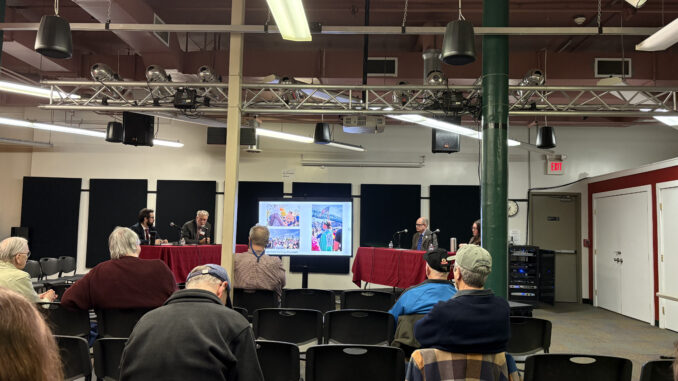
held at the Miami Hamilton Downtown Center on Thursday night, featuring moderator Dr.
Matthew Smith and a panel of three Miami Hamilton historians: Dr. Dylan O’Hara, Dr. Thomas
Bourill, and Dr. Martin Johnson.
To guide the night’s discussion, each panelist started by sharing an informed perspective on the
current state of the nation and on the varying ways in which the promises outlined in its founding
documents have been fulfilled and interpreted in its 250-year history.
The first of the panelists to take the stage was Dr. Dylan O’Hara. O’Hara works at the Miami
University Hamilton campus as a visiting professor of history. As a historian, her special
research interest is in modern African American history, which was heavily reflected in her
initial contributions to the roundtable discussion. To start, she urged members of the audience
and her fellow panelists to consider revolutionary ideas through the lens of Black American
thought. Throughout American history, different groups of people have obtained freedom,
liberty, and access to their natural and unalienable rights at different times; however, in each
instance, the revolutionary ideals of the founding fathers have been used as a guide and
inspiration for the group’s struggle.
While this could of course be examined from the perspective of various demographic groups
throughout American history, O’Hara particularly focuses on the Black American experience.
Black activists, particularly those who emerged after 1945, viewed themselves as revolutionaries,
and creatively interpreted the project of the revolution as it related to their own pursuit for the
fulfillment of individual rights, personal liberty, and freedom—which, according to the text of
the Constitution, they were guaranteed natural and unalienable access to. In their struggles for
civil rights and freedom, Black activist often cited excerpts and ideas directly from the nation’s
founding documents, and even referenced portions of it that were edited out of the final version
as evidence that they ought to be guaranteed the same civil liberties as white citizens, given that
nowhere in these texts do the founding fathers articulate a difference between the rights afforded
to Black and white citizens.
O’Hara then went on to cite specific historical examples of moments where this practice was
demonstrated by Black reformers, the most popular of which was from Dr. King’s 1966 “I Have
a Dream” speech. Ultimately, O’Hara’s goal in doing this was to prompt her peers to consider
the underrepresented perspective of Black Americans, whose road to freedom ran just outside the
thoroughfare of the normal stories U.S. citizens are told about how and when liberty and justice
for all were obtained.
The next speaker was university professor Dr. Thomas Bourill. For his segment of the
discussion, he aimed to articulate a connection between the recent “No Kings” protests and the
American Revolution. To preface, he gave a general overview of the protests, which were
organized by a coalition of progressive labor groups in response to President Donald Trump’s
fascist rhetoric and the anti-democracy actions of his administration.
The first recognized “No Kings” protest occurred on June 14th, 2025, which was then followed
four months later by a second large-scale gathering on October 28th, 2025; a third is set to occur
later this month, on March 28th. However, outside of these larger demonstrations, there have
also been a series of smaller gatherings throughout the nation bearing the same name and
message. According to Bourill, the nature of these protests reflects that of the American
Revolution, given participant’s use of anti-fascist rhetoric, the direct borrowing of quotes from
the nation’s founding documents, and the use of symbolic references to the words and actions of
the founding fathers.
Additionally, both of these protests had a staggering number of participants. The first, for
example, was comprised of between 4 and 6 million citizens, while the second involved 5 to 7
million, which made it the largest single-day protest in American history. Bourill is admittedly
optimistic and is therefore looking at these protests with a sense of hope for the nation’s future.
To him, the number of people willing and able to be involved in these gatherings demonstrates
that American citizens have not lost their investment in maintaining democracy, and they still
have enough spirit to fight for a more idealized society. He noted, too, that despite what one’s
personal opinion is of the “No Kings” protests, it’s impressive nonetheless that the Constitution
has maintained such a strong central focus in American life today.
The last of the panelists to present his perspective on the current state of the nation was Dr.
Martin Johnson. Johnson, like Bourill, is looking towards the future with a sense of optimism.
When the founding fathers established the nation, they inadvertently set in place the fundamental
principles of the modern political world. Their original call for equal rights for all men likely
didn’t intend to include women or minorities; however, similar to O’Hara’s point, over time,
different individuals and groups have reinterpreted the messages of the founding fathers about
who in the nation is afforded rights to freedom and civil liberties. In turn, this broadens the
widespread conception of what “equality for all” entails.
Dr. Johnson is of the opinion that the Constitution isn’t, and has never been, outdated, as it’s kept
relevant by new interpretations. He willingly acknowledges that in present-day society, we’re
facing many transitions: the advent of AI, use of cellphones, rapidly developing technology,
scarcity of resources, and economic troubles, all of which are creating anxiety. Based on past
precedents though, in previous times of crisis and transition, America has preserved its
democracy, through the expansion of human rights—of who is included as part of the nation’s
community—and Johnson suspects this will occur again.
Following the sharing of these perspectives by the panelists, the discussion was opened up to the
audience, which, apart from two college-aged females and one older woman, was entirely
comprised of elderly white men. Still, despite a lack of racial diversity and disproportionate
representation of gender, there was enough variance of opinion in the room to showcase some
interesting differences in individuals based on their age. It was also interesting to see how the
different panelists approached their responses to audience inquiries with their unique and
informed perspectives on the subject matter.
The value of this discussion came in part from observing the different ways in which citizens
from the same area, who exist in the same social and historical context, view their present
society. In fact, it’s through discussions like these where different perspectives are respectfully
shared and received that true progress can start to be made. Possible solutions regarding how to
create a more idealized nation are debated, and they require an understanding of what constitutes
such an environment for all, which can only be developed if the varying opinions of citizens are
shared and respected. Seeing things from alternative perspectives is also beneficial in allowing
one to develop greater compassion and understanding of one’s peers, despite their individual
differences. This in turn might assist in creating a heightened sense of community throughout the
nation that will render the country better equipped to persevere through the present challenges
and transitions at hand.
Thank you for this! As your reporting described, the discussion afterwards– an hour and a half! — was so valuable for showing the importance and benefits of public discussion and exchange. The Miami Downtown center is amply fulfilling its role as a cultural and community anchor in Hamilton.