
By Paige Auxier —
Recently, Miami University Middletown’s library director, John Burke, hosted a presentation as part of the Regionals’ ongoing “AI Toolkit” series at the Gardner Harvey Library. Earlier this month, outreach and instruction librarian Jennifer Hicks led an interactive lecture for the series on how to create and detect AI images. In this edition, Burke shifted the series’ focus to the application of AI tools for research.
Burke started his presentation by enlightening his audience regarding the realities of the ever-increasing connection between AI and research. Nowadays, for example, popular search engines like Google are providing AI overviews in response to user inquiries, without prompting. So, due to the ubiquity of such AI encounters when conducting research, it’s becoming more important for individuals to develop an understanding of how to effectively and ethically implement AI into their research practices.
While Burke recognizes the benefits of using AI to increase research efficiency, he doesn’t discount AI’s numerous imperfections either. Popular AI platforms such as ChatGPT and Google Gemini are known to present false or biased information, and regularly pull from and plagiarize work from outside sources. So, to avoid being misled or inadvertently appropriating the work of someone else without appropriate citation, users must be aware of the technology’s faults and learn strategies for how avert the threats posed by them.
One method Burke suggested viewers consider implementing to avoid such pitfalls is S.I.F.T. This procedure involves evaluating sources by Stopping to consider research goals and plans, Investigating source quality, Finding trusted coverage on the research topic, and Tracing information referenced in one source back to its original to ensure its validity.
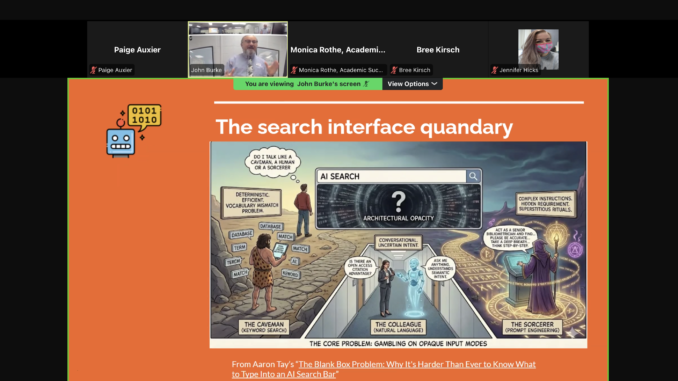
Burke urged viewers not to use AI as a key search engine, and instead he suggested it be used as a supplemental tool. Then, he outlined three distinct ways that AI can be appropriately and effectively applied in this manner.
The first use of AI he spoke in favor of was the implementation of it for brainstorming assistance. AI can help generate research topic ideas based on an assignment’s prompt, and determine terms and phrases correlated with a research question or topic that can be included in searches to improve results.
He also suggested that AI can assist students and researchers in developing research plans and timelines, which can be especially useful in instances where the inquirer is facing a rapidly approaching deadline.
Lastly, he suggested that AI can be appropriately used to summarize information. In saying this, he isn’t, of course, recommending that researchers avoid reading texts altogether, but rather that through AI summaries, individuals can quickly determine whether the information included in a source is relevant to their research goals. On this point, he noted that summaries can also help aid students’ comprehension of complex texts by translating them into language they can easily digest and comprehend.
After this, Burke then moved on to outlining tips for how to construct effective prompts. The kinds of responses AI generates largely depend on the quality of the prompt the user presents to it. So, to ensure that researchers are receiving the best possible results, he suggests that they take on the professional persona of a librarian: provide extensive detail; include references to additional, relevant information; specify elements of their research task; pose follow-up questions; and, give context regarding the length and amount of information they’re seeking when crafting prompts.
He also made sure to emphasize how important it is that students and faculty members who opt to use AI in academic settings ensure they’re doing so in a way that abides by the university’s standards. This means making an effort to consult course syllabi and academic integrity policies. He also outlined different ethical considerations that must be taken into account when using AI for research. These points include considerations regarding plagiarism, lack of clarity in regard to proper citation practices, presence of false information, personal privacy protection, and negative environmental impacts.
Burke then finished by providing viewers with the link to the Artificial Intelligence LibGuide, which he himself crafted and referenced throughout his presentation. He also linked the Generative AI Quickstart Modules on the university library’s website and recommended a free Substack article by Ethan Mollick, titled “One Useful Thing,” which introduces readers to AI tools and discusses the pros and cons of the emerging technologies.
For those interested in learning more about how to practically use AI in their day-to-day activities, a presentation will be hosted by Jennifer Hicks and John Burke on March 12th at 12 PM in the Gardner-Harvey Library or via Zoom, focusing on informing viewers about how AI can be used to accomplish tasks.
Leave a Reply