
By Paige Auxier —
On Thursday, February 12th, Regionals’ outreach and instruction librarian Jennifer Hicks hosted an informational workshop in continuation of the “Your AI Toolkit” series at the Gardner Harvey Library on Middletown’s campus. The event was held at 12 PM and was available both in person and via Zoom. This addition to the series focused specifically on the development of competencies in creating and identifying AI-images.
Hicks hosted this same event in September of last year; however, in the months since then, AI technology has further refined and developed to such an extent that the task of differentiating AI images from real images has undoubtedly become more complex. Hick’s presentation naturally required modification to weed out any of the outdated information or ineffective strategies included in it, and this time, consisted of edited information pulled from her previous content, plus new tips added by necessity to accommodate the rapid changes in AI technology.
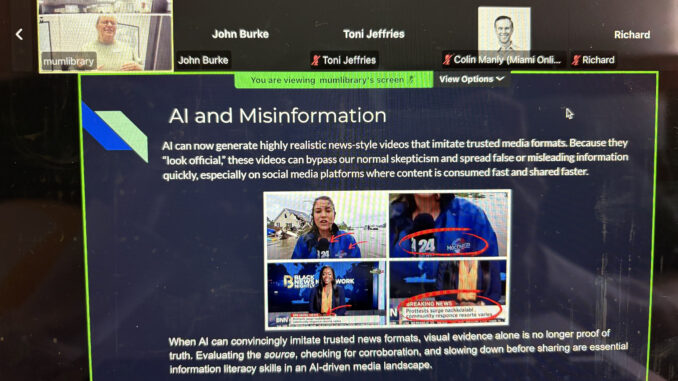
The fast-paced development of AI technology is among its several most unnerving characteristics. For example, Hicks discussed AI’s capacity to quickly spread misinformation through AI-generated image or video content, which is a threat that will only become more prevalent as generative technologies grow sharper. So, informational workshops such as this one that provide attendees with tools to avert these threats can be beneficial to anyone regardless of their age or profession.
To begin with, Hicks described to the audience what an AI image is. Her definition, as it was written on the slide, was as follows: “A visual created or modified using artificial intelligence, often generated from text prompts by altering existing pictures.” After providing this definition, she then touched on how, in the past year, technology has developed so quickly that previously useful methods for differentiating between real and AI-generated content are now growing ineffective. In the past AI images tended to distort the bodies, and hands of humans and would have nonsensical words, letters, or patterns in their backgrounds. These faults are now less prevalent in AI-generated visuals, though, which, in turn, makes it more likely that an individual will mistake them as real.
To demonstrate this point, Hicks then had the audience engage in an activity in which they collectively tried to differentiate which of two images provided was AI-generated. Practice with identifying AI-image and video content continued throughout the rest of the presentation, as she would periodically include it between slides of informative content so that viewers remained engaged and got practice with utilizing the strategies she was discussing.
The bulk of the presentation, though, was dedicated to her listing tips for how to detect whether a video or image is AI-generated. Said tips included, but were not limited to, inconsistent lighting, unnatural expressions on faces, lack of texture, presence of nonsensical text, and abnormal backgrounds. To assist in this differentiation process, however, Hicks also included a list of four sources that viewers could visit to evaluate potential AI images: AI or Not, Google Image Search, TinEye, and Decopy.ai.
The final portion of her presentation was then dedicated to explaining the process of using AI to generate content, then having audience members engage in the act themselves to deepen their understanding of it. During this segment of the event, Hicks displayed various AI images she’d created, what prompt she used, and the platform she used to generate them. Then, after explaining this process and demonstrating the varying quality of the content generated by different platforms using different prompts, she had viewers apply this knowledge to their own creation of AI images.
Through this event, the library is acting in a manner that falls in line with the university’s overall purpose and intent in relation to its students, which is to prepare them for their future careers. The strategies presented in the workshop were directly applicable to the lives of everyone in attendance, as AI competencies will continue to be important for professionals across all fields. AI training can also be used in day-to-day life as well, specifically to assist individuals in avoiding being misled by AI-generated images and videos circulating through the media. So, those who attended—and will attend future events—are better off for having learned ways to better navigate the rapidly changing AI-driven media landscape.
In the near future, there are other similar informational workshops. For example, on February 26th, Middletown library director John Burke is hosting one centered on the topic of utilizing AI for research. There’s another scheduled for March 12th as well, during which Burke and Hicks will present on how to effectively accomplish tasks using AI.
Leave a Reply