
By Sara Sparling —
Last Thursday brought the first chilly night of the school year, and what better way to pass the time than to gather in the Verity Lodge at Miami’s Middletown campus with some hot soup with Cheri Brinkman, to listen to Ohio’s story about WWI. (Brinkman later joked she was relieved the program hosting her was not serving K Rations for dinner.)
Director of Public Programming Dr. Matthew Smith welcomed everyone and gave a brief background on the Verity Lodge, as well as the Public Programming talks remaining in the fall semester that Miami Regionals offers to the public. He noted how excited he was for the 250th Anniversary of America’s Independence next year and the exciting seminars that will follow, much to the audience’s agreement.
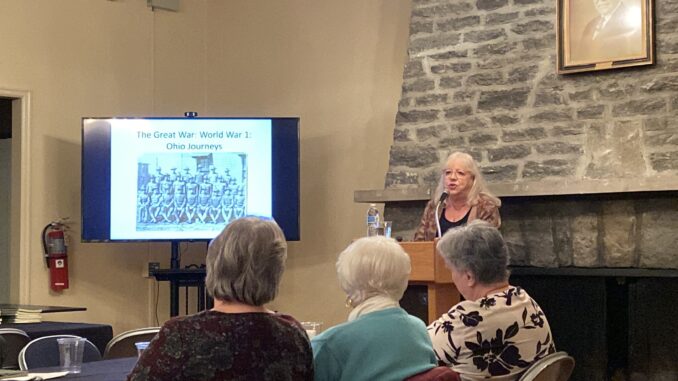
After a detailed introduction of her published works, institutions she’s studied at and her background, Cheri Brinkman was welcomed to the podium. She opened with a brief disclaimer that this talk would not be specifically about WWI, but rather the Southwestern Ohio and American experiences of WWI. She asked the audience how many people had relatives who served in WWI, and a majority raised their hands. She suggested that there would be significant information, photos, and letters in her talk that many audience members may not know about, and how much she cherished the opportunity to share a firsthand account of the war. She gave a brief history of the war, starting overseas and including the US’s failed attempts at peace, before getting into Ohio’s direct involvement.
Two million American troops served in this war, and out of that number, 200,000 were from Ohio, with 6,000 casualties. After the Spanish-American War, in which only a couple hundred got involved, there was a desperate need for more American troops. Cincinnati was asking for volunteers for WWI, and in the first two weeks they received 73,000 responses. There was definitely a need for more people, but unfortunately no one was willing to get involved. As for the whole country there were only a little more than 250,000 people in the military. Back then, it was extremely difficult to get in touch with people because there were no driver license or social security numbers, or really many reliable means of communication, so drafting those into the military was very much on a volunteer basis, even though there were certain parameters that had to be followed.
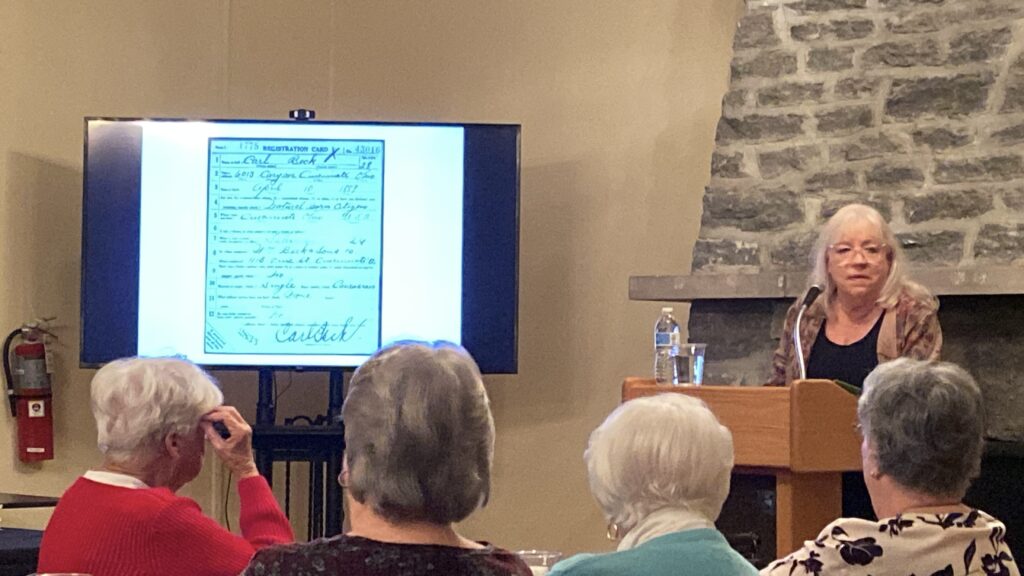
Brinkman then demonstrated what an identification card looked like. Of course, it has some identifiable information like a person’s name, previous occupation, and marital status. She also shared that it was significantly easier to get a deferment back then, and one person in particular that she discussed did receive such a deferment because his wife was pregnant at the time. Brinkman joked, “But what does he look like? We didn’t take a picture. We decided he was medium height–we don’t know what medium is. Medium build, blue eyes, light hair.” The audience found this highly amusing.
In the corner of the card there was a small slip of paper. If the man being described had been African American, that slip would have been torn off due to segregation. An important note to keep in mind is that no one could take someone else’s place as they could in the Civil War. There was a time where if someone didn’t want to go to war, they could go downtown and pay someone to go to war for them. The new rule, however, was that one couldn’t pay another person to take one’s place. Brinkman shared, “You had to go through this process where you could get different kinds of deferment.”
Additionally, many who intended to fight never ended up doing so because of measles or the Spanish Flu, which was very prevalent in this time period; this created many problems for troops, since these conditions were highly contagious.
“Now we have a big problem in Cincinnati!” Brinkman exclaimed. There was a large German population in the area at the time: German people, German street names, plaques, and more. German was still spoken in many households and was taught in schools and churches. Brinkman stated, “This was very serious because we were all ‘too German’ at the time.” She shared that her last name only has one N, because originally it had two, but it was decided to be too German, so they took one out to pass themselves off as more American.
There was also an Austrian conductor that was banned from conducting a symphony solely because of his descent, so he was sent to Georgia. There was a library with 10,000 German books on the first floor that had to be moved to the basement. Those who spoke German at home were not allowed to speak it in schools, and the language was banned until eighth grade. There are plenty of German streets in Cincinnati and they had to be renamed.
Concerning the role of women in WWI, they weren’t drafted to fight, but they were drafted as nurses. A general nursing shortage was a serious problem in the beginning of the conflict. Originally, there were only about four hundred nurses, and after the war, there were over 22,000. An Army nursing school was established that went hand in hand with the already existing Air Corps and Navy nursing schools. African American nurses were recruited quite a bit, and 1,800 of them were certified by the American Red Cross. However, despite the sheer numbers that were recruited, very few of them actually worked as nurses because of segregation. Women were also out working manual labor jobs, screwing bolts into airplanes for mechanized warfare. This was quite common in Ohio especially because the Wright Factory is in Dayton and is accessible from Cincinnati. This was the first time women were heavily involved in war efforts.
At the start of the war, there were very few training facilities in Ohio. Camp Dennison and Camp Chase were both decommissioned, and Camp Perry was used as a target practice range. Brinkman transitioned to a discussion of Camp Sherman, established in 1917, in Chillicothe, Ohio. The first recruits arrived there in September, 1917 and in 1918 the Spanish Flu killed 1,200 people there, which in turn affected the entire town. People were dying due to disease, not on the front lines. Later, the camp became a vocational center and there was a medical center as well as Ross County Correctional Institute, and presently the re-created Hopewell Mounds.
Brinkman showed planes that were designed specifically for war efforts and described two notable pilots. She explained that it was important they had these training facilities, to learn how to operate the aircraft. Eddie Rickenbacker, a pilot she talked about, advocated for every pilot wearing a parachute, so if there was a problem, they at least had a chance of survival. Wearing parachutes became a common practice later on. Ambulances also had to be mechanized for war efforts.
Camp Sherman had a library where one could get post cards to send home to family. Books were available of course, as well as an entertainment center. There was even a Camp Sherman vs. Ohio State football game that was played on Thanksgiving in 1917. These kinds of games originated in WWI. There was a railroad that ran through Camp Sherman that was important for sending troops out and bringing supplies in, as well as telephone and telegraph poles. Troops also had to learn machine gun training.
Brinkman then focused on a specific person whom she felt was important: Leland Norris. There is an exhibit in Caroline Park about Norris, one that his family members set up. Camp Sherman was not built when he was inducted into the service. Instead, the unit he belonged to went to Camp Sheridan in Alabama. According to Leland’s granddaughter, when he got off the train, there was nothing there. It was under construction. He remained at Camp Sheridan until deployment. In that time, he trained with weapons, achieved the rank of corporal, and received training in a new type of warfare—poison gas.

Brinkman then shared several letters Leland wrote to his mother in 1918, along with some photos and a letter to his pastor. When Leland arrived in France after passing through the submarine zone, that was the last time his family heard from him via letter.
After a bit more, Brinkman opened the talk to questions “she didn’t know the answers to,” which was extremely humorous. Still, she did her best to respond to the questions posed. Brinkman speaks all over Ohio and thanked everyone for coming to listen. The next event in the Public Programming schedule is November 13th at Miami Hamilton with CEO and investor Daymond John.